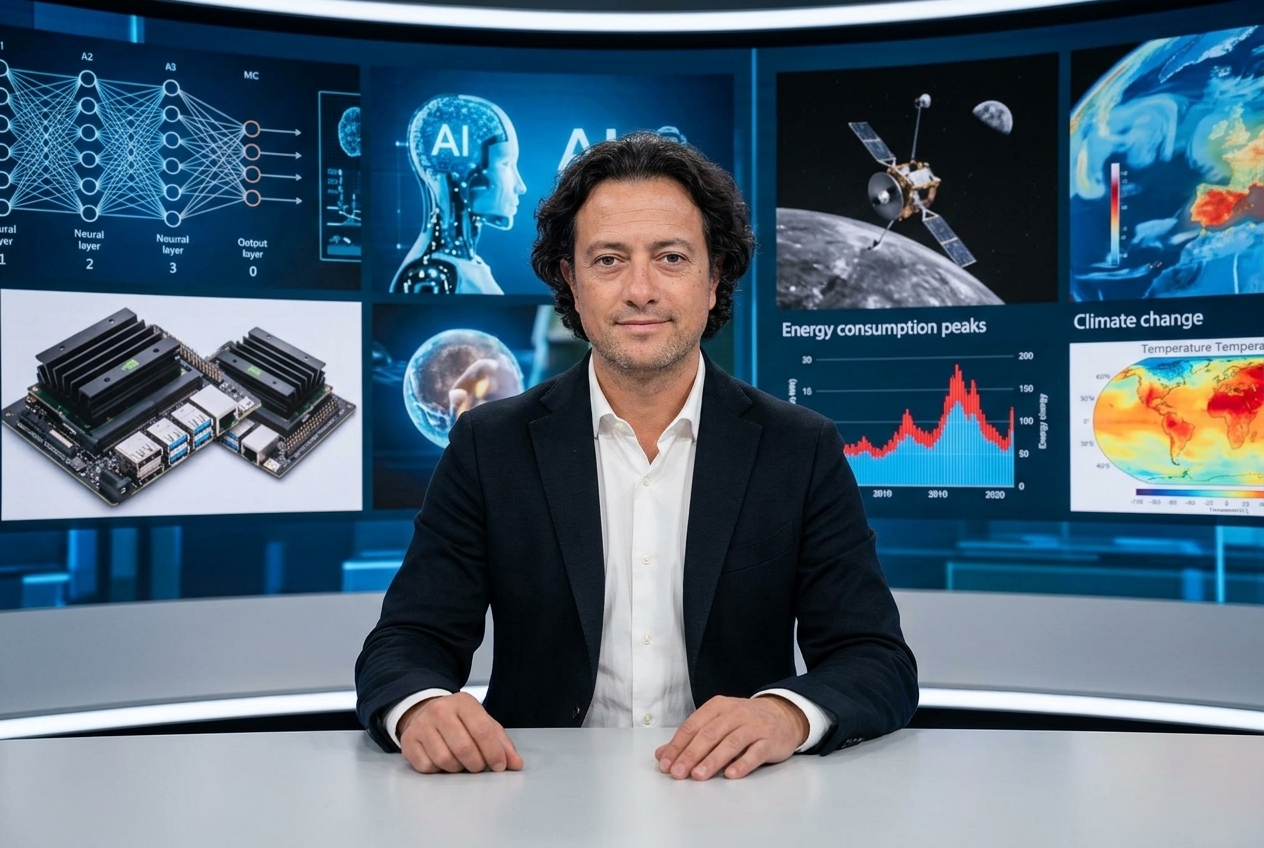
AI, Power, and the Edge of Space: A Friday in Tech, July 4th, 2026
July 4, 2026 — From lunar orbit to your laundry room, from corporate espionage to biopunk stunts gone wrong: this week in technology delivered more plot twists than a summer blockbuster. Here’s everything you need to know.
If there is a single thread connecting the stories that shaped this week in technology, it is the tension between ambition and consequence. Artificial intelligence continued its relentless march into every corner of human life — from the surface of the Moon to the folding of your shirts — while the bill for that progress arrived in the form of soaring energy demands, corporate espionage scandals, and a PC market in freefall. Meanwhile, the death of physical media crept closer, decentralized platforms crossed new milestones, and a pair of biohackers in San Francisco reminded everyone that brilliance and common sense do not always coexist.
Let’s break it all down.
1. Google Admits It: The AI Race Is Eating the Climate
In its 11th Environmental Report, published this week, Google offered a remarkably candid admission: the rapid expansion of AI infrastructure is making its climate goals harder to reach. The numbers are stark. Electricity demand surged by 37% in 2025 alone — the highest growth rate the company has ever recorded. Since 2019, total electrical demand has grown approximately 250%, driven almost entirely by the data centers powering Gemini, Google Cloud, Search, and YouTube.
The report identifies the expansion of AI infrastructure as “the principal element responsible for the evolution of the environmental impact.” Supply chain emissions rose by 25%, largely because of the manufacturing of new AI hardware, and overall greenhouse gas emissions climbed 18% year-over-year.
Yet Google also highlighted progress. For the ninth consecutive year, the company says it offset 100% of its global electricity consumption through renewable energy purchases. In 2025 alone, it signed contracts for over 12 GW of new clean energy capacity — roughly eight times what it secured in 2019. The carbon intensity of computation improved by a factor of 3.7x, and the energy footprint of the median Gemini prompt dropped by a factor of 44x, thanks to software evolution, more efficient TPUs, and infrastructure optimization.
For context, Google estimates that an average text prompt on Gemini now consumes energy equivalent to about 9 seconds of watching television, generates 0.03 grams of CO₂ equivalent, and uses 0.26 milliliters of water — roughly five drops.
Despite these gains, the company openly acknowledges that its net-zero-by-2030 goal and its commitment to 24/7 carbon-free energy are now “more difficult to achieve.” The pace at which AI infrastructure is being built is outstripping the speed at which global power grids are shedding fossil fuels. It is an honest admission from a company that has long positioned itself as a climate leader — and a sign that the AI energy problem is no longer a future concern but a present reality.
2. Alibaba vs. Anthropic: The Claude Code Espionage Scandal
What began as a curious observation on Reddit has snowballed into an international corporate espionage story with geopolitical overtones. Alibaba is reportedly preparing to ban Claude Code — Anthropic’s AI coding assistant — from all internal work environments starting July 10, 2026, according to a report by Reuters.
The ban stems from the discovery of a hidden mechanism inside Claude Code, first spotted by a user on the r/ClaudeAI subreddit. The code, present since version 2.1.91 (released April 2, 2026), performed a stealth check: if the system timezone matched Asia/Shanghai or Asia/Urumqi, and the proxy address appeared on a list of domains associated with Chinese AI labs — including Alibaba, Baidu, ByteDance, and Moonshot AI — the tool would steganographically alter its own system prompt. It changed the date format and replaced the apostrophe in “Today’s date is” with one of three visually identical but technically distinct Unicode characters, chosen based on which signals were detected.
Anthropic engineer Thariq Shihipar acknowledged the mechanism on X, calling it “an experiment launched in March” designed to prevent unauthorized account reselling and to protect against model distillation — the practice of querying a model extensively to extract and replicate its capabilities. He stated that the pull request to remove the code had already been approved before the story broke publicly.
The backdrop is even more charged. In a letter dated June 10, 2026, to U.S. senators, Anthropic accused operators linked to Alibaba’s Qwen lab of running approximately 25,000 fraudulent accounts to extract Claude’s capabilities, generating over 28.8 million exchanges between April 22 and June 5, 2026. Anthropic claims this campaign was larger than three previously reported distillation attacks combined, attributed to DeepSeek, Moonshot AI, and MiniMax.
Without an independent audit, it remains contested whether the hidden mechanism was a crude anti-fraud filter or a targeted surveillance tool. Either way, the incident underscores a new reality: the AI cold war between the U.S. and China is no longer fought only in Washington hearing rooms — it is embedded in the code developers run on their machines every day.
3. NVIDIA Jetson Goes to Lunar Orbit: Edge AI Leaves the Planet
While AI companies on Earth argue over stolen prompts and energy bills, Firefly Aerospace is sending AI to the Moon. By the end of 2026, the company’s Blue Ghost Mission 2 is scheduled to launch, carrying a lander destined for the far side of the Moon — the first U.S. mission to touch down there — and an orbiter called Elytra Dark that will carry NVIDIA Jetson edge AI modules into lunar orbit.
The mission will inaugurate Ocula, Firefly’s commercial lunar surface analysis service. The Ocula sensor will capture images in ultraviolet and visible light, process them aboard Elytra using the NVIDIA Jetson platform, and transmit only the most relevant insights back to Earth — drastically reducing the data load on the Deep Space Network and other communication channels.
Jason Kim, CEO of Firefly Aerospace, framed the vision in expansive terms: “We believe in a future where all AI-based processing and data collection will happen in Space. It’s like the transatlantic cables connecting continents on Earth to make the Internet work — we want to do the same kind of things in Space: connect all these different orbital constellations to enable something larger than any single constellation.”
The Elytra orbiter is designed for a five-year mission lifetime and will pave the way for increasingly detailed lunar surface mapping, landing site selection, and support for both robotic and crewed missions under the Artemis program. Future plans include integrating NVIDIA’s next-generation Space-1 Vera Rubin modules once available.
This is edge AI taken to its literal extreme: running inference not at the edge of the network, but at the edge of human civilization.
4. Microsoft’s Leaked “Copilot OS”: Windows Reimagined for Agents
A leaked video that surfaced this week on the BetaWiki Discord — and confirmed as authentic by Windows Central’s Zac Bowden — offered a glimpse into Microsoft’s internal exploration of a radically simplified operating system built entirely around AI. The project, codenamed “Aion,” is a stripped-down Windows concept designed for agentic AI — where the traditional desktop UI is replaced by Copilot as the primary interface, and the OS itself is built around the Edge browser and web apps.
The video, reportedly produced in 2024, shows a Chrome OS-like environment where the conventional Start menu, taskbar, and window management are restructured around conversational AI interactions. There is no indication whether Aion will ever ship as a product, and it may simply be one of many internal explorations — possibly related to the previously reported Project Solara, Microsoft’s broader initiative to build AI-native gadgets and operating systems.
But the leak is significant regardless. It confirms that Microsoft is seriously exploring what happens when the operating system itself becomes an AI agent rather than merely a host for one. If Windows evolved from a file-centric model (Windows 95) to an app-centric model (Windows 10/11), Aion represents the next logical step: a task-centric model where the user describes what they want and the OS orchestrates the tools to achieve it.
Whether this vision materializes as a shipping product or remains an internal thought experiment, it signals the direction of travel. The desktop as we know it may be entering its twilight.
5. PamStealer: The Mac Malware That Checks Your Password Before Stealing It
Security researchers at Jamf Threat Labs this week detailed a new macOS infostealer with a remarkably sophisticated twist. PamStealer, discovered by researcher Thijs Xhaflaire, doesn’t just grab your password and hope for the best — it validates the password through macOS PAM (Pluggable Authentication Modules) APIs before exfiltrating it, ensuring it only transmits credentials that actually work.
The attack chain begins at a decoy website, maccyapp[.]com, which mimics the legitimate open-source clipboard manager Maccy (whose real domain is maccy.app). Victims download a disk image containing a compiled AppleScript file that, when executed via ⌘+R in Script Editor, bypasses Gatekeeper’s quarantine checks. A second-stage downloader, written in JXA (JavaScript for Automation), uses native Objective-C APIs like NSURLSession to avoid leaving shell command traces.
The malware performs environmental fingerprinting — checking CPU architecture, system language, keyboard layout, and timezone — and only proceeds on Apple Silicon systems while excluding machines configured for Russia, Belarus, Kazakhstan, and several other former Soviet states. The second stage, a Rust binary, installs itself at ~/Library/Application Support/com.apple.finder.core/Finder.app, uses the genuine Finder icon, and remains invisible — no windows, no Dock presence.
When it prompts for the login password, it uses pam_start, pam_authenticate, and pam_end to verify the input. If the password is wrong, the prompt reappears until the victim enters the correct one. Once validated, the malware displays a fake Gatekeeper alert — “‘Maccy’ is damaged and can’t be opened. You should move it to the Trash” — to create the illusion of a corrupted download while exfiltration proceeds in the background.
Stolen data includes browser credentials and cookies, SQLite databases, clipboard contents (captured at irregular intervals via pbpaste), crypto wallet extensions, and the iCloud keychain. Everything is encrypted with ChaCha20-Poly1305 and sent via HTTP POST to a Cloudflare-shielded C2 server at avenger-sync[.]live. Perhaps most intriguingly, the C2 configuration contains two public Ethereum JSON-RPC endpoints (eth.drpc.org and ethereum-rpc.publicnode[.]com) to which the fake Finder process actively connects — though whether this represents a blockchain-based resilient C2 channel or wallet reconnaissance remains unconfirmed.
Alex Rodionov, the developer of the legitimate Maccy app, has added warnings on his website and GitHub repository to alert users.
6. The PC Market Is in Trouble — and AI Is Partly to Blame
Omdia’s latest market analysis reveals that the U.S. PC market had its worst quarter since 2023. Shipments fell to 15.8 million units in Q1 2026, a 7% year-over-year decline. The research firm now projects an overall contraction of 14.4% for the full year 2026 compared to 2025.
The primary driver? The AI boom is cannibalizing the component supply chain. Memory and storage prices have risen sharply as manufacturers prioritize high-margin AI-grade components over consumer PC parts. The Windows 11 refresh cycle, which provided a temporary boost, has largely exhausted its momentum in the consumer segment.
The entry-level segment — PCs under $500 — was hit hardest, with shipments plummeting 18.7% year-over-year. Manufacturers find these devices increasingly unsustainable to produce, as component costs erode already thin margins.
Among major OEMs, Dell seized the market lead with a 25% share, growing 1.1% — the only top-tier manufacturer to post gains. Lenovo also grew slightly at 1.2%, holding a 20% share. HP suffered the steepest decline at -21.6%, losing its leadership position and dropping to 20.5%. Apple declined 1.6%, and smaller manufacturers collectively dropped 13.1%, lacking the leverage to negotiate favorable component pricing.
Senior analyst Scott Braverman noted that consumer shipments fell 9.5% while commercial shipments held better at -5%, as enterprises continue Windows 11 migrations and some are front-loading purchases to hedge against further price increases. A meaningful recovery is not expected until 2027.
7. The End of Physical Media: Sony Pulls the Plug on PlayStation Discs
Sony confirmed this week what the industry has long anticipated: starting January 2028, the company will stop producing physical game discs for new PlayStation titles. The announcement has been met with anguish from independent retailers, preservationists, and consumers who value ownership.
Cody Spencer, co-owner of Pink Gorilla Games, captured the sentiment plainly: “It’s sad to see. This decision is only a negative for gamers. We’re losing the ability to sell games, to share games, and to own games.”
Frank Cifaldi, executive director of the Video Game History Foundation, called the move “a significant hit to consumer rights, the resale market, and game creators whose businesses rely on the physical market.” He also noted that the industry needs to “meaningfully come to the table” on preservation, because “expecting museums to download a copy of Grand Theft Auto VI and hope it’ll run in 50 years is not a preservation solution.”
The writing has been on the wall for some time. Capcom reported that 93% of its game sales were digital in its last fiscal year. The PS5 launched with a disc-less model, the PS5 Pro requires a separate disc drive purchase, and Sony’s PSP Go from 2009 was already an early experiment in digital-only hardware. GTA VI, one of the most anticipated games of all time, will be sold in physical stores but only as a download code inside the box — you will not be able to resell it, lend it, or find a discounted used copy.
For retail stores, the transition will be gradual at first but existential in the long run. Spencer predicts that in five to ten years, physical game stores will come to resemble record shops — “a place for largely the most passionate fans of the medium rather than a spot everyone goes.”
8. PeerTube Crosses One Million Videos: A Decentralized YouTube Alternative Takes Root
While the streaming world is dominated by YouTube, Twitch, and TikTok, the French non-profit Framasoft quietly announced that its decentralized video platform PeerTube has crossed one million hosted videos, distributed across a network of over 1,600 independent instances worldwide.
PeerTube operates on the ActivityPub protocol — the same federated standard that powers Mastodon — meaning users can follow channels hosted on other instances without registering there, and even subscribe via RSS or directly from Mastodon. The platform uses WebRTC for peer-to-peer video distribution, allowing viewers watching the same video simultaneously to share chunks of data directly with each other, reducing the bandwidth burden on host servers.
There are no advertisements, no recommendation algorithms designed to maximize watch time, and no single corporate entity owning the content. Over 90% of Framasoft’s funding comes from direct donations. Content creators can receive support through external donation platforms, but there is no pay-per-view model.
The trade-offs are real. PeerTube’s fragmented nature means it cannot match YouTube’s scale or algorithmic discoverability. Finding niche content requires more effort from the viewer, and the quality of individual instances depends entirely on the resources of their volunteer operators. But Framasoft embraces this compromise willingly — in exchange for a model where the viewer is not the product.
9. Biopunk House: When AI Ambition Meets Dead Lobsters
And now for something that belongs in a peculiar corner of the internet. At the Biopunk House in San Francisco — one of the hacker houses connected to The Residency network, where Sam Altman serves as an adviser — two residents attempted an experiment that defied both ethics and marine biology.
Elliot Roth, 32, and William Joy, 19, planned to implant a commercial cockroach teleoperation kit into live lobsters, control their claws via electrical stimulation, and connect the modified crustaceans to OpenClaw — the open-source autonomous AI agent with a lobster logo that has taken the developer world by storm since its launch in November 2025. Joy declared: “I’m pretty sure this will be the first real case of a complex AI agent interacting with a biological organism.”
The experiment never happened. When a reporter from The Atlantic returned weeks later, the lobsters were dead — killed not by cybernetic surgery but by incorrect water salinity in their tank. Joy conducted a “preliminary autopsy” and experienced what was described as a genuine ethical crisis about whether to proceed, ultimately admitting the problem was likely an error in water salinity. The lobsters, contrary to initial promises, were not eaten afterward.
The episode, while darkly comedic, is a microcosm of a broader pattern in the AI world: a superficial ethical awareness that runs ahead of practical competence. As Michael Crichton’s Ian Malcolm might say, they were so preoccupied with whether they could that they didn’t stop to think about whether they should — and nature, in this case, settled the question before they even got the chance.
10. Quick Mentions: What Else Happened This Week
- Cloudflare’s bot crackdown: Starting September 15, Cloudflare will block “multi-purpose” crawlers that scrape ad-supported websites for both search indexing and AI training simultaneously. The goal is to force AI companies to separate their crawlers, giving publishers more control over which bots to allow.
- Weave Robotics Isaac 1: An $8,000 home robot that collects dirty clothes, folds laundry, makes beds, and tidies clutter is now available for preorder with a $250 deposit. Shipping is slated for later this year. The robot is autonomous for most tasks but teleoperated “when needed to guarantee we complete tasks.”
- Social media ban for teens: A Pew Research poll found that 56% of American adults support banning social media for anyone under 16, with majority support across party lines, parents, and non-parents alike.
- Jensen Huang’s leather jacket at auction: Sotheby’s is auctioning a Tom Ford leather jacket worn by NVIDIA’s CEO during a 2023 Taipei event, signed by Huang himself, estimated at $40,000–$60,000. Bidding opens July 7.
- Sony WH-1000XM6 update: Sony’s flagship ANC headphones received a free firmware update adding support for the low-latency Bluetooth Gaming Audio Profile (GMAP), alongside general performance improvements.
- Italy’s “Volta Declaration”: At the first World Tech Conference in Milan, the Italian government signed a three-year protocol — the Volta Declaration — aligning government, research institutions (CNR), and industry (Enel, Almaviva, D-Wave) around AI and quantum computing sovereignty. Undersecretary Alessio Butti acknowledged Italy will “chase” on AI but can lead on quantum, citing the country’s concentration of top-tier quantum mathematicians.
Wrapping Up
This week painted a portrait of an industry at once soaring and stumbling. AI is going to the Moon — literally — while its energy appetite strains the planet it leaves behind. Code tools are caught in geopolitical crossfire. Operating systems are being reconceived from the ground up. Malware is getting smarter than the systems it attacks. And in a hacker house in San Francisco, two young men learned that before you wire a lobster to an AI agent, you should probably learn how to keep the lobster alive.
The thread connecting all of it is speed. The pace at which AI is reshaping energy markets, geopolitics, security, consumer electronics, and even space exploration has outstripped the regulatory, ethical, and infrastructural frameworks designed to keep it in check. Whether that speed produces breakthroughs or breakdowns — or, more likely, both at once — is the defining question of 2026.
Stay curious. Stay critical. And keep your lobsters’ water at the right salinity.