🧠 Le Reti Neurali Non Sono Algoritmi: Perché l’Intelligenza Artificiale È una Simulazione del Cervello, Non un Programma
“Ma tanto sono solo algoritmi.”
Quante volte avete sentito questa frase? La sento ripetere continuamente, da accademici, da tecnici, da gente che legge un post su LinkedIn e pensa di aver capito tutto. “Le reti neurali sono algoritmi”, “gli LLM sono pappagalli stocastici”, “è solo statistica avanzata”.
C’è un problema fondamentale in tutto questo: è scientificamente sbagliato.
Non è sbagliato “un po'”, non è una questione di sfumature. È un errore concettuale profondo che dice molto su come certi ambienti accademici — in particolare in Italia — faticano ad aggiornare i propri modelli mentali di fronte all’evidenza.
Facciamo un passo indietro e partiamo da un’immagine mentale che chiarirà tutto.
💧 Il Vortice nell’Acqua: Perché un Sistema Non è il Suo Simulatore

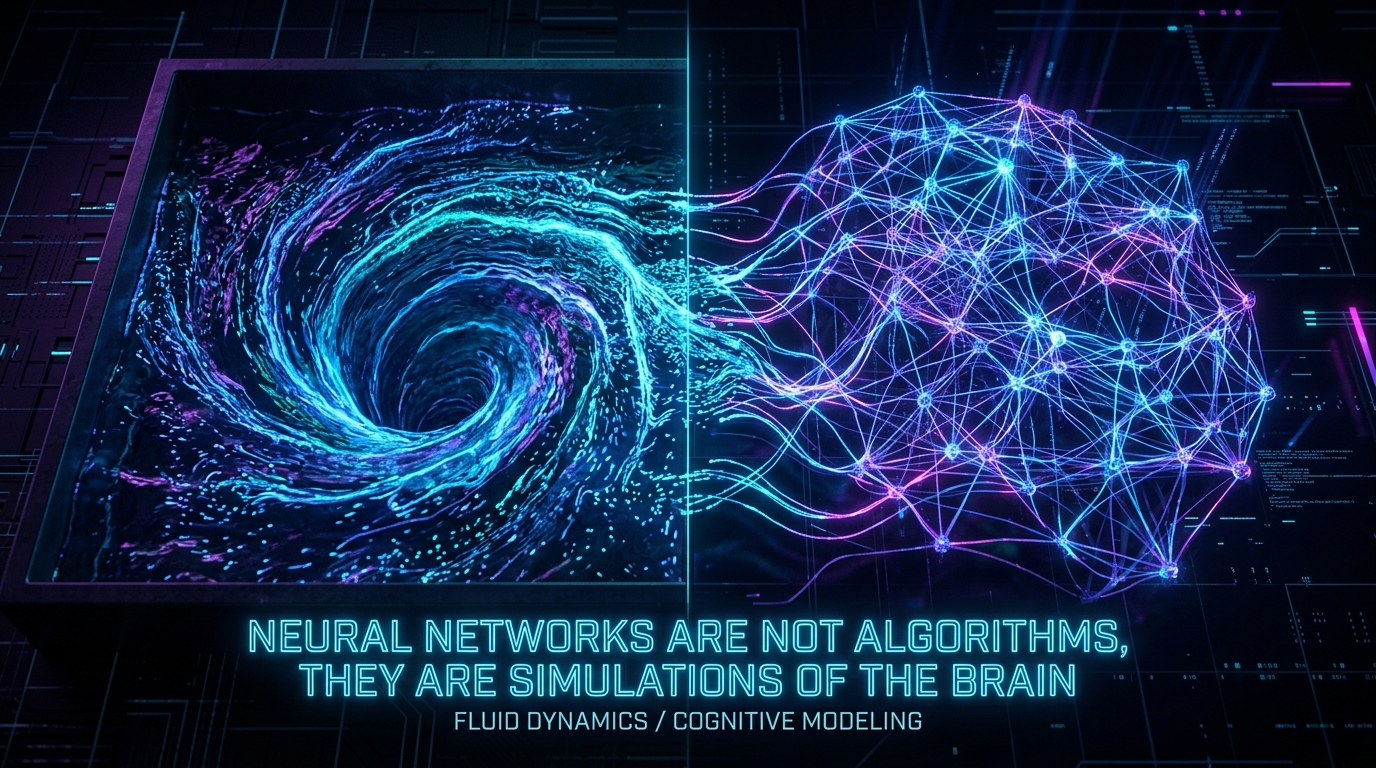
Immagina di scrivere un programma che simula la dinamica dei fluidi. Il tuo software prende milioni di particelle d’acqua virtuali, calcola le loro interazioni, e a un certo punto, davanti ai tuoi occhi, emerge un vortice. Un mulinello che si forma, ruota, si muove.
Ora, la domanda è: quel vortice è “scritto” nell’algoritmo? No. L’algoritmo è un programma che calcola lo stato successivo del sistema a partire dallo stato precedente. Il vortice emerge dalle interazioni delle particelle simulate. È un fenomeno del sistema simulato, non dell’algoritmo che lo simula.
Questo è il punto centrale, e va compreso in tutta la sua profondità.
L’algoritmo di simulazione e il sistema simulato sono due cose completamente diverse. L’algoritmo è ciò che esegue il calcolatore per avanzare la simulazione di un passo temporale. Il sistema simulato è ciò che vive all’interno di quella simulazione — le sue proprietà, i suoi comportamenti emergenti, la sua complessità.
Una rete neurale funziona esattamente allo stesso modo.
Quando esegui l’inferenza di una rete neurale sul tuo computer, stai simulando un sistema computazionale ispirato alle reti neurali biologiche. L’algoritmo che moltiplica matrici e applica funzioni di attivazione non è la rete neurale — è il simulatore. La rete neurale è il sistema che viene simulato, con le sue proprietà emergenti, la sua capacità di rappresentare significati, la sua abilità di ragionare.
Dire che una rete neurale “è un algoritmo” è come dire che un vortice “è un programma C”. È un errore di categoria logica.
🔬 Perché Questa Distinzione è Cruciale
Se sbagli la cornice concettuale con cui guardi le reti neurali, sbagli tutto quello che viene dopo.
Se pensi che una rete neurale sia “un algoritmo”, allora:
– La riduci a una sequenza di istruzioni deterministiche
– Neghi implicitamente la possibilità di comportamenti emergenti
– La confini dentro i limiti di ciò che un programmatore ha esplicitamente scritto
– Arrivi dritto dritto alla teoria del “pappagallo stocastico”
Se invece capisci che una rete neurale è un sistema computazionale simulato, allora:
– Ammetti la possibilità di proprietà emergenti non previste
– Riconosci che l’architettura e i pesi determinano la computazione, non l’algoritmo di inferenza
– Accetti che questi sistemi possano sviluppare capacità che assomigliano alla comprensione umana
– Sei aperto all’idea che la simulazione di un sistema neurale possa produrre comportamenti analoghi a quelli del cervello biologico
La differenza non è sottile. È radicale.
🧠 La Simulazione del Cervello: Un Esperimento Mentale
Prendiamo un esempio ancora più chiaro. Supponiamo che un domani — e non è fantascienza — un computer superpotente sia in grado di simulare ogni singolo neurone, ogni sinapsi, ogni stato elettrico del tuo cervello. Una simulazione completa, molecola per molecola.
Domanda: quella simulazione è “un algoritmo”? Certo che no. È una simulazione di un cervello. L’algoritmo è ciò che fa girare la simulazione. Ma ciò che emerge da quella simulazione — la coscienza, i pensieri, le emozioni — appartiene al sistema simulato, non all’algoritmo.
Chi è negazionista e pensa che un cervello umano non possa essere simulato in un computer, prima o poi, semplicemente non ha capito la natura della computazione. Il funzionalismo computazionale — l’idea che gli stati mentali siano funzionali e quindi realizzabili su qualsiasi substrato — è un pilastro della scienza cognitiva.
Le reti neurali artificiali fanno lo stesso, a un livello di astrazione molto più alto e con neuroni e sinapsi enormemente semplificati. Ma la logica è la stessa: simuliamo un sistema computazionale, e da quella simulazione emergono capacità che non sono “scritte” nell’algoritmo che la esegue.
Un ulteriore prova: l’algoritmo di inferenza per una rete neurale è spesso generico e riutilizzabile. Lo stesso identico algoritmo può far girare modelli completamente diversi (DeepSeek, Llama, GPT, Claude). Cambiano i pesi, e la computazione che avviene è completamente diversa. L’algoritmo è sempre lo stesso — ma ciò che simula cambia radicalmente.
Questo da solo dimostra che l’algoritmo non è la rete neurale. L’algoritmo è ciò che permette alla rete neurale di esprimersi.
📜 L’Origine del Mito: Stochastic Parrot e i Suoi Limiti
Nel 2021, quattro ricercatrici — Timnit Gebru, Emily M. Bender, Angelina McMillan-Major e Margaret Mitchell — pubblicarono un paper dal titolo “On the Dangers of Stochastic Parrots: Can Language Models Be Too Big?”.
Il paper sosteneva che gli LLM sono incapaci di due cose fondamentali:
1. Modellare nelle loro attivazioni il significato logico del prompt ricevuto
2. Pianificare in anticipo ciò che andranno a dire
In altre parole: il modello non capisce nulla, e predice solo la prossima parola in modo statistico, senza una rappresentazione interna del significato.
Ora, anche senza addentrarci negli studi di interpretabilità — che con gli sparse autoencoder hanno ampiamente mostrato quanto questa tesi sia debole — una persona con un minimo di coerenza scientifica dovrebbe riconoscere che questa è una teoria tra tante. Il teorema di approssimazione universale delle reti neurali ci dice che possono approssimare qualsiasi funzione: ciò significa che possono esistere configurazioni in grado di comprendere, ragionare, pianificare. La domanda è se il gradient descent, con i dati che abbiamo, trova quelle configurazioni.
L’evidenza empirica — sempre più schiacciante — dice di sì.
Nel 2021 si parlava di GPT-3. Oggi siamo nel 2026, e i modelli hanno fatto passi da gigante in termini di ragionamento, pianificazione e comprensione. Eppure certi ambienti accademici continuano a ripetere lo stesso mantra, come se il tempo si fosse fermato.
📊 Perché le Reti Neurali Generalizzano (e Non Memorizzano)
Una delle osservazioni più sorprendenti delle reti neurali moderne è che riescono a generalizzare nonostante siano massicciamente overparametrizzate — cioè abbiano molti più parametri che esempi di training.
Se fossero semplici “pappagalli statistici”, memorizzerebbero. Invece generalizzano. Perché?
La teoria più interessante è quella dei gradienti concordi. Quando ci sono abbastanza esempi che puntano nella stessa direzione del gradiente, tutti “tirano” i pesi nella direzione corretta per generalizzare. Quando invece i dati non hanno una struttura generalizzabile, non ci sono gradienti concordi, e la rete impara a memoria quei casi specifici.
Il linguaggio umano, con tutte le sue idee e strutture logiche, è un dominio ricco di gradienti concordi. Ecco perché un LLM addestrato su testi umani impara a ragionare, non a memorizzare.
Man mano che la rete impara, la derivata dell’errore cambia, permettendo al modello di cogliere dettagli sempre più sottili della funzione che sta approssimando, a diversi livelli di astrazione.
🔄 Emergenza: Quando il Sistema Supera il Simulatore
Un altro strato del problema è come pensiamo alle reti neurali. Tendiamo a vederle come un’unica funzione matematica — input, output, scatola nera. È vero, matematicamente è corretto: una rete neurale, data la sua architettura e i suoi pesi, è una funzione.
Ma è più utile pensarla come una cascata di filtri. I layer più bassi processano informazioni sintattiche. Man mano che si sale, emergono rappresentazioni semantiche sempre più astratte, fino ad arrivare a idee complesse nei layer più alti. Questo processo produce una capacità di ragionamento che assomiglia a un filtering bayesiano, dove ogni layer raffina la comprensione del precedente.
Questa è un’intuizione che aiuta molto di più dell’idea di “un’unica funzione matematica”, anche se le due visioni sono equivalenti — perché funzioni composte possono sempre essere ridotte a un’unica funzione.
Il punto è che l’architettura profonda permette l’emergenza di capacità che non sono evidenti guardando i singoli neuroni. Come il vortice nell’acqua, il ragionamento emerge dalle interazioni di milioni di unità semplici.
🎭 La Teoria del Pappagallo e Il Paradosso del Critico
C’è un fenomeno interessante nell’evoluzione del termine “stochastic parrot”. Nato come una metafora specifica in un paper accademico, è diventato:
1. Un meme — ripetuto da chi non ha mai letto il paper originale
2. Una barriera mentale — per evitare di confrontarsi con le reali capacità dei modelli
3. Un insulto — per sminuire il lavoro di chi costruisce o usa questi sistemi
Il problema è che questa posizione è sempre meno sostenibile. A livello internazionale, nessun top researcher di AI dice più queste cose. Hinton, Bengio, LeCun — tutti si sono espressi contro la teoria del pappagallo stocastico. Yann LeCun stesso, che pure all’inizio aveva qualche riserva, da anni dice che ridurre gli LLM a modelli statistici è un errore madornale.
Eppure in Italia — in particolare in certi ambienti accademici — questa teoria continua a essere insegnata come verità assoluta.
Sam Altman lo capì subito. Nel dicembre 2022, twittò: “I am a stochastic parrot, and so r u.” — smontando con ironia l’intera argomentazione. Perché anche gli esseri umani, in larga misura, imparano per imitazione, pattern matching e ripetizione.
C’è una bella differenza tra imitazione meccanica e apprendimento per pattern, ma la linea è molto più sfumata di quanto i critici vogliano ammettere.
💡 Cosa Possono Fare Davvero gli LLM
I modelli di frontiera oggi (2026) sono in grado di:
– Interpolare nei buchi della conoscenza umana: combinare concetti da domini diversi (es. idraulica + scienza dei materiali) per scoprire soluzioni che nessun umano aveva mai esplorato
– Provare e disprovare teorie matematiche: non solo calcoli, ma vera attività di ragionamento matematico
– Generare codice in linguaggi e framework mai visti: combinando concetti di sintassi e semantica in modi originali
– Applicare ragionamento analogico: identificare strutture comuni tra domini diversi
🔍 Esempi Concreti di Ricerca Assistita da LLM
Un esempio affascinante viene dal campo dei CRDT (Conflict-free Replicated Data Types), strutture dati che permettono la sincronizzazione tra più dispositivi senza conflitti. Ricercatori informatici hanno utilizzato LLM di frontiera per esplorare nuove varianti di CRDT, e i modelli hanno prodotto suggerimenti talmente innovativi che gli stessi ricercatori faticavano a comprenderli appieno. Solo dopo aver implementato e testato le proposte, si sono resi conto che superavano lo stato dell’arte.
Altri esempi recenti includono:
– Scoperta di nuovi materiali: LLM che combinano conoscenze di chimica, fisica dello stato solido e scienza dei materiali per suggerire composizioni mai testate
– Ottimizzazione di algoritmi: modelli che propongono varianti di algoritmi noti con complessità computazionale inferiore
– Progettazione di circuiti: AI che esplora configurazioni di semiconduttori e sistemi RF per trovare soluzioni che i progettisti umani non avevano considerato
Tutto questo è possibile perché gli LLM non si limitano a “ripetere” conoscenze esistenti — interpolano nei buchi della conoscenza umana, connettendo punti che nessun umano aveva mai connesso prima. Ecco perché la teoria del pappagallo stocastico è non solo inaccurata, ma attivamente dannosa: ci impedisce di vedere ciò che questi sistemi possono realmente fare.
Ci sono ricercatori in informatica che stanno usando modelli di frontiera per fare nuova scienza, e riferiscono di ricevere suggerimenti talmente nuovi da non capirli completamente — solo per scoprire che i risultati superano lo stato dell’arte in settori come i CRDT e altri ambiti teorici dell’informatica.
Questo non significa che i modelli siano coscienti o che abbiano raggiunto l’AGI. Ma significa che la teoria del pappagallo stocastico è morta.
🏛️ Il Problema Italiano
Uno degli aspetti più interessanti del dibattito attuale è il ritardo culturale di alcuni ambienti accademici italiani. Mentre a livello internazionale si discute di come mitigare i rischi di modelli sempre più capaci (allucinazioni, bias, concentrazione di potere), in Italia si discute ancora se “capiscono o no”.
Questo è il risultato di un sistema universitario che, salvo rare eccellenze, ha perso la capacità di attrarre e trattenere i migliori talenti. Quando mancano grandi luminari capaci di dire “Ragazzi, ma cosa state dicendo? Avete visto cosa sta succedendo?”, la mediocrità si cristallizza e le teorie superate continuano a essere insegnate come verità assolute.
L’AI Act europeo, intanto, classifica i sistemi in base al livello di rischio. Se l’Europa adotta una posizione “pappagallo stocastico” — cioè che gli LLM non capiscono, non ragionano — allora la regolamentazione sarà inadeguata per i rischi reali. E se adotta una posizione troppo allarmista, rischia di soffocare l’innovazione.
Il dibattito su cosa questi sistemi siano o non siano ha conseguenze regolatorie reali. Non è solo accademia.
⚡ La Differenza Pratica: Perché Dovrebbe Importarti
Forse a questo punto ti starai chiedendo: “Ok, ma a me cosa cambia? Sono un professionista, voglio solo capire se questi strumenti mi sono utili.”
La risposta è: cambia tutto. Se pensi che una rete neurale sia “solo un algoritmo”, la userai in modo sbagliato. La tratterai come un programma deterministico, ti fiderai dei suoi output quando non dovresti, e la ignorerai quando potrebbe esserti utile. È come cercare di pesare l’acqua con un metro: stai usando lo strumento sbagliato per capire ciò che hai davanti.
Se invece capisci che le reti neurali sono sistemi complessi simulati, con comportamenti emergenti, le userai nel modo corretto:
– Capirai che possono essere creative, ma anche sbagliare in modi imprevedibili
– Saprai che ragionano per pattern, non per regole, e quindi vanno guidate con il prompt giusto
– Riconoscerai che la loro comprensione è diversa da quella umana — non inferiore, diversa
– Imparerai a lavorare con loro, non a dar loro ordini come fossero un programma
Questa non è una distinzione filosofica. Ha implicazioni pratiche immediate per chiunque usi l’AI nel proprio lavoro.
Inoltre, capire che le reti neurali simulano sistemi computazionali significa capire anche che non c’è un limite teorico noto a ciò che possano raggiungere. Se la simulazione è sufficientemente fedele e sufficientemente grande, le capacità che emergono possono avvicinarsi sempre di più a quelle del sistema originale che stiamo simulando — il cervello umano. Non c’è nessuna barriera fondamentale che impedisca a una rete neurale artificiale di raggiungere capacità analoghe a quelle umane in tutti i domini. È solo una questione di scala, dati e algoritmi di training.
Questo è il vero significato della rivoluzione in corso: non stiamo programmando computer più intelligenti. Stiamo imparando a simulare l’intelligenza.
🔬 Il Paradosso di Moravec: Perché Sottovalutiamo l’Intelligenza delle Macchine
C’è un principio nell’AI che spiega perché tanti faticano ad accettare le capacità degli LLM: il paradosso di Moravec. Hans Moravec osservò che è relativamente facile insegnare ai computer a fare cose che gli adulti trovano difficili (matematica avanzata, scacchi), ma estremamente difficile insegnare loro cose che un bambino di cinque anni sa fare (riconoscere un volto, raccogliere un oggetto).
Noi umani siamo programmati per trovare “intelligente” ciò che ci costa fatica. Sottovalutiamo istintivamente ciò che per noi è “facile” — parlare, capire il contesto — perché lo facciamo senza sforzo apparente. Ma quelle capacità sono il risultato di miliardi di anni di evoluzione. Che un sistema artificiale, creato in pochi anni, possa eguagliarle in certi contesti è sconvolgente — e molti rispondono con negazione, non meraviglia.
Il termine “stochastic parrot” è il veicolo perfetto per questa negazione.
🌐 Il Contesto Globale: Una Battaglia tra Vecchie e Nuove Idee
A livello internazionale, la teoria del pappagallo stocastico è stata sostanzialmente abbandonata dai ricercatori di punta. Yann LeCun, François Chollet, Geoffrey Hinton — nessuno di loro sostiene più questa posizione. Hinton è stato tra i primi a denunciarla pubblicamente, dicendo che è impossibile che un modello puramente statistico compia le funzioni che osserviamo. E questo lo diceva già ai tempi di GPT-3.
Chollet, che pure è critico verso certe narrative esagerate sull’AI, non ha mai sostenuto la teoria del pappagallo stocastico. LeCun ha sempre sottolineato che le reti neurali, attraverso l’apprendimento per gradienti, sviluppano rappresentazioni interne del mondo molto più ricche di quanto i critici riconoscano.
All’estero, il dibattito si è spostato su questioni ben più interessanti: come mitigare le allucinazioni, come rendere i modelli più robusti, come allinearli ai valori umani, come distribuire equamente i benefici dell’AI. Da noi, in Italia, si discute ancora se “capiscono o no”.
Questo ritardo non è solo imbarazzante — è dannoso. Perché tiene l’Italia fuori dal dibattito vero, impedisce ai giovani ricercatori di formarsi su idee aggiornate, e contribuisce a una narrazione pubblica che sottovaluta sistematicamente l’AI, esponendoci a rischi che non vediamo arrivare.
🎯 Quindi, Cosa Dobbiamo Fare?
1. Smetterla di chiamare “algoritmi” le reti neurali. Sono sistemi computazionali simulati. L’algoritmo è il simulatore, non il sistema.
2. Usare l’AI, non parlarne. Non c’è sostituto per l’esperienza diretta. Se non hai passato ore a interagire con LLM avanzati, la tua opinione vale poco.
3. Aggiornare i modelli mentali. Ciò che era vero per le reti neurali del 2010 non lo è più per i modelli del 2026. Il rifiuto di aggiornare le proprie convinzioni è il vero ostacolo alla comprensione.
4. Discutere dei veri rischi. Non perdere tempo a dibattere se gli LLM capiscono o no. Discuti di concentrazione di potere, etica, distribuzione dei benefici, regolamentazione intelligente.
5. Pretendere meglio dall’accademia. Se un professore ti dice ancora che gli LLM sono “solo pappagalli stocastici” o “solo algoritmi”, chiedigli di aggiornarsi.
💬 Conclusione: Oltre il Pappagallo, Dentro la Simulazione
Il punto fondamentale, quello da cui tutto il resto discende, è questo: le reti neurali non sono algoritmi. Sono sistemi computazionali che vengono simulati da algoritmi, esattamente come un vortice in un fluido simulato non è il programma che lo calcola.
Se capisci questa distinzione, capisci tutto il resto:
– Perché le reti neurali possono generalizzare invece di memorizzare
– Perché mostrano capacità emergenti che i critici non si aspettavano
– Perché la metafora del “pappagallo stocastico” è inadeguata
– Perché l’intelligenza artificiale è una simulazione (semplificata, imperfetta, ma reale) di un sistema neurale
Non stiamo programmando un computer. Stiamo simulando un cervello. La differenza è tutto.
Hai trovato utile questo articolo? Condividilo e seguici su Ruocco.it. E tu, cosa ne pensi? Le reti neurali sono “solo algoritmi” o qualcosa di più? Scrivicelo nei commenti.
Articolo ispirato al dibattito contemporaneo sull’intelligenza artificiale. I concetti chiave — reti neurali come sistemi simulati non algoritmi e la metafora della simulazione fluidodinamica — sono tratti dal dibattito in corso nella comunità AI internazionale. Fonti: paper “On the Dangers of Stochastic Parrots” (Gebru et al., 2021), Universal Approximation Theorem, analisi dei benchmark MMLU/GSM8K/HumanEval, e osservazioni indipendenti dal settore AI.