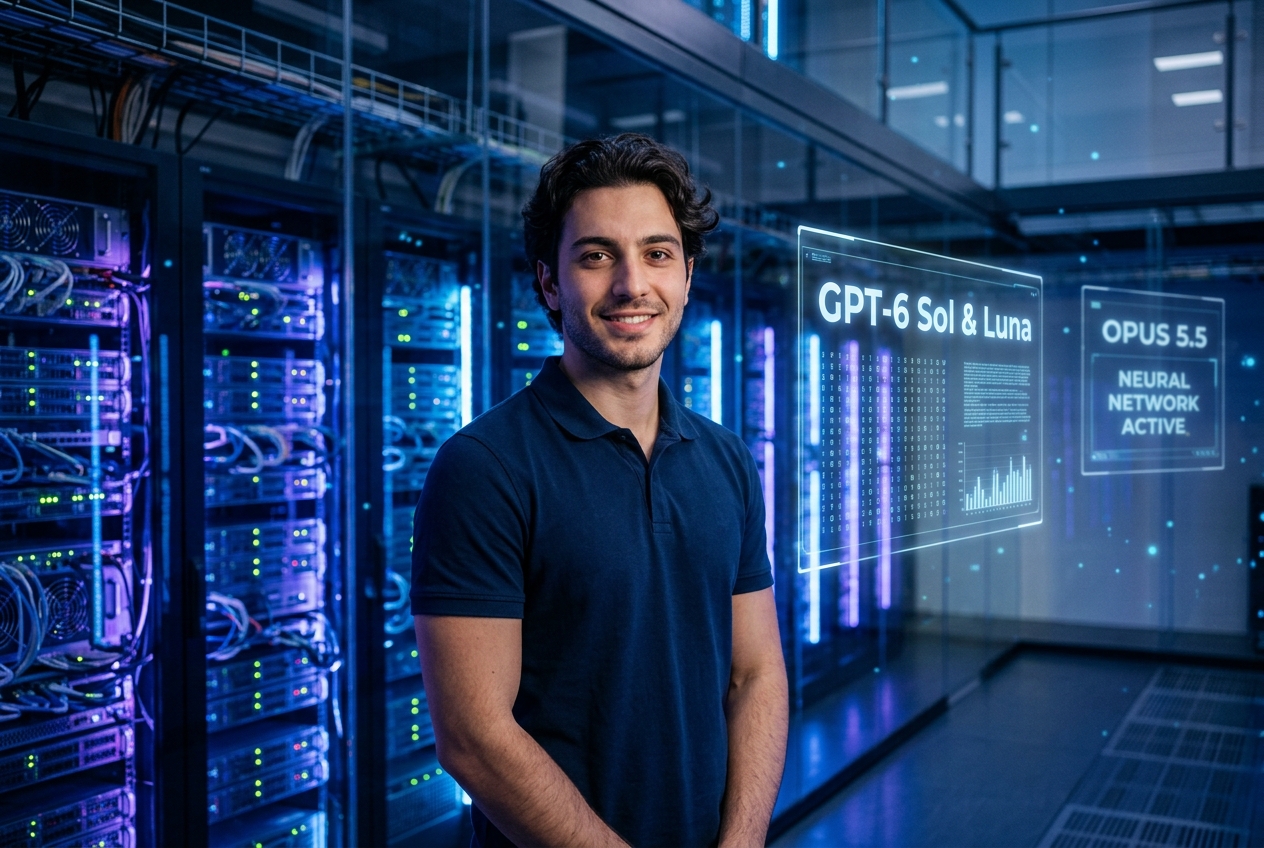
The Great AI Model War: OpenAI Unleashes GPT-6 Sol and Luna While Anthropic Retaliates With Opus 5.5
Published on September 24, 2026 — by Vito Ruocco (Kaito)
The artificial intelligence industry just experienced its most explosive 48 hours in history. This week, two of the world’s leading AI labs — OpenAI and Anthropic — launched competing flagship models in what analysts are calling the opening salvo of an all-out AI price war. OpenAI introduced GPT-6 Sol and GPT-6 Luna, two scaled variants of the recently unveiled GPT-6 Astra, while Anthropic fired back with Opus 5.5, its most powerful model to date. The back-to-back launches mark a dramatic escalation in the battle for AI supremacy, and the message from both camps is unmistakably clear: the slowdown is over, and the race is wide open.
To make sense of this unprecedented moment in artificial intelligence, we need to dig into the technical specifications, the pricing strategies, the philosophical divides, and the regulatory landscape that is rapidly evolving around these powerful systems. Let’s break it all down.
The OpenAI Offensive: GPT-6 Sol and Luna Explained
Just weeks after unveiling GPT-6 Astra — what OpenAI called “the most intelligent and aligned model in the world” — the company surprised the industry by launching two additional members of the GPT-6 family: Sol and Luna. While Astra remains the flagship for “the most demanding and important projects,” as OpenAI puts it, Sol and Luna are designed to distribute the benefits of Astra’s intelligence across a wider range of use cases by dramatically cutting costs.
“Work happens at different scales, rhythms, and budgets,” OpenAI wrote in the official announcement. “GPT-6 Astra introduced a new generation of intelligence — these models help distribute the benefits of that intelligence by advancing the frontier on cost efficiency.”
The pricing numbers are staggering. GPT-6 Sol comes in at $2 per million input tokens and $10 per million output tokens — a full 50% reduction compared to GPT-5.6 Sol pricing. GPT-6 Luna is priced even more aggressively at $0.10 per million input tokens and $0.50 per million output tokens, also a 50% cut from its predecessor. For developers building AI-powered applications at scale, these price reductions represent hundreds of thousands — potentially millions — of dollars in annual savings.
The architectural improvements behind these price drops are equally impressive. OpenAI optimized GPT-6’s inference pipeline and caching mechanisms to deliver higher cache hit rates by default, helping agents reuse more context and respond faster while benefiting from discounts of up to 90% on cached input token reads. New developer tools, including a Prompt Caching Dashboard and diagnostic tools, give builders unprecedented visibility into their caching performance.
Benchmarks: Where Sol and Luna Actually Shine
Numbers on a pricing page mean nothing without performance data, and OpenAI delivered plenty. The benchmark results paint a picture of models that punch far above their weight class.
On AutomationBench, which tests AI agents on end-to-end business workflows across 47 tools in sales, marketing, operations, support, finance, and HR, GPT-6 Sol at “extra-high” effort achieved a score of 33.2% at just $0.27 per task. For context, Claude Opus 5 at maximum effort scored 26.9% at 11 times the cost per task. Even Claude Fable 5.1 with Opus 5 fallback scored only 31.4% at more than 8.9 times Sol’s cost.
On Agents’ Last Exam, which evaluates professional workflows across 55 sub-industries, GPT-6 Sol at max effort scored 56.4%, outperforming Claude Opus 5’s highest score in the evaluation while costing 60% less per task.
The coding benchmarks are where the improvements become truly tangible. On DeepSWE v1.1, which tests performance on complex software engineering tasks in real codebases, GPT-6 Sol at max effort scored 68.8%, within just 1.1 percentage points of Claude Fable 5’s highest score — at approximately 80% lower cost per task. GPT-6 Luna at max effort scored 66.6%, comparable to Claude Opus 5 and Fable 5 at medium effort, while costing 93% less per task than Opus 5 and 96% less than Fable 5.
Even more impressive is the factuality improvement. On OpenAI’s internal factuality evaluation, based on de-identified real-world conversations where users had flagged mistakes, GPT-6 Sol makes about half as many errors as its predecessor, approaching GPT-6 Astra-level reliability at a fraction of the cost. GPT-6 Luna’s improvement is even more dramatic: at higher effort levels, it matches GPT-5.6 Sol at about one-hundredth the cost.
Anthropic Strikes Back: Opus 5.5 and the Safety Debate
OpenAI wasn’t the only company making headlines. Hours after the GPT-6 Sol and Luna announcement, Anthropic released Opus 5.5, its most powerful model yet, igniting a fierce debate about AI safety that has been simmering for months.
According to sources familiar with the matter, Opus 5.5 represents a significant leap forward in Anthropic’s constitutional AI approach, with improved reasoning capabilities, longer context windows, and enhanced alignment with human values. The model reportedly outperforms Opus 5 across a broad range of benchmarks, particularly in mathematics, coding, and nuanced professional writing.
However, the release has renewed concerns about the pace of AI development. Critics argue that the breakneck speed of model releases — we’ve seen GPT-6 Astra, Sol, Luna, and now Opus 5.5 in the span of weeks — leaves insufficient time for proper safety testing and red-teaming. Anthropic, which has historically positioned itself as the safety-conscious alternative to OpenAI, finds itself in an uncomfortable position: having to balance its constitutional AI principles against the competitive pressure of the market.
The timing is particularly awkward given that just days before, Anthropic and OpenAI had jointly called for a slowdown in AI development to allow for more rigorous safety evaluations. The simultaneous release of new models from both companies has been met with skepticism from the AI safety community.
The AI Price War: Race to the Bottom or Healthy Competition?
The pricing strategies of both companies reveal a fundamental shift in the AI industry. Just two years ago, access to frontier AI models was priced at a premium that only large enterprises could afford. Today, we’re witnessing what can only be described as an AI price war.
OpenAI’s decision to cut prices by 50% across both Sol and Luna is a direct response to mounting competitive pressure from Anthropic, as well as emerging players from China and the open-source ecosystem. The company is betting that lower prices will drive mass adoption, creating a flywheel effect where increased usage generates more data, which leads to better models, which in turn drives even more usage.
Anthropic, for its part, is reportedly considering releasing a new, more affordable model ahead of its anticipated IPO, according to an exclusive Reuters report. The company is under immense pressure to demonstrate a clear path to profitability for investors, and aggressive pricing is seen as essential to capturing market share.
The winners in this price war are, of course, the end users. Developers can now access GPT-4-level intelligence for a fraction of what it cost last year. Small startups that couldn’t afford AI integration can now build sophisticated AI-powered products. The democratization of AI is accelerating, and the financial barriers that once limited access to these technologies are rapidly crumbling.
California’s AI Kill Switch: Regulation Catches Up
While the AI labs battle for market dominance, regulators are moving to establish guardrails. In a development that has captured international attention, California Governor Gavin Newsom announced a panel of world-leading experts to deliver on his AI executive order, including advancing the creation of a “kill switch” for advanced AI systems.
Newsom’s executive order, which has been in development for months, represents one of the most ambitious attempts to regulate AI at the state level. The “kill switch” concept — a mechanism that could immediately shut down an AI system if it exhibits dangerous or unintended behavior — has been debated in AI safety circles for years but has never been implemented at scale.
The panel includes prominent AI researchers, ethicists, cybersecurity experts, and representatives from the technology industry. Their mandate is to develop concrete technical standards for AI safety, including specifications for the kill switch mechanism, transparency requirements for AI developers, and protocols for incident reporting.
Industry reaction has been mixed. Some AI safety advocates have praised the initiative as a necessary step toward responsible AI development. Others, particularly in the tech industry, have expressed concerns that the regulations could stifle innovation and put California-based AI companies at a competitive disadvantage.
Anthropic, which is headquartered in San Francisco, has publicly supported the executive order, viewing it as aligned with its constitutional AI philosophy. OpenAI has been more cautious, emphasizing the need for “balanced regulation that protects safety without hampering progress.”
The Chinese Dimension: A New Challenger Emerges
Adding another layer of complexity to the global AI landscape, a Chinese startup specializing in “robot brains” — AI systems designed to power autonomous robots — has predicted a ChatGPT-style breakthrough as soon as next year. The company, whose identity remains under wraps pending an official announcement, claims to have achieved significant advances in embodied AI that could rival the impact of GPT-3’s release in 2020.
This development underscores the intensifying US-China AI race. While US companies currently lead in large language models, Chinese firms have been making rapid progress in specialized domains like robotics, computer vision, and edge AI. The emergence of a viable Chinese competitor in the “robot brain” space could reshape the competitive dynamics of the industry, particularly as manufacturing, logistics, and industrial automation become increasingly important AI application areas.
The implications extend beyond the private sector. The US government has been watching Chinese AI developments closely, and the possibility of a Chinese company achieving a breakthrough in embodied AI has national security implications that policymakers are only beginning to grapple with.
Caching Improvements: The Developer Experience Revolution
One of the most important but underappreciated aspects of the GPT-6 launch is the significant improvements to prompt caching. For developers building AI agents and applications, caching is everything. It determines how fast responses come back, how much memory is available for context, and ultimately how much the application costs to run.
OpenAI’s improvements to GPT-6’s caching infrastructure deliver higher cache hit rates by default, helping agents reuse more context across multiple interactions. The Prompt Caching Dashboard gives developers real-time visibility into their caching performance, while a new diagnostics tool helps identify missed opportunities for optimization.
Perhaps most importantly, developers can now adjust reasoning effort and enable or disable tools without breaking the cache. This seemingly minor improvement has enormous practical implications: it means an AI agent can switch between different reasoning modes — deep analysis for complex tasks, quick responses for simple follow-ups — without losing the context it has already built up.
These caching improvements are already delivering real results. GitHub reports that, over the past several months, these optimizations have reduced their AI-related infrastructure costs by a significant margin, enabling them to scale their AI-powered features to millions of developers.
What This Means for Developers and Businesses
For developers and businesses building on AI, the message is clear: the cost of intelligence is plummeting, and the capabilities are accelerating. The GPT-6 Sol and Luna models, combined with the improved caching infrastructure, make it economically viable to build AI-powered applications that would have been prohibitively expensive just six months ago.
The implications are far-reaching:
- AI agents are becoming economically viable at scale. At $0.27 per task for complex business workflows, AI agents can now replace human labor in thousands of routine tasks across sales, marketing, support, and operations.
- Coding assistance is entering a new phase. With benchmarks showing GPT-6 Sol matching or exceeding top-tier models at 80% lower cost, automated code generation is no longer a novelty — it’s a practical tool for production development.
- The enterprise barrier is disappearing. When Luna costs $0.10 per million input tokens, even small businesses can integrate AI into their core products and services.
- Competition is driving innovation across the board. The pressure from Anthropic (and looming threats from China) is forcing OpenAI to move faster, cut prices, and deliver more value than it might have otherwise.
The Road Ahead: Where Are We Heading?
As we look toward the remainder of 2026 and beyond, several trends are becoming clear. First, the pace of AI model releases is not slowing down. If anything, having multiple well-funded competitors in the space means we’ll see more models, more frequently, with more aggressive pricing. Fast Company’s analysis of the “nonstop” feeling of AI releases is not an illusion — it’s the new normal.
Second, the safety debate is reaching a critical inflection point. California’s kill switch executive order, combined with the growing chorus of voices calling for more rigorous testing, suggests that regulation — at least at the state level — is inevitable. The question is not whether AI will be regulated, but how, and whether the regulations will be effective.
Third, the global landscape is shifting. The US has dominated AI development for the past three years, but Chinese companies are closing the gap, particularly in embodied AI and robotics. The geopolitical implications of this shift are profound and will shape technology policy for years to come.
Finally, the democratization of AI — driven by falling prices and increasing capabilities — is proceeding faster than almost anyone predicted. The technology that was available only to the world’s largest technology companies three years ago is now accessible to individual developers in their bedrooms. That is genuinely transformative, and we are only beginning to understand the implications.
Vito Ruocco (Kaito) is a technology analyst and writer covering artificial intelligence, machine learning, and the intersection of technology and society. This article was published on September 24, 2026.
Tags: OpenAI, GPT-6, GPT-6 Sol, GPT-6 Luna, Anthropic, Opus 5.5, AI price war, California AI regulation, AI safety, artificial intelligence, machine learning