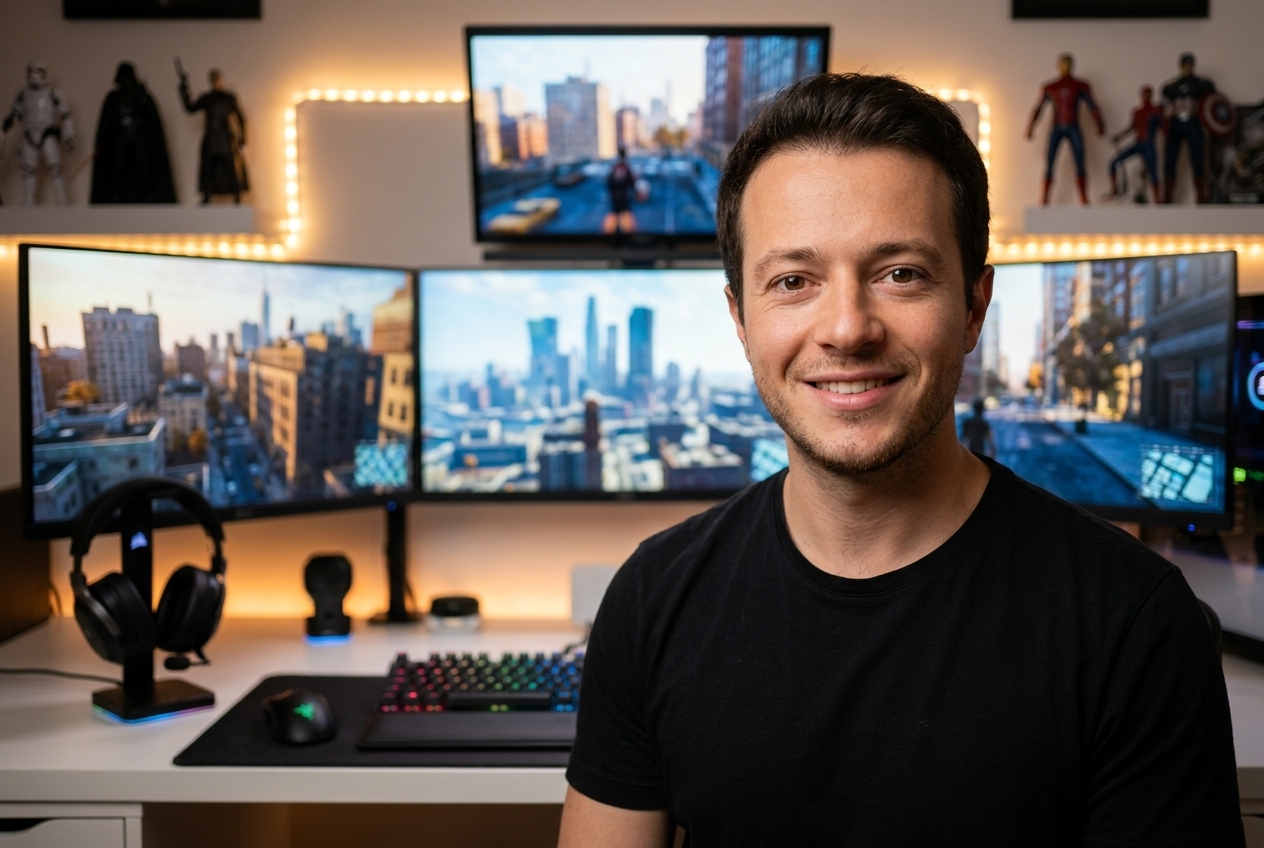
GTA 6 Extended Look Trailer Set for Netflix Premiere on August 27 — Plus the Week’s Biggest Gaming Stories
By Vito Ruocco | August 7, 2026 — It’s been an explosive week in gaming. From Rockstar finally giving fans what they’ve been waiting for, to EA’s historic $55 billion buyout going through, to Halo Studios layoffs and Call of Duty nostalgia driving 11 million sales in under a month, the industry is buzzing harder than it has all year. Here’s everything you need to know.
The Headliner: GTA 6 Gets an Extended Look Trailer on Netflix
Rockstar Games and Take-Two Interactive have officially announced that an “extended look” trailer for Grand Theft Auto 6 will premiere exclusively on Netflix on Thursday, August 27, 2026, at 3 PM ET (8 PM BST). The trailer will then be released on the official Rockstar Games YouTube channel and the GTA 6 website at 9 PM ET on the same day.
This marks a unique and surprising distribution strategy for one of the most anticipated entertainment products in history. Let that sink in for a moment: the biggest video game ever made is choosing to debut its most substantial trailer yet on a streaming platform. While Netflix has been steadily expanding its gaming footprint over the past few years — acquiring studios like Night School Studio (Oxenfree) and Boss Fight Entertainment, and even releasing titles like the FIFA World Cup game directly onto the platform — hosting a GTA trailer is an entirely new frontier for the streaming giant. It signals a deepening relationship between Netflix and the interactive entertainment space that could have far-reaching implications for how game marketing works in the future.
The timing of this reveal is anything but accidental. With GTA 6 slated for a November 2026 release according to multiple reports, fans have grown increasingly hungry for concrete gameplay details. The hunger has reached a fever pitch. At this point in the launch cycles of both Red Dead Redemption 2 and Grand Theft Auto 5, hands-on previews from gaming outlets had already gone live and journalists were publishing detailed impressions. Yet here we are, mere months before launch, and impressions of GTA 6 remain conspicuously absent from the public sphere. No preview events have been held. No extended gameplay has been shown beyond the original reveal trailer released back in December 2023. The information vacuum has been so severe that fan-made AI recreations of trailer footage have been circulating widely — content that Eurogamer’s Connor Makar aptly described as “dire AI slop.”
What exactly will this “extended look” contain? That’s the million-dollar question. The teaser does not explicitly confirm that raw gameplay will be shown, but the wording — “extended look” — strongly suggests more than just a cinematic montage. Industry speculation ranges from a full mission walkthrough to a showcase of the game’s open-world mechanics, character switching, and the much-anticipated modern-day Vice City setting. Given that GTA 6 is rumored to feature the series’ most detailed world yet, with unprecedented levels of interactivity and a story centered around the duo of Lucia and her male partner, fans are desperate to see how it all comes together in motion.
For those in different time zones planning their viewing parties: the Netflix premiere kicks off at 12 PM PT / 8 PM BST / 9 PM CEST, with the YouTube and website release following at 6 PM PT / 2 AM BST (August 28) / 3 AM CEST (August 28). Mark your calendars — this is arguably the biggest GTA reveal since the first trailer dropped back in late 2023. After nearly three years of waiting, the next chapter in the saga is finally coming into focus.
EA’s $55 Billion Buyout Goes Through — Mass Layoffs Expected
In what is arguably the single most consequential corporate event in gaming history, Electronic Arts has officially been acquired by a consortium led by Silver Lake, Saudi Arabia’s Public Investment Fund (PIF), and Affinity Partners (the private equity firm led by Jared Kushner, son-in-law of US President Donald Trump). The deal, first announced in September 2025, closed late last night after gradually clearing a series of regulatory hurdles including approvals from the European Commission and the United States’ Federal Trade Commission.
EA is now a privately held company. It will be delisted from the NASDAQ stock exchange, ending its run as a publicly traded entity that began in the 1990s. Shareholders — including employees who held stock — will receive $210 per share of EA common stock they own. EA CEO Andrew Wilson struck an optimistic tone in the official press release announcing the deal’s completion. “This moment recognizes the extraordinary people whose creativity, ambition and passion have made EA one of the world’s leading interactive entertainment companies,” Wilson said. “We’re entering this next chapter from a position of strength with partners who share our vision and ambition. Together, we’ll invest boldly, accelerate innovation, and build the next generation of games and experiences for the hundreds of millions of players and fans who inspire us every day.”
PIF Deputy Governor Turqi Alnowaiser added: “Entertainment and sports are key areas of strategic focus for PIF, and are among the fastest growing and evolving sectors around the world. Together, the Consortium is uniquely positioned to be a long-term partner to EA’s management team in driving sustained growth and innovation for EA and the industry.”
However, there is a darker side to this story that cannot be ignored. This acquisition is a leveraged buyout — and a record-breaking one at that. The purchase of EA has been partially financed with debt, meaning interest payments must be made every single year by the company’s new owners. EA has taken on $18 billion in debt, with annual interest payments of approximately $1.8 billion now an added cost the company must contend with. To put that in perspective: EA’s operating income in its most recent fiscal year was roughly $1.5 billion. The interest alone exceeds what the company was earning before the deal. Something has to give.
According to veteran games journalist Jason Schreier at Bloomberg, EA has already told debt investors that it will cut $700 million in annual costs, including $170 million in what the company is calling “organizational efficiencies” — a term that Schreier and many others interpret as meaning mass layoffs. Given that EA employs tens of thousands of people across studios worldwide, the human cost of these cuts could be staggering.
Executives have already begun implementing generative AI tools across the company’s studios in an effort to streamline production. Laura Miele, a senior EA executive, has publicly stated that she believes AI has led to a “real rise of creativity” among the publisher’s studios — a claim that many developers have met with skepticism, given that AI tools are often used to replace rather than augment human talent.
The acquisition has drawn sharp criticism throughout its approval process. Human rights organizations have raised concerns about Saudi Arabia’s record, questioning the ethics of one of the West’s largest game publishers falling under the control of a foreign sovereign wealth fund with a controversial track record. Critics have also pointed to Jared Kushner’s role and his connection to political power, questioning whether the deal received preferential treatment from regulators. Eurogamer’s Connor Makar noted that the question on many minds is: “What regulator is going to say no to the president’s son-in-law?”
What EA’s future looks like under private ownership is genuinely mysterious. The company will no longer need to release the same level of financial documentation it did as a publicly traded entity, making it harder for the public and press to hold it accountable. One thing is crystal clear: this is a milestone moment for one of gaming’s oldest and largest entities, and its ripple effects will be felt across Western game development for years to come.
Halo Studios Hit by Layoffs After Campaign Evolved Launch
Just one week after the release of Halo: Campaign Evolved — a project that reunified the Master Chief’s original trilogy campaign into a single, modernized experience — Halo Studios has been hit with layoffs. Multiple developers have taken to social media to announce their departures, painting a grim picture of an industry that continues to shed talent even after successful product launches.
Producer Nick Treitman shared the news on LinkedIn with a poignant message: “After 6.5 years working on Halo and dodging just as many rounds of layoffs — it has finally caught up to me. I have nothing but love for Halo and the folks at the studio, this is just a tough reality in the gaming industry right now.”
Paul Morris, a Scrum Master at Halo Studios, also confirmed his departure: “Today, I learned my time at Halo Studios will be coming to an end following the successful launch of our latest game, Halo: Campaign Evolved. I know this is one of the most challenging job markets our industry has seen, and I know the road ahead won’t be easy.”
The full extent of the layoffs remains unclear as of press time — Xbox did not immediately respond to requests for comment. However, these cuts are part of a much larger wave of reductions sweeping across Microsoft’s gaming division. Last month, Xbox announced 3,200 job cuts across the company and the studios it owns. 1,600 of those positions were eliminated immediately, while the remaining 1,600 were expected to be cut throughout Microsoft’s current financial year. Halo Studios, it seems, is one of the casualties of that ongoing restructuring process.
The timing is particularly cruel. Halo: Campaign Evolved has performed reasonably well both critically and commercially. The game reviewed largely positively among critics, with praise for how it modernized the classic Bungie-era campaigns while preserving what made them special. Alinea Analytics estimates that the game has sold through 212,000 copies on Steam, approximately 900,000 on Xbox (both console and PC), and roughly 351,000 units on PlayStation — the latter being a notably slow start on the competing platform. The game’s presence on Game Pass likely affects the number of direct sales on PC and Xbox, but it also means millions of subscribers can access and enjoy the title without purchasing it individually.
The Halo studio layoffs are a stark reminder that in today’s gaming industry, delivering a successful product is no longer enough to guarantee job security. As Microsoft restructures its gaming ambitions, even beloved franchises and their development teams are not immune to the bottom line.
Call of Duty: Black Ops 1 & 2 PS Ports Sell 11 Million Units in Under a Month
Nostalgia is a powerful force — and it’s also incredibly profitable. According to estimates from industry analytics firm Alinea Analytics, the recently released PlayStation ports of Call of Duty: Black Ops 1 and Black Ops 2 have sold a combined 11.2 million units across PS4 and PS5 since their mid-July launch.
Black Ops 2 was the clear audience favorite, selling a staggering 8.2 million copies compared to the original Black Ops’s 3 million. The generational split tells an important story about where the Call of Duty audience lives today: 93 percent of Black Ops 2’s copies were sold on PS5, with just 7 percent on PS4. The split for Black Ops 1 is nearly identical, with 94 percent on PS5 and only 6 percent on PS4. This data confirms that the PlayStation 5 install base is now mature enough to drive massive sales volumes even for re-releases.
The numbers are particularly impressive given the controversy that surrounded the ports at launch. Critics pointed to the lack of meaningful technical upgrades over the original Xbox 360 and PS3 titles — no ray tracing, no 120 FPS support, no significant visual enhancements beyond a resolution bump. The ports also continue to suffer from lobby hacking and exploiting, with players reporting instances of cheaters and account bans. None of that stopped millions of players from voting with their wallets.
So who exactly are these 11 million buyers? Alinea analyst Rhys Elliott provided fascinating demographic data. The audience skews heavily toward 30-40 year-old players who remember the originals from their teenage years. Looking at the top 10 games this same cohort plays provides additional context: 23 percent also bought the Black Ops 1 port — meaning they purchased both games. 19 percent have used the Call of Duty app where Warzone and modern COD titles live. 10 percent are Rainbow Six Siege players. Outside the shooter genre, 24 percent have played EA Sports FC 26, and 13 percent play NBA 2K26. The audience also overlaps heavily with Fortnite, Grand Theft Auto 5, Minecraft, and even Roblox.
Financially, the numbers are eye-watering. Alinea estimates that Microsoft has generated approximately $435 million in sales from the two games alone in under a month — about as much as Forza Horizon 6, one of Xbox’s biggest first-party launches, has made through game sales since its release.
The success of the Black Ops ports sends a clear message to every publisher sitting on a back catalog of beloved classics: the appetite for high-quality re-releases of beloved titles is enormous, especially when targeted at an aging player base with disposable income and fond memories.
PS5 Pro Gets a Major Boost: PSSR 2.0 Becomes Default in New Beta Firmware
Sony has released a new PS5 firmware beta that brings excellent news for PS5 Pro owners — and it addresses one of the most persistent criticisms of the premium console since its launch. The update makes PSSR 2.0 (PlayStation Spectral Super Resolution) the default upscaling technology for all games, rather than only those that have been specifically patched to support it.
To understand why this matters, we need to go back. The PS5 Pro launched with PSSR 1.0, Sony’s proprietary AI upscaling technology designed to compete with NVIDIA’s DLSS and AMD’s FSR. Reception was mixed at best. While the technology worked well in some titles, others suffered from blurry image quality, shimmering artifacts, and inconsistent performance. Digital Foundry’s analysis was particularly critical, noting that in several games, the image quality was actually worse than running at a lower native resolution with standard upscaling.
PSSR 2.0 debuted alongside Resident Evil Requiem in March 2026 and was widely regarded as a significant improvement over the original implementation. Image quality was sharper, artifacts were reduced, and performance overhead was lower. Since then, a growing number of games have adopted the updated technology. However, many titles in the PS5 Pro catalog were still running the older 1.0 version — creating an inconsistent experience where some games looked dramatically better than others for no apparent reason.
When PSSR 2.0 first arrived, Sony released a firmware update that gave PS5 Pro owners the option to force-toggle version 2.0 on at the console level, regardless of whether individual games natively supported it. This was a welcome solution, but it required users to know about the feature and manually enable it. Now, the new firmware beta makes PSSR 2.0 the default console-wide option — though users can still disable it if they encounter issues with specific titles.
The firmware beta also introduces the ability to turn off Bluetooth entirely, though this feature is only available in “certain countries or regions” for both PS5 and PS5 Pro. When Bluetooth is disabled, the console also turns off HDMI link functionality and Rest Mode. This may sound like a niche feature, but it’s actually a significant quality-of-life improvement for esports venues and competitive gaming setups where multiple consoles are present in close proximity. Turning off Bluetooth on nearby consoles makes it much easier to pair controllers and peripherals to the specific console a player wants to use, eliminating the signal interference and cross-pairing issues that have plagued tournament organizers for years.
The beta program is available in select regions, with codes circulating on Reddit for those who want to join. This update, combined with the steady stream of PS5 Pro-enhanced titles, suggests Sony is committed to refining its premium console experience — even if the launch was rockier than the company would have liked.
Baldur’s Gate 3 Turns Three: Larian Reveals Fascinating Player Statistics
It’s been three years since Larian Studios released Baldur’s Gate 3 and fundamentally changed the RPG landscape forever. To celebrate the anniversary, Larian released a deep dive into player statistics that reveals some truly surprising truths about the community — and about human nature.
The most-killed story NPC in the game is Zevlor, the argumentative tiefling leader from the Druid’s Grove who players encounter early in Act 1. If you’ve played the game, this probably makes sense — Zevlor is pushy, demanding, and stands between you and resolving the druid-tiefling conflict in a way that doesn’t sit well with many players. But the really fascinating stat involves a different character entirely.
Alfira the bard is the game’s most notable tragic figure for Dark Urge players. As a Dark Urge character, if Alfira visits your camp overnight, you are forced to murder her in her sleep. It’s a scripted, unavoidable event designed to show you exactly what kind of monster you’re playing as — a moment that Larian’s writing team has spoken about extensively in interviews. But here’s the twist: Larian revealed that more non-Dark Urge players have managed to murder Alfira than Dark Urge players. Non-Dark Urge players have no such compulsion — if Alfira dies at their hands, it’s a deliberate, conscious choice. Of the 2.62 million Alfira murders recorded, a higher proportion were committed by players who had no in-game reason to do so. As Larian cheekily put it: “Well, what rotters you are.”
Other statistics paint a vivid picture of how players approach the game. The most popular weapon in the final battle against the Netherbrain is the Gontr Mael bow, chosen by a staggering 33.4 million players — nearly 10 million more than the second-place Balduran’s Giantslayer greatsword. Gontr Mael is an Elven legendary bow that hits hard, applies Haste to the wielder, and has a chance to cast a powerful Guiding Bolt spell. It’s the ultimate ranged weapon for a game where positioning and action economy matter enormously.
A handful of players accumulated over 560 manual saves per playthrough — a number so high that Larian specifically called it out. Fewer than one percent of players managed to amass 180,000 gold in a single run, or spend more than 120,000 gold. “That’s roughly 24 naked statues bought from Stoney and Boney at the Circus,” Larian noted, referring to the eccentric vendors in the Circus of the Last Days.
Some of the most entertaining stats are the most niche: 114 people played the game in a square 1:1 screen ratio, presumably pretending it was a CRPG from the 1990s. More than 9,000 players — “it’s over 9000!” as Larian put it — played in a vertical 9:16 screen ratio, almost certainly on a second monitor while “working.”
Larian has since moved on from Baldur’s Gate 3 to develop its next project, simply titled Divinity. CEO Swen Vincke has confirmed it will be a turn-based RPG using a custom game system rather than Dungeons & Dragons rules. The studio has described the project as “Larian unleashed” — freed from the constraints of adapting someone else’s IP. Meanwhile, Wizards of the Coast is internally developing its own D&D game, an action-adventure title called Warlock, and speculation is mounting that Owlcat Games — the studio behind Pathfinder and Warhammer 40,000: Rogue Trader — might be in the running for Baldur’s Gate 4.
Capcom Goes All-Digital: 90% of Sales Now Digital as Physical Market Shrinks
Capcom has shrugged off any concerns about the industry’s accelerating shift toward digital distribution, revealing in a recent financial communication that approximately 90 percent of its unit sales are now digital. The publisher — responsible for franchises like Resident Evil, Monster Hunter, Street Fighter, and Devil May Cry — suggested that the shrinking physical market will not have a “significant impact” on its operations going forward.
This news comes as Capcom outlines an aggressive strategy to make Monster Hunter Wilds surpass Monster Hunter World’s legendary sales figures. World remains Capcom’s best-selling game of all time with over 25 million copies sold, and Wilds — which has already performed well at launch — needs to maintain momentum to reach that pinnacle. Capcom’s plan includes three key pillars: a generous demo to convert skeptics, a major expansion called Ascendance, and “pricing measures” that could include strategic discounts and bundle offers. With cross-platform play, a steady stream of free title updates, and strong word of mouth in the community, the potential is certainly there — but matching World’s once-in-a-lifetime success will require near-flawless execution.
Meanwhile, Capcom’s Resident Evil: Code Veronica remake has reached 2 million wishlists on Steam, signaling enormous pent-up demand for the revival of the series’ cult classic entry. Code Veronica has long been considered the “forgotten” classic of the survival horror franchise — originally released on the Dreamcast before being overshadowed by Resident Evil 4’s revolutionary approach. The remake is being built on Capcom’s proprietary RE Engine, the same technology behind the critically acclaimed Resident Evil 2, 3, and 4 remakes. If the wishlist-to-sales conversion is anywhere close to previous RE Engine remakes, Capcom has another multi-million seller on its hands.
Other Stories Worth Your Time This Week
Minecraft Switch 2 Release Date Confirmed: Mojang has finally announced a launch date for Minecraft on Nintendo’s new console, though the announcement came with a bittersweet note for original Switch owners — the upgrade path may not be as straightforward as many hoped. Players who already own Minecraft on the original Switch may need to repurchase the game for Switch 2, sparking debate in the community.
Gears of War: E-Day Beta Adds PvP: The upcoming weekend beta for Gears of War: E-Day has suddenly added PvP modes due to overwhelming fan demand. Originally planned as a PvE-only test, The Coalition listened to community feedback and will allow players to experience the game’s signature competitive multiplayer — complete with wall bouncing, active reloads, and chainsaw duels.
Marvel Rivals Shrinks Install Size: NetEase’s wildly popular superhero shooter is receiving a major update that “drastically reduces” the game’s install size on PC and console. “Our tech wizards have been hard at work forging solutions,” the developer said, addressing one of the most common complaints about the game since its launch.
Roblox Continues to Struggle: The platform’s player numbers continue to plummet alongside its stock price following disappointing Q2 2026 earnings. Once a Wall Street darling, Roblox is facing increasing competition from Fortnite’s UEFN, Minecraft’s expanding creative tools, and an increasingly skeptical investor base.
Diablo 4 Season 15 Adds Rebirth Feature: Blizzard has finally addressed one of the most requested features from the Diablo 4 community — the ability to bring Eternal (non-seasonal) characters into the Seasonal realm. While the implementation has caveats, it’s a step toward bridging the gap between the game’s two core progression systems.
Game Freak Promises Fixes for Beast of Reincarnation: Following a divisive launch, the Pokémon developer has publicly committed to listening to feedback and planning patches for story pacing, difficulty balancing, and technical performance issues. “We take your feedback to heart,” the studio said.
Looking Ahead: August 2026 Is Shaping Up to Be a Pivotal Month
As we settle into the second week of August, the gaming calendar is absolutely stacked. The GTA 6 extended look on August 27 will undoubtedly dominate headlines and social media feeds, but the EA buyout will have structural ripple effects across the industry for years to come — affecting everything from how games are funded to how they’re made to who ultimately controls the IP we love.
The contrast between the stories this week is striking. On one hand, we have astonishing consumer demand driving 11 million sales of re-released decade-old games in under a month. On the other, we have Halo Studios developers losing their jobs a week after shipping a successful product. The games industry has never been bigger, never generated more revenue, and never been more volatile for the people who actually make the games.
With PS5 Pro’s PSSR 2.0 maturing into a genuinely competitive upscaling solution, Capcom going all-digital, Baldur’s Gate 3 still generating conversation three years after launch, and the promise of GTA 6 gameplay on the horizon, there is an incredible amount to be excited about — and an incredible amount to be concerned about. That’s the state of gaming in 2026.
As always, we’ll be here to break it all down. Stay tuned for our full coverage of the GTA 6 extended look trailer on August 27, and in the meantime, check back daily for the latest updates on all the stories above.
— Vito Ruocco, covering the biggest stories in gaming. August 7, 2026.