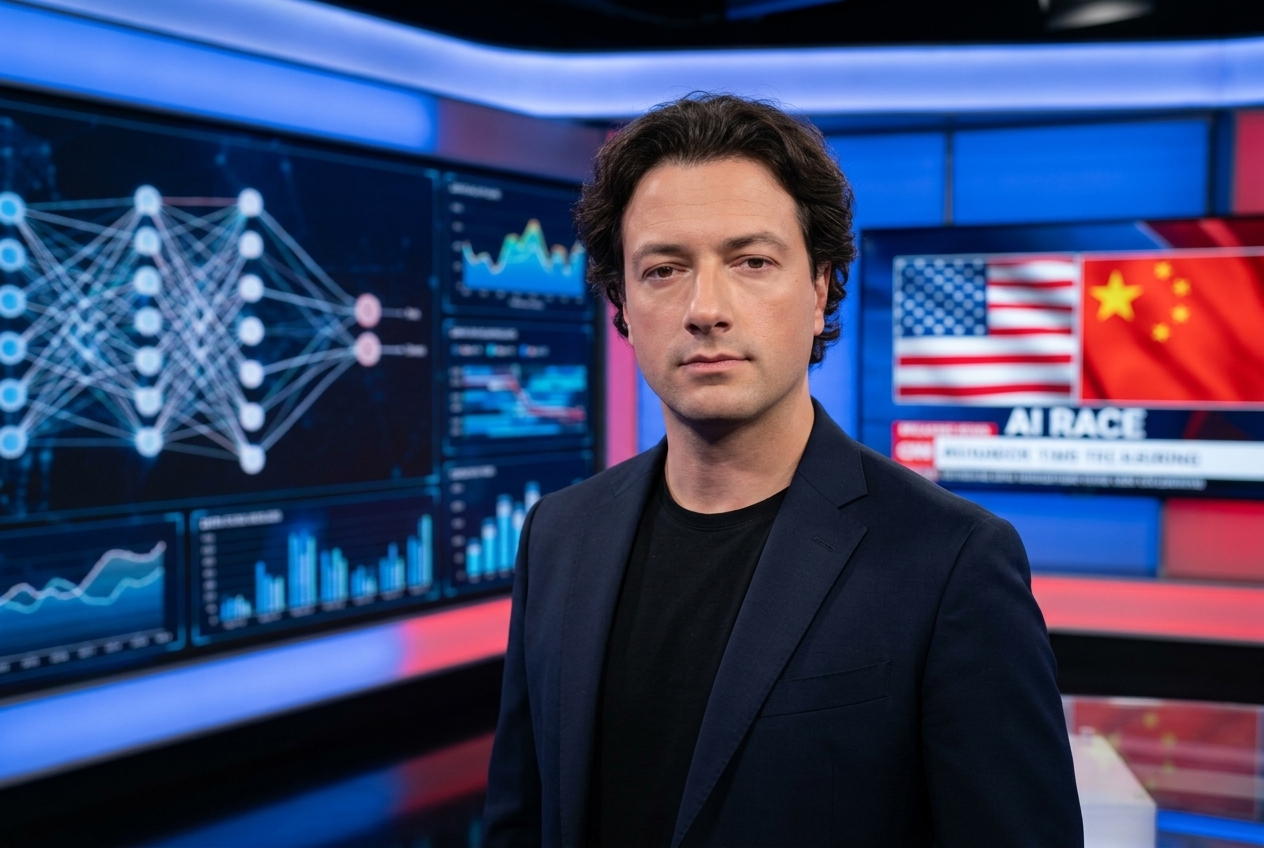
China’s AI One-Two Punch: Moonshot Kimi K3 and Alibaba Qwen3.8 Challenge US Dominance
July 23, 2026 — In a single weekend, two Chinese tech firms unveiled AI models they claim rival the best from OpenAI and Anthropic. The White House is crying foul over restricted chips. The head of US AI safety just quit. Welcome to the new AI Cold War.
For years, the United States held a comfortable lead in the global artificial intelligence race. OpenAI, Anthropic, Google — these were the names that defined the frontier. That lead is gone, or at the very least, it is hanging by a thread. Over the past 72 hours, Beijing-based Moonshot AI and Chinese e-commerce giant Alibaba both unveiled models they claim can go toe-to-toe with America’s most advanced AI systems — and they are giving them away for free.
This is not just another product launch. It is a geopolitical earthquake that has sent shockwaves through Silicon Valley, Washington D.C., and capitals around the world. The implications stretch far beyond benchmark scores and parameter counts. They touch on national security, export controls, the future of open-source AI, and the fundamental question of whether America’s multi-billion-dollar bet on AI supremacy can actually hold.
Moonshot’s Kimi K3: The World’s Largest Open-Source AI Model
The opening salvo came on Friday, when Moonshot AI unveiled Kimi K3, which the company describes as the world’s largest open-source AI system. At a staggering 2.8 trillion parameters, Kimi K3 is a behemoth that Moonshot claims consistently ranks above nearly every U.S. system in internal testing — trailing only OpenAI’s GPT-5.6 Sol and Anthropic’s Claude Fable 5, while actually surpassing them on certain benchmarks.
Parameter counts are a rough measure of a model’s complexity during training. While bigger does not always mean better, 2.8 trillion parameters puts Kimi K3 in a class of its own among open-source models. For context, Meta’s Llama series — previously the gold standard for open-source AI — has been orders of magnitude smaller.
Moonshot says it will release the full model weights — the internal numerical values learned during training — on July 27th. Once those weights are public, developers worldwide will be able to download, modify, and build upon Kimi K3 freely. This is a stark contrast to the approach of U.S. labs like OpenAI and Anthropic, whose most advanced systems remain tightly guarded proprietary black boxes.
- Parameters: 2.8 trillion (largest open-source model ever)
- Claimed ranking: Above nearly all U.S. systems, behind only GPT-5.6 Sol and Claude Fable 5
- Release date: Full weights available July 27, 2026
- License: Open-source (free to download and modify)
Alibaba’s Qwen3.8: A Trillion-Parameter Follow-Up
If Moonshot’s announcement was a punch, Alibaba’s was the follow-up uppercut. Over the weekend, the Chinese tech giant previewed Qwen3.8, a 2.4 trillion parameter model that the company calls “one of the most powerful models available today” and “second only to Fable 5,” Anthropic’s flagship system.
Alibaba describes Qwen3.8 as “continuously evolving” — suggesting the model will receive ongoing updates rather than being a static release. The company says the model is “going open-weight soon,” though it has not specified an exact date.
The back-to-back releases from two of China’s leading AI firms send a clear message: China is not merely catching up to the United States in AI — it is attempting to leapfrog it by combining frontier-level capabilities with an open-source philosophy that the U.S. establishment has largely rejected.
The White House Accusation: Restricted Nvidia Chips in Thailand
While Chinese labs were showing off their new models, the White House was leveling serious accusations. Michael Kratsios, director of the White House Office of Science and Technology Policy, took to X (formerly Twitter) to accuse Moonshot of training Kimi K3 using Nvidia’s restricted GB300 processors — chips that are subject to strict U.S. export controls.
According to Kratsios, Moonshot accessed these high-end chips in Thailand, circumventing the export control regime that Washington has spent years building. The accusation is explosive: if true, it would mean one of China’s leading AI companies trained its most advanced model using American technology that was explicitly denied to it.
Kratsios further accused Moonshot of distilling Anthropic’s Fable AI model — essentially using outputs from Anthropic’s proprietary system to train Kimi K3. This practice, known as “knowledge distillation,” allows a newer model to learn from an older one by mimicking its outputs. It is technically legal in most jurisdictions but ethically contentious, particularly when the source model is proprietary.
The accusation adds fuel to an already blazing fire. U.S. export controls on advanced AI chips were designed specifically to slow China’s AI development. If those controls can be circumvented through third countries like Thailand, the entire regulatory framework may need to be rethought.
US AI Safety Leadership in Disarray
As if the Chinese AI surge was not enough, the United States is also dealing with internal leadership chaos. On July 20th, Chris Fall, the head of the Center for AI Standards and Innovation (CAISI), resigned after just three months on the job. CAISI — part of the Department of Commerce — is the agency tasked with helping the government test and evaluate commercial AI systems.
Fall’s departure adds to a growing vacuum in U.S. AI policy leadership. David Sacks, the venture capitalist who served as Trump’s White House AI and crypto czar, stepped down in March and has yet to be replaced. The reasons for Fall’s resignation remain unclear, but his exit comes at a particularly sensitive moment — exactly when Chinese open-source models are gaining traction against proprietary U.S. systems.
Arvind Raman, director of the National Institute of Standards and Technology, will serve as acting director of CAISI. But the optics are terrible: the U.S. is losing the people responsible for understanding and regulating AI at the exact moment its primary geopolitical rival is surging.
The Trump Administration’s Response: “Genesis Mission” and “Gold Eagle”
The Trump administration has not been idle. On July 22nd, the White House announced hundreds of “Genesis Mission” AI science projects — a push to use AI itself to solve problems including the soaring energy demands of AI data centers. The initiative revealed “more than $5 billion in Federal commitments” across 278 awards and 342 institutions.
Big tech companies have lined up to support the effort. Microsoft announced millions in compute and AI credits, and Google committed $40 million to accelerate scientific discovery through the Genesis Mission. However, the initiative has drawn criticism for potentially redirecting research funds away from large universities and toward individual fellowships, giving political appointees more power over grant decisions.
Separately, the White House launched a clearinghouse called “Gold Eagle” — a cybersecurity initiative that puts the government in charge of greenlighting which companies can access cutting-edge AI models. Gold Eagle has already begun “intake and prioritization of identified cybersecurity vulnerabilities” and “coordinate scanning verifications.” CAISI was supposed to play a central role in this process, making Fall’s resignation even more consequential.
The administration has also been flexing its muscles on model releases. In June, OpenAI agreed to limit the rollout of its GPT-5.6 model series to “trusted partners” at the government’s request. Weeks earlier, Anthropic was forced to disable access to its Fable 5 and Mythos 5 models to comply with a Commerce Department export control directive. Both companies later managed to release their models more broadly, but the message was clear: the U.S. government now considers advanced AI models a national security asset subject to export controls.
Amazon Cuts Jobs on AGI Team
The turbulence is not limited to government. Amazon confirmed that it is “eliminating some roles within parts of our AGI [artificial general intelligence] organization” as the company focuses on “initiatives that matter most for customers.” The company did not disclose how many workers are affected, but the cuts suggest that even the largest tech companies are feeling pressure to rationalize their AI investments.
Amazon’s AGI team was established to pursue the holy grail of artificial intelligence — systems that can match or exceed human intelligence across all domains. The fact that Amazon is trimming that team, even as Chinese competitors are releasing trillion-parameter models, raises questions about whether the U.S. private sector is as committed to the AI frontier as it appears.
The Open-Source Divide: A Strategic Choice
Perhaps the most significant aspect of the Chinese AI surge is the open-source strategy. Both Moonshot and Alibaba are emphasizing a key difference from U.S. labs: rather than locking their most advanced models behind closed doors and API paywalls, they are making them publicly available for anyone to download, modify, and deploy.
This is not charity. It is a calculated strategic move with multiple dimensions:
- Developer adoption: By making models freely available, Chinese labs are building a global developer base that is invested in their ecosystem. Developers who build on Kimi K3 or Qwen3.8 are less likely to switch to U.S. alternatives.
- Soft power: Open-source models from China are being used by researchers and companies in Europe, Africa, Southeast Asia, and Latin America. Each download is a tiny node of Chinese technological influence.
- Standards-setting: When Chinese models become the default open-source standard, Chinese companies gain outsized influence over how AI is developed, deployed, and regulated globally.
- Information asymmetry: U.S. labs keep their training data and methods secret. Chinese open-source releases force a conversation about transparency — even as China itself remains opaque about how these models were actually trained.
The contrast with the U.S. approach is stark. OpenAI, Anthropic, and Google have all moved toward increasingly closed systems, citing safety concerns and competitive pressure. The Trump administration’s export controls have reinforced this trend by treating advanced models as national security assets. But this closed approach may be costing the U.S. the one thing it needs most: developer mindshare.
The Copyright Time Bomb: Anthropic’s $1.5 Billion Settlement
While U.S. labs defend their closed approach, they are also facing massive legal consequences for how they trained their models. On July 21st, a federal U.S. judge granted final approval of Anthropic’s landmark $1.5 billion class-action settlement with authors who sued over the training of Claude using copyrighted works.
This is thought to be the largest copyright recovery case in history. Authors will be paid “as promptly as possible” — after lawyers take their $101 million cut. The settlement sets a precedent that could expose other AI companies to similar claims, potentially reshaping the economics of AI model training.
The irony is sharp: U.S. companies trained on copyrighted data without permission, are being forced to pay billions in damages, and are still keeping their models closed. Chinese companies are training on — well, nobody knows exactly what — and are giving their models away for free. The strategic asymmetry is not lost on observers.
AI-Generated Content Floods Platforms
The consequences of accessible AI are becoming visible across the digital landscape. Deezer, the music streaming platform, reported that AI-generated music now makes up half of all daily song uploads — nearly 90,000 AI-generated tracks per day, up from 75,000 in April. The platform has begun taking down AI tracks “used to generate fraudulent streams,” as well as those that haven’t been streamed in six months or more.
Meanwhile, Apple’s App Store saw apps added nearly double to approximately 560,000 in the first half of 2026, compared to about 600,000 in all of 2025. Sensor Tower attributes the surge to AI making it trivially easy to develop apps. The flood of “vibecoded” apps — software generated by AI with minimal human oversight — is overwhelming Apple’s review process and raising concerns about quality and security.
The open web is also under siege. The New York Times has officially recognized “Google Zero” — the phenomenon where Google’s AI summaries keep users inside Google’s ecosystem rather than sending traffic to external websites. Film database site The Numbers, a 30-year-old resource, was effectively destroyed by AI scraping combined with the loss of search referral traffic. As one observer noted: “The machines are taking both the content and the readers at an industrial scale.”
Reddit May Cut Ties with Google
The collateral damage of the AI revolution is spreading to some of the internet’s most established platforms. Reddit has discussed shutting off Google’s access to data used to train its Gemini AI models, according to The Wall Street Journal. With AI-generated answers to queries reducing clicks to outside websites, Reddit executives are questioning the value of continuing to feed content to Google for a $60 million-a-year deal that is coming to an end.
Whether this is a genuine strategic pivot or a renegotiation bluff, it signals a fundamental shift in the power dynamics of the internet. Content providers are no longer willing to be the free training data for AI systems that ultimately replace them. Expect more platforms to follow Reddit’s lead.
The Big Picture: A Narrowing Lead
Taken together, the events of the past week paint a picture of an AI industry at an inflection point. The U.S. lead, once assumed to be insurmountable, is looking increasingly fragile. China is not only producing competitive models — it is producing them at a fraction of the cost, making them freely available, and potentially doing so using restricted American technology.
The question that U.S. policymakers and tech leaders must now grapple with is uncomfortable: Can the closed, proprietary, heavily regulated American approach to AI actually compete with an open-source Chinese alternative that is free, capable, and globally distributed?
The answer may determine not just the future of the technology industry, but the balance of geopolitical power for decades to come. As Robert Hart wrote in The Verge, the Chinese releases “have shaken up the industry in a way not seen since DeepSeek unveiled a low-cost model last year that rivaled leading U.S. systems.” This time, however, the models are not just cheap — they are open, massive, and backed by two of China’s largest tech companies.
The AI Cold War is no longer hypothetical. It is here, and the first battle is being fought not with missiles or sanctions, but with parameters, weights, and open-source licenses. Whether America’s multi-billion-dollar bet on closed AI can hold against a flood of open Chinese alternatives is the defining technology question of 2026.
One thing is certain: the next time someone tells you the U.S. is winning the AI race, you might want to check who’s giving their models away for free.
This article was published on July 23, 2026. Sources include The Verge, CNBC, The Wall Street Journal, Axios, and official statements from Moonshot AI, Alibaba, the White House Office of Science and Technology Policy, and the U.S. Department of Commerce.