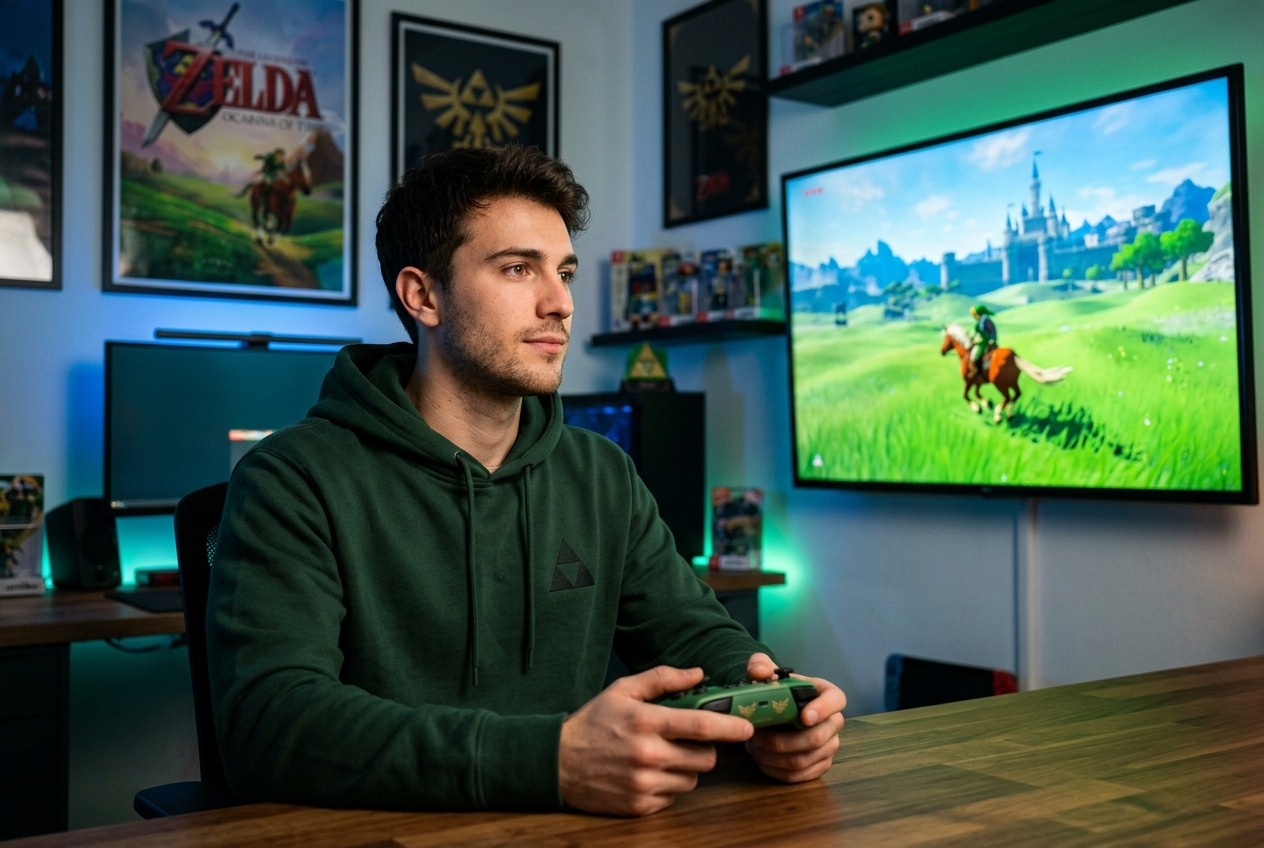
Zelda at 40: Ocarina of Time Remake Gameplay Revealed, Live-Action Film Teased, and a New Era for Hyrule Dawns
Published: September 9, 2026 — by Vito Ruocco
Introduction: The Day Hyrule Stood Still
Yesterday marked a historic moment for gaming. Nintendo dedicated an entire Direct broadcast to celebrating the 40th anniversary of The Legend of Zelda — one of the most beloved and culturally influential franchises in interactive entertainment history. What unfolded was nothing short of extraordinary: a full gameplay reveal of the long-awaited Ocarina of Time remake for Switch 2, first glimpses of the live-action Zelda film, a special edition Switch 2 console, a global orchestral tour, Lego collaborations, and much more. The Zelda 40th Anniversary Nintendo Direct, which aired on September 8, 2026, delivered on decades of fan anticipation and set the stage for what looks to be the most expansive year Hyrule has ever seen.
From its humble 8-bit beginnings in 1986 to its current status as a pillar of global pop culture, The Legend of Zelda has sold over 160 million copies worldwide across dozens of entries. The 40th Anniversary Direct was Nintendo’s love letter to fans — and a roadmap for the franchise’s future.
Ocarina of Time Remake: A Faithful Reimagining with Modern Soul
The show’s centerpiece was undoubtedly the first proper gameplay reveal of The Legend of Zelda: Ocarina of Time remake for Nintendo Switch 2. After its controversial teaser earlier this year — which left fans divided over the semi-realistic art style — Nintendo finally pulled back the curtain on what producer Eiji Aonuma called “a faithful recreation with modern sensibilities.”
From the footage shown, the remake appears to retain the core structure and progression of the original 1998 masterpiece while rebuilding it entirely from the ground up. The new engine delivers a moody, misty, fairytale atmosphere unlike any Zelda game before it. Classic animations — the famous chest-opening sequence, Link’s iconic sword swings — have been faithfully recreated, but everything is layered with richer textures, dynamic lighting, and volumetric fog that gives Hyrule Field a hauntingly beautiful depth.
Key new features shown during the Direct include:
- Manual Jumping: Link can now leap, swim, and dive underwater with full manual control, opening up exploration possibilities far beyond the original.
- Real-Time Day/Night Cycle: Time of day now progresses naturally across the entire world, not just in specific areas, affecting enemy behavior and NPC schedules.
- Full Voice Acting: All cutscenes are fully voiced — a first for an Ocarina of Time experience, and one that drew the strongest reactions from fans online.
- New Hyrule Castle Town Areas: Previously closed-off sections of Castle Town are now explorable, adding new side quests and lore.
- Ocarina Humming Feature: Perhaps the most inventive addition — players can hum, whistle, or sing into the Switch 2’s microphone to play ocarina tunes, eliminating the need for button combos.
- Dash Mechanic: A sprint button allows faster traversal across Hyrule’s expansive fields.
- Item Swapping: Quick-swap between items with a single button press, modernizing the original’s cumbersome menu system.
The remake also introduces a companion app called Zelda Notes, available through the Nintendo Switch app. It allows players to take screenshots, embark on mini-quests of discovery for points, create custom ocarina tracks, and test their knowledge with Zelda trivia quizzes.
Nintendo has confirmed the game retains loading screens between major areas — a deliberate design choice to preserve the feel of the original. “The loading screens are part of the memory,” Aonuma explained during the presentation. “Removing them would change the rhythm of the adventure.”
Release Date: November 5, 2026 — exclusively on Nintendo Switch 2.
The Legend of Zelda Film: No Subtitle, No Trailer, All Mystery
Fans hoping for a full trailer of the upcoming live-action The Legend of Zelda film left the Direct slightly disappointed — but not empty-handed. Nintendo and Columbia Pictures revealed that the film will simply be titled The Legend of Zelda, with no subtitle or episode number. Series creator Shigeru Miyamoto explained during the Direct that “when you see the film, you’ll understand why there’s no subtitle,” teasing that the narrative draws from the entire 40-year history of the franchise rather than adapting any single game.
Directed by Wes Ball (Kingdom of the Planet of the Apes, The Maze Runner), the film stars Benjamin Evan Ainsworth as Link and Bo Bragason as Princess Zelda, with the late Sam Neill appearing in one of his final roles. Production wrapped filming in New Zealand in early 2026, with the shoot having begun in October 2025. The film is set for theatrical release on April 30, 2027, and will later stream on Netflix at an undisclosed date.
The film borrows heavily from the visual aesthetic of Breath of the Wild and Tears of the Kingdom, with location scouting that took the production team through New Zealand’s most dramatic landscapes — echoing the journey of the Lord of the Rings films that previously used the country as Middle-earth.
While no trailer was shown, Miyamoto did pose an intriguing question to fans: “What role do you think the Triforce will play?” — suggesting the golden triangle will be central to the film’s plot.
Nintendo Switch 2 — The Legend of Zelda 40th Anniversary Edition
Nintendo also unveiled a stunning Zelda 40th Anniversary Edition of the Switch 2 console, available from October 29, 2026. The limited-edition hardware features green-tinted Joy-Cons inspired by Link’s tunic, with a triangular golden pattern etched into the back of the console that evokes the glow of the Triforce. The package also includes a matching Pro Controller with the same Triforce-inspired design and a premium carrying case.
The announcement comes alongside the news that a separate EU-compliant revision of the Switch 2 is already hitting shelves, featuring a user-replaceable battery in accordance with the EU’s Right to Repair directive. The revised model has a slightly smaller battery (reduced by approximately 48 mAh) and weighs 14 grams more than the launch model, but the trade-off is significantly easier access to internal components — with visible screws in the Joy-Con rails replacing the hidden, sticker-sealed fasteners of earlier units.
Zelda 40th Anniversary Concert Tour: A Symphony of Hyrule
Nintendo announced a global orchestral tour celebrating four decades of Zelda music, beginning January 23, 2027 in Tokyo, Japan, before heading to North America, Europe, and Australia. The UK leg includes a London date on April 3, 2027. The tour will feature performances of iconic themes spanning from the original 1986 overworld theme to the sweeping orchestral works of Breath of the Wild and Tears of the Kingdom.
The concert is part of a larger wave of Zelda-themed events planned throughout 2027. Additionally, Nintendo showcased a range of collectibles and merchandise, including a 1,750-piece Lego Link & Epona set arriving in spring 2027, a 27-inch electronic Master Sword from Hasbro featuring 15 touch- and motion-activated sound effects, an officially licensed playable ocarina from Hori, and two new amiibo figures based on the Ocarina of Time remake’s Young Link and Young Zelda.
Meanwhile, Elsewhere in Gaming: GTA 6, Don’t Nod, and Industry Shifts
While Zelda dominated the headlines, several other major stories broke this week. Grand Theft Auto 6 worldwide unlock times were officially revealed, confirming the game arrives on November 19, 2026 for PlayStation 5 and Xbox Series X/S. The New Zealand trick — changing your console’s region to NZ to play early — reportedly still works on Xbox, while PS5 unlock times are tied to account regions, with up to 19 hours of difference between the earliest and latest launches.
In less cheerful news, Don’t Nod, the studio behind Life is Strange, announced a restructuring plan that “may result in the reduction of up to 90 positions.” The studio warned it may not survive beyond January 2027 unless external financing is secured — a stark reminder of the ongoing turbulence in the gaming industry, where even celebrated developers face existential threats.
On the hardware front, Valve reportedly made £11 billion from Steam in 2026 alone, with Forza Horizon 6 being the biggest new arrival on the platform. Meanwhile, Nvidia’s DLSS 5 technology came under fire as experts tested its new features and found significant frame-rate penalties, with one analyst calling it “a really expensive way to add nice lighting detail.”
And in a massive leak, Steam achievement lists for Persona 6 and Kingdom Hearts IV surfaced online, essentially confirming both titles are heading to PC — though neither publisher has officially commented.
Fan Reactions: The Internet Speaks
The Zelda Direct triggered a firestorm of reactions across social media. The Ocarina of Time remake’s visual direction — described by some as “Unreal Engine Zelda” — drew the most polarized responses. On Eurogamer, the article covering the reaction racked up over 110 comments within hours, with users debating whether the moody, realistic aesthetic captures the spirit of the original or strays too far from the classic cel-shaded charm.
“Dawg it’s Unreal Engine Zelda,” one commenter wrote, capturing the sentiment of those who felt the remake leaned too heavily into modern technical fidelity at the cost of the original’s stylized soul. Others praised the direction, calling it “the Zelda remake we’ve dreamed of since the GameCube tech demo.” The full voice acting was a particular flashpoint — for every fan excited to hear Link speak properly, another mourned the loss of the iconic “HYAAAH!” and “HUP!”
The Zelda Notes companion app and the ocarina humming feature were near-universally praised, with many calling the microphone-based song mechanic “the most Nintendo thing ever.”
The Remake’s Technical Foundation: Unreal Engine and a New Visual Language
One of the most fascinating aspects of the Ocarina of Time remake is its technical underpinnings. While Nintendo has not officially confirmed the engine, multiple sources familiar with the project have indicated that the remake runs on a heavily customized version of Unreal Engine 5 — a significant departure from Nintendo’s in-house engines used for Breath of the Wild and Tears of the Kingdom. This explains the game’s dramatically different visual presentation: realistic material rendering, Nanite-powered geometry, and Lumen-driven global illumination give Hyrule an unprecedented level of detail.
The original N64 classic ran on a custom 64 MB cartridge with 4 MB of RAM. The Switch 2 remake, by contrast, leverages the console’s custom Nvidia Tegra chip with advanced ray tracing capabilities, delivering 4K resolution in docked mode and 1080p in handheld mode at a targeted 60 frames per second. While the Direct footage appeared to run at a smooth 30 FPS, Aonuma confirmed that performance optimization is ongoing and that a 60 FPS mode is planned for launch.
The audio has also received a complete overhaul. While the original’s MIDI-based soundtrack holds a special place in fans’ hearts, the remake features a fully reorchestrated score recorded with a live symphony orchestra at Abbey Road Studios in London. Koji Kondo, the original composer, returned to supervise the new arrangements. “The music of Hyrule is timeless,” Kondo said in a statement shared during the Direct. “But hearing it performed by human hands and breath adds a dimension we could never achieve in 1998.”
Battle mechanics have seen subtle but meaningful updates. Lock-on targeting (Z-targeting) — a mechanic that Ocarina of Time essentially invented — has been refined with smoother camera transitions and optional gyro-assisted aiming for projectile weapons like the bow and hookshot. New enemy AI patterns keep veterans on their toes without alienating newcomers. Boss fights like Ganondorf’s castle showdown and the iconic confrontations with Phantom Ganon and Twinrova have been redesigned with additional phases that draw on the lessons of modern action games.
Zelda at 40: A Franchise Retrospective
The 40th anniversary milestone invites reflection on how far the series has come. The Legend of Zelda debuted in February 1986 for the Famicom Disk System in Japan (later arriving on the NES in North America that summer). Created by Shigeru Miyamoto and Takashi Tezuka, the original game was groundbreaking — a non-linear, open-world action-adventure that encouraged exploration, experimentation, and discovery. Its gold cartridge on the NES became an icon.
Since then, the series has seen over 20 mainline entries spanning every Nintendo console. From the top-down perspective of A Link to the Past (1991) to the 3D revolution of Ocarina of Time (1998), the cel-shaded charm of The Wind Waker (2002), the dark maturity of Twilight Princess (2006), the motion-controlled innovation of Skyward Sword (2011), and the open-air freedom of Breath of the Wild (2017) — each iteration has redefined what an adventure game can be.
Breath of the Wild alone sold over 30 million copies, while its sequel Tears of the Kingdom surpassed 25 million, making them the best-selling Zelda games by a wide margin. The franchise as a whole has sold over 160 million units worldwide, ranking it among the most successful gaming series of all time — behind only Mario, Pokémon, Call of Duty, and Grand Theft Auto in overall sales.
The live-action film, if successful, could push Zelda into even rarer territory: a video game adaptation that breaks the Hollywood curse. With Wes Ball’s track record, an A-list production team, and Nintendo’s notoriously hands-on approach to licensing, hopes are higher than they’ve been for any previous game-to-film attempt.
Other Gaming Headlines from September 9, 2026
Beyond the Zelda earthquake, the gaming world continues to spin with major developments:
- Battlefield 6 Redsec is borrowing Call of Duty: Warzone’s Resurgence mode, rebranding it as “Rapid Royale” — a faster, respawn-enabled battle royale variant. EA’s shooter franchise is clearly looking to recapture the momentum it lost in recent years.
- Forza Horizon 6 remains on track for PS5 release this year, Xbox confirmed, even as the company walks back some of its multi-platform publishing strategy. The game was also revealed as Steam’s biggest new revenue generator of 2026, contributing to Valve’s reported £11 billion annual haul.
- Onimusha: Way of the Sword has already sold over one million copies, marking a triumphant return for Capcom’s feudal demon-slashing series after nearly two decades.
- Civilization 7 is getting its first paid expansion, Earthrise, introducing an atomic age and new victory conditions — a welcome sign that Firaxis is committed to long-term support after the game’s rocky launch in 2025.
- SEGA’s president made a surprising admission: an increasing number of fans have never actually played SEGA games, instead experiencing them through streamers and content creators. The comment underscores how dramatically gaming consumption has shifted in the streaming era.
- Xbox Game Pass Ultimate is introducing a 15-hour monthly cloud gaming cap, though existing members in certain countries are exempted — at least for now.
- Riot Games co-founder Marc Merrill spoke about the company’s in-development MMO (codenamed “The Grail”) following the cancellation of 2XKO, promising that “many a brave knight are going to die” in the studio’s quest to deliver a worthy MMORPG.
- Tetris Company publicly condemned a White House “Build the Wall” game that allegedly infringes on Tetris intellectual property, stating “we take copyright infringement very seriously.”
Looking Ahead: What’s Next for Zelda?
This week’s Direct was the first of two planned Nintendo showcases — a second Direct is expected later this week, though its contents remain unannounced. Speculation suggests it could cover other Nintendo franchises, but the Zelda team made clear that 2026 and 2027 represent the most content-rich period in the franchise’s history.
With the Ocarina of Time remake launching in just under two months, the live-action film arriving in April 2027, a concert world tour, collectible merchandise, and rumored future projects — including the possibility of additional remakes (Persona series producer recently hinted that Persona 1 and 2 remakes are “something we’ll probably eventually do,” and similar logic could apply to Majora’s Mask) — Hyrule has never been busier.
The Zelda franchise has survived and thrived across four decades, three home console generations, and two handheld eras. At 40 years old, it’s not slowing down — it’s reimagining its past while charging toward the future. And for millions of fans around the world, that’s the greatest gift the anniversary could bring.
The week isn’t over yet. Nintendo has confirmed a second Direct later this week — rumors suggest it may cover the 40th anniversary of another beloved franchise, potentially Metroid. For Zelda fans specifically, the Ocarina of Time remake’s launch on November 5 will be followed by the live-action film in April 2027, the concert world tour beginning in January, the Lego Link & Epona set in spring, and the distinct possibility of further announcements at The Game Awards in December.
Speculation around a Majora’s Mask remake — which would logically follow Ocarina of Time’s treatment — continues to simmer. The Steam achievement leak that includes Persona 6 and Kingdom Hearts IV also points to an industry-wide shift toward transparency about PC ports, raising hope that older Zelda titles might finally find their way to PC through official Nintendo channels — though no such plans have been announced.
One thing is certain: 2026 and 2027 will be remembered as the years Hyrule conquered the world — on the screen, on the stage, on the big screen, and in the hands of millions of players old and new. At 40, Zelda isn’t just celebrating its past. It’s building its future.
As originally published on Ruocco.it — September 9, 2026.