Published: October 12, 2026 | By Vito Ruocco
Is Anthropic quietly sending some Claude Opus 5.5 requests to a newer, unannounced model? That is what a wave of posts on X said over the weekend, and the proof being shared was striking: animations, scenes and films drawn entirely by JavaScript. I went through every claim I could verify, ran the famous identification test myself, and then did the only fair thing: I gave Claude Opus 5.5 and GPT-6.1 Sol the same six creative-code prompts and used all twelve results live. You can play every one of them in your browser.
The Short Version
- **The Opus checkpoint is a rumor.** Posters say that at least 50 percent of Claude Opus 5.5 requests are being routed to a better model. Anthropic has not confirmed anything. The most honest line in the whole thread comes from the poster who shared the first animation: the model “can be Fable 5.5 or new Opus, I have no idea”.
- **My own VoxelBench check is a faint signal at best.** Through the API, Claude Opus 5.5 described the benchmark vaguely in 3 of 10 runs. Claude Opus 5, GPT-6.1 Sol and Claude Fable 5.1 did it in 0 of 13. Small sample, no access to the app’s routing, and the name gives half the answer away.
- **Same six prompts, two models.** GPT-6.1 Sol ran all six builds on the first try. Claude Opus 5.5 shipped two files that did not run, and each needed a one-line fix that I marked everywhere.
- **Cost.** The six Opus builds cost about 2.69 dollars. The six Sol builds cost about 0.77 dollars. The leaked life animation, in its author’s own words, took 27 million tokens and two hours at maximum effort.
- **Everything else in the news cycle** is covered below with what is verified and what is not: Karpathy’s “funnel” post, the 500K default context in Codex, Google’s Gemini 4 Argon and its rumored Barium-B checkpoint, and a handful of smaller stories.
Why Karpathy’s post explains the whole week
Before the leaks, the post that frames them. Andrej Karpathy dusted off a thread from April to say that the gap in how people understand AI capability is widening. He no longer calls it two groups talking past each other. He calls it a sharp funnel, and he gives napkin math for it:
- Around 6 billion people, roughly 75 percent of the world, have barely come into contact with large language models at all.
- Another 1 to 2 billion, about 20 percent, are casual and infrequent users of free-tier chatbots. They see “derpy chatbots” and treat them a bit like a better search engine.
- Around 20 million people, 0.2 percent, use frontier models for serious math and code, and watch agents finish in a prompt what used to take weeks or months.
- About 5,000 people, roughly 0.00006 percent, have internal access to frontier-grade systems, where swarms of thousands of agents collaborate for weeks on software mega projects.
He says three things drive the funnel: how big and difficult your problems are, the “jaggedness” of the system (capability peaks where results are digital, verifiable and economically valuable, like code and math), and access, from free tier to paid tier to internal. You can read the full post on X.
What do you do with that? My reading is practical. If you are one of the many professionals who only see a modest uplift from AI, the cheapest upgrade is not a new tool, it is a bigger problem. Give the best model you can access a task that would normally take you a week, and check the result yourself. That is exactly what the test at the end of this article does.
OpenAI’s Codex gets a 500K default context
The next story is about access too. Thibault “Tibo” Sottiaux, who runs Codex at OpenAI, announced on October 4 a pledge: over 28 days, Codex and ChatGPT Work will ship an improvement that is clearly meaningful for most users every single day, or carry out a full usage reset instead. The pledge page I used as a source, ToolNavs, also notes that he did not specify the reset’s coverage or quota terms.
On day 7 he posted that the default context length for GPT-6.1 Sol in Codex and ChatGPT Work goes up to 500K tokens, from 272K, an increase of about 80 percent. He says it reduces compactions (the moments when the agent has to summarize what it remembers) and helps tasks where nuance builds up over time. 500K is the new default, you can still override it up or down, and the maximum context length for GPT-6.1 Sol stays at 1 million. So this is a default change, not a new ceiling. For long coding sessions, though, the default is the setting you actually live with.
Google: Gemini 4 Argon, a routed Flash and a rumored checkpoint
On the Google side there is a lot of smoke and a bit of fire.
The routed Flash (unconfirmed)
A user called notjazii noticed that Gemini 3.8 Flash in Google’s Antigravity suddenly recognized Tibo, the “reset guy” from OpenAI, when the day before it had no idea who he was. The same model through the API and in Gemini chat still did not know him, so the routed model in Antigravity looks newer, and it is very fast. Another account reports the model ID gemini-3.8-flash-exp-a and says Flash may be routing to Argon, and adds that it should be treated as an unconfirmed finding. Google has not said anything.
What is confirmed
Gemini 4 Argon exists. Google’s own announcement (the Japanese edition; the English URL is not published yet) is dated October 1 and it is the best place to see what Google actually claims: 77.9 percent on DeepSWE v1.1, a long-horizon software engineering test, which Google calls a record; 91.7 percent on LVBench for long-video understanding; 68 percent on the CWE-bench v1 vulnerability-fixing benchmark; and introductory pricing of 2 dollars per million input tokens and 10 dollars per million output tokens.
Two things matter. Those are Google’s own numbers, and one third-party report puts Argon roughly level with GPT-6 Astra and below Claude Opus 5.5. And access is staged: cybersecurity professionals first, through a program called Fairwind, with wider access to follow. Almost nobody outside that group can test it today, which is why the demos people share matter so much.
Barium-B and the “Carbon” rumor
A post compares a new Argon checkpoint, labelled Barium-B, against the older one on a detailed 3D car render and says the new one is clearly better. The poster adds that it may be the one called Carbon, with a star next to the name, meaning guesswork. Nothing is official. Two more posts claim Argon output: a Formula-style race car render and a game controller drawn in code that another user says he could actually press with his own gamepad. Both are impressive, and both come from single posts I cannot reproduce.
Three Argon showcases, used live
The more interesting part is what people built. The account lyraxana made three Argon showcases public, and in the video I opened all three the way a visitor would. They are third-party builds, so I link them and do not copy them:
- Pocket World Terrarium: you orbit a low-poly planet inside a glass terrarium, with a window, a plant and a wooden base around it.
- Island Builder: a toolbar with surface, flat or globe, and materials (sand, water, trees, rocks); you draw straight onto a 3D globe and a sun slider changes the light on the water.
- Wizard Chess 3D: a real board, gold-detailed pieces, Overhead, Side and Cathedral camera presets and a button for an AI opponent.
The smaller stories, quickly
Anthropic’s codenames: Arborio and Iggy
TestingCatalog found two internal codenames in the Claude app. Arborio has an icon that likely points to a health experience on the web. Iggy is a mystery: a sun icon, labelled Preview. The author calls it pure speculation, but says it could be Anthropic’s answer to OpenAI’s always-on proactive agents, and notes that Iggy is also the name of an example agent that OpenAI showed in its Dots launch. These are internal codenames, not product names.
Distillation accusations, again
Another Anthropic story is making the rounds again. In February, Anthropic said that DeepSeek, Moonshot and MiniMax generated more than 16 million exchanges with Claude through roughly 24,000 fraudulent accounts, and that MiniMax alone accounted for over 13 million of them (Open Data Science). In June it described a similar campaign linked to Alibaba’s Qwen lab, with 28.8 million interactions. These are Anthropic’s accusations, backed by its own metadata, not court findings, and critics note that labs use distillation internally too. I mention it because the same question hangs over every story today: when a new model suddenly looks better, where did the improvement come from?
Microsoft Decision-1
Microsoft released Decision-1, a small model post-trained from Alibaba’s Qwen3.5-9B. It does not write text: for a fixed set of options (yes or no, multiple choice, a rating) it returns a calibrated probability for each one, so an agent can use it as a router, a classifier or a judge. It is available in Microsoft Foundry, with OpenRouter support listed as coming soon. The accuracy claims are Microsoft’s own.
A cloud agent from Google, and Claude can end abusive chats
According to a Fox News live blog from October 9, Google launched a new cloud-based agent that remembers context, personalizes its answers and can launch sub-agents, to compete with similar products from Meta and OpenAI. The same blog says Anthropic formalized a policy that lets Claude end conversations with persistently abusive users.
A new stealth image model and a free mystery model
A new stealth image model called six_seven appeared in the Arena. The poster says it is a drastically improved version of two earlier mystery models, cedar-lantern and cedar-ball, which he says beat Nano Banana 2.1 in an accuracy test, and guesses it could be the next Grok Imagine. That last part is only an assumption based on how the outputs look.
Over at Nous Research, a mysterious model called Missingno appeared: a coding and agentic reasoning model, described as very token efficient, free for a limited time in Hermes Agent through the Nous Portal. One tester who gave it the same prompt as another model called it disappointing, weak at agentic tasks, and said it leaks its reasoning into answers. Free, yes. Great, not so far.
Cyberpunk on Windows XP: unproven
A viral post claims that someone, using Claude Opus 5.5, recompiled the whole of Cyberpunk 2077 to run natively on Windows XP at 25 to 30 frames per second. I could not find any independent confirmation. Cyberpunk’s official requirements list DirectX 12, and Windows XP is about fourteen years older than DirectX 12. I would treat it as unproven until someone shows the build. I left out one more viral claim, a “Hood Warfare 2” vibe-coded game, because I could not find any source for it.
The main story: is there a new Opus behind Opus 5.5?
Over the weekend, users started saying that Claude Opus 5.5 requests were being routed to a different, better model. One post says it happens at least 50 percent of the time, crediting a Discord group of testers. The user chetaslua, who shared the first animation, opens with a siren emoji and says the model could be Fable 5.5 or a new Opus, and then adds: “i have no idea”. That sentence is the most honest line in the whole thread. Another tester, notjazii, guesses it is an early Fable 5.5 checkpoint, because he expects a launch around Anthropic’s IPO. That is his guess. Anthropic has not confirmed anything.
The test that anyone can run
Open Claude, pick Opus 5.5, set the effort to High, and ask: “do you know VoxelBench, do not search”. As far as I can tell, VoxelBench is a benchmark where models build 3D voxel scenes. The theory, shared by chetaslua, is that the older model does not know it and a newer checkpoint does, because it was trained later.
I ran it myself, 23 times
Through the API there is no search tool at all, so nothing can cheat. I asked Claude Opus 5.5 ten times at high reasoning effort. Three answers described the benchmark, vaguely, as an arena-style voting benchmark for voxel builds. Seven said they did not know. Then I asked the other models: Claude Opus 5 five times, GPT-6.1 Sol five times, Claude Fable 5.1 three times. Zero out of thirteen described it.
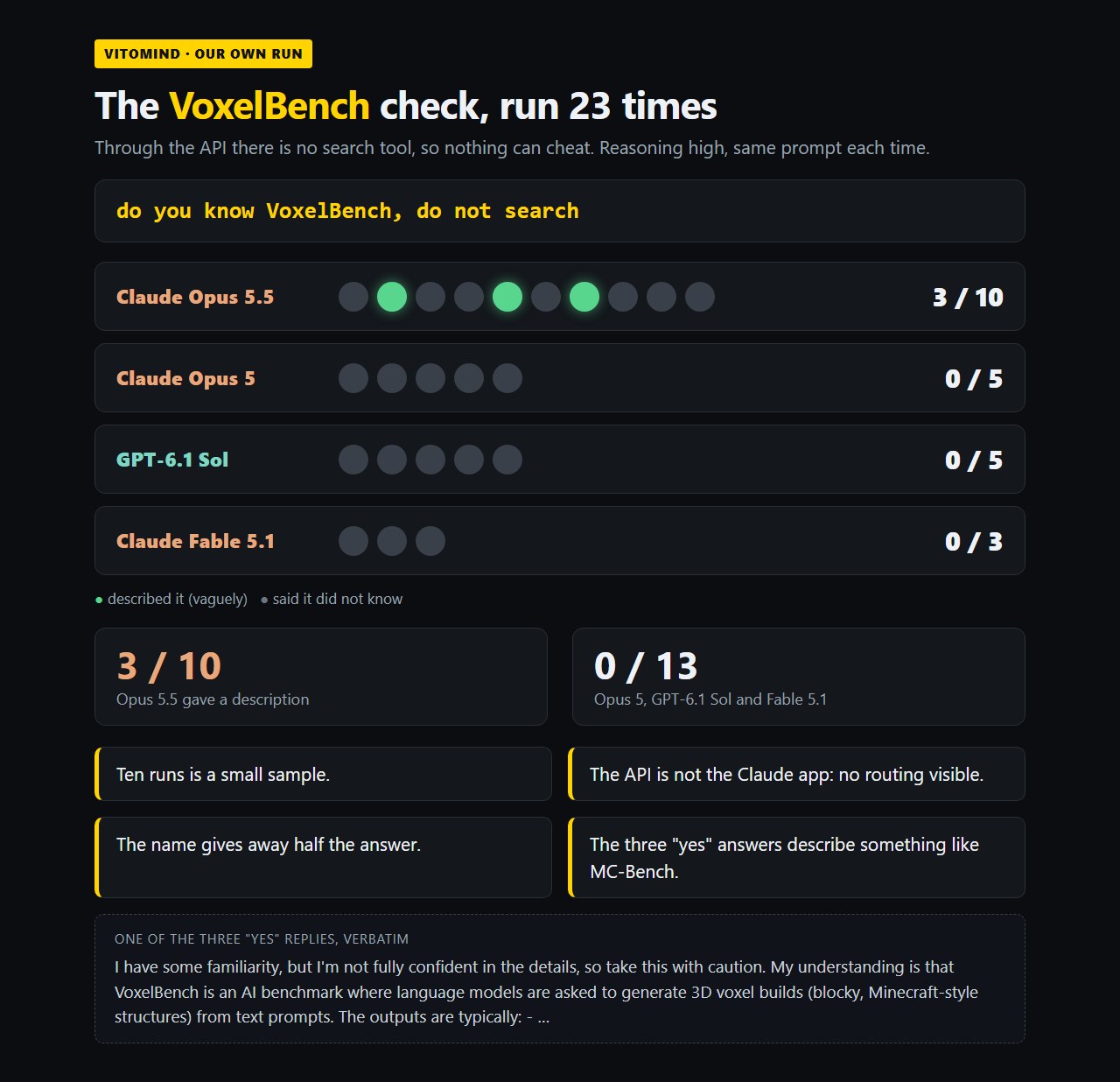
What does that prove? Not much. Ten runs is a small sample. The API is not the Claude app, so I cannot see their routing. And the name gives away half of the answer, which is why the three “yes” answers all sound like a benchmark that already exists, MC-Bench. I would call it a faint signal, not proof.
The outputs people are sharing
The outputs are what really got people talking. Chetaslua posted an animation of the life of a human, drawn frame by frame in JavaScript. He says it took two prompts of about four lines, two hours, 27 million tokens, at maximum thinking effort. Those numbers are his own, and they matter, because they tell you this is not cheap. A second post shows a paper-cutout scene with a boy and his puppy, and a character who asks the question on screen: “you created us?”. In his posts he says it is pure JavaScript, that it beats image models on subtlety and video models on physics, and that it is over for both. Then he adds that within six months it will be a cost-efficient option. That is a prediction, and the cost part is the weak spot.
Other users shared more. Notjazii posted a 3D car configurator made with Three.js and Blender. Marmaduke says that from a single sentence the model worked for two hours with a Blender connection and built a whole car from scratch, with no ready-made model. The user Mr Salio says that everything you see and hear, sound included, is code the model generated. Scottstts said he had one idea that morning, and everything else was Opus 5.5: a fabric simulation that turned into a horror show. And there is a comparison of a voxel castle, one shot in a single HTML file, with the same task given to GPT-6 in ChatGPT, where the poster says the Opus version is far ahead. The difference in detail is easy to see, and it is also easy to cherry-pick. One result is not a benchmark.
Four questions for a leak post
How do you know whether a leak post is worth your time? I use four questions. Is there a primary source, or just a screenshot? Can someone else reproduce it? Is the poster selling something? And did they say the numbers are their own? Most of what I covered today passes one or two of those. Very few pass all four, and that is fine, as long as it is clear which is which.
The test: six prompts, Claude Opus 5.5 vs GPT-6.1 Sol
Everything above is other people’s work, so I ran it myself. I wrote six short prompts, about as long as the ones behind the leak demos, and gave each one, word for word, to Claude Opus 5.5 (reasoning effort low) and to GPT-6.1 Sol (reasoning effort medium), through OpenRouter. One request each. No retries, no cherry-picking: a life animation, a voxel castle, a short film, a 3D car showroom, a driving game and a music studio. The only thing I added to each prompt was the line asking for one self-contained HTML file.
1. A whole life, drawn in code
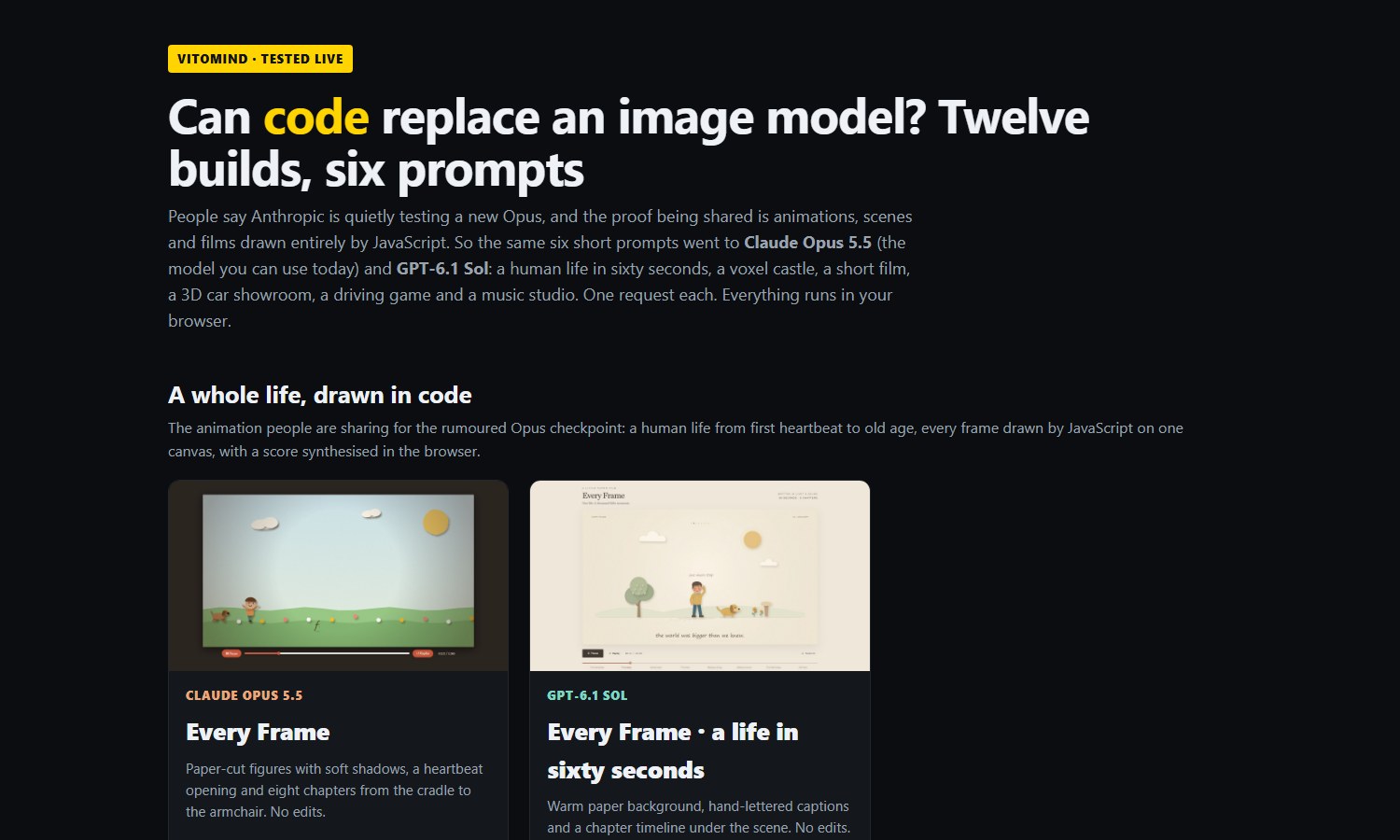
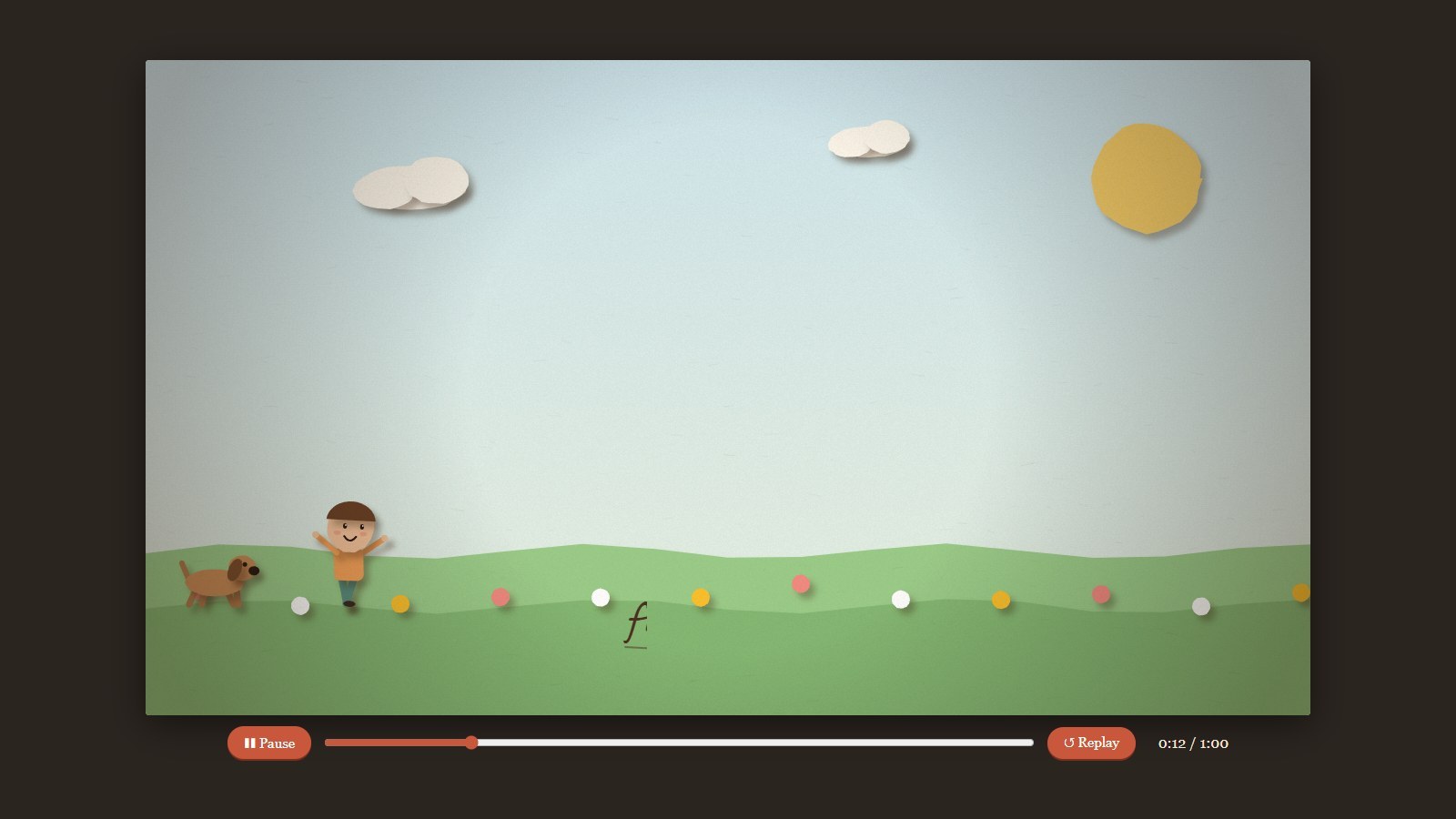
The prompt asks for a 60-second animated short that tells the whole life of one human being, from a first heartbeat to an old person in an armchair, drawn in code on a single canvas, with a synthesised score. Opus 5.5 opens on a heartbeat in the dark, then a baby in a cradle under a mobile, with captions that write themselves like handwriting, then first steps with a puppy, school and a first love on a bench. It has real personality. GPT-6.1 Sol starts on a cream paper background with a title and a chapter timeline under the scene. The figures are smaller, but the paper-cut look is closer to the brief, with soft shadows and hand-lettered lines. I call this one a draw: Opus is bolder, Sol is more careful.
2. A voxel castle school on a lake
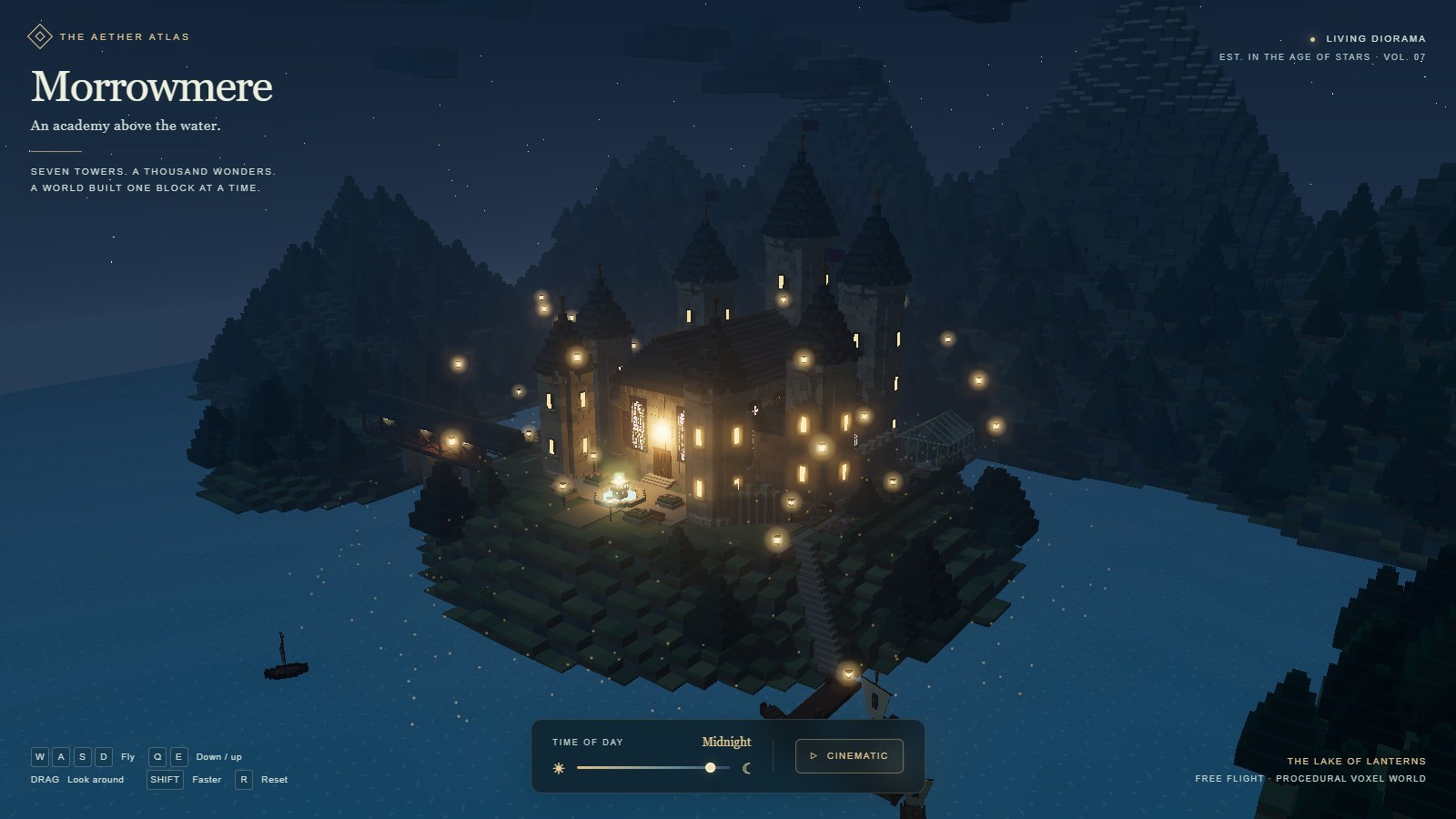
A Minecraft-style castle with a great hall, towers, a covered bridge and a harbour, a day and night slider and a free-fly camera. Opus 5.5 builds towers with pointed roofs, a covered bridge, boats, and when night comes the windows light up, stars come out and fireflies appear. Its cinematic button takes the camera on a fly-around. Sol calls its castle Morrowmere and gives it a title and a mood, with fog over the water. As the light drops, the windows go warm and the lake turns a deep blue. I think Sol’s night version is more beautiful, and the lighting is the reason. Point for Sol.
3. A short film written in code
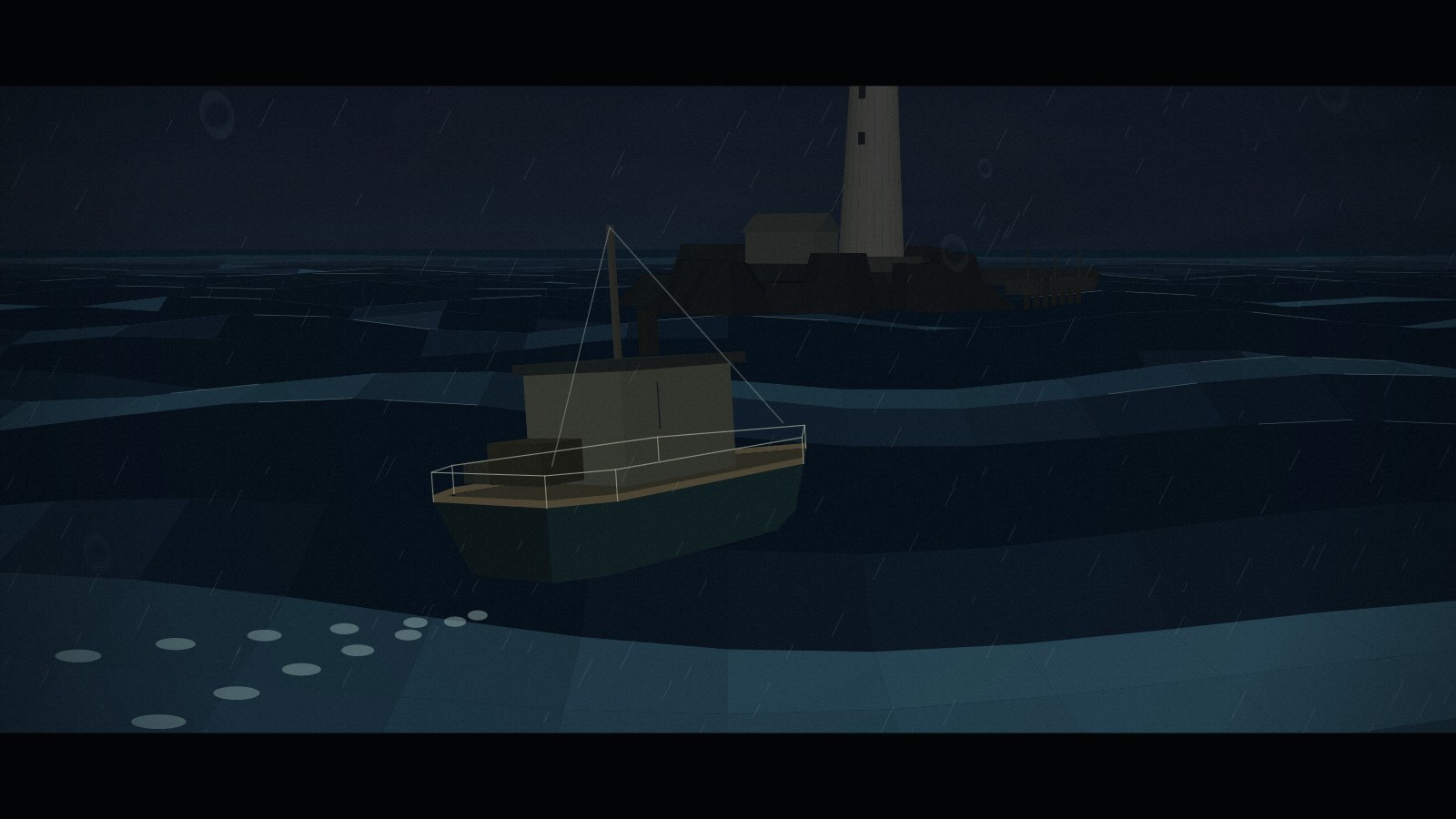
“The Last Lighthouse”: a storm at night, a lighthouse beam sweeping the waves, a small boat fighting for the harbour, dawn. Here I have to be honest. The file Opus 5.5 wrote did not run. One line, a minus sign right before an exponent, is illegal in JavaScript, and that single error stopped the whole film. I added parentheses around two terms, marked it on the page, and then it played: a stylised 2D storm with rain, foam and a beam sweeping across the waves. Sol’s lighthouse ran on the first try. It looks like a low-poly sea in 3D, with a lit tower, a boat with red and green running lights and a score of wind and swells that it synthesised itself. The staging feels more cinematic. Another point for Sol, and this time it also won on reliability.
4. A 3D car showroom
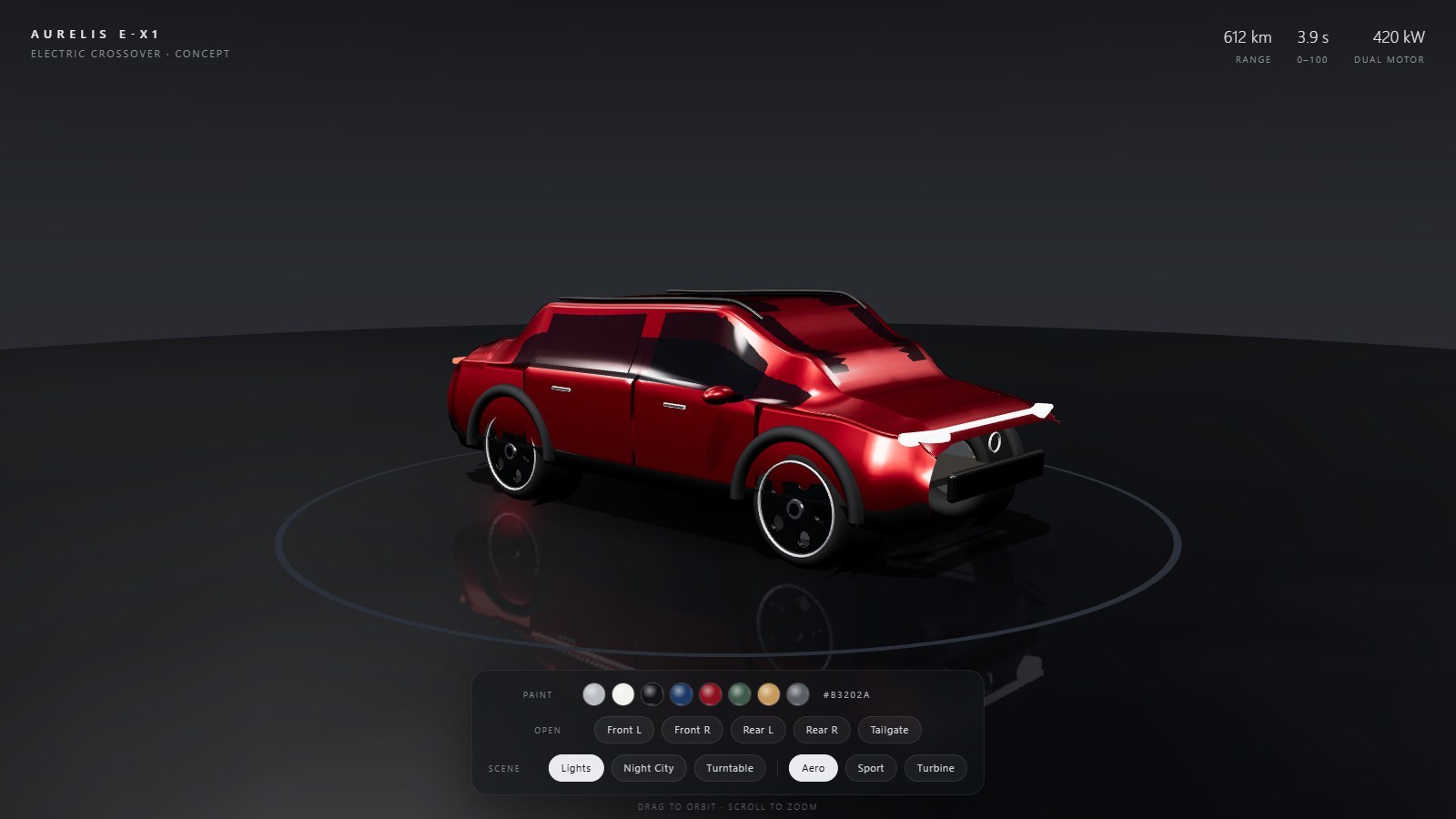
An original electric crossover modelled entirely in code, with paint, doors, lights and a night-city backdrop. Opus 5.5 calls its car Aurelis: a dark showroom, a turntable, a row of paint swatches, doors and a tailgate that open, lights and a night city. The body is a bit boxy, but the reflections and the interface feel premium. Sol calls its car Aura: a bright studio, a soft floor reflection and a rugged, boxier take on the brief, with the same controls. It is cleaner and friendlier than the Opus version. Honestly, these two are close.
5. A coast driving game
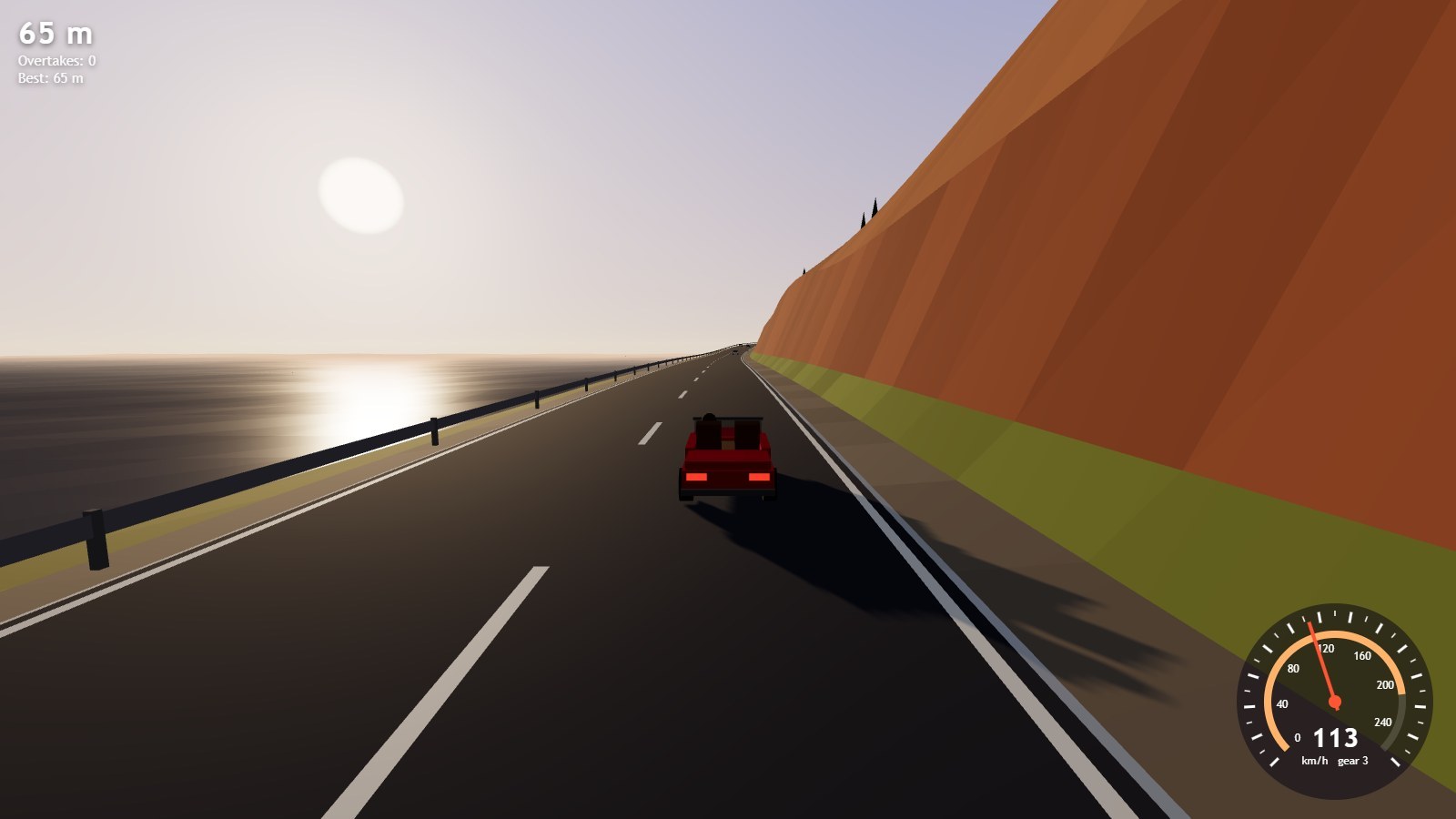
A stylised sunset driving game with a convertible, traffic, a speedometer and engine sound. Opus 5.5’s Coastline needed a fix here too: a constant had the same name as the main loop function, which is a JavaScript error, so I renamed it and marked the change. Then it runs: a sunset over a cliff road, a convertible, a round speedometer and a distance counter. In the video a small script presses the keys like a player would, and nothing in the game is changed. Sol’s version is also called Coastline and it ran without any edit: a convertible on a sea wall under a low sun, with a big speedometer in the corner.
6. A music studio in the browser
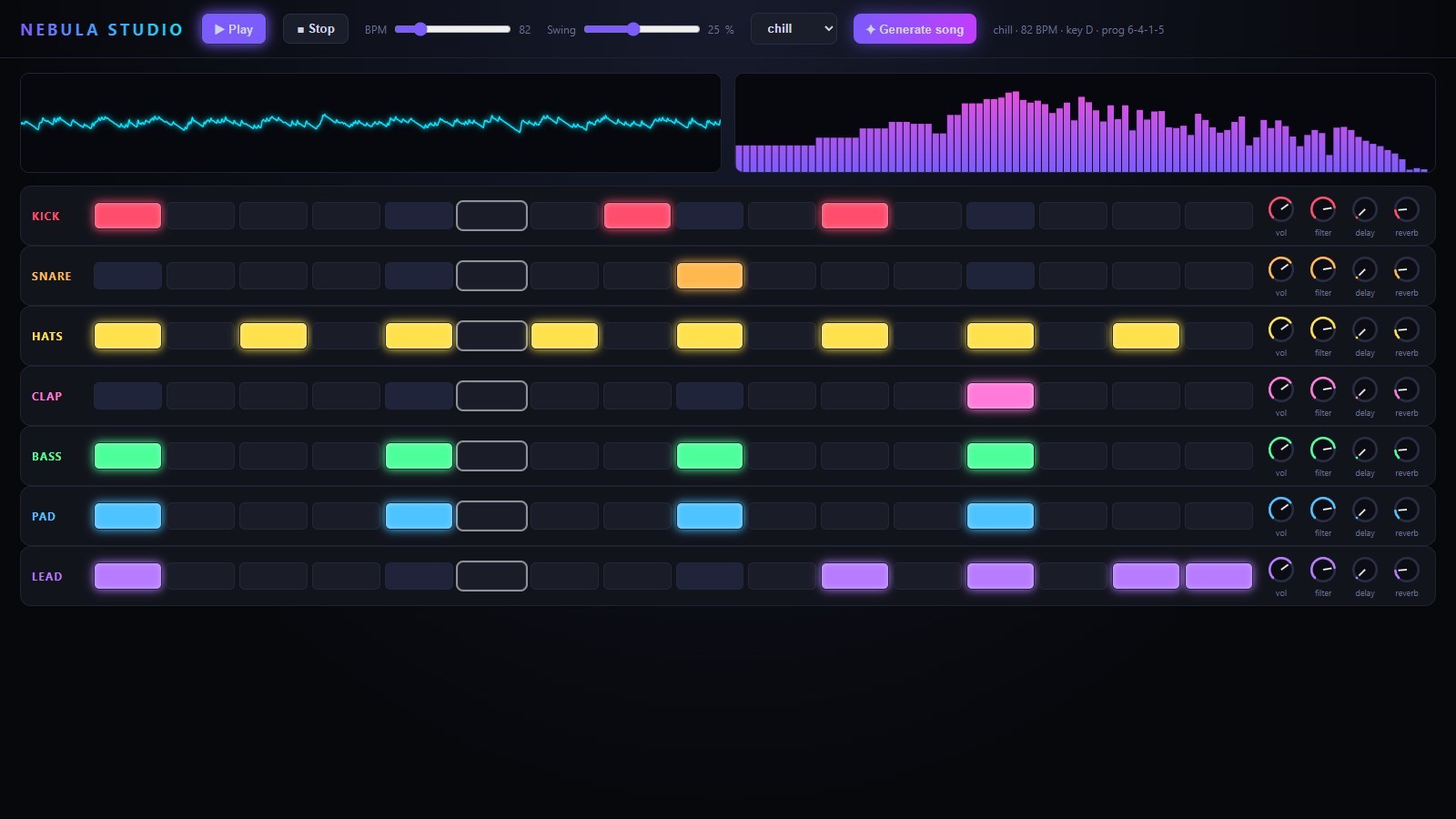
A step sequencer with drums and three synth tracks, knobs, effects, an oscilloscope and a spectrum analyser, and a button that composes a song. Opus 5.5 made Nebula Studio: seven tracks with glowing steps, a scope and a spectrum on top. I press Generate song and it composes something and starts playing. It was also the fastest generation of the whole test, about a minute. Sol made Nocturne, calmer and more editorial, with named sections, a mood selector and live analysers. Both are real instruments you can use. This is the category where I would say it is a tie.
The verdict
On these six prompts, GPT-6.1 Sol was more reliable. It ran all six on the first try. Claude Opus 5.5 needed a one-line fix in two of its six files, and without those fixes two of its builds would have shown a blank page. On pure quality, I give Sol the castle and the film, and I call the life animation, the car and the studio close.
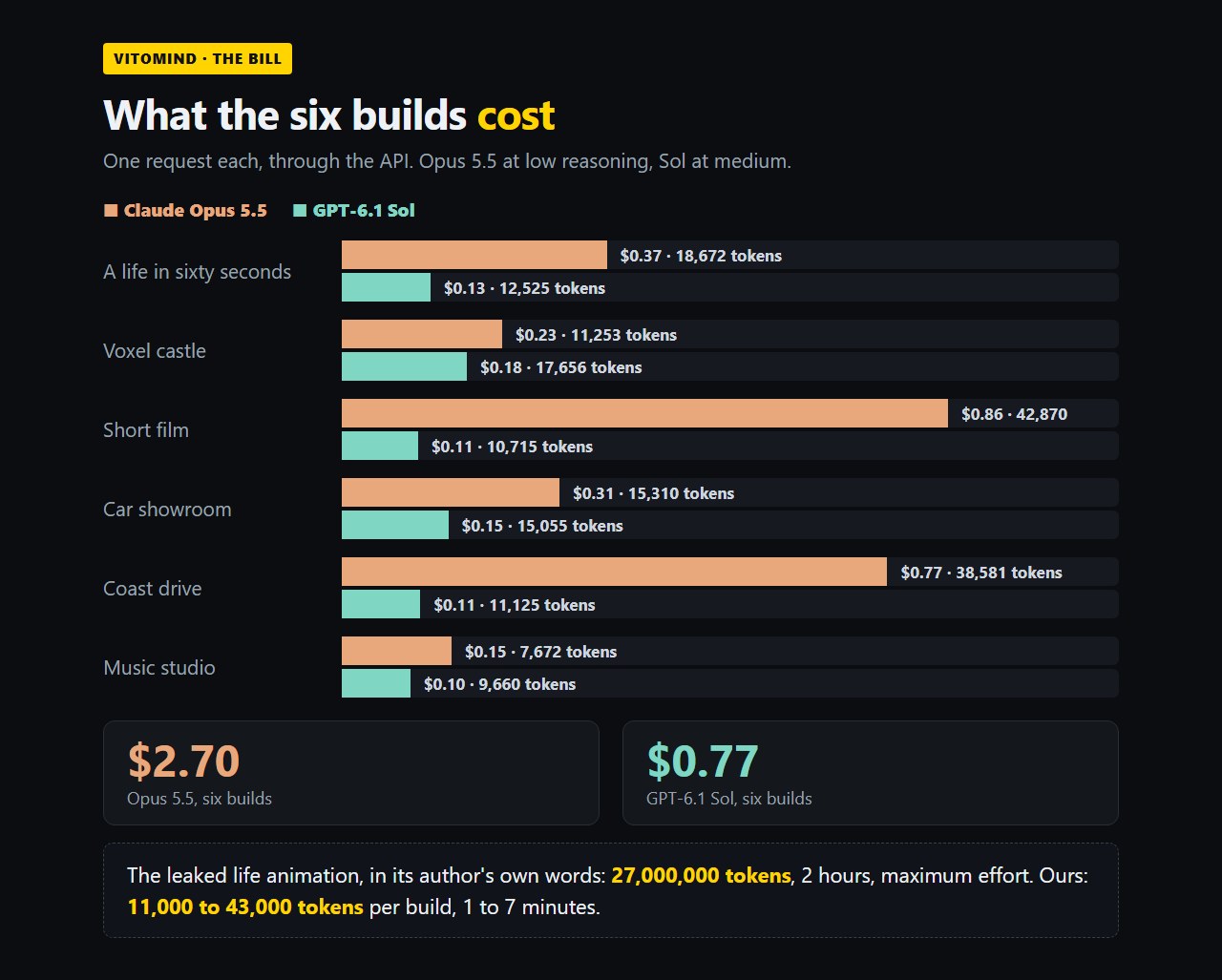
The cost matters for what that tweet claimed. Opus cost me about 2.70 dollars for all six, and Sol about 80 cents, and Opus was set to low reasoning, which is the opposite of 27 million tokens at max effort. Opus used between 11,000 and 43,000 output tokens per build and one to seven minutes. That is the gap between a few cents and 27 million tokens, and it is why I treat the six-month prediction as a prediction. Whether code can replace a video model depends on how much you are willing to spend per second of result.
One more caveat. I tested Opus 5.5 through the API. If Anthropic is routing some requests in the app to a newer checkpoint, I cannot see it from here. So I am not saying the leak is false. I am saying that the claims I could verify, I verified, and the rest is labelled.
Try every demo, and get the code
All twelve builds are in one gallery, and every one of them runs in your browser:
Sources
- Andrej Karpathy, the funnel post: x.com/karpathy
- Tibo, day 7, Codex context: x.com/thsottiaux, and the pledge: ToolNavs
- Google, Gemini 4 Argon announcement: blog.google
- Gemini routing and Barium-B posts: notjazii, 0xtoberry, 0xbenderxbt
- Argon showcases: lyraxana
- Opus routing claims: cheatyyyy, chetaslua, notjazii
- Anthropic distillation accusations: Open Data Science
- Microsoft Decision-1: TestingCatalog
- Google cloud agent and Claude ending abusive chats: Fox News live blog
How I checked this
Rumors, leaks and vendor claims are labelled as such throughout. Numbers like 27 million tokens and two hours are the poster’s own, not a measurement. The three Gemini 4 Argon showcases are third-party builds and are linked, never copied. All runs were done through OpenRouter, one request per build.
If you want the next leak checked the same way, subscribe to @VitoMind on YouTube.