From Brain Waves to Words: Inside Meta’s Brain2Qwerty v2
Published on July 10, 2026
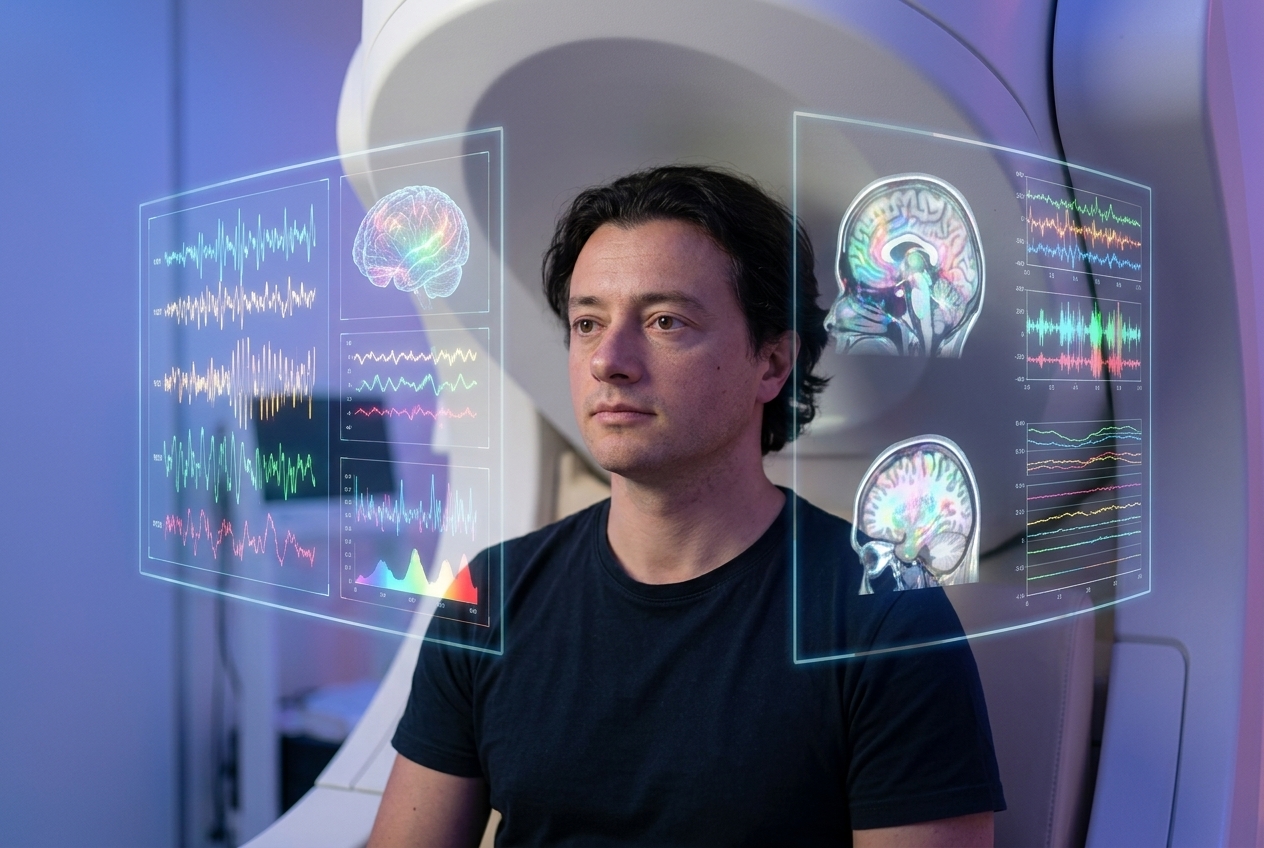
Imagine sitting inside a large, dome-shaped scanner, thinking silently to yourself — and watching your thoughts appear as text on a screen in real time. No electrodes drilled into your skull. No wires threaded through your cortex. Just a helmet, a deep learning model, and a large language model working together to decode the electromagnetic whispers of your brain.
This is no longer science fiction. Meta AI, in collaboration with the Basque Center on Cognition, Brain, and Language (BCBL), has just released Brain2Qwerty v2 — the most capable non-invasive brain-to-text decoding system ever built. It achieves levels of accuracy that were previously only possible through surgical implants, and it does so using nothing more than a magnetoencephalography (MEG) headset, deep neural networks, and fine-tuned language models.
But as with every breakthrough that touches the human mind, the implications stretch far beyond the laboratory. The same research division has also built Tribe V2, a foundation model that simulates how the human brain responds to visual and auditory stimuli — a tool with profound implications for advertising, attention engineering, and the future of human autonomy in an age of algorithmic persuasion.
What Is Brain2Qwerty v2?
Brain2Qwerty is Meta AI’s end-to-end deep learning pipeline capable of decoding sentences from non-invasive brain recordings in real time. First introduced as v1, the system has now been upgraded to v2, which represents a quantum leap in both architecture and performance.
The core innovation is deceptively simple in description but extraordinarily complex in execution: participants sit inside a magnetoencephalography (MEG) scanner — a device that measures the magnetic fields produced by electrical activity in the brain — and type sentences on a keyboard. The system records their brain activity and learns to map those electromagnetic patterns directly to the characters and words being typed.
Unlike previous approaches that relied on hand-crafted feature extraction pipelines to detect specific neural events, Brain2Qwerty v2 uses end-to-end deep learning. This means the model learns directly from raw brain signals, without human engineers manually selecting which features matter. The neural network discovers the patterns on its own — and it does so with remarkable effectiveness.
The pipeline has three key stages:
- Brain signal acquisition: A MEG scanner records the magnetic fields generated by neural activity at millisecond temporal resolution, capturing the dynamic ebb and flow of cognitive processes.
- Deep learning decoding: A deep neural network processes the raw MEG signals, learning to map complex spatiotemporal brain patterns to linguistic representations.
- Language model refinement: A fine-tuned large language model (LLM) leverages semantic context to clean up noisy decodings, bridging the gap between imperfect neural signals and coherent, grammatically correct sentences.
This last step is crucial. Brain signals are inherently noisy — they’re the combined electrical chatter of roughly 86 billion neurons firing in parallel, filtered through the skull and scalp. Even the best decoding models produce garbled output. But by fine-tuning an LLM on neural data, the system can leverage the statistical structure of language to correct errors, infer missing words, and produce coherent sentences from fragmented neural input.
The Numbers: A Leap From 8% to 61%
The performance metrics of Brain2Qwerty v2 are, by any standard, a dramatic improvement over previous non-invasive approaches. Meta trained the system on approximately 22,000 sentences from nine volunteer participants, each recorded for about 10 hours while actively typing inside a MEG scanner.
The results:
- 61% average word accuracy rate across all participants — a more than sevenfold improvement over the 8% accuracy achieved by previous non-invasive methods documented in the scientific literature.
- 78% word accuracy for the best-performing participant, meaning that more than half of all decoded sentences contained one word error or fewer.
- Decoding accuracy improves log-linearly with data volume, suggesting that simply scaling up the training data could further narrow the performance gap with invasive approaches without any architectural changes.
To put these numbers in perspective: previous non-invasive brain-to-text systems, such as those based on fMRI or EEG, struggled to produce anything resembling coherent language. The 8% baseline represents essentially random guessing with occasional lucky hits. A 61% average — and 78% for the best participant — crosses a threshold where decoded text becomes not just recognizable but genuinely useful for communication.
For comparison, invasive techniques like electrocorticography (ECoG) and stereotactic electroencephalography (stereo-EEG), which require surgeons to open the skull and place electrode grids directly on the surface of or inside the brain, have achieved higher accuracy rates. But these procedures carry significant risks: infection, bleeding, cognitive disruption, and the simple logistical challenge of requiring a neurosurgical operation. They are difficult to scale and reserved for patients with severe medical conditions, such as drug-resistant epilepsy, who already require brain surgery for clinical reasons.
Brain2Qwerty v2, by contrast, requires nothing more than sitting still inside a scanner for a few hours. No surgery. No implants. No hospital stay.
Open Science: Code, Data, and the BCBL Partnership
In a move that has been widely praised by the neuroscience community, Meta has committed to full transparency with the Brain2Qwerty project. The company is releasing:
- Full training code for both Brain2Qwerty v1 and v2, allowing researchers worldwide to reproduce the results, build upon them, and explore modifications.
- The v1 dataset, released by Meta’s partner BCBL on Hugging Face, containing the brain recordings and corresponding typed sentences from the original study.
- Full documentation of the experimental protocols, preprocessing steps, and model architectures.
This open-source approach is part of a broader strategy. Meta has positioned itself as a leader in open neuroscience, arguing that progress in brain science requires collective, collaborative effort rather than siloed corporate research. The release aligns with the company’s broader open-science initiatives, including the Digital Brain Project, which we’ll explore below.
The decision to open-source both code and data is not without risk. Brain decoding technology, even at this early stage, raises significant privacy concerns. By making the tools freely available, Meta is effectively democratizing access to brain-reading capabilities — for researchers and clinicians, yes, but also potentially for less benevolent actors. The company has stated that the released data is fully de-identified and that the technology requires specialized MEG equipment costing hundreds of thousands of dollars, making casual misuse impractical for now.
Tribe V2: Simulating the Human Brain for Advertising
Brain2Qwerty does not exist in isolation. It is part of a broader ecosystem of brain research at Meta that includes Tribe V2, a foundation model trained to predict how the human brain responds to complex stimuli — including images, videos, audio, and text.
Released in March 2026, Tribe V2 builds on Meta’s earlier Algonauts 2025 award-winning model. While that earlier system was trained on low-resolution fMRI recordings from just four individuals, Tribe V2 leverages a massive dataset of brain scans from more than 700 healthy volunteers who were exposed to a wide variety of media: photographs, podcasts, videos, and written text.
The model can predict high-resolution fMRI brain activity in zero-shot fashion — meaning it can accurately forecast how a new person’s brain would respond to a novel stimulus without needing to scan that individual first. This capability enables researchers to rapidly test hypotheses about brain function without requiring human subjects for every experiment.
But here’s where the story takes a turn that has critics deeply concerned. Tribe V2 was explicitly designed to understand how the human brain responds to visual and musical stimuli — the exact type of stimuli used in advertising. Meta’s business model, it’s worth remembering, is built almost entirely on advertising revenue. The company generated over $160 billion in ad revenue in 2025 alone, primarily from Instagram, Facebook, and its other platforms.
The concern, as articulated by commentators including content creator Simone Rizzo in a widely viewed YouTube Short, is straightforward: if you can simulate how a human brain responds to visual and auditory stimuli, you can optimize advertisements to maximize engagement at a neurological level. You can, in effect, reverse-engineer the brain’s reward circuitry to determine which images, sounds, and sequences will keep people scrolling, clicking, and consuming content for the longest possible time.
And now, with Brain2Qwerty v2, Meta has a complementary technology that can decode what a person is actually thinking while viewing those advertisements — not just infer engagement from behavioral signals like clicks and dwell time, but directly read the neural output of the cognitive process.
The Ethical Minefield: Medical Promise vs. Commercial Pressure
The tension at the heart of Brain2Qwerty is the same one that has defined much of Meta’s AI research: the gap between stated humanitarian goals and the company’s commercial imperatives.
On the medical side, the potential is genuinely transformative. According to research cited by Meta, millions of people worldwide suffer from brain lesions that prevent them from communicating — conditions like locked-in syndrome, advanced ALS, severe stroke, and traumatic brain injury. For these patients, invasive brain-computer interfaces like those developed by Neuralink and academic research groups have shown promise, but they require neurosurgery, which carries significant risks and is difficult to scale.
Brain2Qwerty v2 offers a non-invasive alternative that, while not yet as accurate as implanted systems, is improving rapidly. The log-linear scaling of performance with data volume suggests that simply collecting more training data — more participants, more recording hours, more sentences — could push accuracy into ranges that would be genuinely life-changing for patients who have lost the ability to speak or type.
But the same technology that could give voice to the voiceless could also give unprecedented power to those who already hold it. The combination of Brain2Qwerty (decoding thoughts) and Tribe V2 (simulating brain responses to stimuli) creates a feedback loop with alarming commercial implications:
- Hyper-optimized advertising: By testing ad creatives against the Tribe V2 brain simulation model, Meta could identify which advertisements produce the strongest neural engagement signals — not just the highest click-through rates, but the deepest neurological engagement.
- Real-time attention monitoring: If MEG or future portable equivalents become wearable (and Meta has invested heavily in AR/VR hardware), the company could potentially measure users’ neural engagement with content in real time, adjusting feeds dynamically to maximize the time spent scrolling.
- Reverse-engineering cognition for profit: Understanding exactly how the brain processes and responds to stimuli could enable the design of content that is virtually impossible to resist — engineered to trigger dopamine release, sustain attention beyond natural thresholds, and create behavioral dependencies that go far beyond what current algorithmic recommendation systems can achieve.
As Rizzo noted in his critique: “Instead of using it for medical purposes, in my opinion, they will use it to make more money.” The fear is that the medical applications serve as a legitimate and laudable shield behind which the commercial applications — with their far greater revenue potential — can be developed and deployed.
NeuralBench, NeuralSet, and the Digital Brain Project
Brain2Qwerty and Tribe V2 are pieces of a much larger puzzle that Meta has been assembling under the umbrella of what it calls “open foundational models of the brain.” Three additional components complete the picture:
NeuralBench is a unifying framework for benchmarking AI models that process brain activity. Published as a 31-page paper on arXiv in May 2026 by a team led by Hubert Banville and Jean-Rémi King, NeuralBench addresses a critical gap in the field: the lack of standardized evaluation metrics. Different research groups use different datasets, different preprocessing pipelines, and different evaluation tasks, making it nearly impossible to compare results across studies. NeuralBench-EEG v1.0, the first release, includes 36 EEG tasks, 14 deep learning architectures, and 94 datasets accessed through a standardized interface. Critically, the framework already reveals that current foundation models only marginally outperform task-specific models, and that a large set of cognitive and clinical prediction tasks remain highly challenging even for the best available systems.
NeuralSet is Meta’s solution for processing brain data at scale — a data processing pipeline designed to handle the enormous volumes of neural recordings generated by modern brain imaging studies, which can easily reach terabytes for a single research project.
The Digital Brain Project is the most ambitious component of all. Coordinated by the Rothschild Foundation Hospital and funded by Meta in partnership with the University of Montreal, it aims to assemble a dataset of 10,000 hours of standardized brain recordings from participants playing interactive games inside brain scanners. The project will use three neuroimaging modalities — fMRI, MEG, and intracranial EEG — and will span 3.5 years. The goal is to build a functional digital model of the human brain that can simulate not just passive perception but active reasoning, planning, and decision-making.
The project design is meticulous: 50% of recording time goes to interactive games (the training set), 25% to reasoning benchmarks (evaluation), and 25% to cognitive science tasks (evaluation). Each selected team receives up to $500,000 in funding, and the resulting de-identified dataset will be released for open scientific research in BIDS (Brain Imaging Data Structure) format.
Together, these initiatives form a comprehensive infrastructure for brain-AI research: NeuralBench for evaluation, NeuralSet for data processing, Tribe V2 for brain response simulation, Brain2Qwerty for thought decoding, and the Digital Brain Project for the foundational dataset. It’s an ecosystem that no single academic lab could build — and one that only a company with Meta’s resources and strategic interest in the human brain would invest in building.
The Invasive vs. Non-Invasive Landscape
To understand the significance of Brain2Qwerty v2, it’s essential to place it in the broader landscape of brain-computer interface (BCI) research.
The gold standard for brain-to-text communication comes from invasive approaches. In 2021, a team at UCSF demonstrated a neuroprosthesis that could decode speech in a paralyzed person with anarthria at rates of up to 15 words per minute, using electrode arrays implanted on the surface of the brain’s speech motor cortex. Earlier work by the same group had shown that ECoG recordings could be used to synthesize spoken sentences from neural activity with remarkable fidelity. And in 2021, researchers at Stanford demonstrated that a brain-computer interface could decode attempted handwriting at 90 characters per minute with 94% accuracy, using intracortical microelectrode arrays.
These results are impressive — and completely out of reach for the vast majority of patients who need them. Each requires a craniotomy, carries surgical risks including infection and hemorrhage, and depends on specialized neurosurgical expertise that is available in only a handful of medical centers worldwide. The electrodes also degrade over time as scar tissue forms around the implants, typically requiring replacement surgeries every few years.
Non-invasive methods have historically lagged far behind. EEG, which measures electrical activity through electrodes placed on the scalp, offers excellent temporal resolution but poor spatial resolution — the skull blurs the electrical signals much like a frosted glass window diffuses light. fMRI, which measures blood oxygenation changes in the brain, offers good spatial resolution but terrible temporal resolution — neural activity happens in milliseconds, but blood flow changes take seconds. MEG, which measures the magnetic fields generated by neural electrical activity, offers the best of both worlds: millisecond temporal resolution and reasonable spatial resolution, without the distortion that affects EEG signals.
This is why Meta chose MEG for Brain2Qwerty. It’s also why the 61% accuracy figure is so significant: it demonstrates that non-invasive approaches, given sufficient data and the right deep learning architecture, can approach the performance of surgical systems. The log-linear scaling with data volume suggests that the gap could continue to narrow — potentially making brain surgery unnecessary for communication restoration, at least for some patients.
The trade-off, of course, is that MEG scanners are not portable. They’re room-sized machines that require magnetically shielded rooms and cost upwards of $2 million. A patient cannot use a MEG scanner at home. But as a research platform and a proof of concept, Brain2Qwerty v2 demonstrates that the fundamental science works — and that future advances in sensor technology (portable MEG, optically pumped magnetometers, or other emerging technologies) could eventually bring this capability into a clinical, or even consumer, setting.
The Road Ahead: Promise and Peril
Brain2Qwerty v2 represents a genuine scientific breakthrough. The jump from 8% to 61% word accuracy with non-invasive technology is not an incremental improvement — it’s a paradigm shift. The decision to open-source the code and data is commendable and will accelerate research across the entire field of neuroscience and brain-computer interfaces.
But we would be naive to ignore the context in which this breakthrough has occurred. Meta is not a medical research institute. It is an advertising company — one of the most powerful and profitable in human history. Its investment in brain research, while producing genuinely beneficial scientific outputs, also serves a strategic interest that goes far beyond medicine.
The combination of Brain2Qwerty (reading thoughts) and Tribe V2 (simulating brain responses to advertising stimuli) creates a toolkit that could, in principle, enable the most sophisticated attention-manipulation system ever conceived. Current social media algorithms optimize for engagement based on behavioral signals: clicks, likes, shares, watch time, scroll velocity. These are crude proxies for what’s actually happening inside a user’s brain. Neural data would transform these proxies into direct measurements — a difference as profound as guessing someone’s mood from their body language versus reading their diary.
The technology is not there yet. MEG scanners are immobile and expensive. Brain2Qwerty requires hours of training data per individual. Tribe V2’s predictions, while impressive, are still coarse approximations of actual brain function. No one is being mind-read against their will today, and no one will be tomorrow.
But the trajectory is clear. The first neural interfaces will be medical, serving patients who have no other option. The second wave will be consumer — likely in the form of AR glasses with EEG sensors, already in development at multiple companies including Meta. And the third wave, if it arrives, will be ambient: brain-sensing technology embedded in the devices and environments around us, constantly measuring and responding to our cognitive states.
Whether that future is utopian or dystopian depends not on the technology itself but on the governance frameworks we build around it. Meta’s decision to open-source its brain research is a double-edged sword: it democratizes access for researchers and clinicians who could use these tools for good, but it also lowers the barrier for those who might use them for less noble purposes. The company’s stated goal of advancing neuroscience “to identify, diagnose, and treat neurological disorders faster than in siloes” is laudable. Whether the same tools will be used to optimize Instagram ads for maximum neural engagement remains the open question of our age.
For now, Brain2Qwerty v2 stands as a testament to what’s possible when deep learning meets neuroscience at scale. Nine volunteers, 22,000 sentences, and a MEG scanner have shown that the barrier between thought and text — the most intimate barrier in the human experience — is not as impenetrable as we once believed. What we do with that knowledge is up to us.
This article is based on research published by Meta AI (ai.meta.com/blog/brain2qwerty-brain-ai-human-communication), the Digital Brain Project (digitalbrainproject.org), the NeuralBench framework (arXiv:2605.08495), and critical commentary from the broader AI community. The original YouTube analysis by @simone_rizzo98 provided valuable perspective on the commercial implications of this technology.