Meta’s Brain2Qwerty v2 Reads Minds Without Surgery — and That Should Make You Think
Date: July 11, 2026
Imagine sitting in a room, thinking a sentence, and watching it appear on a screen — word by word — without lifting a finger, without a surgeon drilling into your skull, without a single electrode planted in your brain. Sounds like science fiction? Meta AI just made it science fact. The system is called Brain2Qwerty v2, and it represents the highest-performing non-invasive brain-to-text decoder ever built. But beneath the marvel of engineering lies a question that deserves our full attention: what happens when a tech giant learns to read minds?
From Brain Waves to Words: How Brain2Qwerty v2 Works
Last year, Meta AI introduced Brain2Qwerty v1, a research pipeline that used artificial intelligence to decode brain activity into text without any surgical implant. Now, they’ve taken the next step with Brain2Qwerty v2 — the highest-performing end-to-end pipeline capable of real-time sentence decoding from non-invasive brain recordings, approaching levels of accuracy previously exclusive to techniques that require brain surgery.
The system relies on magnetoencephalography (MEG), a non-invasive neuroimaging technique that measures the magnetic fields produced by electrical activity in the brain. Unlike EEG, which measures electrical signals through the scalp and suffers from poor spatial resolution, or fMRI, which tracks blood flow but is too slow for real-time decoding, MEG sits in a sweet spot: it captures neural activity with millisecond temporal resolution and decent spatial resolution, all without breaking the skin.
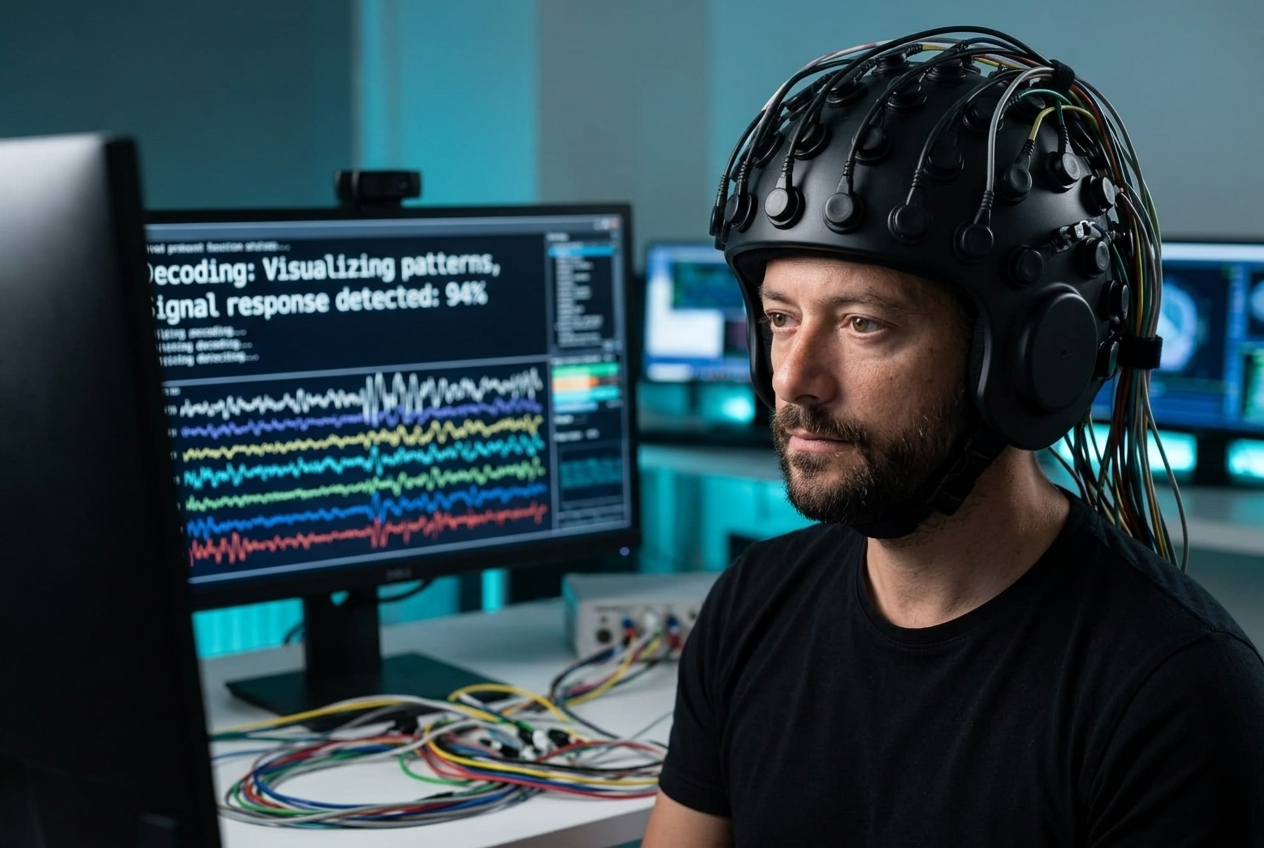
The pipeline is remarkably straightforward in concept, yet staggeringly complex in execution. Participants sit in a MEG scanner and type sentences on a keyboard. The system records their brain activity — thousands of magnetic field measurements per second — and a deep learning model learns to map those raw neural signals directly to characters and words. No hand-crafted feature extraction, no manual identification of neural events. Just raw brain data in, text out.
But the real innovation comes from fine-tuning large language models (LLMs) on neural data. By leveraging the semantic context that LLMs provide, Brain2Qwerty v2 bridges the gap between noisy brain recordings and coherent language. The LLM acts as a powerful prior — it knows what words are likely to follow other words, what sentences are grammatically and semantically plausible — and it uses that knowledge to clean up the messy, ambiguous signals coming from the brain. Meta also deployed AI agents to explore optimizations for the decoding pipeline, with final training configurations selected manually by engineers.
The Numbers: 9 Volunteers, 22,000 Sentences, 61% Accuracy
The results are nothing short of remarkable. Meta trained Brain2Qwerty v2 on approximately 22,000 sentences from nine volunteer participants, each recorded for about 10 hours while actively typing inside a MEG scanner. The system achieved a word accuracy rate of 61% on average across all participants — a dramatic improvement over the 8% accuracy reported by other non-invasive methods in the field.
For the best-performing participant, Brain2Qwerty v2 reached a staggering 78% word accuracy rate, where more than half of all decoded sentences contained one word error or less. To put this in perspective: previous non-invasive approaches were essentially guessing. Brain2Qwerty v2 is actually reading.
Even more encouragingly, the researchers found that decoding accuracy improves log-linearly with data volume. This means that the remaining performance gap with surgical approaches could potentially be narrowed through data scaling alone — more training data, better performance. No fundamental breakthrough required, just more compute and more recordings.
Open Source: Code, Data, and the Digital Brain Project
In a move that deserves genuine praise, Meta is releasing the full training code for both Brain2Qwerty v1 and v2 as open source. Their partner, the Basque Center on Cognition, Brain, and Language (BCBL), is releasing the v1 dataset publicly on HuggingFace. This is not a press release with a closed model behind a paywall — it’s a genuine contribution to the scientific community.
This release is part of a broader ecosystem Meta is building around what they call their “open foundational models of the brain.” The key components include:
- TRIBE v2: A predictive foundation model trained to understand how the human brain processes complex stimuli. Built on an Algonauts 2025 award-winning model, TRIBE v2 was trained on fMRI recordings from more than 700 healthy volunteers who were presented with images, podcasts, videos, and text. It reliably predicts high-resolution fMRI brain activity and enables zero-shot predictions for new subjects, languages, and tasks. Model weights and code are released under a CC BY-NC license.
- NeuralSet: A high-performing Python package for Neuro-AI research that unifies the processing of diverse neural recordings — fMRI, M/EEG, spikes — and complex experimental stimuli like text, audio, and video. It addresses a critical bottleneck in the field: the fragmented software ecosystem that forces labs worldwide to re-implement similar data processing workflows. NeuralSet provides a single PyTorch-ready interface that scales from local prototyping to high-performance cluster execution.
- NeuralBench: A unified framework for benchmarking AI models of brain activity, accompanied by NeuralBench-EEG v1.0 — a large EEG benchmark that includes 36 EEG tasks and 14 deep learning architectures, evaluated on 94 datasets. NeuralBench already reveals two key findings: current foundation models only marginally outperform task-specific models, and a large set of tasks (cognitive decoding, clinical predictions) remain highly challenging even for the best models.
- Digital Brain Project: A broader initiative accompanied by a $5 million fund to stimulate open datasets, done in close collaboration with the research community through digitalbrainproject.org.
This ecosystem approach is significant. Meta isn’t just releasing a model — they’re attempting to build the infrastructure for an entire field. NeuralSet provides the data pipeline, NeuralBench provides the evaluation framework, TRIBE v2 provides the brain simulation model, and Brain2Qwerty demonstrates the clinical application. Together, they form a coherent research stack that could accelerate neuroscience discovery in ways that siloed academic labs simply cannot match.
TRIBE v2: Simulating the Human Brain at Scale
While Brain2Qwerty focuses on decoding brain signals into text, TRIBE v2 tackles the inverse problem: predicting how the brain will respond to stimuli. This is, in a very real sense, a simulation of human perception. Given an image, a sound, or a piece of text, TRIBE v2 can predict the fMRI activity pattern that a human brain would produce in response.
TRIBE v2 was trained on a massive dataset of over 700 volunteers who were exposed to a wide variety of media — images, podcasts, videos, and text. The model can generate zero-shot predictions for new subjects, meaning it can predict brain activity patterns for people whose data it has never seen before. It consistently outperforms standard modeling approaches and represents Meta’s first AI model of human brain responses to sights, sounds, and language.
The implications are profound. If you can predict how a brain will respond to a stimulus, you can — in theory — reverse-engineer which stimuli will produce desired brain responses. Which brings us to the uncomfortable part of this story.
The Elephant in the Room: Meta Ads and Reverse Engineering the Brain
Here’s where we need to have an honest conversation. Meta is not a neuroscience research institute. Meta is a company that generated over $164 billion in revenue in 2025, the vast majority of which came from advertising. Their core business model depends on understanding human attention, predicting engagement, and optimizing content to maximize the time users spend on their platforms.
Brain2Qwerty decodes brain activity into text. TRIBE v2 predicts brain responses to stimuli. NeuralSet processes neural data at scale. NeuralBench evaluates brain models systematically. Put these together, and you have a complete pipeline for understanding, predicting, and potentially manipulating human brain responses.
The critical perspective raised in recent commentary — including a YouTube Short that has been making the rounds — highlights several concerns that deserve serious consideration:
- Meta Ads integration risk: If TRIBE v2 can predict how brains respond to visual and auditory stimuli, the temptation to use it for optimizing ad creatives, content recommendations, and engagement loops is immense. Meta already uses AI to optimize ad placement and content ranking. A brain-level predictive model would represent a qualitative leap — from optimizing what people click to optimizing what their brains respond to on a neurological level.
- Reverse engineering the brain for profit: The stated goal of Brain2Qwerty and the Digital Brain Project is medical — to help the millions of people who suffer from brain lesions that prevent them from communicating. But the same technology that decodes thoughts in a MEG scanner could, in principle, be adapted to decode responses to content in less controlled environments. The jump from “brain-to-text in a lab” to “brain-response-optimized content feeds” is not as large as we might hope.
- Social media addiction: Meta’s platforms — Facebook, Instagram, WhatsApp, Threads — already face criticism for their role in mental health crises, attention manipulation, and addictive design patterns. Adding brain-level predictive modeling to this mix could create engagement optimization systems that operate below the level of conscious awareness. If you can predict what a brain finds rewarding, you can build systems that deliver it relentlessly.
- Consent and privacy: The research participants in Brain2Qwerty gave informed consent. But what happens when consumer-grade brain-computer interfaces — like EEG headbands from companies such as Kernel or Neurable — become widespread? Could neural data collected in consumer contexts be used to train the next generation of brain decoding models? Who owns your brain data?
The YouTube Short video that critically examines Brain2Qwerty raises a pointed question: is Meta developing brain-reading technology primarily for medical benefit, or is the medical application the palatable framing for a technology whose ultimate commercial value lies in brain-optimized advertising and engagement? The answer may well be both — but we should be clear-eyed about the fact that Meta’s business model creates incentives that go far beyond helping patients communicate.
Medical Promise vs. Commercial Temptation
Let’s be fair to Meta. The medical case for Brain2Qwerty is genuinely compelling. Millions of people worldwide suffer from conditions that prevent them from communicating — amyotrophic lateral sclerosis (ALS), locked-in syndrome, severe stroke, brainstem lesions. For these patients, invasive procedures like stereotactic electroencephalography (sEEG) and electrocorticography (ECoG) have shown that neuroprostheses feeding signals to AI decoders can restore communication. But these procedures require brain surgery, which is expensive, risky, and difficult to scale.
Brain2Qwerty v2 offers a non-invasive alternative that could — with further development — make brain-to-text communication accessible to far more patients than surgical approaches ever could. The fact that it approaches the accuracy of invasive methods without requiring any surgery is a genuine breakthrough. And Meta’s decision to release the code and data openly means that researchers worldwide can build on this work, not just Meta employees.
The $5 million Digital Brain Project fund to stimulate open datasets is also a legitimate contribution to the scientific commons. NeuralBench and NeuralSet are tools that the entire neuroscience community can use, regardless of their relationship with Meta. TRIBE v2’s model weights, released under a CC BY-NC (non-commercial) license, at least attempt to prevent direct commercial exploitation — though the definition of “commercial” in the context of a company like Meta is fuzzy at best.
But we cannot ignore the structural reality. Meta is building the most comprehensive brain-AI research stack in existence — not a university, not a government lab, but a for-profit advertising company. The same LLM technology that helps Brain2Qwerty decode thoughts also powers Meta’s content systems. The same deep learning infrastructure that processes neural data also optimizes ad delivery. The same research team that publishes papers on brain decoding also works on products that shape the attention of over 3 billion daily active users.
This doesn’t make the research bad. It makes the governance questions urgent.
Comparison with Invasive Methods: ECoG, sEEG, and the Scalability Problem
To understand why Brain2Qwerty v2 matters, it’s worth comparing it to the invasive approaches it aims to complement:
- Electrocorticography (ECoG): Electrodes placed directly on the exposed surface of the brain, requiring a craniotomy (removal of part of the skull). ECoG provides excellent signal quality and spatial resolution, but it is highly invasive, expensive, and typically only used in patients who are already undergoing brain surgery for epilepsy or tumor resection. ECoG-based decoders have achieved high accuracy in research settings, but scalability is essentially zero — you can’t deploy this to millions of patients.
- Stereotactic EEG (sEEG): Thin electrodes surgically implanted deep into brain tissue through small holes drilled in the skull. sEEG can record from deep brain structures that surface methods cannot reach, but it carries surgical risks including infection, bleeding, and brain damage. Like ECoG, it is primarily used in epilepsy patients who are being monitored for surgical planning.
- Non-invasive EEG: Electrodes placed on the scalp. Cheap, portable, and safe, but the skull acts as a low-pass filter, blurring the electrical signals and severely limiting spatial resolution. Non-invasive EEG-based decoders have historically achieved very low accuracy — the 8% benchmark that Brain2Qwerty v2’s 61% so dramatically surpasses.
- MEG (Brain2Qwerty v2): Magnetic fields measured outside the head. MEG doesn’t suffer from the skull’s signal degradation the way EEG does, providing both temporal and spatial resolution. The downside? Current MEG scanners are large, expensive, require cryogenic cooling (for superconducting quantum interference devices, or SQUIDs), and must be operated in magnetically shielded rooms. They are not portable and cannot be deployed in homes or clinics easily.
Brain2Qwerty v2’s achievement is significant because it demonstrates that non-invasive methods can reach accuracy levels approaching invasive methods — at least in controlled laboratory settings. The log-linear scaling with data means that more training data could close much of the remaining gap. But the practical deployment challenge remains: you can’t put a MEG scanner in every hospital, let alone every home.
This is why Meta’s investment in the broader ecosystem matters. NeuralSet makes it easier to process brain data from any modality. NeuralBench makes it possible to compare models fairly. TRIBE v2 provides brain simulation capabilities. If a future non-invasive technology — perhaps optically pumped magnetometers (OPMs) that don’t require cryogenic cooling — makes MEG portable, the Brain2Qwerty pipeline could be ready to deploy at scale.
The Ethical Road Ahead
Brain2Qwerty v2 is a technological marvel. There is no denying that. The leap from 8% to 61% accuracy — with a peak of 78% — represents a fundamental advance in our ability to decode human thought from outside the skull. The open-source release of code, data, and supporting infrastructure is exactly the kind of responsible science we should expect from organizations with the resources to make it happen.
But we must be clear-eyed about what is happening here. A company whose primary business is attention engineering — whose revenue depends on understanding, predicting, and shaping human behavior at planetary scale — is now building the most sophisticated brain-AI research stack in existence. The medical applications are real and important. The commercial temptations are equally real and potentially far more impactful.
The YouTube commentary that criticized Brain2Qwerty raised a valid concern: the risk that brain-reading technology gets used for reverse engineering human cognition to optimize advertising and engagement, rather than — or in addition to — healing the sick. This is not a conspiracy theory. It’s a structural incentive. When a company’s revenue depends on engagement, and that company develops technology to predict and decode brain responses, the commercial applications are not hypothetical — they are inevitable, unless governance structures are put in place to prevent them.
We need several things to happen:
- Independent oversight: Brain-AI research at companies like Meta should be subject to independent ethical review, not just internal ethics boards that report to the same executives who profit from the company’s ad business.
- Neural data rights: We need legal frameworks that explicitly protect neural data — not just as “biometric data” under GDPR, but as a special category requiring informed, specific, and revocable consent for any use, including research.
- Transparency about commercial applications: Meta should be explicit about what commercial applications they envision for TRIBE v2 and related technologies. The CC BY-NC license on TRIBE v2 is a start, but Meta itself is not bound by it — they can use their own models commercially.
- Public investment in alternatives: If brain-AI technology is too important to be left in the hands of a single advertising company, then governments and philanthropic organizations should invest in public alternatives — independent research consortia that can build brain-AI infrastructure without the conflict of interest inherent in Meta’s business model.
Conclusion: A Breakthrough We Cannot Afford to Celebrate Uncritically
Brain2Qwerty v2 is a landmark achievement. It demonstrates, for the first time, that non-invasive brain recordings combined with deep learning and large language models can decode thoughts into text with accuracy approaching surgical methods. For the millions of people trapped in their own bodies by neurological conditions, this technology could be life-changing. Meta deserves credit for the research, for the open-source release, and for the broader infrastructure they’re building to accelerate neuroscience.
But we cannot celebrate this breakthrough uncritically. The same technology that can give voice to the voiceless can give advertisers unprecedented power to understand and shape human cognition. The same models that decode neural signals in a lab can, in principle, be used to optimize content for maximum neurological engagement. The same research team that publishes in Nature and on arXiv also works for a company that has been fined billions of dollars for privacy violations and has been linked to mental health crises in adolescents worldwide.
Brain2Qwerty v2 is not just a medical device. It is a window into the human mind — and the company holding that window open is also the one selling ad space on the other side. We need to be grateful for the science, vigilant about the application, and proactive about the governance. The mind is the last frontier of privacy. We cannot afford to lose it to a newsfeed.
This article is based on Meta AI’s official blog post, research papers on NeuralBench and NeuralSet from arXiv, and critical commentary from the broader tech community. The technology described represents published research as of July 2026.