Published: October 24, 2026 | By Vito Ruocco
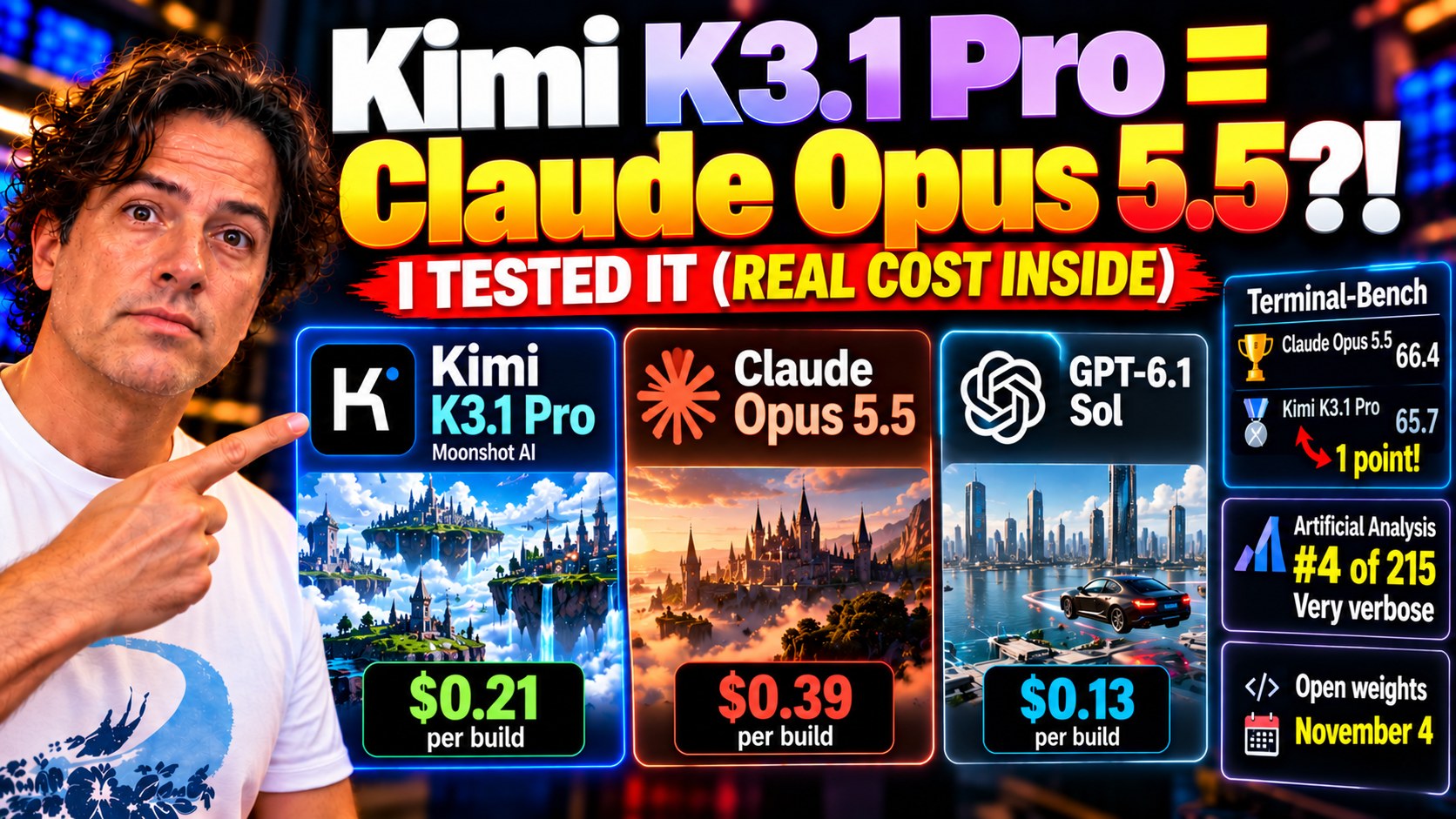
One point. That is the gap on Terminal-Bench 4.0 between Claude Opus 5.5 and Kimi K3.1 Pro, a model from Moonshot AI whose weights are promised for download on November 4. Within hours of the launch, people were calling it “a cheaper Opus”. I wanted to check that with my own money, so I took the eight prompts that Claude Opus 5.5, GPT-6.1 Sol and Claude Fable 5.1 had already answered in my earlier tests, gave them to Kimi word for word, paid the OpenRouter bill and used every build live. Kimi is good, and in 3D it is excellent. But it is not one third of the price of Opus, and it was not the cheapest model in the test.
The Short Version
- What it is: Kimi K3.1 Pro, released by Moonshot AI on October 23, 2026. A mixture of experts with 2.8 trillion parameters in total and 104 billion active per token, text and image input, a 1-million-token context window. Live on kimi.ai, the Kimi apps, Kimi Code and the API. Open weights promised “by Nov 4”, so for now still a promise.
- Benchmarks (Moonshot’s own): Terminal-Bench 4.0 65.7% against Opus 5.5 at 66.4% and GPT-6 Astra at 58.2%. Ahead of Opus on SWE Marathon and OfficeQA Pro v2, well behind on ExploitBench. Almost every coding score was measured inside Anthropic’s Claude Code harness, as Moonshot’s own footnotes say.
- Independent check: Artificial Analysis puts it at 55 on its Intelligence Index, number 4 of 215, but slower than average (73.5 tokens per second) and very verbose (150 million output tokens to run the index, against a median of 87 million).
- Price: $2 per million input tokens and $10 per million output tokens. That is half of Claude Opus 5.5 ($4 / $20), one fifth of GPT-6 Astra ($10 / $50) and exactly the same as GPT-6.1 Sol ($2 / $10).
- The hacking cut: Moonshot removed cyber-attack material from training before the open release. On its own exploit test, the uncut model solved 90.5% of tasks, the released one 81%.
- My test, eight builds: Kimi cost $1.69, Opus 5.5 $3.09 on the same eight prompts. Kimi shipped one broken file out of eight, Opus two.
- The surprise: on the six prompts of the first test, Kimi cost $1.26 and GPT-6.1 Sol $0.77, with zero fixes. Same price per token, but Sol writes less.
- Play every build: all 26 builds are free in your browser at ruocco.it/ai-demos/kimi-k3-1-pro-vs-opus-5-5-vs-gpt-6-1-sol.
What Moonshot Actually Released
Moonshot published a long tech blog for the launch on October 23. Kimi K3.1 Pro is the first model of a new K3.1 series, and the company calls it its “most capable 3T-class open-weight model to date”. It is not a brand new model trained from scratch. It is Kimi K3, the model Moonshot released in July, with a lot more training on top. Moonshot says it scaled up reinforcement learning across hundreds of different domains at once, and rebuilt the stack around it (the RL framework, long-context inference, the sandboxes the model trains in, the scheduling of the runs) so that every extra unit of training compute gave a predictable return.
The architecture did not change. It is still a mixture of experts: 2.8 trillion parameters in total, but only 104 billion of them work on each token. It reads text and images and writes text, with a context window of one million tokens. That is roughly fifteen hundred printed pages in a single conversation.
There are two versions. Kimi K3.1 Pro is the normal one. Kimi K3.1 Pro Highspeed is, in Moonshot’s words, two to three times faster, and costs twice as much. Both are available today on kimi.ai, in the Kimi mobile apps, in the Kimi Work desktop app, in Kimi Code and through the Kimi API.
And then there are the weights, the part that makes the model “open”. The blog says: “Full model weights will be released by Nov 4, 2026.” Until that happens, the open-weights claim is a promise. Artificial Analysis still lists the model as proprietary on its page, for exactly that reason. Kimi K3’s weights did arrive on time in July, a day early in fact, so there is a track record. But keep the date in mind.
The Benchmarks, and the Small Print Under Them
Moonshot’s launch post comes with a big chart of benchmarks, all run at maximum reasoning effort. The headline is Terminal-Bench 4.0, a test where an AI agent has to solve real tasks in a terminal, under strict checks. Kimi K3.1 Pro scores 65.7%. Claude Opus 5.5 scores 66.4%. GPT-6 Astra scores 58.2% and Claude Fable 5.1 57.9%. That is the “one point” everybody is quoting.
On SWE Marathon, the long, multi-step coding tasks, Kimi is actually ahead of Opus: 51.7 against 46.3, with Fable 5.1 at 45.6 and Astra at 42.5. On OfficeQA Pro v2, questions on real financial documents rendered as images, Moonshot says Kimi beats every model it tested, 64.4 against 62.2 for Opus. On Humanity’s Last Exam with tools it is at 70.0 against 67.7.
But read the whole table. On ExploitBench, finding and exploiting security bugs, Kimi scores 74.7, Opus 91.0, and GPT-6 Astra a perfect 100. On GPQA Diamond, the hard science questions, Astra is still ahead at 96.1 against Kimi’s 94.2. On Terminal-Bench Science, a separate track, Kimi is at 38.1 while Astra is at 68.1 and Opus at 63.3. Kimi is close to the top on many tests, not on all of them.
The footnotes
Scroll down Moonshot’s blog to the footnotes and you find a sentence repeated for almost every coding benchmark: “Kimi K3.1 Pro is evaluated with the Claude-Code harness.” Terminal-Bench 4.0, Terminal-Bench Science, DeepSWE, SWE Marathon, PostTrainBench, ProgramBench, BenchCAD with tools, OfficeQA: all of them were run inside Claude Code, Anthropic’s own coding agent.
A harness is the program around the model. It reads the files, runs the commands, checks the results and feeds everything back to the model. It is a perfectly legitimate choice: Claude Code is one of the most popular agents around, and plenty of people use it with other models. But the harness can move a score a lot, and different agents give different results with the same model. So these numbers tell you how Kimi does inside Claude Code. If you plan to run it in a different tool, your results may be different, better or worse.
Artificial Analysis: Number Four, and Very Talkative
The most useful independent check comes from Artificial Analysis, which runs its own battery of tests on every new model. On its Intelligence Index, Kimi K3.1 Pro scores 55. That is eleven points more than Kimi K3, and it is number four out of 215 models on the board. Claude Opus 5.5 is at 58, and Claude Sonnet 5.5 and Muse Wonder are just above Kimi, at 56. Behind it sit Claude Fable 5.1, GPT-6 Astra and Gemini 4 Argon at 53, and GPT-6.1 Sol at 52. If the weights really ship, The Decoder points out that this would be the highest-scoring open-weights model on the index, and the gap between the best open and the best closed model would shrink from twelve points to three.
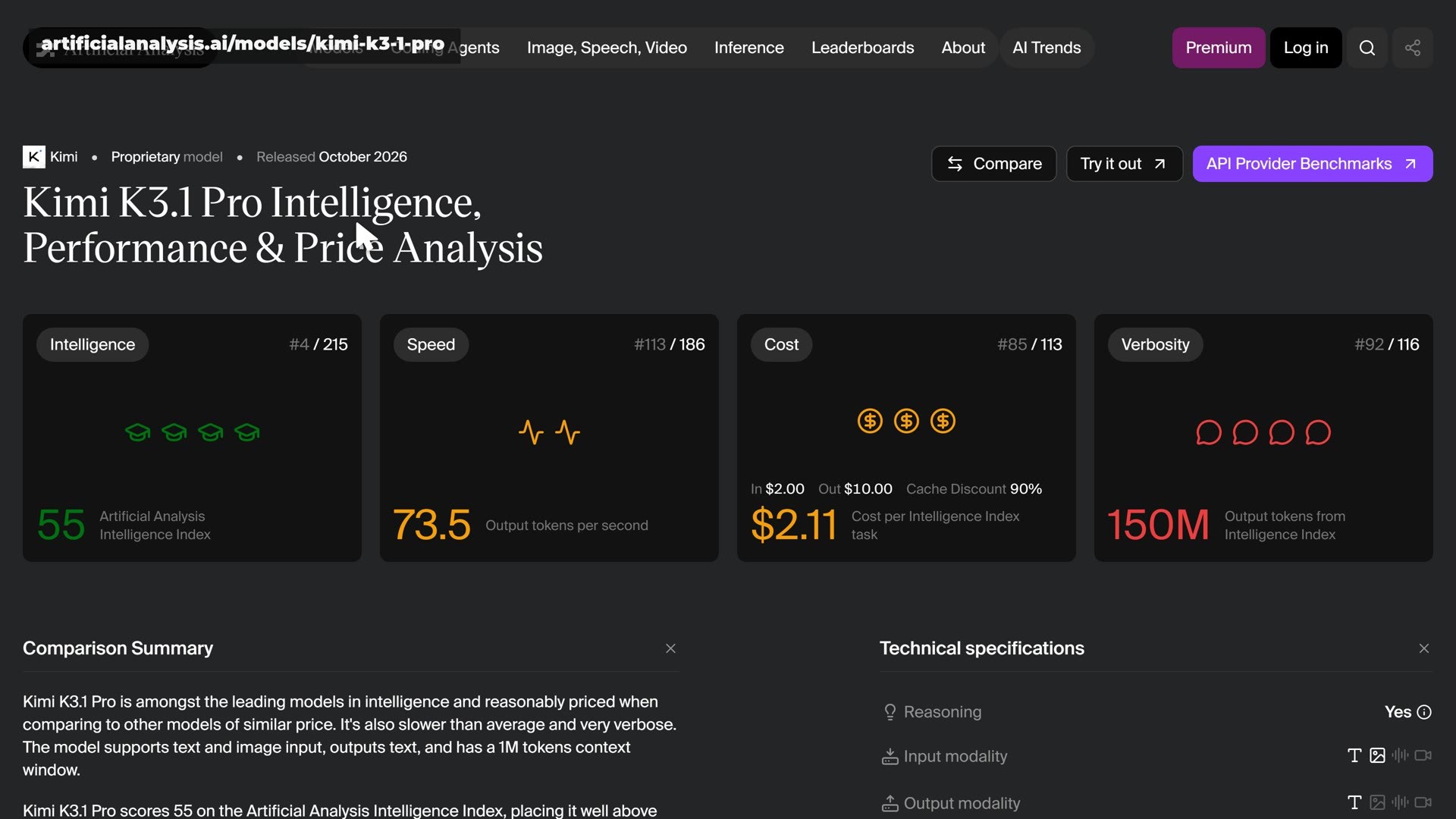
Look at the rest of the same page, though. Speed: 73.5 output tokens per second, which Artificial Analysis rates as slower than average. Cost per index task: $2.11. And verbosity: to run the whole index, Kimi K3.1 Pro generated 150 million output tokens, against a median of 87 million. This is a model that thinks, and writes, a lot. Remember that number, because it is the key to the bill.
The Price, Compared Properly
On the Kimi API platform, Kimi K3.1 Pro costs $2 per million input tokens and $10 per million output tokens. Cached input costs $0.20. That is one third less than Kimi K3, which was $3 and $15. The Highspeed version costs $4 and $20.
Now the comparison that the “cheaper Opus” posts usually skip. On OpenRouter the list prices are:
- Claude Opus 5.5: $4 input / $20 output. Kimi is half the price per token. Not one third, not one fifth.
- GPT-6 Astra: $10 / $50. Against Astra, Kimi is five times cheaper.
- GPT-6.1 Sol: $2 / $10. Exactly the same price as Kimi.
And there is one more thing about cost. Moonshot also sells a monthly coding plan for Kimi Code. One tester on X wrote that they used up their whole five-hour window on the $100 plan in twenty minutes. A Hacker News user, quoted by Handy AI, reported hitting the five-hour limit of the $99 plan within 47 minutes of a single session, without running swarms of agents. Those are two individual reports, not an official figure, but with a model that writes this much, a quota goes fast.
The Part Almost Nobody Is Talking About: Kimi Was Made Worse at Hacking, on Purpose
The most interesting section of Moonshot’s blog is not about coding at all. It is called Cybersecurity, and it explains a choice that is rare in this industry.
While they were training K3.1 Pro, Moonshot noticed that the model’s skill at finding and exploiting software vulnerabilities was rising steadily as training went on. They traced it back to two sources: cyber-related content mixed into the general training corpus, and cyber-related tasks present in the reinforcement-learning environments. In their words, it was “a natural byproduct of training on broad data”. For the open-weights release, they identified that data and removed it from both training stages, while keeping the ordinary coding tasks the model needs to be useful.
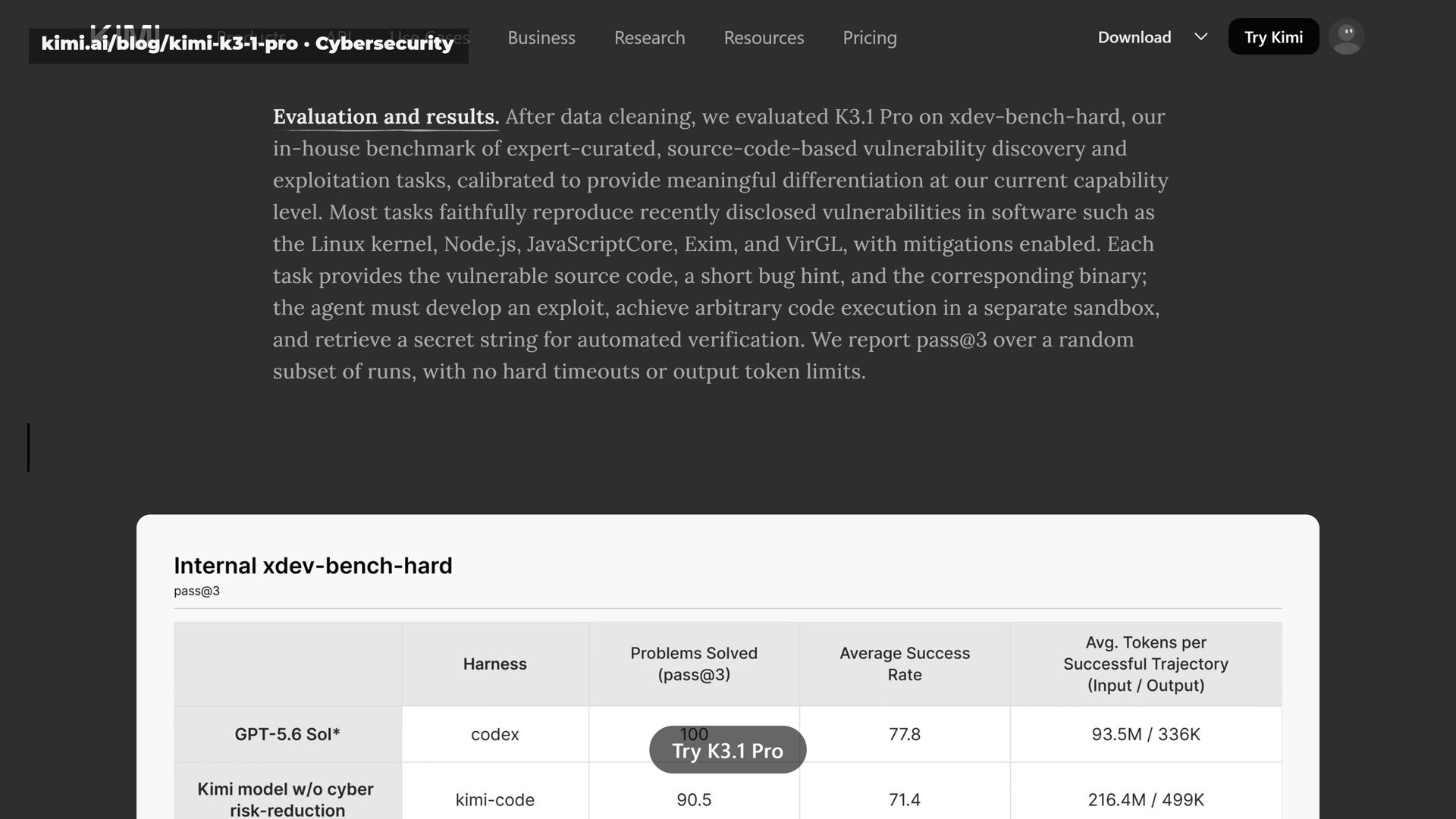
Then they measured the difference on xdev-bench-hard, their in-house test made of real, recently disclosed vulnerabilities in software like the Linux kernel, Node.js, JavaScriptCore, Exim and VirGL. The agent gets the vulnerable code, a short hint and the binary, and has to build a working exploit that runs arbitrary code. The checkpoint trained without the cuts solved 90.5% of the problems. The released Kimi K3.1 Pro solves 81.0%. Kimi K3 solved 33.3%. So the company made its own model weaker on purpose, and it is still far stronger than the previous version, because better general coding and debugging carry over to security work anyway.
Their reasoning is simple. Open weights cannot be taken back once people download them. So Moonshot says it aims “not to release open weights that would extend the absolute frontier of cyber capability”, and that K3.1 Pro stays behind frontier closed models that have been public for at least three months. At the same time, it argues that capable open models help defenders audit their own code, including old systems that rarely get a security review, so it plans to raise the cyber capability of its open releases gradually. Whatever you think of the balance, a lab choosing to hold back its own model before giving it away is the most important news in this release.
What Else Moonshot Showed
Moonshot’s examples are mostly big, long projects. In one internal test, Kimi K3.1 Pro built a simulator of a walking human body on top of human-atlas, an open-source anatomical model with 296 skeletal components and 402 muscles. Over 167 missions and 420 independent reviews, the simulated person went from collapsing within seconds to walking continuously, with alternating strides, for 11.2 seconds. When the arms still did not move correctly, the model did not just keep tweaking the reward: it ran open-loop probes of the physics, then found and fixed 36 errors in how the shoulder-muscle moment arms were calculated, and retrained the controller.
On 3D, Moonshot says K3.1 Pro is strongest at parametric modelling: mechanical parts, architectural models, configurable products, custom furniture. It can write and run its own scripts for Blender and CAD software without MCP connectors, and it works with game engines like Unity, Unreal Engine and Godot. On BenchCAD, rebuilding 3D objects from multi-view pictures through CAD code, it scores 92.7% with tools, against 96.2% for Opus 5.5 and 95.9% for GPT-6 Astra. And on kimi.ai there is a new 3D Make feature to preview a 3D model, edit it and download it for 3D printing. I do not have a Kimi account, so in the video I only showed the public pages, and every generation I made went through the API.
The Community’s First Day
The first tests from the community appeared within hours. The one that went viral: a tester asked Kimi K3.1 Pro and Opus 5.5 to build the same animated voxel pagoda island, with bridges, floating islands and tiny details. The numbers in the clip say $5.71 for Kimi and $17.13 for Opus. Both look great; Opus has a few more small details, but for a third of the cost it is a strong result for Kimi.
A sailing ship on the open sea, Opus on top and Kimi below: Opus has stronger colours and bigger waves, Kimi a sunset and a calmer sea. Honestly, it is close. A running horse in Three.js, against Opus and GPT-6 Astra: that tester found Kimi’s run the most natural, with the mane and tail flowing, Opus smooth but stiffer, and Astra’s horse the most awkward. New York at golden hour: Kimi built the Empire State, the bridges and the rivers, but the tester’s verdict was that it is not as detailed as Opus. And that is the same person who burned through the coding plan in twenty minutes.
Robot ducks: this one was posted by an API reseller, so take it with a grain of salt. They say Opus took three hours and Kimi one, and the cost counters in the clip rise much faster for Opus. Then four models on one prompt, the Arc de Triomphe at sunset in pure Three.js: Kimi made the most detailed one, with sculpted reliefs and a city around it, for about six dollars. But DeepSeek V4.1 Flash came very close for 78 cents. Kimi is cheap against Opus. It is not cheap against everyone.
A peacock in pure SVG code, on maximum reasoning, next to GPT-6 Astra on the same prompt: Kimi’s tail opens and closes like a fan, Astra’s is fuller and more even. And not everything is great: on RoboDojo-RC, a benchmark of real robot tasks, Kimi scored 9%, while Opus 5.5, Gemini 4 Argon and GPT-6 Astra all sit at 47 or 48. Writing code for a robot arm in the physical world is a very different job from building a web page.
My Test: the Same Eight Prompts, the Real Bill
On October 12, for an earlier video, I gave six short prompts to Claude Opus 5.5 and GPT-6.1 Sol: a sixty-second animated life story drawn in code, a voxel castle school for young wizards, a short film about a lighthouse, a 3D showroom for an electric car, a coastal driving game and a browser music studio. On October 17 I gave two more to Claude Fable 5.1, Opus 5.5 and GLM 5.3 Flash: KAZE BLOCKS, a Japanese voxel sandbox, and floating sky islands at golden hour.
Kimi K3.1 Pro got the exact same eight prompts. My script read each prompt from the files saved by the old tests, so not a single character changed. One request per build through OpenRouter, reasoning effort medium, no agent and no second try. For reference, Opus had run on low effort and Sol on medium. One build per prompt is a sample, not a benchmark, so read what follows as what happened on these eight tries.
Floating sky islands: Kimi’s best
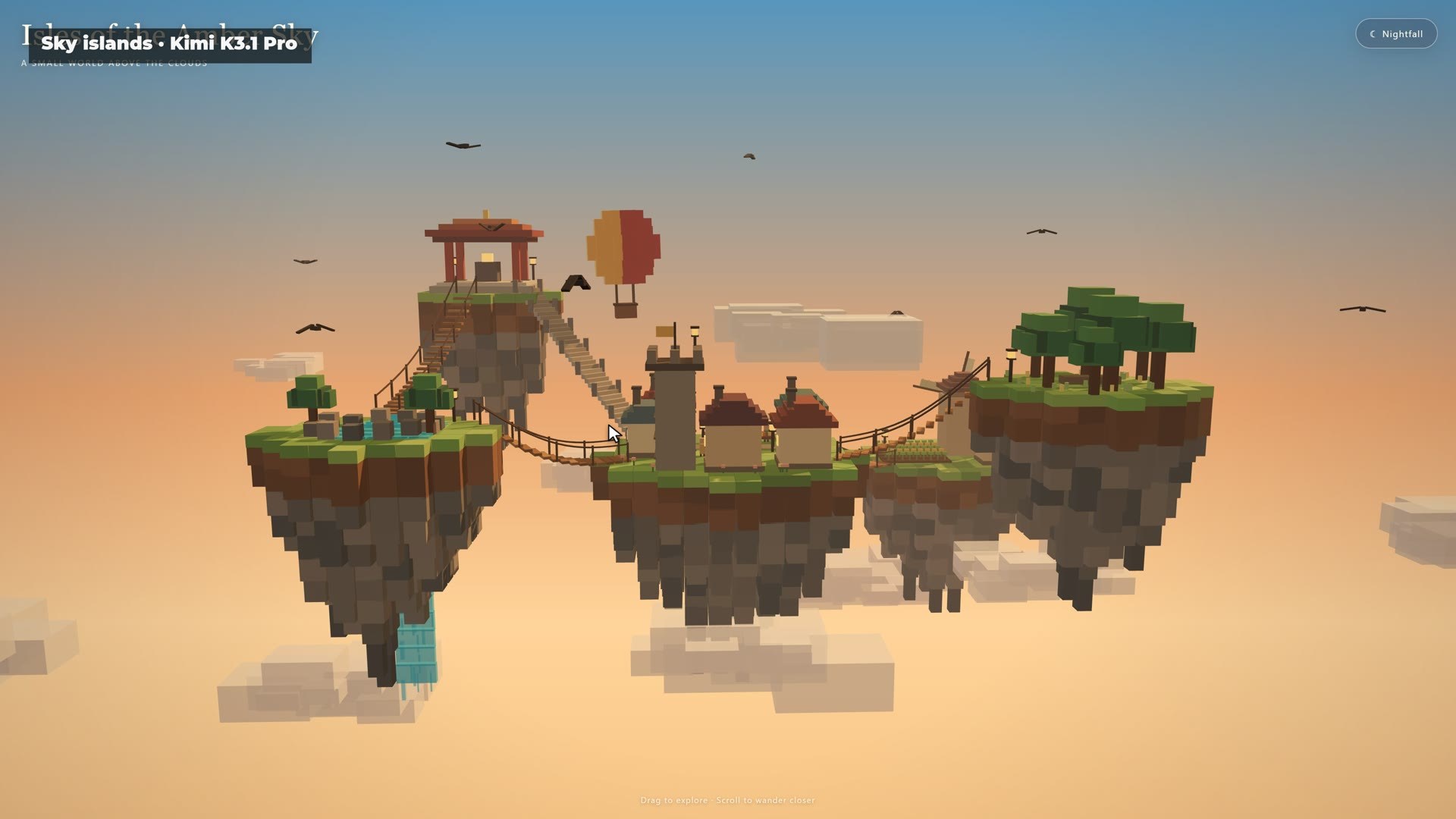
This is where Kimi did best. It called the world “Isles of the Amber Sky”, and it is dense: a village with lit windows, a windmill, rope bridges and a waterfall pouring off the edge into the clouds below. Click the night button and the windows light up. Fable 5.1 on the same prompt made a bigger sun and more birds; Opus a cleaner layout with long rope bridges. For me, Kimi’s islands are the richest of the four, and they cost fifteen cents.
The wizard castle
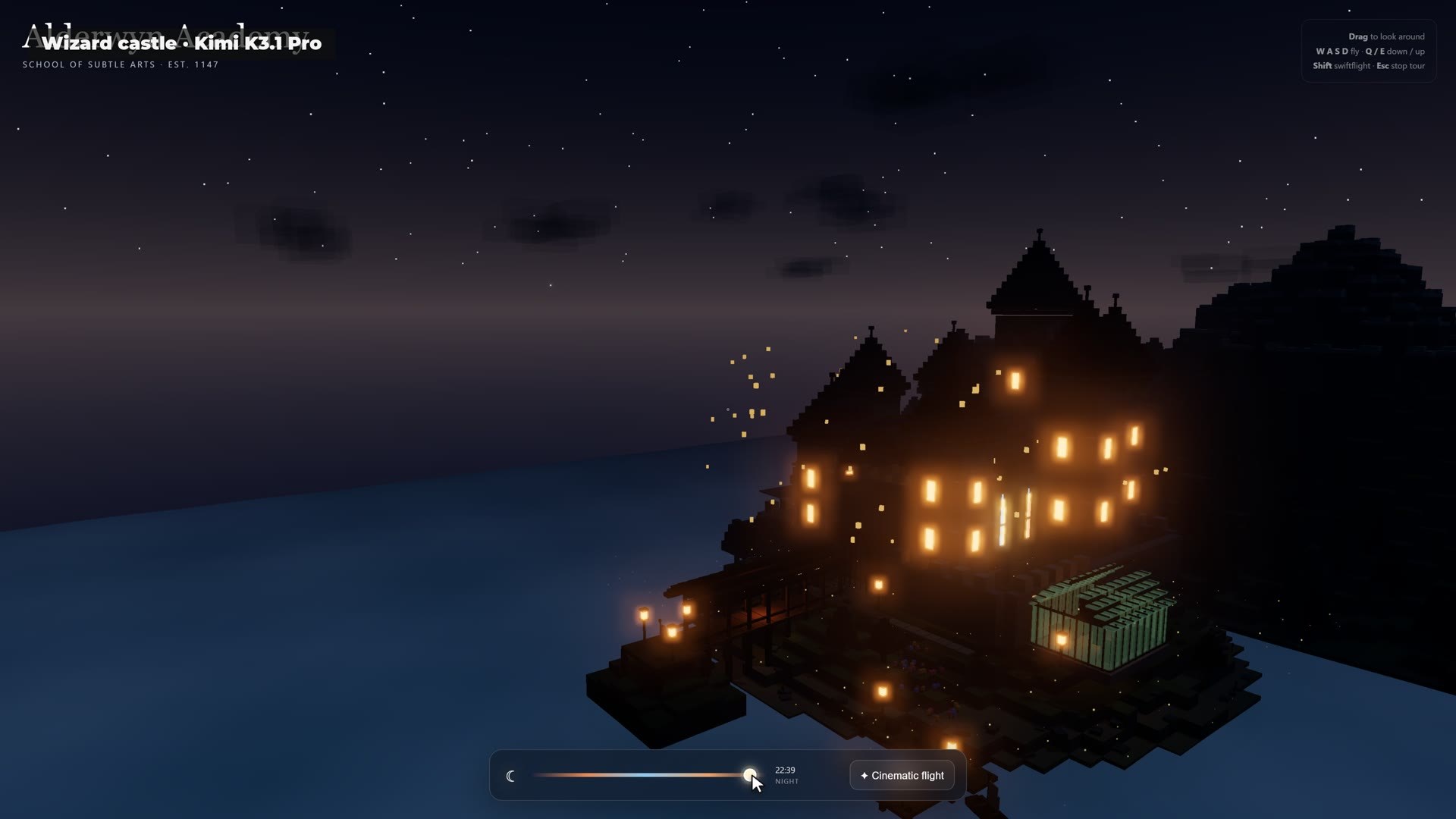
Kimi named its castle school Alderwyn Academy: towers with pointed roofs, a covered wooden bridge, a glass greenhouse and boats by the dock. Move the time slider to night and lanterns and fireflies come out over the lake; the cinematic button flies the camera around the castle on its own. Opus built a bigger world, with snowy mountains and a round lake; Sol made Morrowmere, softer and foggier. Three very different castles, and all three work.
The short film
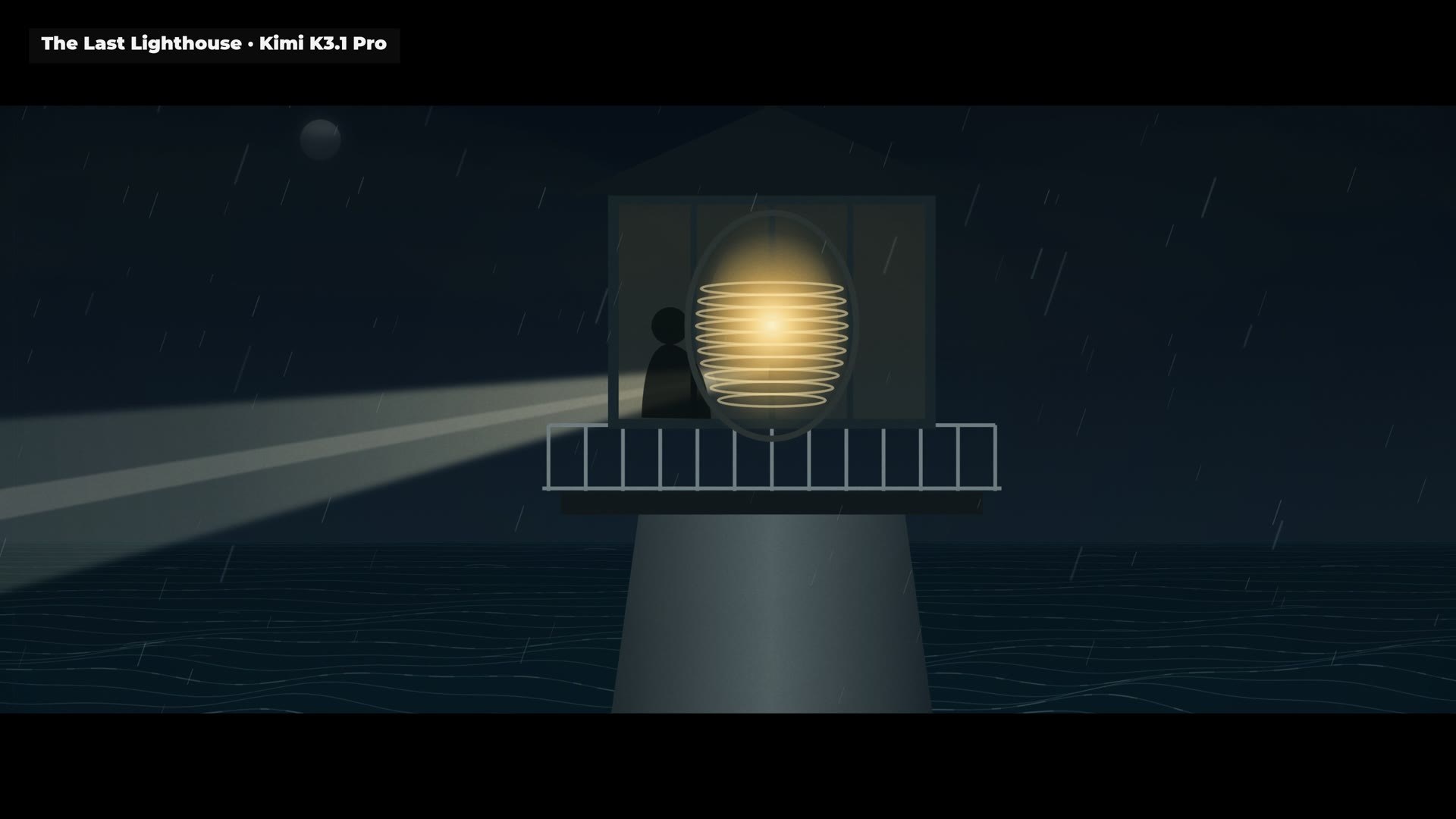
For The Last Lighthouse, Kimi chose an illustrated look: the storm, the beam sweeping the sea, the little fishing boat, the keeper inside the lamp room, then the dawn. Opus had the most dramatic storm, but its original file did not run until I fixed one line in October. Sol went for low-poly 3D.
The life story: Kimi’s one bug
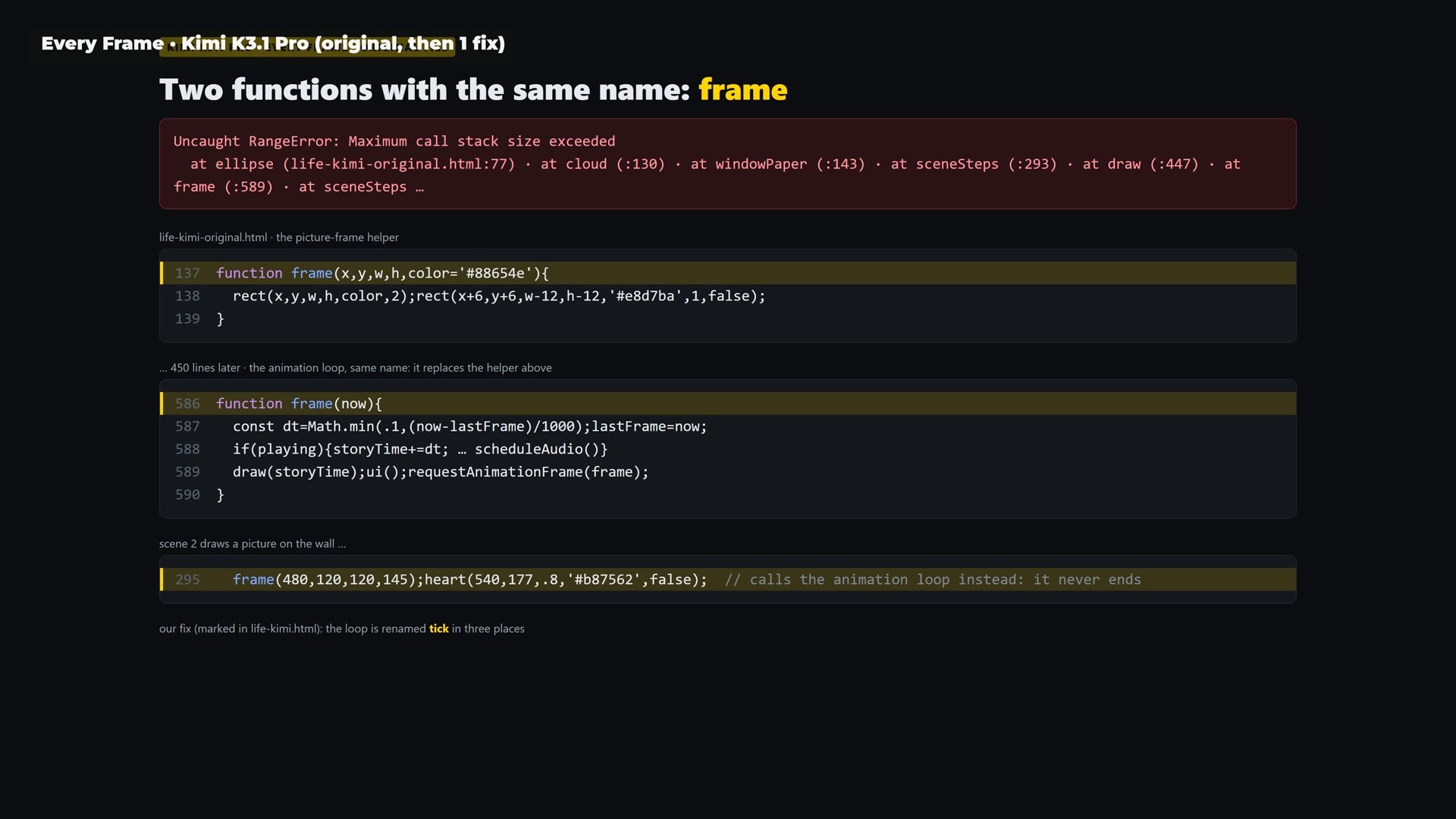
Every Frame is where Kimi stumbled. Press play: a heartbeat, the baby in the cot, and then it stops. It stays on the baby forever. The reason is in the code. Kimi wrote two different functions with the same name, frame: one draws the picture frames hanging on the walls, the other runs the animation loop. In JavaScript the second declaration replaces the first, so as soon as scene two tries to draw a picture on the wall, it calls the animation loop instead, which calls the scene again, until the browser gives up. I renamed the loop to tick, in three places, and the film now plays to the end: school, work, family, the walk in the park, and the armchair at the end. Funny detail: Opus made exactly this kind of mistake in my driving game test, a name used twice. Both versions are published, the original and the marked fix.
The SUV showroom
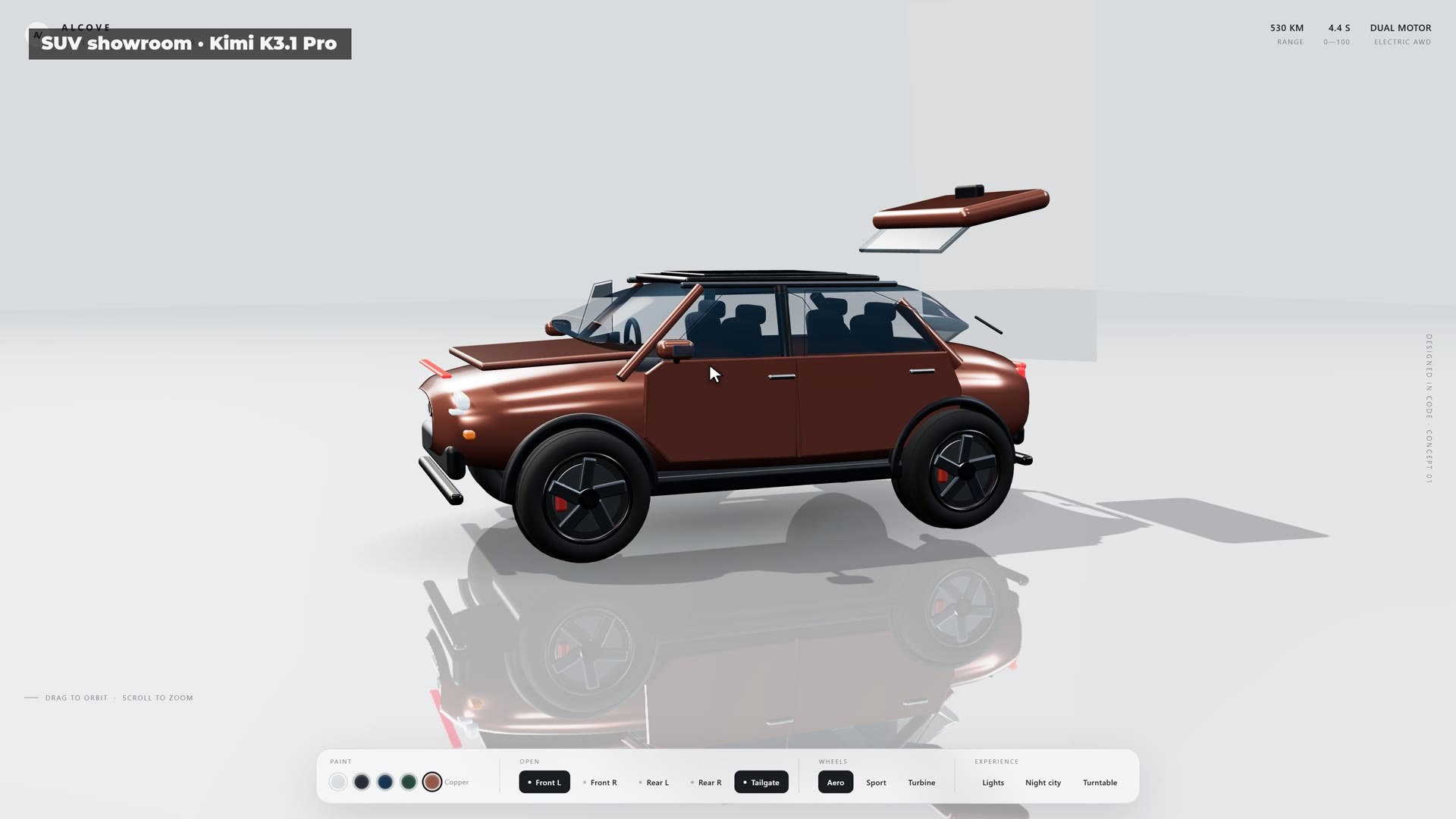
Kimi called its car Alcove E-01. Every control works: the paint swatches, the doors, the wheels, the lights, the night city and the turntable. But open the tailgate and it flies off the car and floats in the air above the roof. That is a real bug, and I left it as it is. Opus made a dark studio with a spotlight; Sol a clean configurator that looks like a car brand’s own website.
Driving game, music studio, KAZE BLOCKS
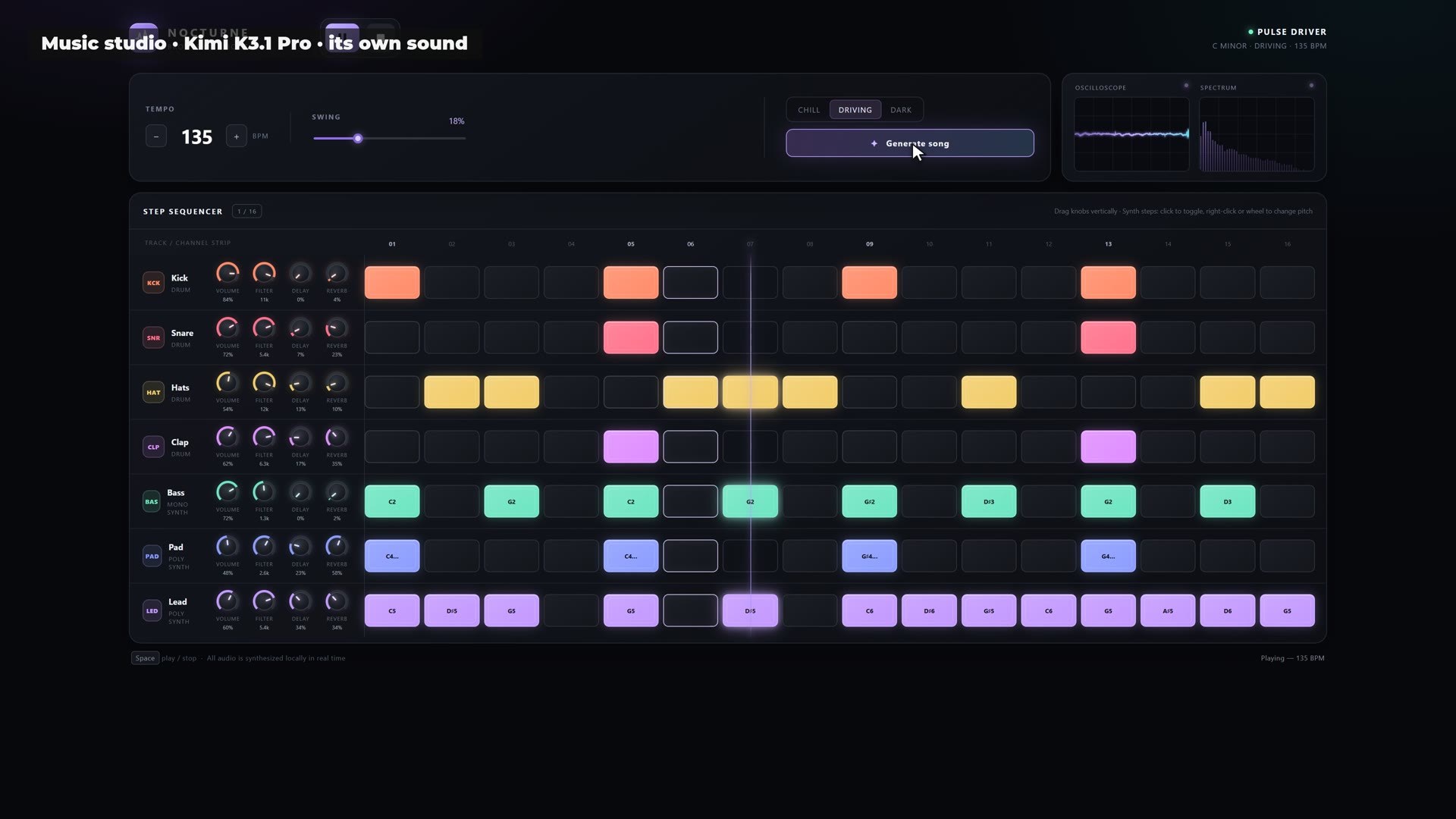
The driving game is called Coastal Drift: a sunset over the sea, guard rails, a speed dial, drifting with tyre smoke and a “Wrecked” screen when you hit the rail. It works, and it is fun for a minute. The music studio is called Nocturne, and GPT-6.1 Sol, a few days earlier, chose the very same name for its own. Every track has its own knobs; press Generate song on the “driving” mood and it writes a beat, a bass line and a melody, and the “dark” mood changes the tempo and the pattern. In the video you can hear the song it made. KAZE BLOCKS is a torii path to a shrine with cherry trees and a pond, and the autopilot walks around and builds on its own.
The Bill
Here is the cost table from the gallery, as billed by OpenRouter.
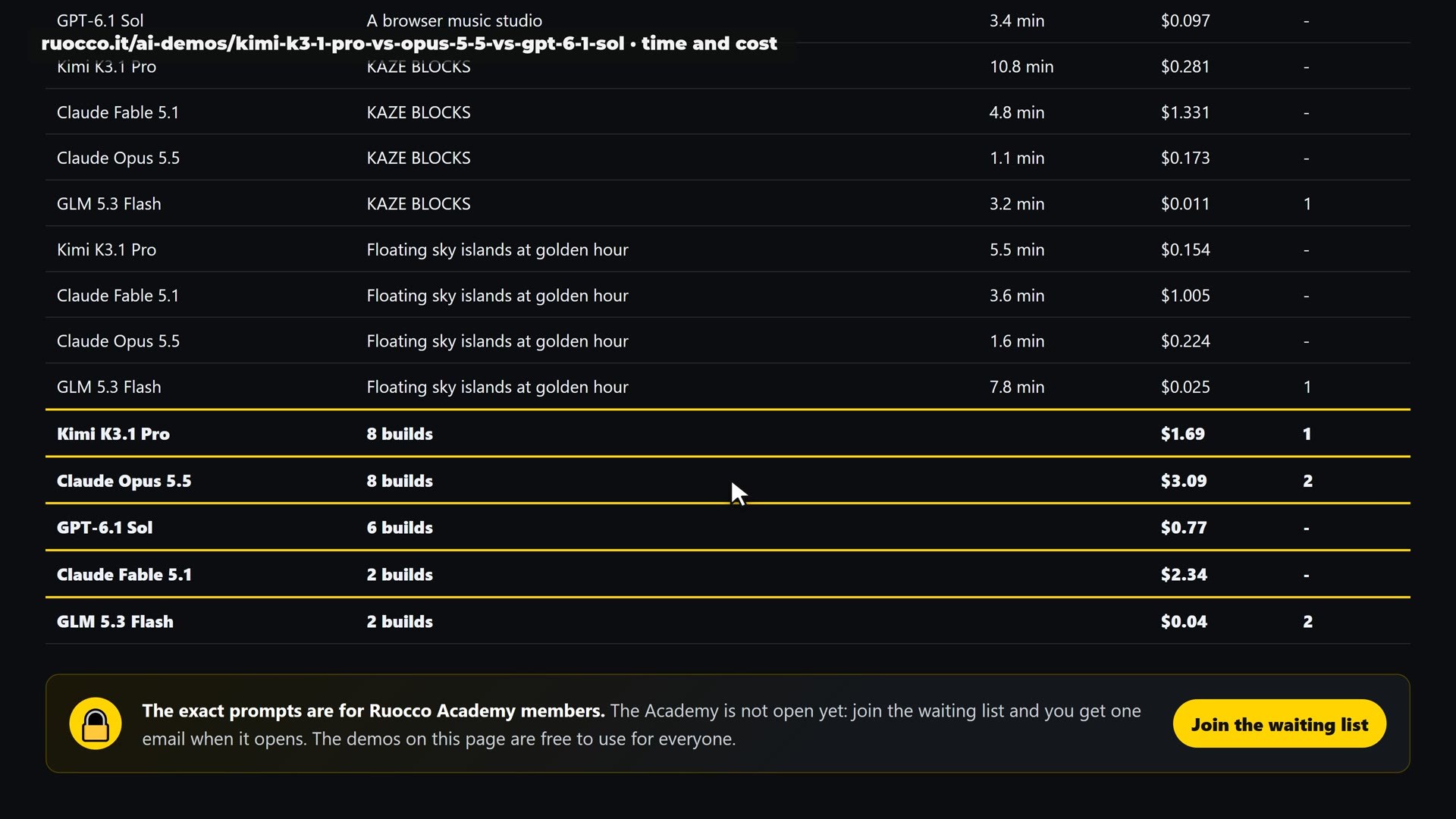
- Kimi K3.1 Pro, 8 builds: $1.69 in total, about $0.21 per build. One fix.
- Claude Opus 5.5, the same 8 prompts: $3.09, about $0.39 per build. Two fixes.
- GPT-6.1 Sol, its 6 prompts: $0.77, about $0.13 per build. No fixes.
- Kimi on those same 6 prompts: $1.26.
- Claude Fable 5.1 (2 builds): $2.34. GLM 5.3 Flash (2 builds): $0.04, with two one-line fixes.
So yes, Kimi cost about half of Opus, and it shipped fewer broken files. But here is the number that surprised me. On the six prompts of the first test, GPT-6.1 Sol cost 77 cents and Kimi $1.26. Same price per token, and Sol ran all six without a single fix. Why? Because Sol wrote fewer tokens for the same job. Kimi was also the slowest of the three: between five and eleven minutes per build, while Opus took one to seven minutes.
My Take
Kimi K3.1 Pro is a real model, and at least in 3D it is right up there with the best. Its sky islands are my favourite build of this whole test, and seven of its eight files ran first time. It costs about half of Opus, not the one third that some posts claim, and it is not cheaper than GPT-6.1 Sol. The price per token is only half the story: what you actually pay depends on how much the model writes, and Kimi writes a lot.
The most important part is still to come. If the weights really arrive by November 4, anyone with the hardware will be able to run a model this close to the frontier on their own servers, with their data never leaving the building, and with the hacking skills deliberately trimmed first. That is a bigger deal than any single benchmark.
Try Every Demo, and Get the Code
All 26 builds from this test are free to open and play in your browser: Kimi K3.1 Pro’s eight, next to the builds of Claude Opus 5.5, GPT-6.1 Sol, Claude Fable 5.1 and GLM 5.3 Flash on the exact same prompts, with the time and the cost of each one. Cards that needed a fix say so, and the original files are published too.
- Gallery: ruocco.it/ai-demos/kimi-k3-1-pro-vs-opus-5-5-vs-gpt-6-1-sol
- All my AI demos: ruocco.it/ai-demos
- Exact prompts, settings and full source code: in the Ruocco Academy. It is a waiting list for now: leave your email and you will be the first to know when it opens.
How I Tested, and What I Could Not Verify
- One request per build through OpenRouter (provider: Moonshot AI), no agent, no retry. Kimi K3.1 Pro at reasoning effort medium on October 24, 2026; Opus 5.5 low and GPT-6.1 Sol medium on October 12; Fable 5.1, Opus 5.5 and GLM 5.3 Flash low on October 17. The prompts are byte-identical across models.
- Costs are as billed by OpenRouter. One build per prompt is a single sample, not a benchmark, and the effort settings are not identical across models.
- Fixes are the smallest change that made a build run, marked in the file. Kimi’s floating tailgate was not fixed.
- The benchmark figures are Moonshot’s own unless marked as Artificial Analysis. The open weights are promised, not yet released.
- The community clips are their authors’ tests and opinions. The coding-plan limits are reports from individual users.
Sources
- Moonshot AI, Kimi K3.1 Pro tech blog (benchmarks, footnotes, cybersecurity, availability)
- Kimi API pricing
- Moonshot’s launch post on X
- Artificial Analysis, Kimi K3.1 Pro
- The Decoder, full benchmark table
- TNW, Moonshot cuts Kimi’s hacking skills
- Handy AI, Model Drop: Kimi K3.1 Pro
- OpenRouter prices: Kimi K3.1 Pro, Claude Opus 5.5, GPT-6.1 Sol, GPT-6 Astra
- Community tests on X: @adxtyahq, @Da7_Tech, @NFT_Chen, @aipulseda1ly, @aimlapi, @thehypedotnews, @lyraxana, @robocurve (CC BY 4.0)
KAZE BLOCKS is an original game written by AI models; “Minecraft-style” only describes the genre. Not affiliated with Mojang or Microsoft.
If you like tests like this one, with real prompts, real builds and the real bill, subscribe to VitoMind on YouTube. See you in the next one.