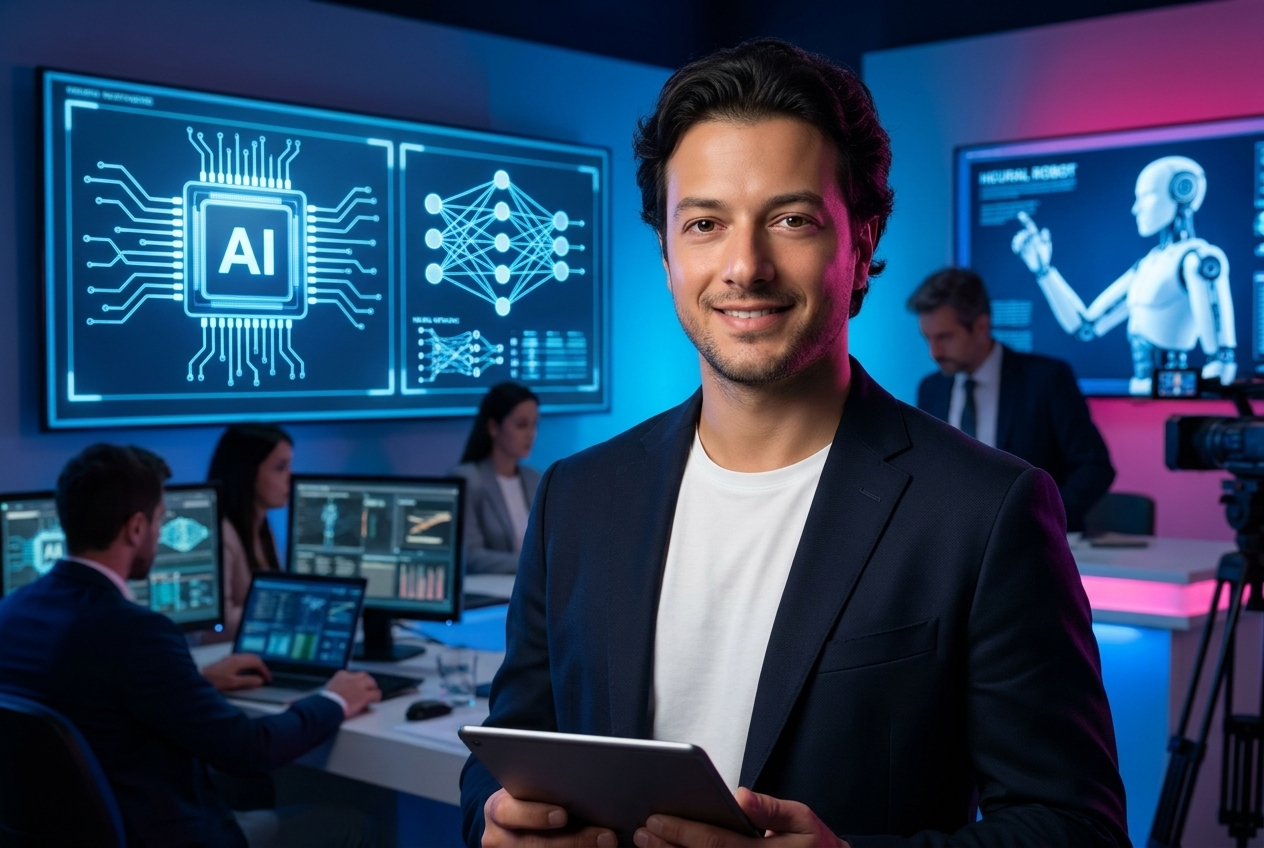
The AI World Woke Up to a Scandal: Nvidia Under Siege, Robots That Feel, and the $0.10 Model That Humiliates Giants
November 11, 2026 — by Vito Ruocco
There are mornings when the technology industry shuffles through routine announcements — a chip refresh here, a model update there — and then there are mornings like this one. If you follow artificial intelligence even casually, the past 48 hours have felt less like a news cycle and more like a season finale: the CEO of the most valuable company on Earth admitted to an affair with a woman accused of being a Chinese intelligence asset, humanoid robots quietly hit a 96 percent success rate on real Mercedes-Benz production lines, Meta shipped a model so cheap it costs about fourteen cents per benchmark task, and Google unveiled two new TPU systems in a single week. It is a lot. So let’s unpack it, because each of these stories tells you something important about where AI is heading — and about who controls it.
This is your daily briefing for November 11, 2026: the espionage story that could reshape the US-China AI race, the robotics milestone that moves physical intelligence out of the lab, the efficiency war erupting in model pricing, and the quiet infrastructure arms race happening underneath it all.
The Bombshell: Jensen Huang and the Alleged Spy
Start with the story that has everyone talking. Jensen Huang, co-founder and CEO of Nvidia — the company that effectively controls the world’s supply of advanced AI accelerators — has acknowledged an extramarital relationship with Alice Huang (no relation), a former television reporter turned executive at a company called Megaspeed, whom US intelligence reportedly believes was recruited by China’s Ministry of State Security.
The details, pieced together by The New York Times and reported widely across the industry, are staggering. Megaspeed — a company with reported ties to the Chinese military that builds data centers in Southeast Asia to sell compute to Alibaba — purchased roughly $4.8 billion worth of hard-to-get Nvidia chips, with some industry reporting putting the total enabled sales at over $7 billion. The relationship between Jensen Huang and Alice Huang reportedly began around the time they were photographed together at a bar in Taipei in 2024. A memo reportedly overseen by Secretary of State Marco Rubio, detailing her recruitment and her relationship with the Nvidia CEO, circulated in May — and President Donald Trump was reportedly briefed on the findings but took no action.
Nvidia’s own response has been a masterclass in damage control that keeps generating more damage. A spokesperson told the Times that Nvidia “does not disclose classified information to customers” and that Huang’s interactions with Alice Huang were “not unusual.” Two days later, Jensen Huang sent the now-famous email “To my colleagues at Nvidia,” admitting he had been “unfaithful” and apologizing to his wife and family — family members who, notably, also happen to work at Nvidia. His son is a director of product management; his daughter is a senior marketing director.
The company has opened an investigation into its own CEO, who is also its largest individual shareholder. Nvidia’s stock slid roughly five percent in the days following the revelations.
Why This Matters: Nvidia Is the Gatekeeper of Compute
It is tempting to file this under celebrity scandal and move on. That would be a mistake, because Nvidia occupies a position with no historical parallel. The simplest way to understand it comes from The Economist: Nvidia is effectively the central bank of AI. It finances AI neoclouds, holds investments in companies across the ecosystem — including OpenAI, CoreWeave, and SpaceX — and its chips are the scarcest, most essential resource in the industry.
Every frontier AI lab — OpenAI, Anthropic, Meta, Google, and dozens of Chinese rivals — depends on Nvidia’s GPUs to train and run models. The US government has restricted the export of the most advanced chips to China, betting that the bottleneck would keep America’s lead in AI intact. China has responded by making domestic chip production a strategic national priority and by building a thriving black market for restricted Nvidia hardware. In this context, a CEO who was personally close to a suspected Chinese intelligence operative — and who has lobbied aggressively to loosen export controls while enjoying direct access to the President — represents a systemic vulnerability, not a personal one.
“When so much of America’s AI infrastructure depends on one company, any significant security or governance problem at Nvidia can create uncertainty across the industry,” Kyle Chan, a fellow at the Brookings Institution, told The Verge.
What China Could Actually Gain
Experts are careful to note that there is no public evidence Jensen Huang knowingly helped funnel restricted chips to China or handed over blueprints for next-generation silicon. But espionage doesn’t only travel through stolen documents. Sunny Cheung, a fellow at the Jamestown Foundation, argues that too much attention is focused on trade secrets. The far more realistic prize, he says, is strategic intelligence: insight into how American companies plan their infrastructure expansions, their compute requirements, their pricing, and their long-term roadmaps — not to mention the private views of Silicon Valley executives on China and Taiwan, and the White House’s internal thinking on export controls.
Emily Kilcrease, senior fellow at the Center for a New American Security, puts the stakes in the starkest possible terms: without access to the latest Nvidia chips, China “cannot close the gap with US frontier capabilities.” But with them? “The US lead could vanish in a matter of weeks or months.”
There is also the disruption angle. Nvidia’s unusual corporate structure — the CEO reportedly has roughly 60 direct reports — means no part of the company is untouched by the crisis. Investigations “will consume an immense amount of bandwidth within the company,” Kilcrease warns, and if the distraction slows product rollouts or chip allocation decisions, the cost lands directly on the AI labs waiting for compute. In a race measured in months, delay is defeat.
The Political Shockwave: From Rubio to Warren
The scandal has detonated in Washington precisely as the political landscape shifts. The Democratic Party recently swept back into power in the midterms, and Senator Elizabeth Warren has already issued pointed statements on the reports. Members of the House Foreign Affairs, China, and Intelligence committees have requested a closed-door briefing with Jensen Huang on November 18 to discuss the company’s “security protocols against foreign adversary espionage.”
The politics are delicious and dangerous in equal measure. Trump’s relationship with Huang — he personally intervened to add the Nvidia CEO to the China trip guest list — makes Huang a convenient target for any politician looking for daylight from the outgoing administration. Rubio’s name attached to the memo gives him a hawkish talking point. And the midterm backlash against data centers that house Nvidia’s chips gives ambitious politicians a ready-made populist angle: the AI boom’s physical footprint is unpopular, and now its most prominent CEO is compromised.
The most immediate legislative consequence, according to Kilcrease: “The odds of AI chip control legislation being passed in Congress just went through the roof.” The era of Nvidia’s lobbying dominance in Washington may be ending.
Meanwhile, the Robots Got Hands: Gemini Robotics 2.5
Amid the corporate drama, the actual science kept moving. On November 10, Google DeepMind introduced Gemini Robotics 2.5, its most capable vision-language-action (VLA) model to date — and the numbers are genuinely impressive.
The model was evaluated across more than 200 distinct tasks, from serving food with tongs to tying a bow on a gift box to pipetting liquid. Compared to previous baselines, Gemini Robotics 2.5 achieves a 30 to 100 percent higher success rate depending on task type, while completing tasks 20 to 30 percent faster. It natively drives multiple robot platforms, including Apptronik’s Apollo 2 humanoid — featuring the five-finger, 22-degree-of-freedom SharpaWave hand — and Franka’s dual-arm platforms.
“We’re enabling robots to learn faster for the real world — from everyday skills to the factory floor,” wrote Carolina Parada, DeepMind’s head of robotics, in the announcement. The model combines advanced tool use, complex manipulation of deformable objects, and handling of delicate items with what DeepMind describes as “finesse.”
The Mercedes-Benz Pilot: 96 Percent, on Real Lines
The most consequential number in the robotics announcement isn’t a benchmark score — it’s 96 percent. In a proof-of-concept conducted with Apptronik and Mercedes-Benz on active automotive production lines in Kecskemét, Hungary, and Sindelfingen, Germany, the Apollo 2 humanoid autonomously performed automotive kitting: reaching into supply bins, picking up metal brackets, and placing them in the exact order needed for each vehicle — all while correcting for gaps and adapting to an unpredictable factory environment.
This is the difference between a demo and a deployment. Robots have long struggled with unstructured environments — the “real world tax” that keeps them confined to cages and conveyor belts. By pairing the embodied reasoning model (Gemini Robotics ER) to track workflow with the 2.5 actions model to control hands and arms, Google DeepMind is attacking precisely that problem. The company frames it as “a promising step toward widespread real-world industrial applications,” and it’s easy to see why: if a humanoid can hit 96 percent on monotonous kitting work, the business case for replacing that labor — or rather, freeing technicians for complex build tasks — writes itself.
Safety advances accompanied the capability jump. The model uses inference-time reasoning guidance to steer around physical hazards, boosting safe task completion by 33 percent around obstacles and 43 percent around people in evaluations. And with robotic jailbreaks in mind, DeepMind released ASIMOV-Jailbreak, an open-source benchmark of hundreds of adversarial prompts across dozens of scenes, on which the underlying Gemini 4 Argon model achieved 99.5 percent jailbreak resistance, up from 82 percent on the previous baseline.
Notably, the entire development loop was accelerated by another Google model: Gemini 4 Argon acted as a simulation engine, generating thousands of varied practice runs from real-world camera scenes and building digital twins — a taste of AI helping build AI, compounding the pace of progress.
Meta’s Muse Ember: The $0.10 Model That Bothers the Giants
On the model front, Meta made a quietly aggressive move on November 9 with Muse Ember, which it describes as its smallest and most efficient model. The pitch is not raw intelligence — it’s intelligence per dollar.
The numbers are the story. Muse Ember costs $0.10 per million input tokens and $0.50 per million output tokens, with a 1M-token context window and up to 512K output tokens. Meta claims it “delivers more intelligence per dollar than Claude Haiku 5.5 or GPT-6 Luna at any reasoning setting”: it matches Haiku’s best score at about one-third the cost and beats every Luna setting on the company’s internal composite. On the Artificial Analysis leaderboard, Meta says, no model scores higher for less per task — roughly $0.14 per task at list pricing, versus $2.39 for its own larger Muse Spark.
The design target is telling: Muse Ember is built for “the work agents repeat all day” — tool calls, coding subtasks, routing, extraction, and long-document parsing. Agents burn most of their tokens on many small, structured steps, so a model that’s cheap, fast, and natively multimodal (text, image, audio, video) becomes the workhorse underneath everything else. The strategy is explicit: “Muse Wonder plans, Muse Ember handles the volume.” It is the first model trained using Muse Wonder Full, and Meta frames it as the first step toward models “efficient enough to run in every product, for everyone.” Early partner praise, from Box’s VP of AI Products among others, emphasizes accuracy, speed, and token efficiency on real enterprise workloads like contract review and candidate screening.
Google’s Silicon Blitz: TPU 8tx and 8i Max
Underneath all of this — the models, the agents, the robots — runs the hardware arms race. Google used this week to announce two new eighth-generation TPU systems, TPU 8tx and TPU 8i Max, completing four new TPU systems in a single year: a pace the company says has never happened before.
Each system targets a distinct bottleneck of the agentic era:
- TPU 8tx — built for secure and confidential inference, pairing training-grade compute with hardware-level encryption and 5th-generation AMD EPYC hosts. Regulated enterprises and governments can fine-tune models on private data, distill large models, and run agents without data ever leaving protected memory. It delivers up to 2x lower latency than TPU 8t thanks to the low-latency Boardfly network.
- TPU 8i Max — engineered for the “memory wall.” Two low-latency TPU 8i chips are combined on a single package, doubling compute, SRAM, and HBM bandwidth, and fitting twice the silicon into the same rack footprint for maximum compute density. It’s aimed squarely at massive context windows: dozens of agents reasoning across an entire codebase or hours of video at once.
The software story is arguably as important as the silicon. Google open-sourced TorchTPU last month so PyTorch code and Hugging Face models run natively on TPUs; it’s shipping a TPU agent suite that plugs into Claude Code, Cursor, and Google Antigravity to automate onboarding; and it claims state-of-the-art price-performance on the InferenceX and AgentX benchmarks with its native vLLM-TorchTPU stack. TPU Sync — an open-source “model-state layer” — tiers massive KV caches off-chip in milliseconds, cutting KV transfer latency and time-to-first-token by more than 90 percent. And Cloud Pathways, the DeepMind runtime behind Gemini, is now generally available on Google Kubernetes Engine, letting customers orchestrate TPU slices as if they were one machine.
Even the chip design loop is now AI-driven: Google says it uses AlphaChip reinforcement learning and Gemini to deliver chip layouts “in hours rather than weeks.” The next generation of TPUs is being designed, in part, by the previous one.
Agents Everywhere: ChatGPT Goes Shopping, Muse Reads Your Email
The agentic wave continued on the product side too. OpenAI’s ChatGPT introduced new AI agents that can represent users commercially — handling things like comparison shopping on the user’s behalf, a meaningful step toward the “delegate an errand to an AI” vision OpenAI has been selling for years. It’s early days, but the direction is unambiguous: chatbots are becoming doers, not just talkers.
Meta’s Muse assistant, meanwhile, gained email superpowers. The company is rolling out email addresses for Muse, which means you can add it to a thread or forward an email and it will “handle the replies and follow-ups for you,” according to Meta’s VP of AI products, Vishal Shah. The feature is coming to paid Muse subscribers in the US and Canada. Combined with Muse Ember’s economics, Meta is clearly positioning itself as the default agent workhorse: cheap inference, practical automation, tiny model footprint.
Google also shipped a quietly valuable trust feature: Gemini Memory summary lets US users with an active Google AI plan view, edit, and delete what Gemini Apps understands about them — an acknowledgement that as assistants accumulate personal context, transparency and control become product features, not afterthoughts.
The Little Things: Spotify DJ Grows Up, Ring’s Drone Returns
Not everything this week was geopolitics and megamodels. Spotify’s AI DJ gained eight new English voices in various accents plus two Spanish voices, and — for the many people who find the between-song commentary charming for exactly one song — the ability to turn the talking off entirely.
On the hardware-adjacent front, Amazon’s Ring confirmed that its smaller, cloud-piloted Drone Cam will ship in January, six years after the original Always Home Cam project failed to take flight. And on a more sobering note, the RIAA’s fight over AI-generated music continued to make strange bedfellows, with music fans and the industry’s top lobbyist briefly finding themselves on the same side of a copyright dispute.
Even Meta’s research pipeline got into the act: the company says Muse Ember’s efficiency push is only the beginning, with “even more efficient models in training.” The era of trillion-dollar training runs is giving way to something more interesting — the era of making every dollar of inference count.
What to Watch Next
If there is a through-line to this chaotic 48 hours, it’s this: the center of gravity in AI is shifting from raw capability to control and efficiency. The Nvidia scandal is a reminder that compute is not just a technical resource but a strategic and geopolitical one — and that its gatekeepers are human, with all the fragility that implies. The robotics milestone is a reminder that the physical world is the next frontier, and that the gap between lab demo and factory deployment is closing fast. Muse Ember and the TPU announcements are reminders that the next competitive battleground is cost and infrastructure: who can deliver the most intelligence per dollar, and who controls the silicon underneath.
Over the next weeks, three questions will dominate:
- Can Nvidia contain the fallout? Congressional briefings, a company investigation, and a shaken stock price are just the beginning. If investigators find evidence of actual data access or chip diversion, the “irreplaceable” argument for keeping Huang in place collapses.
- Will Washington act? Export control legislation suddenly has bipartisan tailwinds. The question is whether it arrives as targeted reform or as a blunt instrument that slows the entire US AI industry.
- Who wins the efficiency war? Meta is pricing models at pocket-change levels, Google is stacking TPUs a generation at a time, and OpenAI is pushing agents into commerce. The winners will be the companies that turn intelligence into a utility — cheap, everywhere, and trustworthy enough to delegate real work to.
One thing is certain: the AI industry no longer gets quiet news cycles. Whether it’s a spy story, a robot hand, or a price war, the pace of change is accelerating — and the stakes keep getting higher. Stay tuned; tomorrow will almost certainly bring something new.
Article by Vito Ruocco — published on ruocco.it, November 11, 2026. Sources: The Verge, Google DeepMind, Meta AI Research, Google Cloud Blog, The New York Times, The Economist, CNBC, Axios.