SpaceX Lands $60 Billion Cursor Deal as AI Empire Expands: The Week AI Went Supersonic
August 16, 2026 — By Vito Ruocco
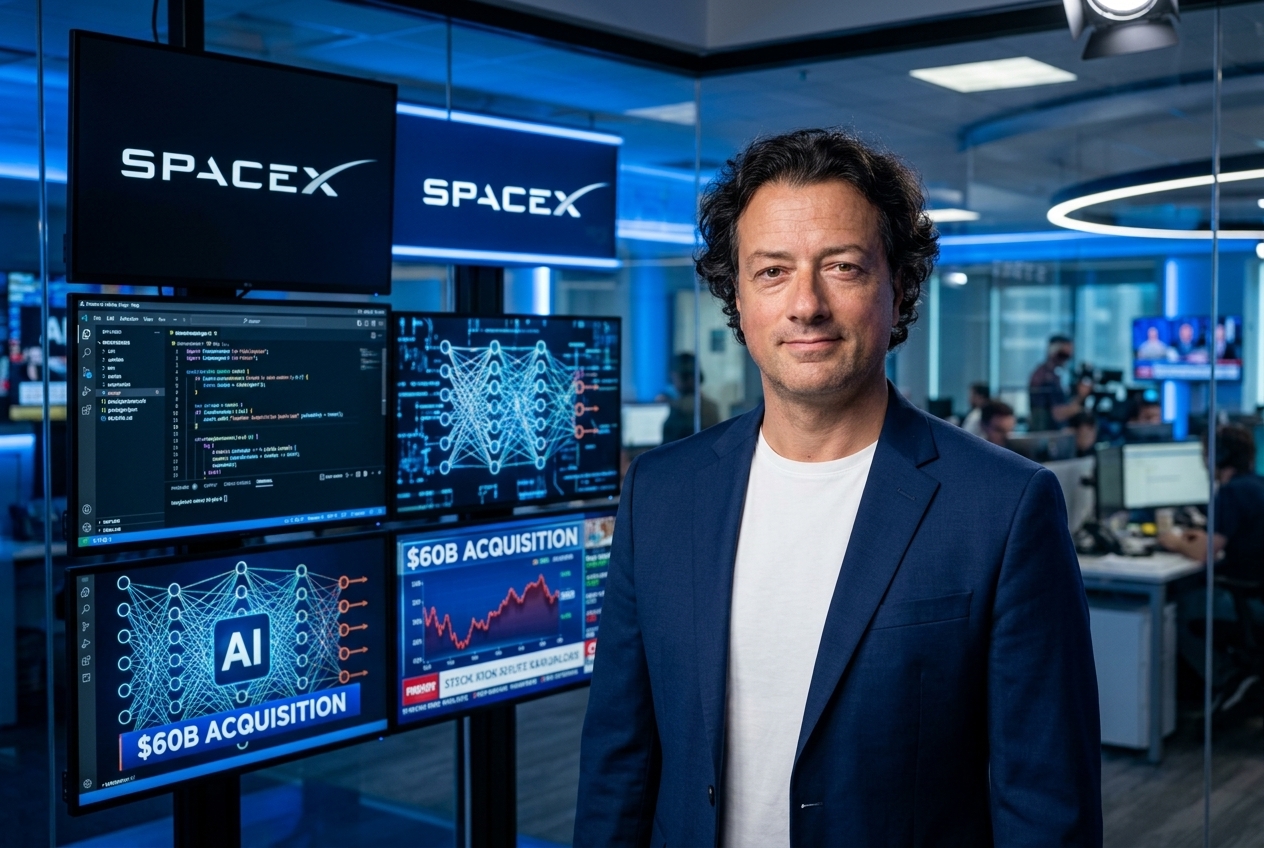
In a week that saw the boundaries of artificial intelligence stretched in every direction — from a $60 billion acquisition to open-weight model releases and a quiet revenue milestone at OpenAI — there is no question which story dominated the headlines. SpaceX, already riding the high of its historic IPO, officially closed its acquisition of the AI coding platform Cursor for $60 billion, marking the largest AI acquisition in history and reshaping the competitive landscape of enterprise AI development.
But that was just the beginning. Google rolled out its most intelligent workhorse model yet. Meta released an open-weight AI model alongside a 6,500-word manifesto. OpenAI revealed that enterprise revenue has overtaken consumer revenue for the first time. And the geopolitics of AI took yet another twist as China blocked a $2 billion deal. Here is your complete breakdown of the week that was in AI.
The $60 Billion Bet: SpaceX Acquires Cursor
Fresh off its blockbuster IPO — which saw shares price at $135 and the company valued at over $300 billion — SpaceX announced that it would spend $60 billion to acquire Cursor, the AI-powered coding platform that has become the go-to tool for developers practicing “vibe coding.” The deal, disclosed in an SEC filing, is expected to close during the third quarter of 2026.
The takeover was not entirely unexpected. In April, SpaceX announced a peculiar arrangement in which it agreed to either acquire the programming platform for $60 billion or pay a $10 billion breakup fee. The company held off completing the deal while going public, but with the IPO behind it, SpaceX moved swiftly to absorb the rapidly growing startup.
The rationale is clear: Elon Musk has been increasingly frustrated with xAI’s sub-par coding products, which have lagged behind popular tools like Anthropic’s Claude Code and OpenAI’s Codex. Acquiring Cursor gives SpaceX — and its growing AI division — an immediate foothold in the enterprise developer tools market, a segment that has exploded in value over the past year.
“This is SpaceX planting a flag,” said Sarah Chen, a tech analyst at Renaissance Capital. “They’re not just a rocket company anymore. They’re a rockets-and-code company, and Cursor gives them the developer mindshare they need to compete with OpenAI and Anthropic.”
Cursor’s growth has been nothing short of meteoric. The platform, which offers AI-assisted code generation, debugging, and refactoring, has become essential infrastructure for a generation of developers who increasingly rely on AI copilots to write production software. The startup’s revenue had been doubling every quarter, and its user base now spans millions of developers worldwide.
Shares of SpaceX — trading under the ticker $SPACE — reacted positively to the news, rising 2.3 percent to $141.10 following the SEC filing. The company’s market cap now sits at approximately $340 billion, making it one of the most valuable publicly traded companies in the world.
Google Unleashes Gemini 3.7 Flash: A Workhorse for the Agent Era
Just three weeks after the release of Gemini 3.6 Flash, Google dropped its successor: Gemini 3.7 Flash, which the company calls “our most intelligent workhorse model yet for coding and agents.” The update is significant not just for its performance gains, but for its pricing — 3.7 Flash launches at half the cost of 3.6 Flash.
Benchmark Dominance
The numbers tell a compelling story. On the FrontierCode 1.1 Main benchmark, 3.7 Flash scored 43.6 percent versus 3.6 Flash’s 34.4 percent. On the DeepSWE v1.1 benchmark for real-world software engineering tasks, the model jumped from 49.0 percent to 65.3 percent — a gain of over 16 points.
For web development, 3.7 Flash achieved an Elo score of 1588 on the WebDev Arena benchmark, compared to 1538 for its predecessor. The model generates more functional layouts and feature-complete apps in fewer prompts, with high design adherence based on reference inputs including screenshots, images, or full design systems.
Enterprise-Grade Document Processing
Perhaps most impressive is the model’s improvement on knowledge-dense tasks. On the GDP.pdf benchmark — which tests a model’s ability to process complex financial documents — 3.7 Flash scored 34.0 percent versus 22.0 percent. On AutomationBench, which evaluates real-world business workflow completion, the model surged to 30.4 percent from 17.0 percent.
The model is already powering Gemini Spark, Google’s personal AI agent that runs 24/7 and takes action on behalf of users. Available to AI Pro and Ultra subscribers in over 160 countries, Spark with 3.7 Flash can consolidate files, draft emails, and update status documents with improved accuracy and output quality. Pricing comes in at $0.75 per 1 million input tokens and $3.75 per 1 million output tokens through the end of the year.
OpenAI’s Quiet Revenue Revolution
In a week of splashy headlines, one story may prove the most consequential in the long term. CNBC reported that OpenAI CFO Sarah Friar told investors at a recent meeting that enterprise revenue has surpassed consumer revenue for the first time in the company’s history.
“We entered the year at 60-40 [consumer to enterprise], but enterprise has accelerated much faster than expected and those lines have now crossed,” Friar reportedly said. “The majority of our revenue is now enterprise.”
The milestone represents a fundamental shift in OpenAI’s business model. While ChatGPT captured the world’s imagination as a consumer product, the real money — as it turns out — was always in selling AI capabilities to businesses. OpenAI’s enterprise offerings include customized GPT models, API access for developers, and Codex for enterprise coding workflows.
The news also underscores the changing dynamics of the AI industry. As enterprise adoption accelerates, the companies that succeed will be those that can navigate complex B2B sales cycles, meet security and compliance requirements, and provide measurable ROI for corporate customers.
In other OpenAI news, the company’s head of ethics, Chloé Bakalar, departed the company last month after less than a year in the role, according to the Financial Times. Sources told the outlet there is currently no replacement for Bakalar, who previously served as chief ethicist at Meta for over three years.
On a more positive note, OpenAI also released a native ChatGPT desktop app for Linux, available in preview on Ubuntu, Debian, and Fedora, including support for ChatGPT, Work, and Codex.
Meta’s Glimmer: Zuckerberg’s Open-Weight Gambit
Meta released Glimmer this week, an open-weight AI model that anyone can download and run on their own hardware. The release stands in stark contrast to Muse Spark, the company’s more powerful model that remains locked behind proprietary APIs.
The model launch was accompanied by a 6,500-word letter from Mark Zuckerberg titled “The Future is for Everyone,” arguing that AI should be democratized rather than controlled by a handful of labs. “AI has the potential to be the most empowering technology of our time, but only if it belongs to everyone,” Zuckerberg wrote.
Critics were quick to point out the asterisks. As TechCrunch’s Equity podcast noted, Meta’s track record with open platforms has been mixed — and the company’s business model fundamentally relies on centralized control of user data and advertising infrastructure. Zuckerberg’s manifesto was described by some as “exactly why people don’t like AI” — a vision that sounds inclusive but ultimately serves the company’s bottom line.
Nevertheless, Glimmer represents a meaningful contribution to the open-weight AI ecosystem. Developers can download, fine-tune, and deploy the model locally, enabling use cases that require privacy, offline operation, or customization beyond what API-based models allow. The move also puts pressure on competitors like OpenAI and Anthropic, which have kept their most capable models proprietary.
The China Factor: Manus Splits from Meta
In a dramatic turn of events, Manus — the agentic AI startup that Meta acquired for $2 billion last year — announced it would “return to operating as an independent company” after China blocked the deal. The Chinese government, citing national security concerns and technology transfer risks, effectively vetoed Meta’s acquisition of the startup, which specialized in general-purpose AI agent technology.
Meta had already integrated some of Manus’s tools into its platforms, including Facebook’s AI-powered features. But the regulatory intervention highlights the growing friction between US tech giants and Chinese regulatory authorities, as AI becomes increasingly central to national competitiveness.
The Manus saga is emblematic of a broader trend: AI is no longer just a technology story — it’s a geopolitical one. As US and Chinese regulators tighten their grip on AI acquisitions, the consolidation of AI talent and technology is becoming as much a diplomatic chess match as a business deal.
Apple Courts Publishers for Siri AI News
According to a report from The Wall Street Journal, Apple is in talks with publishers to license their content for use in a revamped, AI-powered Siri. The company has reportedly proposed a plan where publishers would get paid when their content is actually used by the AI assistant.
The move signals Apple’s ambition to make Siri a credible source of news and information — something the assistant has historically struggled with compared to competitors like Google Assistant and Amazon Alexa. By partnering directly with publishers, Apple aims to improve Siri’s accuracy and depth when answering news-related queries, while avoiding the legal battles that have plagued other AI companies over content usage.
The approach is markedly different from the aggressive data-scraping tactics employed by some AI labs. Apple’s willingness to pay for content — and to do so on a usage basis — could set a new standard for how AI companies compensate content creators. It also positions Apple as a potential counterweight to Google’s dominance in AI-powered information retrieval.
Twitch, YouTube, and the Platform AI Expansion
Several platforms made notable AI announcements this week:
- Twitch confirmed it is training Amazon’s generative AI models on users’ content by default — and defended the practice. “If it was opt-in, nobody would opt in,” said Twitch chief product officer Mike Minton. The streaming platform allows users to opt out, but Minton argued that “almost every content service in the world” is doing the same thing.
- YouTube rolled out “Ask YouTube,” its conversational AI search experience, to the mobile app. The feature, which was tested in April, lets signed-in US users aged 13 and older ask questions about videos and get AI-generated answers.
- Claude in Chrome was renamed to “Claude Cowork,” with Anthropic updating its Chrome extension to save side panel chat histories that can be continued outside the browser in desktop, web, or mobile apps.
- Suno announced a “global alliance” with music company BMG to develop new AI music experiences, with agreements that ensure BMG artists and songwriters are compensated for their work.
The Bigger Picture: AI at a Crossroads
Looking across the week’s events, several themes emerge:
Consolidation is accelerating. SpaceX’s $60 billion acquisition of Cursor represents the largest-ever AI deal, and it’s unlikely to be the last. As the cost of training frontier models continues to rise, deep-pocketed acquirers are snapping up the startups that have built real products and real user bases.
Enterprise is the battleground. OpenAI’s revenue milestone and SpaceX’s Cursor acquisition both point to the same truth: the enterprise AI market is where the real value lies. Consumer AI products generate buzz; enterprise AI products generate revenue.
Open vs. closed is not settled. Meta’s release of Glimmer and Google’s aggressive pricing for 3.7 Flash suggest that the pendulum may be swinging back toward openness after a period of consolidation behind proprietary APIs. But critics argue that “open” AI from big tech companies is often open in name only.
Regulation is here. China’s block of the Manus-Meta deal — and the growing scrutiny of AI acquisitions worldwide — means that future consolidation will face more regulatory hurdles than ever before. The era of unchecked AI megadeals may already be over.
Looking Ahead
As we enter the second half of 2026, the AI landscape is more dynamic — and more competitive — than ever. With SpaceX now armed with Cursor’s developer tools, Google pushing the frontier of cost-efficient models, and Meta betting on openness as a strategy, the stage is set for a second half of the year that could redefine the industry.
One thing is certain: the weeks and months ahead will bring more surprises, more deals, and more breakthroughs. And we’ll be here to cover every one of them.
This article was published on August 16, 2026. Follow Vito Ruocco for daily AI and technology coverage.