Published: October 8, 2026 | By Vito Ruocco
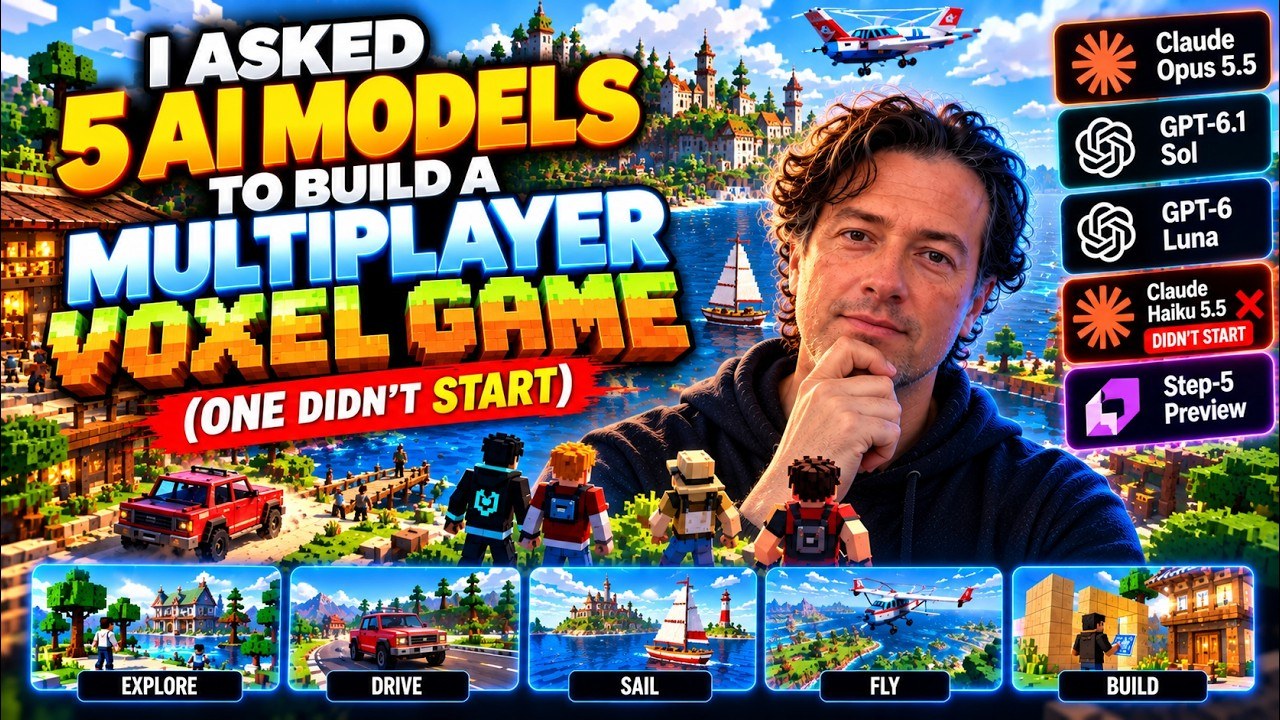
I gave five AI models the exact same prompt: build me a multiplayer voxel world, a bit like Fortnite, but nobody shoots. You explore a procedural world, you drive a car, you sail a boat, you fly a plane, you build with blocks and one-click prefabs, and your friends join you with a room code. The five models were Claude Opus 5.5, GPT-6.1 Sol, GPT-6 Luna, Claude Haiku 5.5 and Step-5 Preview, which StepFun released the same day. One of them spent two dollars and fifty-six cents on the job. One spent less than one cent. And one of them did not even start. All five games are now live on my site, you can play every version with your friends, and you can vote for the best one. If the votes keep coming, I will take the winner and keep building it with bigger models.
This is the written version of my latest VitoMind video. I called the game VOXARA, a name that sounds like a place you would want to explore, and that is exactly what the prompt asked for. Below you will find how I ran the test, what each model built, five side-by-side rounds, a real multiplayer test with two players in the same world, every cost down to the cent, and the lessons I took away about building games with AI.
If you prefer reading, everything from the video is here, with the numbers, the settings and the details that did not fit into five and a half minutes.
The Short Version
- One prompt, five models, one request each. Claude Opus 5.5, GPT-6.1 Sol, GPT-6 Luna, Claude Haiku 5.5 and Step-5 Preview all received the same text, word for word, through OpenRouter.
- The game: a peaceful multiplayer voxel sandbox with biomes, water, a day and night cycle, a car, a boat, a plane, a build mode with prefabs, and peer-to-peer multiplayer with a room code. No weapons, no combat.
- Winner: Claude Opus 5.5. The most beautiful world (a sea with islands, beaches and palm trees), every vehicle works, and at night the jeep turns its headlights on. It also cost $2.56, which is 85% of the whole test.
- Second: GPT-6.1 Sol. A soft pastel style, named biomes, the smoothest plane, and the best-looking building. $0.22, about a tenth of Opus.
- The surprise: GPT-6 Luna. Plainer, but everything works, for less than one cent.
- Claude Haiku 5.5 thought itself out of output twice and wrote nothing. With reasoning switched off it wrote the whole game in two and a half minutes for two cents.
- Step-5 Preview did not start: two bugs. After two one-line fixes it runs and connects, but the terrain almost never shows up.
- Multiplayer works in all five. A second player joins with the room code, both players see each other, and blocks placed by the host appear on the guest’s screen.
- Total cost: about $3. Every version is playable at ruocco.it/ai-demos/voxara, with a live vote.
What VOXARA Is
The idea was simple to say and hard to build: a game that feels like a creative sandbox, where you and your friends explore a big world together, jump into vehicles and build things, with no shooting at all. I wanted to see whether today’s models can build something like that in a single answer, as one HTML file that runs in any browser.
The prompt asked for six things.
- Graphics clearly better than classic Minecraft. Smooth flat-coloured voxels instead of pixel textures, ambient occlusion on the blocks, soft real-time shadows from the sun, atmospheric fog, a sky with drifting clouds and a full day and night cycle, animated water with waves and reflections, a gentle bloom, swaying grass and leaves.
- A large procedural world built from chunks around the player, with several biomes: meadows, forests, snowy mountains, a desert and an ocean with islands, plus rivers, cliffs, trees, flowers and rocks. The same seed gives the same world to every player.
- A player seen in third person, a chunky voxel avatar with a name tag that walks, sprints, jumps and swims.
- Three vehicles parked near the spawn point: a car with simple but fun physics, a boat that floats and rocks on the waves, and a glider or small plane that takes off, banks and lands.
- A build mode with a hotbar of at least twelve materials, a ghost preview of where the next block lands, and one-click prefabs: a wall, a tower, a bridge and a small house.
- Real multiplayer with no server of our own. The prompt asked for PeerJS: one player presses “Create world” and gets a short room code, the others press “Join world” and type it. The host is in charge of the block edits, late joiners receive everything built so far, and everyone sees each other’s avatars, name tags and vehicles, with a small chat and three emotes.
I also asked every model for a way to test the game automatically: a window.game object with the scene, camera, player, vehicles and world, and URL parameters to create or join a world without clicking through the title screen. That is what made it possible to film all five games the same way, with the same actions at the same moment.
The exact prompt, word for word, is in the Ruocco Academy, together with the full source of every version.
How I Ran the Test
Every model got one request through OpenRouter with an output limit of 128,000 tokens. My only addition to the prompt was the usual line asking for one self-contained HTML file, with Three.js loaded from a CDN. Nothing was fixed by hand, with one exception that I explain in detail below.
- Claude Opus 5.5 on effort low. In an earlier test, on effort medium, Opus spent its whole output thinking and returned empty files on big builds, so for long jobs I start it on low.
- GPT-6.1 Sol and GPT-6 Luna on effort medium, their default.
- Claude Haiku 5.5 first on effort low, then with reasoning switched off, for reasons you will read below.
- Step-5 Preview on effort medium.
Then I tested every build the same way, in a real browser running on the GPU. First a probe: does the page load, does it throw errors, does it run at 60 frames per second, does it expose the test hooks. Then a scripted play session: get into the car and drive, get into the boat, take off with the plane, open build mode and place a prefab and some blocks, switch to night. Finally a real multiplayer test with two separate browser tabs: one creates a world, the other joins with the room code, and I check that both players see each other and that a block placed by the host shows up for the guest.
Here is what each model built.
Claude Opus 5.5: The Island World
Opus took the longest by far. It worked for nineteen minutes and wrote almost the whole output limit, about 127,000 tokens. And the result is the best of the five.
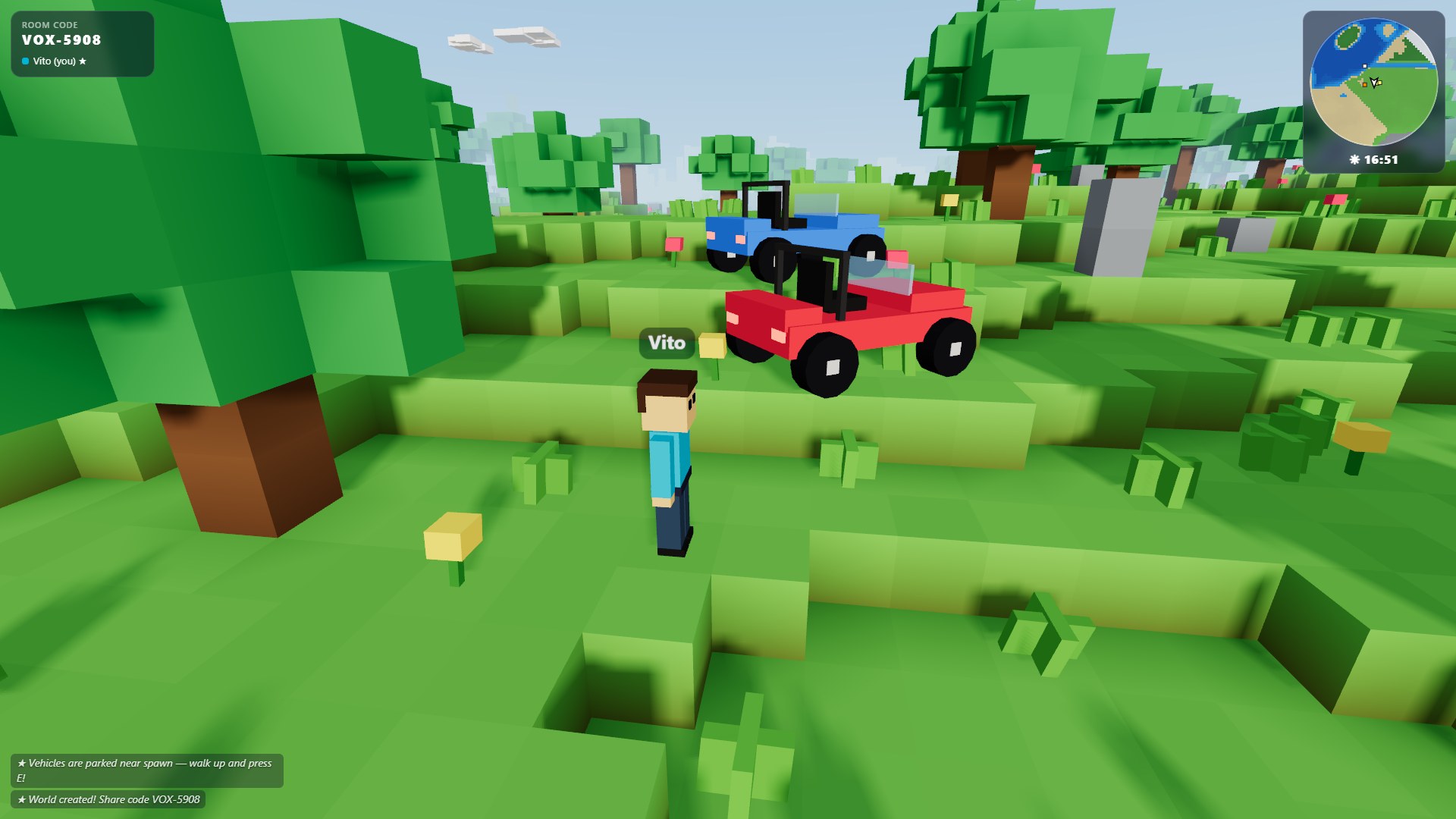
The world is an archipelago. You spawn near a beach, with a sea that stretches to the horizon, small islands with palm trees, cliffs, forests and snowy peaks inland. The water is a soft turquoise that catches the light, and at sunset the sun really goes down over the sea. The round minimap in the corner draws the coastline in real time, and the clock under it follows the day.
The vehicles
There are two jeeps, a red one and a blue one, parked near the spawn. Walk up to one and a prompt says “E, drive the car”. Press E and you are driving, with a speedometer in the corner. The plane is a small orange propeller aircraft: full throttle, and it reaches around 128 kilometres per hour on the runway and lifts off over the island. In my recordings it climbed up to about 155 kilometres per hour over the sea. The boat is the only one of the five that really sails: put it in the water, hold W, and it cruises along the coast.
Building and night
Build mode shows a hotbar of materials, a ghost block where the next one will land, and a line of help that says “Prefab: Tower, Q place, Z next”. One key drops a whole stone tower in front of you, and the blocks go down one at a time where the ghost preview shows them. At night the world turns a deep blue, the stars come out, and the jeep switches its headlights on by itself. No other model did that.
Two dollars and fifty-six cents. Expensive compared to the others, but this is the one that looks like a game you would actually want to play.
GPT-6.1 Sol: Pastel Meadows
Sol took six minutes and cost twenty-two cents. It chose a completely different style: soft pastel colours, gentle light, clean shapes, almost like a toy. The interface is the tidiest of the five, with a title card, an “Explorers” list of the players in the world, and a minimap that names the biome you are in: Green Meadows, Emerald Forest.
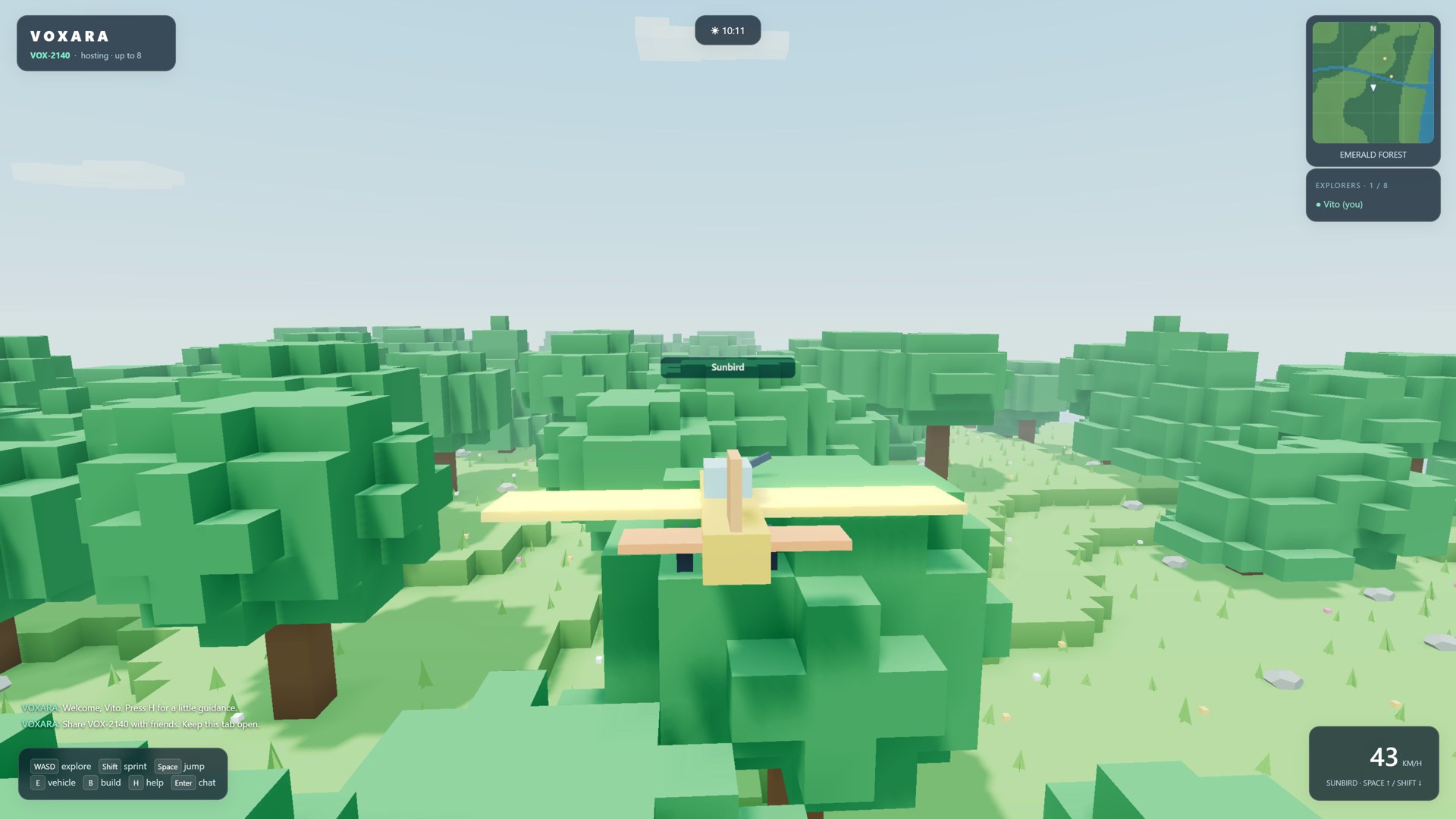
The car is called the Meadow Rover, and the speedometer counts up as you climb the hills. The plane is the smoothest of the five: it takes off at around 130 kilometres per hour and glides over the treetops. Build mode is where Sol shines: one key and a whole brick house appears right in front of you, clearly visible, exactly where you expect it. The boat is the weak spot: in my tests it stayed stuck where it was parked.
If I had to show one of these five games to a child, it would be Sol’s.
GPT-6 Luna: The Quick One
Luna, OpenAI’s small model, wrote its version in under three minutes, and it cost less than one cent: $0.008. The first thing you see is a problem: the camera starts inside a wall, so the opening shot is a flat block of colour. But turn around and everything works.
The car drives at around fifty kilometres per hour. The sea is right there. One key places a whole prefab house. The plane takes off and flies over the snow and the coast. The look is plainer than Opus or Sol, with flatter light and simpler trees, and the night goes almost black. But for one cent, that is a lot of game.
Claude Haiku 5.5: Thinking Less Works Better
Haiku 5.5 came out on October 7, the day before this test, and it gave me the biggest surprise.
On effort low, Haiku thought until it hit the output limit: 128,000 tokens of reasoning. Then it wrote only the style sheet of the game, about 4,600 characters of CSS, and stopped. I asked it to continue from where it left off. It thought again, for another 64,000 tokens, and wrote nothing at all. Ten cents for nothing.
So I ran it again with reasoning switched off. Two and a half minutes later, for two cents, I had a complete game: 79,000 characters, no errors, 60 frames per second, and multiplayer that connects on the first try.
The world is a deep, dark green forest, a bit flat and dense, so you often find yourself walking between tall walls of leaves. But there are two cars, a boat and a plane, and the plane flies for hundreds of metres over the trees. The boat, like Sol’s, stays stuck where it is parked.
The lesson is worth remembering if you use Haiku 5.5 for code: on big builds, the reasoning budget can eat the whole output before a single line of the answer is written. Thinking less can be the difference between a finished file and an empty one. Including the failed run, Haiku’s version cost twelve cents.
Step-5 Preview: Two Bugs Before the Title Screen
Step-5 Preview is StepFun’s new model, released on the same day as the test, at $1 per million input tokens and $2.70 per million output tokens. It wrote its version in under four minutes, for thirteen cents. And as it came out, it did not start at all.
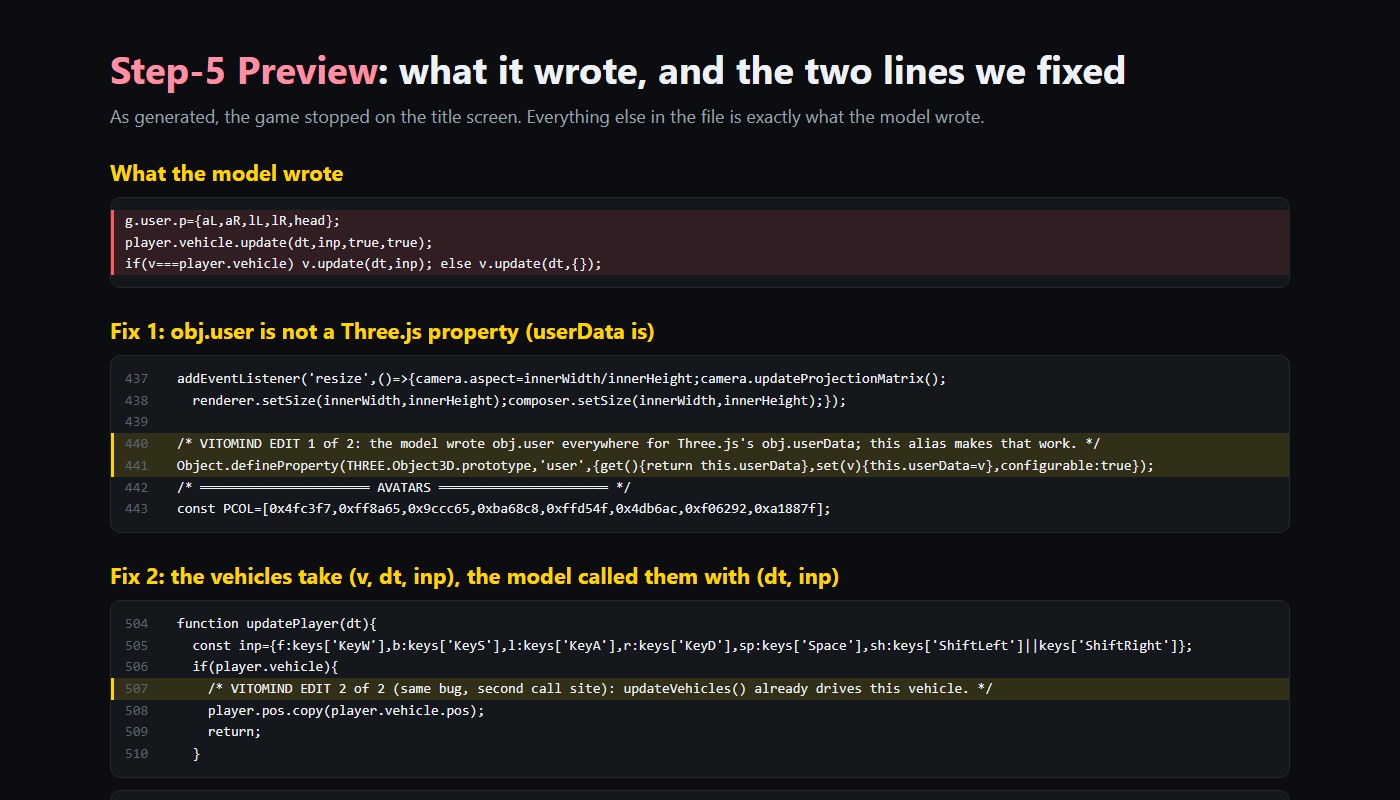
There were two bugs. The first was a typo in a Three.js property: the model wrote obj.user everywhere it meant obj.userData, the property Three.js gives every object for custom data. The page stopped with an error before the title screen. The second bug was in the vehicles: the update functions for the car, the boat and the plane expect the vehicle as their first argument, but the model called them without it, in two different places.
I fixed those two things, one line each, and marked both fixes in the source with the words “VITOMIND EDIT”, so anyone can see exactly what I changed. The original, untouched file is in the Academy.
Now it runs, and the multiplayer even connects. But the world almost never shows up. You float in the fog, with the jeep next to you. The plane is there, red and white, flying over nothing. There is also a third problem that I did not fix: starting a world through the URL parameters never starts the render loop, so the screen stays black. If you want to try it, start it from the title screen with “Create world”.
Side by Side: Five Rounds
Watching the five games one after another is one thing. Putting them next to each other is another. So I ran exactly the same actions, at the same moment, on all five, and compared them round by round.
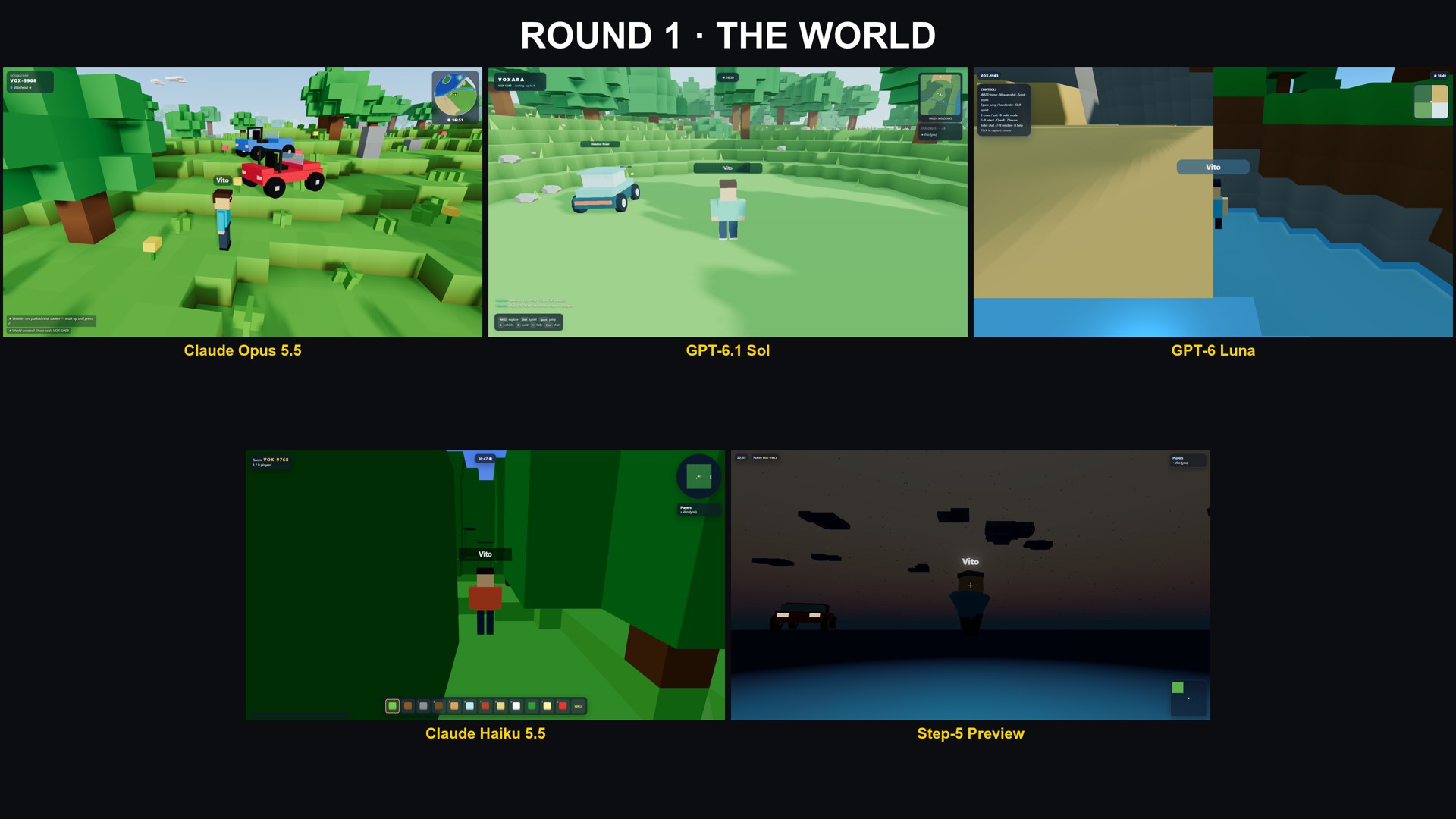
Round one: the world
Opus has a sea and islands. Sol has soft green meadows. Luna has a beach and a river. Haiku has a wall of forest. And Step-5 has nothing to stand on. Point to Opus.
Round two: the car
All five cars drive, and that alone is impressive for a single answer. Sol’s Meadow Rover and Luna’s little orange car look the best from behind. Opus puts the camera very close to the jeep. Step-5’s jeep drives through empty sky. Point to Sol.
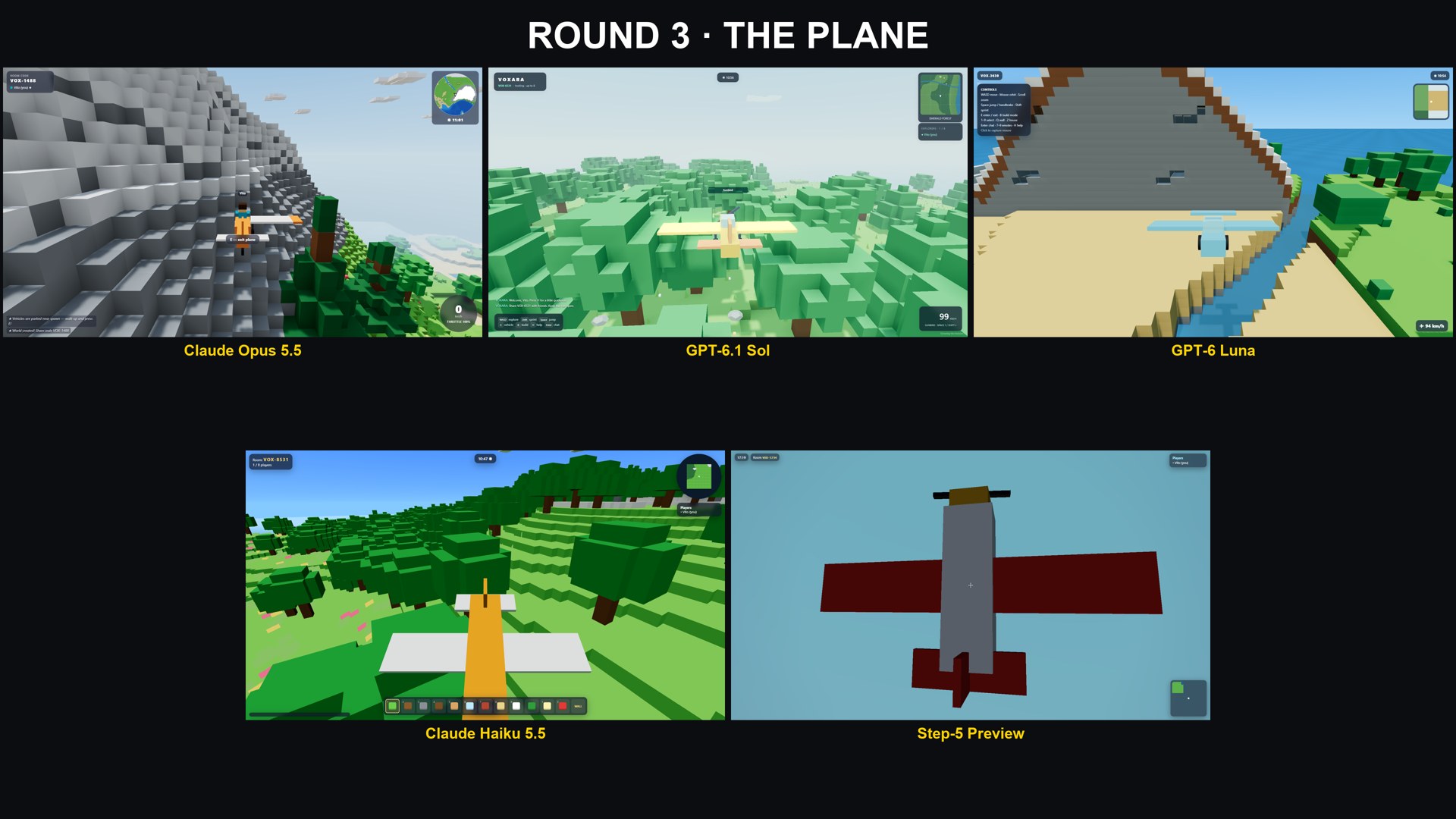
Round three: the plane
All five planes take off, every single one. Sol and Haiku fly over endless forest, Luna over snow and the sea, Opus skims a mountain, and Step-5’s red and white plane flies over the void. That is a draw.
Round four: building
Build mode, one key for a prefab, three clicks to place blocks. Sol drops a whole brick house right in front of the player, and Opus a stone tower. On the other three it is hard to even see what you have built. Points to Sol and Opus.
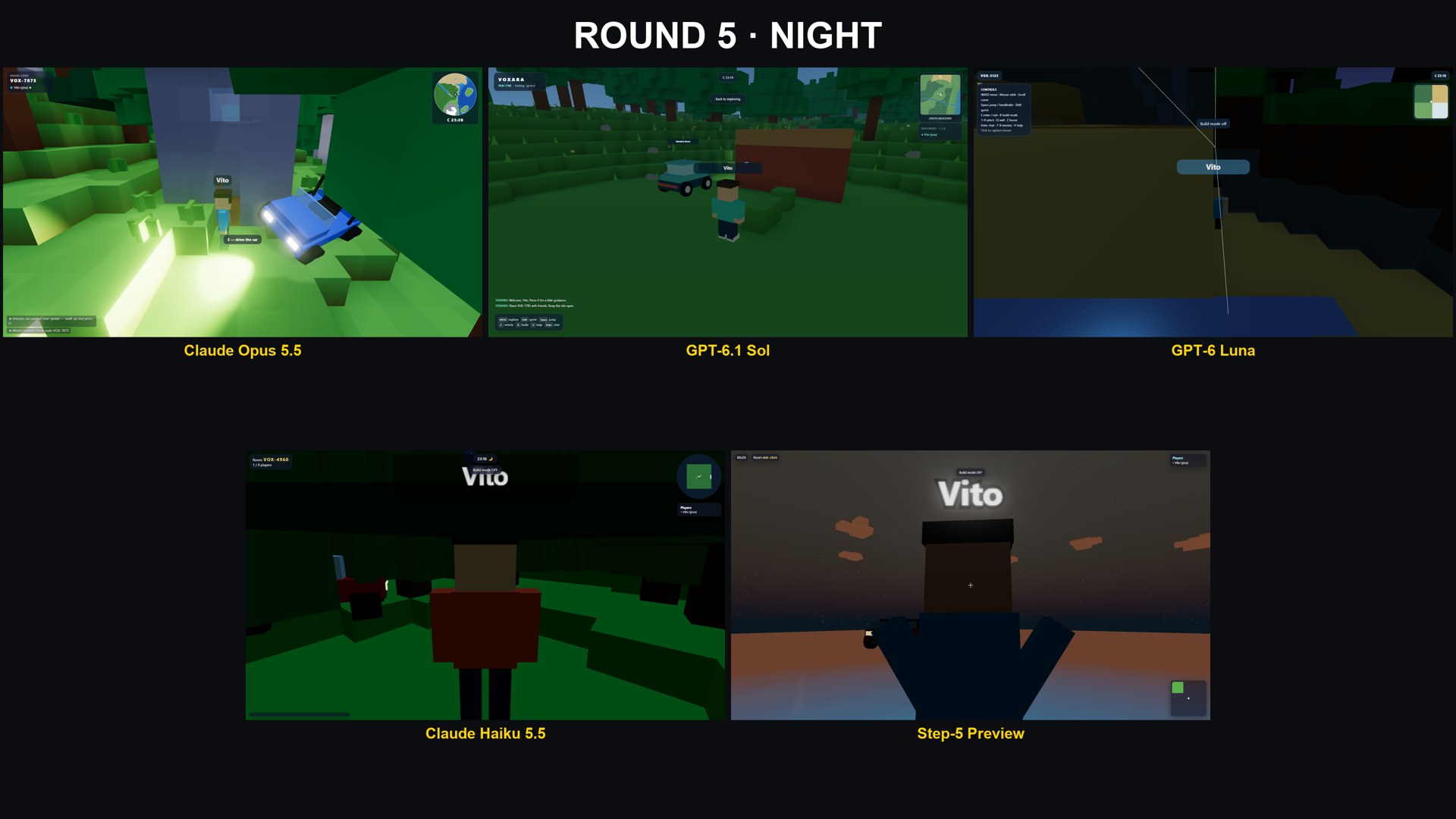
Round five: night
Only Opus turns the headlights on, and they light up the grass in front of the jeep. Sol goes a dusky blue, Luna and Haiku go almost black, and Step-5’s night still looks like a sunset. Point to Opus.
And the boats
Opus’s boat really sails. Luna’s and Step-5’s move. Sol’s and Haiku’s stay stuck where they are parked.
The Real Test: Multiplayer
This was the part I was most curious about, because multiplayer is where single-file games usually fall apart. Every model used the same approach the prompt suggested: PeerJS, a small library that connects browsers directly to each other with WebRTC. The host’s peer id doubles as the room code, so there is no server of my own to run or pay for. The free public PeerJS server only introduces the players; after that, the game data goes straight from one browser to the other.
In the video I show it with two windows side by side, running Opus’s version. On the left, Vito creates a world and gets a room code. On the right, a second player, Luca, opens the same game and joins with that code. A few seconds later he is there: both players see each other, with name tags over their heads, the player list in the corner shows two explorers, and a message says “Luca joined”. Then, from the left window, I build a stone tower one block at a time, and it rises on Luca’s screen too.
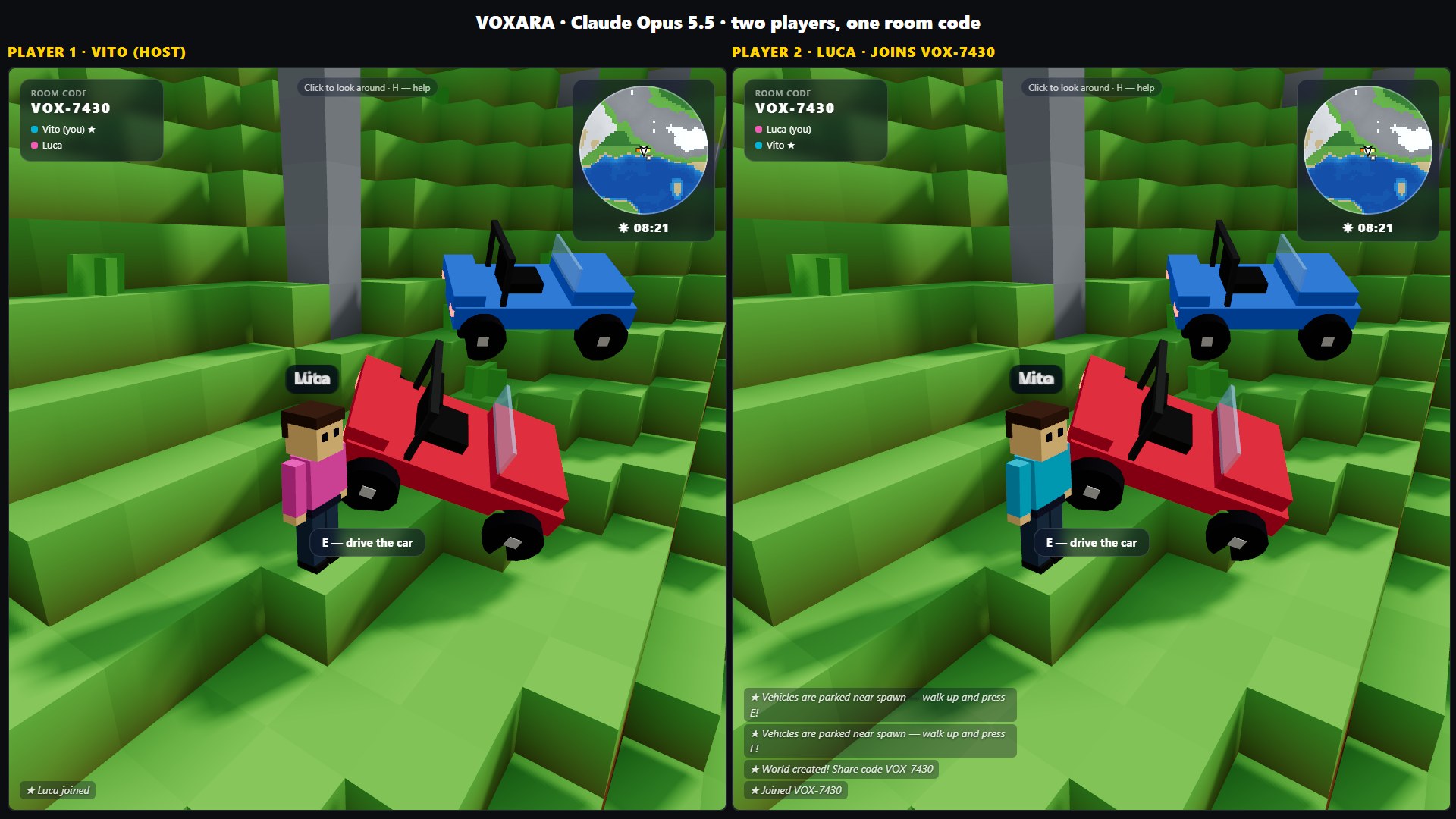
I checked this on all five versions with two separate browser tabs, and on all five it actually works: the guest connects, both sides see the other player, and a block placed by the host appears for the guest. For a test like this, that was the result I trusted least before running it, and it turned out to be the most consistent of all.
One practical note: because it is peer to peer, very strict networks (some offices and schools) can block the connection. At home, with friends on normal connections, it is the easiest multiplayer you can set up: send a code, and you are in the same world.
My Verdict
Opus wins, clearly: the most beautiful world, every vehicle works, the boat really sails, and the night is gorgeous. Sol is second, with the cleanest style and the best building, for a tenth of the price. Luna is the surprise for one cent. Haiku only works if you stop it from thinking. And Step-5 needed my help just to start.
What It Cost
The whole test cost about three dollars on OpenRouter.
- Claude Opus 5.5: $2.56, 19 minutes, about 127,000 output tokens. That is 85% of the total.
- GPT-6.1 Sol: $0.22, 6 minutes, about 22,000 output tokens.
- Step-5 Preview: $0.13, under 4 minutes.
- Claude Haiku 5.5: $0.12 in total: $0.10 for the two failed attempts on effort low, $0.02 for the version that works.
- GPT-6 Luna: $0.008, under 3 minutes, about 15,000 output tokens.
The interesting part is how little the price says about the result. Opus cost three hundred times more than Luna and is clearly better, but Luna’s version still works from end to end. Sol is the best value of the five: second place for a tenth of the winner’s price.
What I Learned About Building Games With AI
- One answer can hold a whole multiplayer game. Five out of five models wrote a working world, three vehicles, a build mode and peer-to-peer networking in a single HTML file. A year ago that would have been a project.
- Ask for test hooks in the prompt. Asking every model for a
window.gameobject and URL parameters to create or join a world is what made it possible to test and film all five the same way. It costs one paragraph of prompt. - Watch the reasoning budget. Haiku 5.5 on effort low and Opus 5.5 on effort medium can both spend the entire output limit thinking. On long builds, lower the effort or switch reasoning off, and check that a file actually came back.
- The style is the model’s choice. The same paragraph about graphics gave a sunlit archipelago, a pastel toy world and a dark forest. If you care about the look, describe it with references, not just features.
- Test before you trust. Two of the five had problems you only find by playing: a camera inside a wall, boats stuck on the shore, a render loop that never starts. A screenshot of the title screen would have told you nothing.
Play Them, Vote, and Get the Code
Every version is on my site. Go to ruocco.it, open All demos, and VOXARA is right at the top. Or go straight to the gallery: ruocco.it/ai-demos/voxara.
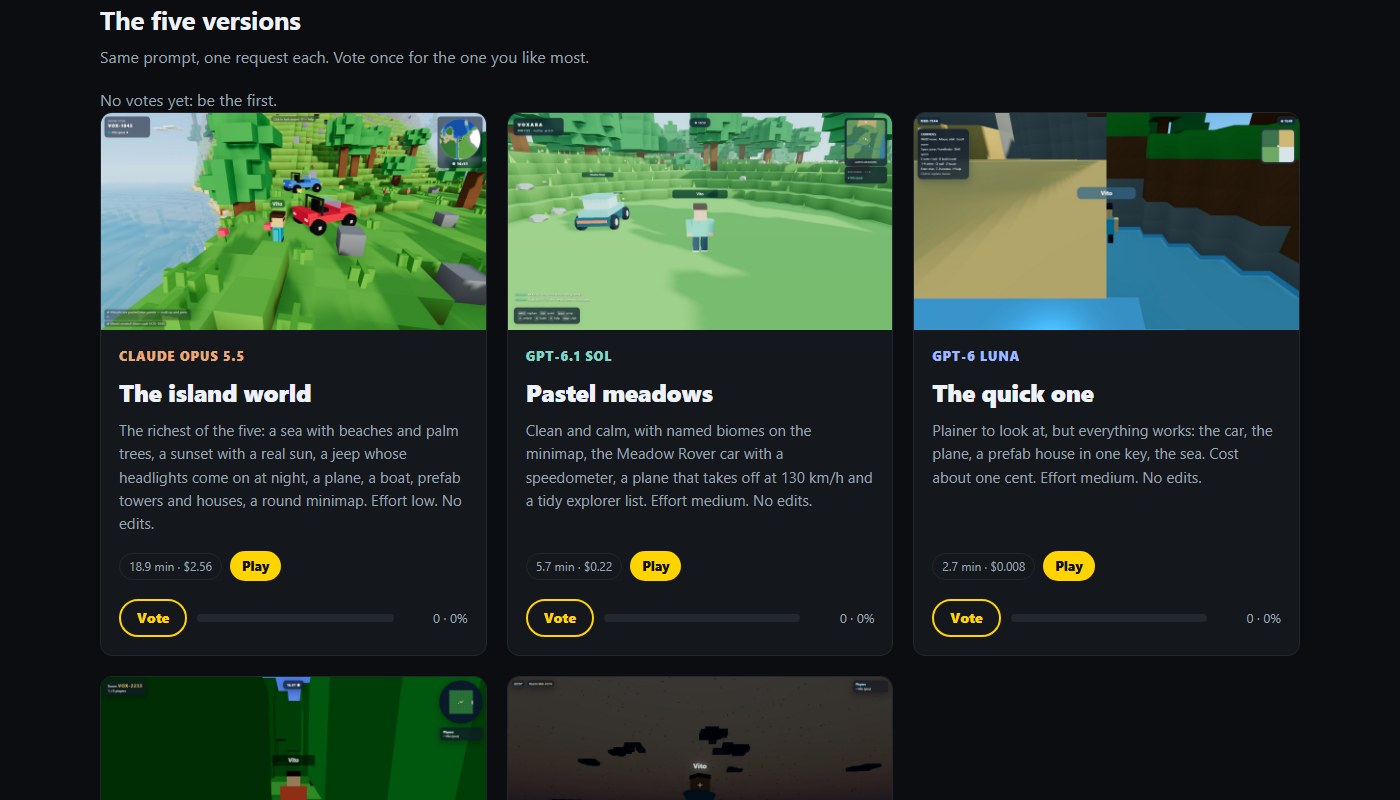
Each card shows the model, the time it took, what it cost, my notes, a Play button and a Vote button. To play together, open any version, type your name, press Create world and send the room code to a friend, who opens the same version and presses Join world. Up to eight players. Controls: WASD to move, the mouse to look, E to get into the car, the boat or the plane, B for build mode, 1 to 9 for the blocks, Q and Z for the prefabs, Enter for the chat, H for help.
Then vote. One vote each, and the results are live on the page.
The exact prompt, the settings for every model, the full source of all five versions as a ZIP (including Step-5’s original file and Haiku’s failed attempt) and the two-window page I used to film the multiplayer are in the Ruocco Academy.
What Happens Next
This is meant to be the first episode, not the last. If the votes grow, the next episode takes the winning version and develops it for real: saving your world, more vehicles, a proper multiplayer server, more biomes and better building, with bigger models and more effort. You decide which version that will be.
Sources
- The five models via OpenRouter:
anthropic/claude-opus-5.5,openai/gpt-6.1-sol,openai/gpt-6-luna,anthropic/claude-haiku-5.5,stepfun/step-5-preview. Prices and costs are from OpenRouter’s own usage records for each request. - Three.js, the 3D library every version uses.
- PeerJS, the WebRTC library behind the peer-to-peer multiplayer.
- The five games and the vote: ruocco.it/ai-demos/voxara.
A note on honesty: everything in the gallery is exactly what each model wrote, with one exception. Step-5 Preview’s file has two one-line fixes, marked “VITOMIND EDIT” in its source, without which it did not start at all; its original file is in the Academy. Haiku 5.5’s version comes from its third request, with reasoning switched off, after two attempts on effort low returned no game, and that cost is included in its total. Speeds and behaviours described here are what I saw in my own recordings; the worlds are procedural, so your session may look a little different.
If you want every new AI model tested hands-on like this, subscribe to VitoMind on YouTube, and tell me in the comments which version you voted for.