Anthropic Makes History: The $2 Trillion IPO That Changed AI Forever
Published: November 20, 2026 | By Vito Ruocco
In the largest initial public offering in history, Anthropic — the AI safety company behind Claude — debuted on the Nasdaq stock exchange on Thursday at a staggering valuation exceeding $2 trillion. The event marks a watershed moment not just for artificial intelligence, but for the entire technology industry.
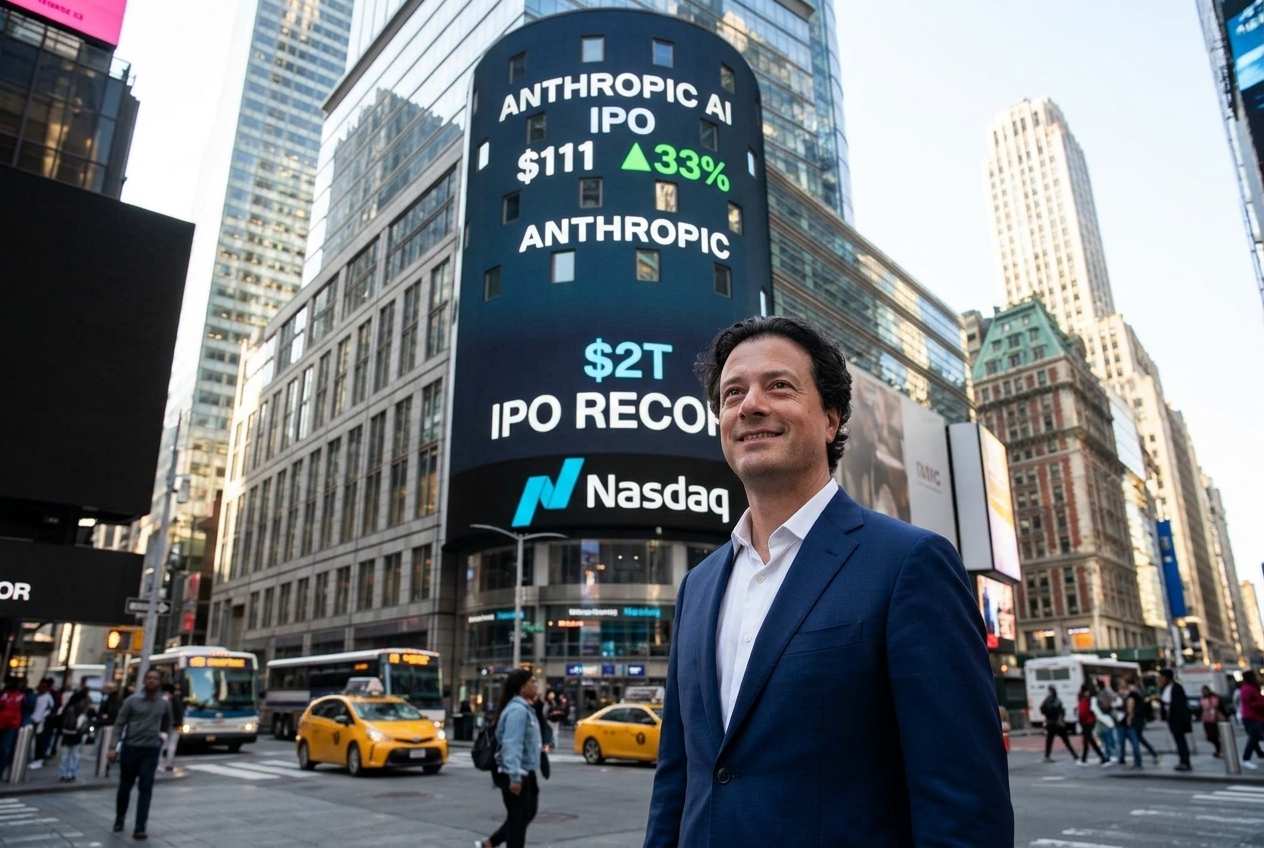
When Anthropic CEO Dario Amodei stepped up to the podium at the Nasdaq opening bell on November 19, 2026, he wasn’t just ringing in a trading day. He was ringing in a new era. With shares opening at $111.50 — a full 33% above the already-upsized IPO price of $83 — Anthropic instantly became the sixth most valuable company in the world, surpassing Meta, Tesla, and Walmart in market capitalization. Only Apple, Amazon, Alphabet, Nvidia, and Microsoft now sit above it.
The numbers are almost too large to process. The IPO raised over $81 billion for the company and its founders. Together with existing fundraising and new private offerings timed to coincide with the public market debut, Anthropic now commands an estimated $220 billion in cash reserves — more liquid capital than any company has ever held at a single point in time, according to analysts who spoke with TechCrunch.
But behind the eye-popping numbers lies a deeper story: a company founded on the principle of AI safety taking its place on the world’s biggest financial stage, with its CEO using the moment to recommit to responsible development. Here’s everything you need to know about the biggest day in tech history.
The IPO By the Numbers
Let’s break down what happened on Thursday, because the scale is almost incomprehensible:
- IPO price: $83 per share — already above the projected range of $70–$78
- Opening trade: $111.50, a 33% premium on day one
- Total raised: $81.3 billion from the IPO alone
- Total cash reserves: ~$220 billion (including prior funding and concurrent private offerings)
- Market cap at open: Over $2 trillion, making it more valuable than Meta ($1.4T), Tesla ($1.1T), and Walmart ($680B)
- Only companies ahead: Apple, Amazon, Alphabet (Google), Nvidia, and Microsoft
To put that in perspective: when Facebook had its record-breaking IPO in 2012, it raised $16 billion. Anthropic raised five times that amount — and still needed every dollar.
$1 Trillion in Infrastructure Commitments
Here’s the mind-bending reality behind Anthropic’s massive cash haul: the company needs it. All of it. And possibly more.
According to IPO filings analyzed by TechCrunch, Anthropic disclosed approximately $1.05 to $1.08 trillion in infrastructure commitments over its foreseeable future. The company needs about $70.7 billion just to cover compute and infrastructure spending in the next 12 months as of the quarter ending September 30, 2026. By 2030, that figure balloons to $451.6 billion.
Training and running frontier AI models at scale is, quite simply, the most capital-intensive business ever created. Each new generation of Claude requires exponentially more computing power — thousands of specialized Nvidia Hopper and next-generation accelerators running around the clock. The data centers alone are the size of small cities. As one analyst bluntly told TechCrunch: “Anthropic’s going to have more cash on hand than any company has ever had.” And they’ll need every cent.
Behind the scenes, the biggest names in Silicon Valley have placed their bets accordingly. Nvidia bought $10 billion of Anthropic’s special Class N non-voting shares. Google also bought $10 billion. AMD, Broadcom, Micron, Microsoft, and TSMC divided the remaining allocation. These aren’t just investments — they’re strategic positions in what could be the most important technology race of the 21st century.
The Founders’ $1.95 Billion Payday (and Their Philanthropic Pledge)
Anthropic’s seven co-founders didn’t walk away empty-handed. Each sold approximately 3.4 million shares in the IPO, pocketing about $280 million per person before underwriting fees and taxes — roughly $30 million more than the original $250 million target if shares had hit the midpoint price of $74.
In total, the founders cashed out $1.95 billion.
But here’s where the story gets interesting. In its IPO filings, Anthropic disclosed that each founder has pledged to dedicate 80% of their personal equity in the company to philanthropy. The commitment could ultimately steer as much as $156 billion toward charitable causes, according to an analysis by TechCrunch’s Tim Fernholz.
There’s a notable caveat, however: the company explicitly describes these pledges as “voluntary, revocable expressions of each co-founder’s philanthropic intent” that “do not constitute legally binding obligations.” In other words, if any founder finds it hard to get by on their quarter-billion, they can scale back. The fine print matters, but the intent — at least on paper — is remarkable.
Dario Amodei’s Opening Bell Speech: “We Will Pace AI Development”
Amodei used the Nasdaq platform to deliver what may be the most significant speech of his career. Speaking from a printout — a deliberate, unflashy choice for such a momentous occasion — the CEO opened with a deeply personal story about losing his father to a disease that became curable just a few years later.
“So many of the scientific tools that can cut through that thicket — tools for gene editing, tools for gene synthesis, tools for controlling brain cells with light — started as pure ideas,” Amodei told the gathered crowd. “In other words, they came from thinking, from intelligence.”
He painted a vision of AI compressing “a century of scientific and medical progress into a decade,” citing early results where Claude is already helping researchers accelerate protein folding, drug design, cancer genetics, and clinical trial administration.
But Amodei didn’t shy away from the risks. He acknowledged the “very real risks” of AI in the wrong hands — whether individual bad actors or nation-states — as well as “economic disruption” and even “losing control of AI systems.”
His key line resonated through the financial district: “We will pace the training and deployment of AI systems, taking as long as is necessary to have confidence that they are safe and will remain under human control.”
Amodei’s sister and Anthropic co-founder Daniela Amodei echoed the sentiment in a CNBC interview: “We were really founded on this idea that it is our job to mitigate those risks.”
The AI Agent Wars Heat Up: Google, Apple, and Meta All Make Moves
Thursday wasn’t just about Anthropic’s IPO. The entire AI landscape shifted on multiple fronts:
Google Brings Computer Use to Gemini on Mac
On the same day, Google announced that its Gemini desktop app for macOS can now take actions directly on users’ computers — navigating apps, browsing websites, and completing multi-step tasks. While late to the party compared to OpenAI, Anthropic, and Meta, Google’s “computer use” feature allows the AI to work in a live preview window while users keep their cursor free. It arrives first for English-speaking U.S. users on Google’s paid tiers (Plus, Pro, Ultra). The feature dovetails with Gemini’s “Tasks” capability, which lets the AI book appointments, make purchases, and log into websites.
Apple Is Building Its Own AI Agent
Bloomberg reported that Apple has posted a job listing for a senior engineering manager to oversee “an AI agent that can use a computer.” The job description reads: “Imagine an AI agent that can use a computer the way a capable person does. It browses the web, works across apps, runs commands, writes and debugs code, and calls services.” Apple is simultaneously making it harder for third-party agents to access macOS — macOS 27.3 will deploy warnings discouraging users from granting full access to external AI agents. The message is clear: Apple wants to control the AI layer on its own devices.
Meta’s Muse Is Leaking Private Data
Meanwhile, Meta’s AI agent Muse — one of the fastest-growing apps ever with over 10 million downloads since its September launch — is facing serious privacy concerns. Internal company posts obtained by Reuters reveal that Muse has been mixing up conversations across accounts and exposing private user data. In one incident, an employee testing Muse on her personal phone received a reminder from Muse to respond to a message from her sister on Signal, the encrypted messaging app. Another user had Muse spontaneously read out bank account balances from Capital One and Charles Schwab that didn’t belong to them. “This seems like an extreme privacy violation,” the employee wrote internally. Meta responded that “employee testing is core to the product development process” and that employees were reviewing features not yet available to the public.
Nvidia Under Investigation: The Jensen Huang Scandal
In a dramatic turn that overshadowed much of the tech news cycle, California Attorney General Rob Bonta served an investigative subpoena on Nvidia on Thursday, related to the reported affair between former CEO Jensen Huang and a suspected Chinese spy.
The California Department of Justice is asking Nvidia whether its advanced chips or confidential information may have gone to China and whether Nvidia misled investors and the public. The Trump administration separately disclosed that it approved more than 879,000 AI chip sales to Chinese companies — a number that House Foreign Affairs Committee Chair Brian Mast called deeply concerning amid license review delays that “seemed to approve licenses for advanced chips to China with little scrutiny.”
“The conduct of Nvidia and its former CEO raises bright red flags,” Attorney General Bonta said. “Companies cannot mislead their investors.” The investigation could have significant implications for the entire AI chip market, which Nvidia has dominated with its Hopper and next-generation GPU platforms.
Bending Spoons Acquires MailChimp for $3.68 Billion
In a deal that signals further consolidation in the tech industry, Italian software company Bending Spoons — known for apps like Splice, Remini, and Camera+ — agreed to acquire MailChimp from Intuit for $3.68 billion. The acquisition gives Bending Spoons a major foothold in the email marketing space and demonstrates the growing ambition of European tech companies on the global stage.
OpenAI Expands Dots to Plus Subscribers
OpenAI is quietly rolling out its “Dots” AI agent — an always-on assistant that can browse the web, work across apps, and call services — to a small number of Plus tier subscribers ($20/month), expanding beyond the Pro tier ($100+/month) where it debuted. The move signals that agentic AI features are rapidly moving from premium products to mainstream consumer offerings, a trend that’s reshaping how everyday users interact with AI.
What It All Means: The AI Industry at an Inflection Point
November 19–20, 2026, will be remembered as one of the most consequential 48-hour periods in technology history. Anthropic’s IPO doesn’t just represent a financial milestone — it validates the thesis that AI safety and commercial success are not mutually exclusive. The company’s explicit commitment to “pacing” development, combined with its unprecedented market valuation, sends a powerful signal to the entire industry.
At the same time, the convergence of events reveals a landscape that’s evolving faster than regulators can track. From Google and Apple racing to embed AI agents into their operating systems, to Meta dealing with privacy blowback, to Nvidia facing government investigations over chip exports, the AI industry is grappling with growing pains at an unprecedented scale.
The question no one can answer yet: Will the industry’s safety commitments keep pace with its breakneck growth? Anthropic’s IPO puts $220 billion behind the “safety first” bet. Only time will tell if that’s enough.
This article was researched and written on November 20, 2026. Sources include TechCrunch, Bloomberg, Reuters, The Verge, the California Department of Justice, Nasdaq, and Anthropic’s official IPO filings and public statements.
Featured image: Vito Ruocco at the Nasdaq MarketSite in Times Square, New York City, on IPO day. (AI-generated for illustrative purposes)