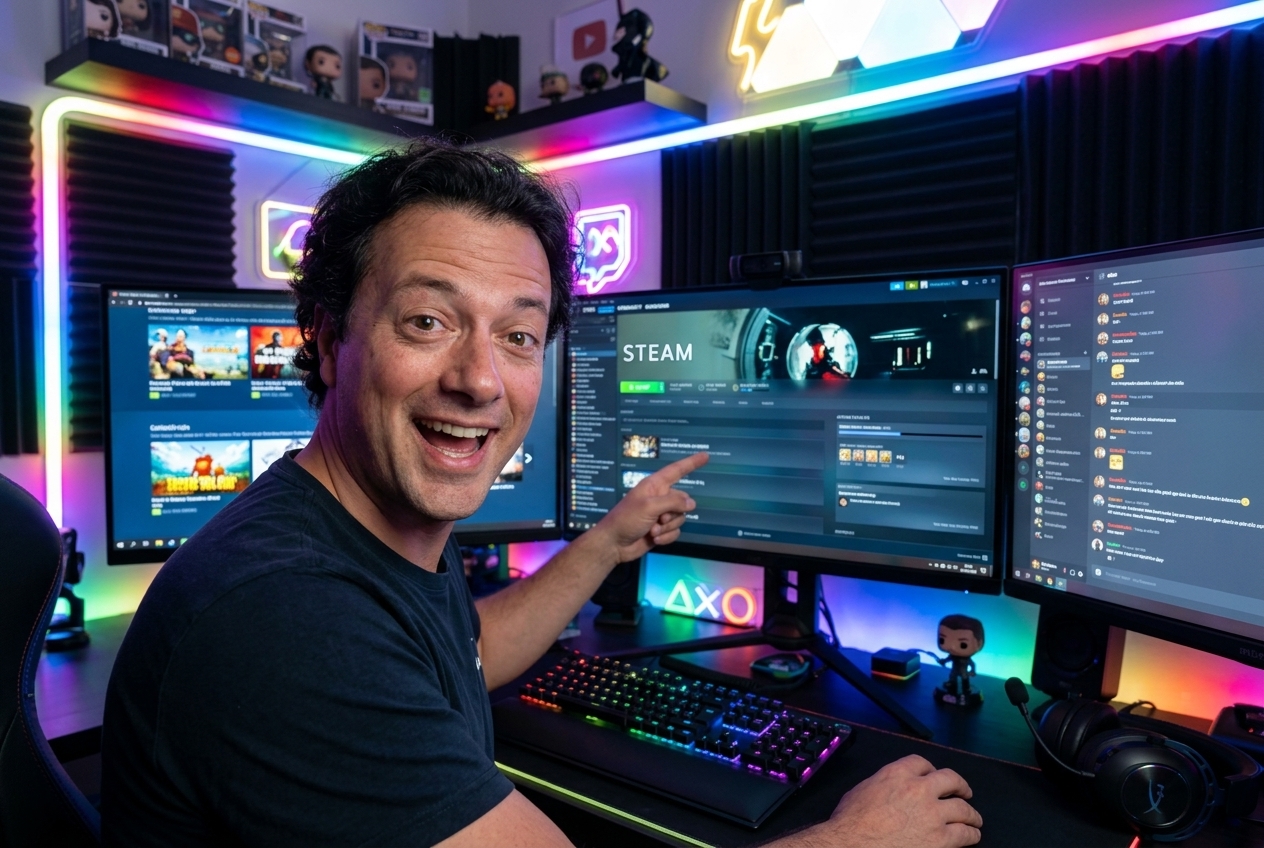
August 19, 2026 — While Sony and Microsoft navigate one of the most turbulent periods in console gaming history, Valve’s Steam platform just posted its highest-ever first-half revenue: an eye-watering $11.1 billion. The data, compiled by analytics firm Alinea Analytics and reported by Eurogamer, paints a stark picture of an industry in flux — one where the PC gaming ecosystem is thriving while traditional console giants hemorrhage talent, sales, and consumer trust.
The Numbers That Tell the Story
According to Rhys Elliott, head of market analysis at Alinea Analytics, Steam’s $11.1 billion in revenue during the first half of 2026 represents not just a record for the platform, but a continuation of a relentless upward trajectory that has seen the storefront nearly quintuple its revenue over the past decade. The first half of 2026 alone brought in nearly five times as much money for Valve as the same period in 2017.
“Zoom out over the last decade and things get really crazy,” Elliott noted. “There’s obviously a visible dip as the market normalised after the pandemic sugar-high, but the long arc is relentlessly up, with seven half-years of growth.”
The growth comes despite — or perhaps because of — a shifting landscape. Higher prices on new releases, the massive Chinese market (where 50 percent of all Steam accounts belonged to Chinese-speaking users as of February 2025), and third-party publishers returning to Steam after abandoning their own game launchers have all contributed to Valve’s continued dominance.
The Biggest Games on Steam in 2026
The first half of 2026 has been exceptionally strong for major releases on Steam. The top performers reveal a diverse ecosystem where blockbuster franchises, new IPs, and indie darlings all find massive audiences:
- Forza Horizon 6 — $197.7 million in under two months, proving Microsoft’s first-party titles sell exceptionally well on PC even as Xbox hardware struggles
- Resident Evil Requiem — $194.5 million since its February launch, with 3.4 million copies sold on Steam alone. Notably, $1.3 million came from cosmetics packs alone
- Crimson Desert — $190 million since its March launch, an extraordinary performance for a brand-new IP from a Korean developer stepping beyond MMOs for the first time
- Slay the Spire 2 — $141.7 million, demonstrating the enduring power of the deck-building roguelike genre
- Subnautica 2 — $133.6 million, proving that deep-sea exploration remains a compelling niche
- Meccha Chameleon — $71.3 million, a surprise indie hit rounding out the top earners
What’s striking is the balance: three AAA titles and three indie/smaller titles in the top six earners. This suggests that Steam’s audience is neither purely casual nor purely hardcore — it’s a broad, diverse market that rewards quality regardless of budget or studio size.
Xbox’s ‘Reset’: 3,200 Layoffs and Four Studio Departures
On the other side of the coin, Microsoft’s Xbox division is undergoing what its leadership has described as the “most significant” restructuring in the brand’s history. In July 2026, Xbox announced 3,200 layoffs — 1,600 immediately and another 1,600 over the course of fiscal year 2027 — alongside the departure of four major studios from its first-party roster.
The affected studios include Double Fine (Psychonauts), Compulsion Games (South of Midnight), Ninja Theory (Hellblade), and Undead Labs (State of Decay). Arkane Lyon is also in talks regarding its future. Notably, these studios aren’t necessarily closing — Double Fine and Compulsion will transition to independent studios with their IP and runway secured, while Ninja Theory and Undead Labs have entered terms to join new ownership with funding to complete their current projects.
Xbox leader Asha Sharma delivered a remarkably candid assessment in an internal email published on Xbox Wire. “I know this is painful,” she wrote. “These changes will directly affect people who have poured their creativity into building Xbox.”
But the most revealing statement was this: “History is full of companies that mistake longevity for inevitability. We will not be one of them.”
Sharma described the Xbox business today as “not healthy,” operating at margins three to ten times lower than comparable platform and publishing businesses. She acknowledged that while Game Pass, multi-platform expansion, and a broader content portfolio had created “meaningful value,” they “did not grow at the pace we expected.” The result: a division that added teams and investment hoping for a better outcome, only to face “the most severe hardware crisis in its history.”
The restructuring also targets middle-management bloat. “In some parts of the company, work passes through as many as 14 layers of management,” Sharma said. “Our platform teams are 40 percent larger than they were at the start of this generation, even as our player base and playtime have declined.”
PlayStation’s Quiet Crisis: First-Party Sales Halved Since 2020
If Xbox is the more visible trainwreck, PlayStation’s situation is a slower-burning but equally concerning decline. New data compiled by Game File from Sony’s own financial reports reveals that first-party exclusive game sales have been on a steady downward trend since peaking in fiscal year 2020.
In FY20 (April 2020 to March 2021), Sony sold 58.4 million copies of games it published — a peak driven by the PS5 launch, cross-gen releases on PS4, and pandemic-era lockdowns that supercharged gaming across the board. By FY24, that number had fallen to just 28.9 million, a nadir that represents less than half the peak. FY25 saw a modest recovery to 32.1 million, but that still barely registers above half of what Sony was selling five years earlier.
The implications are profound. Sony has historically positioned PlayStation as the only place to play the best games — and invested billions into in-house studios to maintain that advantage. But longer development cycles, ballooning costs, and the diminishing returns of the exclusivity model have eroded that position.
Perhaps most tellingly, Sony recently announced it will no longer bring its exclusive single-player titles to PC, reversing a strategy it had maintained since 2020’s Horizon Zero Dawn port. The decision suggests that Sony may have concluded that day-one PC releases were cannibalizing console sales, or — more worryingly — that the PC audience had become the primary market for these titles. Either way, it’s a retreat from a strategy that many analysts believed was the future of PlayStation.
On top of all this, Sony’s announcement that it will cease production of game discs entirely in 2028 has tanked consumer sentiment and sparked petitions from preservationists and physical media advocates.
The AI RAM Crisis: How Hardware Costs Are Strangling Consoles
Underlying both Sony and Microsoft’s struggles is a hardware crisis that neither company could have fully anticipated. The AI boom has triggered an unprecedented demand for high-bandwidth memory (HBM) and DRAM, driving up the cost of the components that go into gaming consoles.
Eurogamer has reported extensively on how “the AI-fuelled RAM crisis” is impacting console manufacturing costs. Both the PS5 Pro and the rumored next-generation Xbox have faced cost overruns and supply constraints as chip manufacturers prioritize AI accelerators and data center hardware over consumer gaming devices.
For Microsoft, this has meant “major price increases” on Xbox hardware. For Sony, it’s contributed to slower-than-expected PS5 Pro adoption and squeezed margins on every console sold. Meanwhile, PC gamers have been largely insulated from these supply chain pressures — when one GPU vendor’s prices rise, competitors offer alternatives, and the modular nature of PC hardware allows consumers to upgrade incrementally rather than buying a whole new box.
Nintendo’s Switch 2: The Exception That Proves the Rule
Not all console makers are suffering. Nintendo’s Switch 2, which launched on June 5, 2025, has sold over 20 million units as of May 2026, and its software attach rates are nothing short of astonishing.
Mario Kart World leads the pack with 15.39 million copies sold — meaning three out of every four Switch 2 owners have bought the game. That’s an attach rate that would make any platform holder weep with joy.
Pokémon Pokopia, a spin-off from the creators of Dragon Quest Builders, has sold over 5 million copies in just over four months — roughly one in four Switch 2 users now owns the game. That’s particularly impressive given that it’s a third-party title (co-published by Nintendo and Koei Tecmo) that has actually outsold Pokémon Legends: Z-A on the Switch 2 platform.
Pokopia’s success was likely bolstered this week by the release of “Part 1: Bubbly Basin,” the first paid expansion for the game, which introduces an underwater town, new Pokémon to discover, new furniture, and new recipes.
What makes Nintendo’s success notable is that it hasn’t chased the same high-cost, photorealistic, live-service model that has ensnared its competitors. Nintendo’s games remain accessible, family-friendly, and — crucially — exclusive to its hardware in ways that Sony and Microsoft can no longer claim.
Crimson Desert: The Franchise Blueprint for 2027 and Beyond
One of Steam’s biggest success stories of 2026, Crimson Desert, is also expanding its ambitions. Pearl Abyss has confirmed that a Switch 2 port is in development and targeting a first-half 2027 release. The company also revealed plans for multiplayer modes, live service elements, and DLC expansions — all while maintaining that the game’s “dynamic action combat and expansive open-world structure” make it suitable for long-term franchise treatment.
In its Q2 2026 earnings letter, Pearl Abyss noted an additional 2.11 million sales of Crimson Desert, bringing the total to over 7 million since its March launch. The company sees the title as its “core flagship IP” and is already working on DLC that “delivers a new gameplay experience,” with details expected in the current financial quarter.
The Switch 2 port is particularly notable given Pearl Abyss’s emphasis on preserving “the game’s graphics, combat action, and seamless open-world experience” on each target platform. “While optimisation is required,” the company stated, “the game is currently playable at a foundational level” on Switch 2.
Perhaps most intriguingly, Pearl Abyss mentioned “live service operation models” as part of its multiplayer research — suggesting that Crimson Desert could eventually evolve into something closer to an MMO, which would be a natural return to form for a studio best known for Black Desert Online.
The Sinking City 2 and More: August’s New Releases
This week also saw the release of The Sinking City 2 on August 17, a Lovecraftian open-world investigation game that picks up where the 2019 original left off. Early reviews praise its atmospheric underwater environments and improved combat mechanics, though the game’s commitment to bleak, oppressive storytelling may limit its mainstream appeal.
Looking ahead, 1666: Amsterdam is scheduled for release on August 25, promising an open-world historical adventure set during one of the Dutch Golden Age’s most turbulent periods. And Marvel Tōkon: Fighting Souls has just launched to generally positive reviews, with Eurogamer’s critic describing it as a surprisingly deep fighting game that makes creative use of the Marvel license.
On the deals front, Humble Choice August 2026 is now live, headlined by Like a Dragon: Infinite Wealth — itself one of the most acclaimed RPGs of the generation. The bundle also includes an impressive lineup of supporting titles, making it one of the strongest Humble Choice offerings in recent memory.
What It All Means: The Great Platform Reset
If 2026 has a unifying theme for the gaming industry, it’s reset. Xbox is resetting its entire studio strategy and organizational structure. PlayStation is resetting its PC release strategy and grappling with the end of the disc-based era. And the market at large is resetting its expectations about what a “platform” means in an era where Steam has become the default destination for high-quality gaming across every genre and budget.
The numbers don’t lie. Steam’s $11.1 billion half-year is more than Microsoft’s entire gaming division generated in the same period, despite Microsoft owning Activision Blizzard, Bethesda, and a dozen other studios. And while PlayStation’s first-party sales have been cut in half, Steam’s revenue has nearly quintupled over a decade.
This isn’t to say consoles are dying. Nintendo’s Switch 2 proves there’s still enormous appetite for dedicated gaming hardware — provided the software is compelling enough. But the era when console manufacturers could count on locked-in audiences, high-margin exclusive software, and generational upgrade cycles is clearly ending.
The question now is whether Sony and Microsoft can navigate this transition without losing their identities entirely. For Xbox, that means becoming a multi-platform publisher and service provider rather than a hardware company — a painful but potentially viable path. For PlayStation, it means doubling down on the exclusivity model at a time when fewer and fewer players are willing to commit to a single piece of hardware.
For PC gamers — and Steam — it means the good times keep rolling. And with games like Forza Horizon 6, Resident Evil Requiem, Crimson Desert, and Slay the Spire 2 all finding massive audiences on Valve’s platform, the second half of 2026 looks equally promising.
This article was written on August 19, 2026. Data sources: Alinea Analytics, Eurogamer, Game File, Sony Interactive Entertainment financial reports, Microsoft/Xbox Wire, Pearl Abyss Q2 2026 Earnings Letter, Nintendo Co., Ltd. sales data.