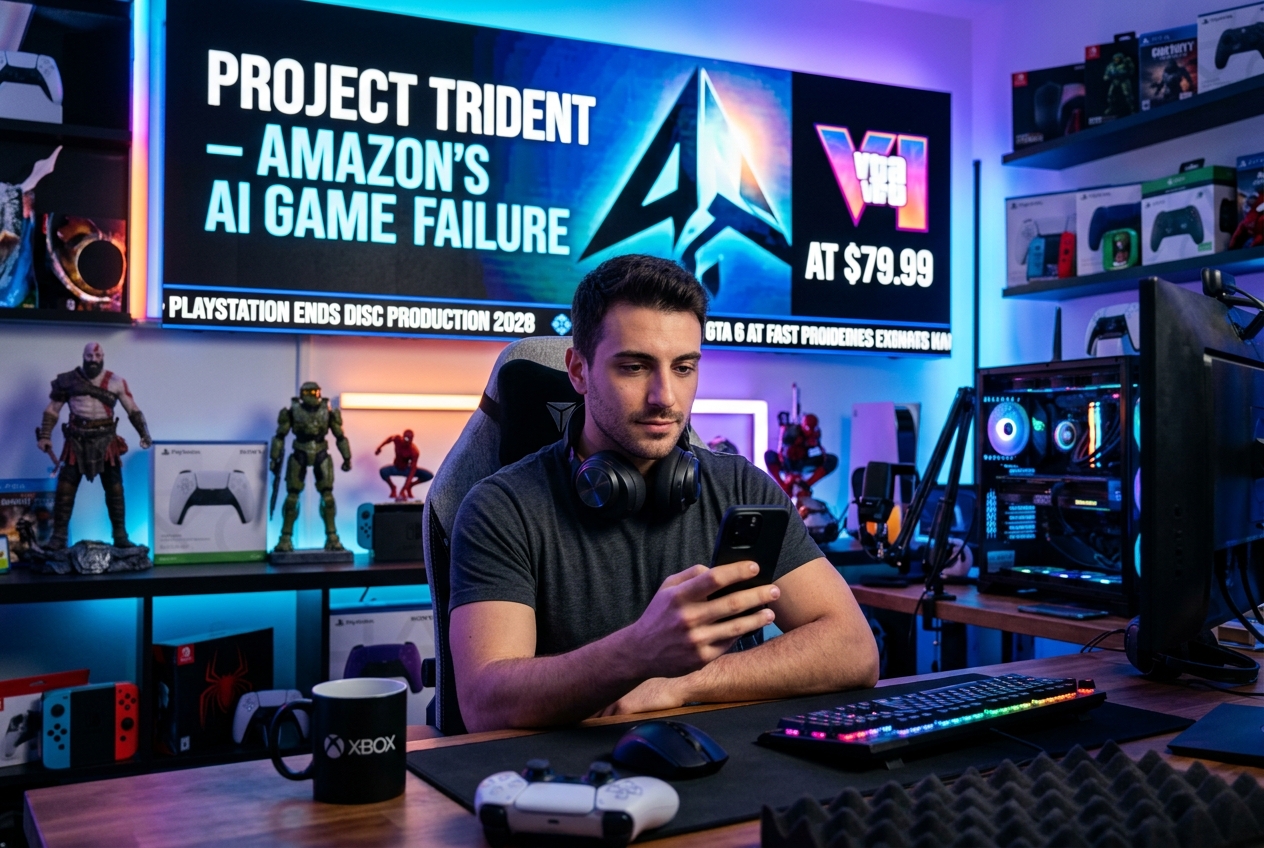
Amazon’s AI Dream Crumbles, Sony Kills Physical Media, and GTA 6 Breaks the Bank: The Week in Gaming
Published: October 13, 2026 — by Vito Ruocco
Introduction: A Pivot Point for the Industry
If you blinked, you might have missed it — but the last seven days in gaming have been nothing short of seismic. From the carcass of Amazon’s ambitious AI-powered game Project Trident to Sony’s decision to pull the plug on physical PlayStation discs by 2028, and Rockstar’s confirmation that Grand Theft Auto 6 will carry a price tag that forces a reckoning with what “ownership” even means in a digital-first world, the industry has delivered three stories that will echo for years.
This isn’t just news. These are structural shifts — tectonic movements beneath the floorboards of an industry still reeling from post-pandemic layoffs, AI paranoia, and a slow-rolling extinction event for physical game retail. Today, we unpack all three, along with new releases, hardware deals, and the human cost behind the headlines.
The Fall of Project Trident: When Amazon Forced AI Into a Game, and Then Killed It Anyway
In October 2025, developers at Amazon Game Studios found out they had lost their jobs. They were far from alone — since the end of the Covid-19 pandemic, an unrelenting assault of layoffs has carved up studios across the world. But the story of one team within Amazon’s umbrella — the team behind the internal project codenamed Project Trident — stands out as a particularly brutal case study in mismanagement, AI hype, and the disconnect between executive mandates and creative reality.
Eurogamer broke the story in a detailed investigative report, speaking to multiple anonymous sources across Amazon Game Studios teams. What emerged is a tale that reads less like a game development postmortem and more like a corporate tragedy in three acts.
The Mandate: Build an AI Game, or Else
Prior to 2024, Project Trident was conceptualized as a cooperative four-player action game set in a Nordic-inspired fantasy world. Think Shadow of the Colossus meets Viking mythology — a team of players battling giant, looming monsters, using grappling hooks to scale ledges and pull themselves toward their titanic foes. It was ambitious, but it was also hand-made — the kind of game that lives and dies on the artistry of its developers.
Then came the AI mandate.
According to sources, a company-wide push from Amazon leadership demanded that generative AI be integrated into every product. Game development was not exempt. The Project Trident team was instructed to pivot their entire vision around large language models (LLMs) and generative AI, whether it made creative sense or not.
“We were playing outside of the play tests because it was really fun,” one source told Eurogamer. “We knew what we wanted to make and how to do it, we just needed time to make it.”
But time was not a luxury Amazon was willing to grant.
The Pivot: A Comedy Game Powered by ChatGPT-Like Tech
Project Trident was radically reworked. The serious, co-op monster-hunting game became a comedy-focused, single-player third-person action adventure. The setting remained Nordic, but the tone shifted dramatically: the player character works for a parody company called Valhalla Ventures, navigating a world where NPCs — powered by LLMs — can hold real-time conversations, be persuaded, and even recruited.
Eurogamer reviewed substantial gameplay footage, and the details are fascinating. In combat, the player could command an NPC named Thor by speaking or typing the name of a special attack. The LLM would recognize the command, and Thor would execute the move in real-time. Environmental puzzles, reminiscent of a typical triple-A action-adventure, could be solved by verbally instructing Thor to take specific actions — moving a heavy object, triggering a mechanism, or creating a diversion.
Perhaps most impressively, the player could attempt to recruit enemies to Valhalla Ventures mid-combat. Thor would capture an enemy, assess their personality — “they seem to have an ego you could play up to” — and the player would then need to deliver a convincing argument, typed or spoken, to win them over. The enemy’s response, powered by the LLM, would be dynamic and contextual.
Importantly, the game’s art, music, story, and core gameplay remained hand-crafted by developers. The AI was a layer on top — not the foundation. Generative AI was also used to improve animation quality, such as dynamically generated lip-syncing. The comedic tone was a deliberate choice: it helped paper over the inevitable LLM hallucinations without breaking immersion.
In other words, the team did what Amazon asked. They built an AI game. And by many internal accounts, it was fun.
The End: Laid Off Anyway
It wasn’t enough.
In October 2025, Amazon Game Studios announced a “significant amount” of internal triple-A development would halt as part of a drastic restructuring. The San Diego-based Project Trident team, operating under studio head Andy Sites, was let go alongside their peers from New World, Lost Ark, and more.
The broader Amazon Game Studios umbrella had already been bleeding. New World, Amazon’s flagship MMORPG, received an end-of-life announcement following its tenth and final season. The Lord of the Rings MMO, long rumored and speculated upon, has also been cancelled — confirmed to Eurogamer by sources, despite Amazon’s claims that it is still “working on something” with the IP.
One source described the Lord of the Rings MMO team as having “like three people on it for the longest time” before New World developers were shifted over — and then everyone was let go.
Project Trident, the AI game that Amazon demanded its team build, is dead. Its developers, who scrambled to reinvent their vision on executive orders, are gone. The message is unmistakable: even when you do exactly what your corporate overlords ask, the system can still eat you alive.
Sony’s Physical Media Death Knell: The End of Discs as We Know Them
Last week, Sony dropped what industry analysts are calling a “hammer blow” for games retail: the company announced that in January 2028, large-scale production of physical discs for PlayStation games would cease entirely.
“As consumer preferences and the broader entertainment industry continue to shift away from physical discs to digital, physical game disc production for all new games releasing on PlayStation consoles will be discontinued starting January 2028,” Sony announced via a PlayStation Blog post.
The reaction was swift and visceral. For an industry that has already watched physical retail dwindle — GAME in the UK stopped accepting trade-ins, CEX is essentially gone, and GameStop has been a zombie stock for half a decade — this feels like the final nail.
The Retail Perspective
Chris Dring of The Game Business summed it up succinctly: “PlayStation games do sell well at physical retail. It’s a smaller part of the business than digital, of course, but we’re still talking millions of sales worldwide. So the news surprises me. From a retail perspective, it’s clearly a blow.”
Rhys Elliot from Alinea Analytics was blunter, calling the decision a “hammer blow for games retail.” He emphasized the importance of the pre-owned market — “one of the rusty engines keeping specialist retailers alive.”
“The margins on new physical games are so thin for retailers, but used games are where the real money was,” Elliot said. “Why pre-order a ‘physical’ copy from Amazon or GameStop when what arrives is a slip of cardboard with a download code, no better than buying it on the PlayStation Store, and often slower? A code-in-box has none of the things that made physical worth choosing: no resale value, no lending, less collectability.”
Piers Harding-Rolls from Ampere Analytics offered a slightly more measured take, noting that the pre-owned market for new releases has been “ever-shrinking” for years. He suggested the move could finally push retailers to innovate around digital sales in-store.
The Ownership Question
Perhaps most importantly, Sony’s decision — combined with Rockstar’s confirmation that GTA 6’s “physical edition” will contain no disc, just a download code — raises an existential question: what does it mean to own a video game in 2026?
Digital codes cannot be shared. Once redeemed, a game is bound to that account forever. This is especially ironic given that Sony famously mocked Microsoft when the Xbox One was announced with restrictions on used game resales. Sony’s 2013 video featuring then-executives Adam Boyes and Shuhei Yoshida showed off that sharing PS4 games was as easy as handing a friend your disc. That era is officially over.
Sony, Nintendo, and Microsoft have all flirted with discless futures before. But this is the first time a platform holder has issued a blanket, date-certain end to physical media production. The message is clear: by 2028, if you’re buying a new PlayStation game, it will be digital, whether you like it or not.
GTA 6: The Screenshots, The Price, The Reckoning
Amid all the doom and gloom, Rockstar did what Rockstar does best — it released a new batch of GTA 6 screenshots, and the internet collectively lost its mind.
The images showcase Vice City in all its Floridian glory: sun-bleached vistas, characters with impossibly expressive faces, a woman twerking on a police cruiser, and our first good look at dual protagonists Jason and Lucia framed as doomed lovers in the Miami heat. One screenshot — Jason on a kayak, bare-backed against a sunset — has already become the wallpaper of choice for thirsty gamers everywhere.
But the screenshots came with a price tag — literally. GTA 6 will cost £69.99 in the UK ($79.99 in the US), making it the most expensive standard-edition game in Rockstar’s history. The “physical” edition contains no disc — just a download code in a box. The Ultimate Edition, priced at £89.99, locks an entire mission and some in-game stores behind a paywall, and comes with a GTA+ subscription that auto-renews at £6.99 per month.
The value question is, as always, complicated. GTA 6 will almost certainly be the most expensive game ever made, and it will almost certainly sell an unprecedented number of copies. But the bundling of a subscription with a premium-priced game, the code-in-a-box model, and the removal of resale value — all of these are signposts pointing in the same direction as Sony’s disc announcement. Ownership is being unbundled. You no longer buy a game — you buy a license, a subscription, or a code.
As one Eurogamer columnist put it: “If we want lavish things — and GTA 6 will surely be nothing if not lavishly made — then we do have to pay for them.” But the question is whether we’re paying for a product we can call our own, or simply renting access to a billionaire’s playground.
New Releases: Valor Mortis Arrives Today
On a lighter note, October 13 marks the release of Valor Mortis, a new title that launched today across PC and consoles. Developed by an independent European studio, Valor Mortis is described as a tactical horror-strategy game set in plague-ridden medieval Europe, blending resource management with squad-based combat against supernatural forces.
Early reviews have been cautiously positive, with praise focused on the game’s atmospheric lighting system and its morally complex narrative choices. The game sits in an interesting intersection of genres — think Darkest Dungeon meets Medieval Total War with a layer of survival horror on top.
We’ll have a full review on the site later this week.
Prime Day Gaming Deals: Build an Entire PC From Bargains
Amazon’s Prime Day is still running, and the deals are aggressive enough that tech journalists are literally building entire gaming PCs from the discounts. Eurogamer’s hardware team documented a full build using Prime Day component deals, calling it “a whole new PC” for a fraction of the usual cost.
Standout deals include:
- AMD Ryzen 7 9800X3D at 38% off — a beast of a gaming CPU now within reach of mainstream buyers.
- Thermalright Peerless Assassin 120 CPU cooler at its lowest price all year.
- Sennheiser HD 560S open-back headphones slashed significantly — a genuine audiophile steal.
If you’ve been waiting to upgrade your rig, this week is the time.
The Bigger Picture: What These Stories Tell Us
It’s tempting to treat each of these stories as isolated news items — a bad week for Amazon, a strategic shift from Sony, a pricing controversy from Rockstar. But together, they paint a coherent picture of an industry in transition.
First: AI is a mandate, not a choice. Amazon’s Project Trident shows that when the world’s largest tech companies decide AI is the future, game developers become foot soldiers in a war they didn’t choose. The team did what they were told, built a genuinely creative AI-powered game, and were laid off anyway. The lesson is not that AI games can’t work — it’s that corporate AI mandates are often disconnected from the reality of how great games are made.
Second: Physical media is dying, and fast. Sony’s 2028 deadline is the first concrete end-date from a platform holder. Combined with Microsoft’s discless Series S strategy and Nintendo’s Switch 2 Game Key Cards (download codes on cartridges), the trend is undeniable. By 2030, buying a disc for a new console game may be a historical curiosity.
Third: The cost of gaming is rising — and so is the cost of entry. GTA 6 at $79.99 is a bellwether. It will normalize that price point for AAA games the way Call of Duty and Grand Theft Auto have done at every previous price ceiling. Combined with the erosion of resale value and the rise of subscription models, the total cost of being a gamer is climbing faster than inflation.
Finally: The human cost remains unacceptably high. The developers of Project Trident, New World, and countless other projects are not just footnotes in a corporate restructuring. They are artists, engineers, and craftspeople who poured years of their lives into work that was discarded on a spreadsheet. Until the industry reckons with the cycle of boom-and-bust hiring, these stories will keep repeating.
What We’re Watching This Week
Looking ahead: Rockstar is expected to release another trailer for GTA 6 before the end of the month. Sony’s next State of Play is rumored for late October, where we may finally see gameplay from the next Naughty Dog title. And with Prime Day drawing to a close, expect a flurry of hardware announcements as manufacturers clear inventory for the holiday quarter.
The industry is moving fast. We’ll be here every day to track it. Stay tuned.
— Vito Ruocco covers gaming, tech, and digital culture. This article was published on October 13, 2026.