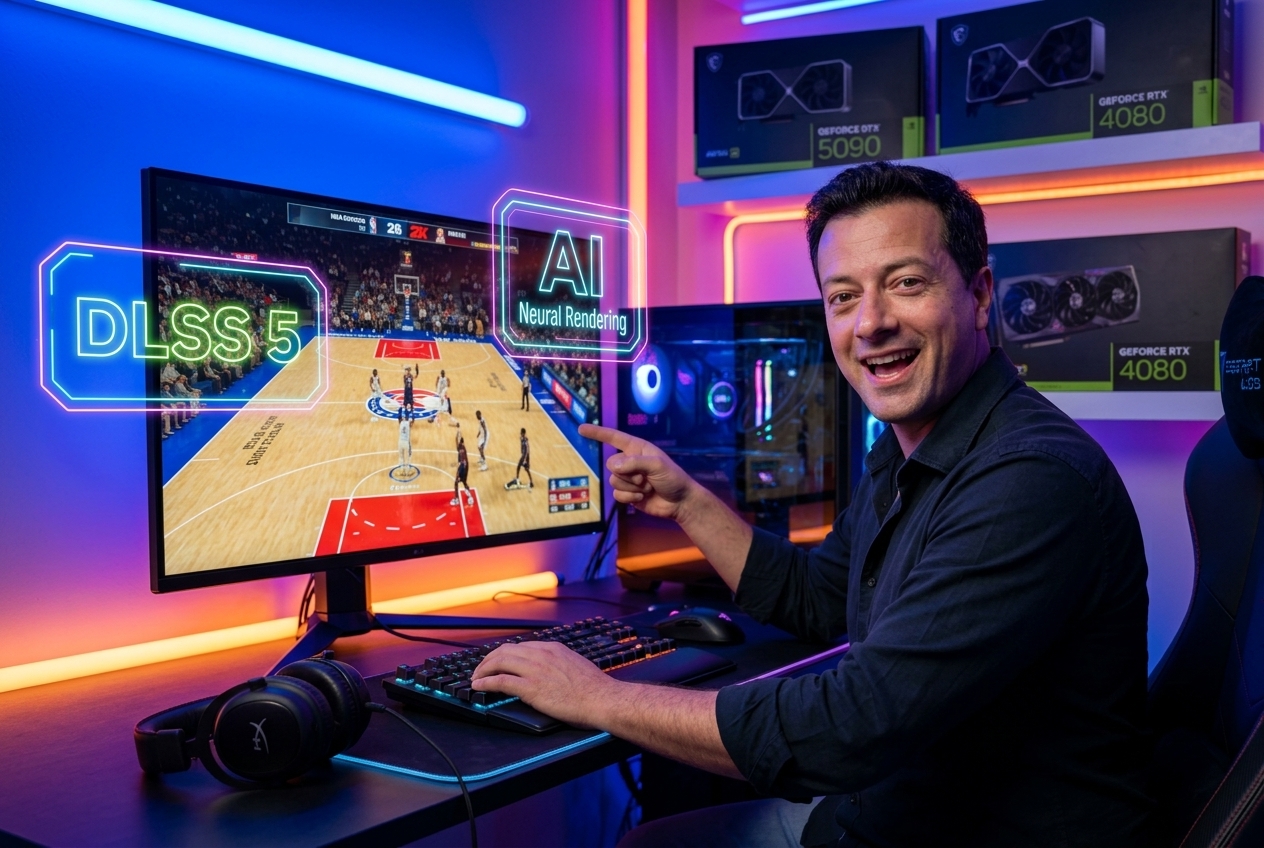
NVIDIA DLSS 5 Launches Today: AI Neural Rendering Arrives Amid Performance Concerns and Ethical Debate
September 3, 2026 — NVIDIA’s most controversial graphics technology to date, DLSS 5 with 3D-Guided Neural Rendering, goes live tonight, bringing generative AI directly into the real-time rendering pipeline. But the technology arrives with serious questions about performance costs and artistic integrity.
1. The Dawn of Neural Rendering: What DLSS 5 Actually Does
Today marks a pivotal moment in PC gaming graphics. At 9 PM Pacific Time, NVIDIA flips the switch on DLSS 5, the latest iteration of its Deep Learning Super Sampling technology — and this time, it’s fundamentally different from everything that came before.
While earlier DLSS versions focused on reconstructing existing scene data to deliver higher-resolution images, generate additional frames, or clean up ray-traced lighting, DLSS 5 introduces what NVIDIA calls 3D-Guided Neural Rendering. This is a generative AI model that sits at the final stage of the graphics pipeline, infusing scenes with lifelike lighting and material details that traditional rendering — constrained by real-time performance budgets — had to leave out.
“Rather than brute force rendering each frame or adding more details to the scene, an alternative approach to photorealism emerged: generative AI,” NVIDIA explains in its official launch blog post. The technology uses the game engine’s rendered frame — geometry, textures, and lighting buffers — as an “unyielding foundation,” then applies AI to generate rich lighting effects like natural skin subsurface scattering, realistic light transmission through hair and foliage, and deeper contact shadows alongside global illumination.
The technology debuts exclusively in NBA 2K27, developed by Visual Concepts and published by 2K, and is available only on GeForce RTX 50 Series GPUs, RTX 50 Series laptops, and GeForce NOW. “What’s great is the level of control that it gives us,” said Peter Kavic, Senior Producer at Visual Concepts. “We can set the overall tone and style to match our existing art direction and then really get precise where it matters most, using a per pixel uplift control mask to fine tune detail on characters.”
2. The Performance Elephant in the Room
DLSS was originally designed as a performance-enhancing technology — a way to render at lower resolutions and use AI to upscale, gaining frames without sacrificing visual quality. DLSS 5 flips that equation on its head.
According to testing by PC Gamer, the performance hit from enabling DLSS 5’s neural rendering is a staggering 50-60 percent. NVIDIA’s own published benchmarks show the numbers, but they’re based on 6X multi-frame generation figures — in other words, the frame rates have been multiplied by six. When you reverse that math, the picture changes dramatically:
- A GeForce RTX 5060 in a high-end system manages only 43 FPS in NBA 2K27 at 1080p on Ultra settings with DLSS 5 enabled.
- Even a flagship GeForce RTX 5090 barely breaks 60 FPS in 4K on Ultra — and that’s with every frame generation trick in the book active.
NVIDIA acknowledges the performance gap but argues it’s early days. “Since the initial announcement of DLSS 5 in March, our progress has been rapid: from running on dual GeForce RTX 5090s to now a single graphics card, we’ve achieved a 5X performance gain in just six months,” the company wrote. “Our optimisation curve isn’t flattening out, and we have further optimisations in active development. We expect upcoming model updates coming in the autumn to boost performance beyond today’s baseline.”
Still, for a technology that was once synonymous with “free performance,” the irony is hard to miss. Gamers who invested in RTX 50-series cards expecting a smooth, high-frame-rate experience may find themselves making a genuine trade-off between visual fidelity and playability.
3. The Face-Changing Controversy: “Yassification” and Artistic Integrity
The most heated debate surrounding DLSS 5 isn’t about frame rates — it’s about faces. When NVIDIA first demonstrated DLSS 5’s neural rendering back in March, using Capcom’s Resident Evil Requiem as a showcase, the gaming community reacted with shock and mockery. The main character, Grace Ashcroft, appeared noticeably altered — her face AI-enhanced with smoother skin, fuller lips, and what many described as an artificial “beautification” filter applied.
The internet had a field day. Terms like “yassification” — referring to social media filter-style beautification — were thrown around. The comparison was unflattering: DLSS 5 seemed to be applying a TikTok beauty filter to carefully crafted character art, undermining the original artistic vision of developers.
The controversy didn’t die down. Over the past weekend, modders got their hands on leaked builds of the technology and experimented with it in other games. Control, Cyberpunk 2077, GTA 5, and The Witcher 3 were all subjected to DLSS 5’s neural rendering — and the results were often bizarre. Geralt of Rivia looked noticeably older and oddly AI-smoothed. Characters lost their intended imperfections, gaining an uncanny, generically “enhanced” appearance.
NVIDIA has responded by emphasizing artistic controls. “DLSS 5 is designed to operate deterministically, delivering consistent outputs when processing identical input frames,” the company states, adding that developers can use per-pixel “uplift control masks” to fine-tune where and how the AI applies enhancements. The technology can be dialed back or turned off entirely. But the question remains: how much control will players have when they can’t trust that a character’s face is the face the artist designed?
4. The Bigger Picture: NVIDIA’s 25-Year March to Photorealism
To understand DLSS 5, it helps to understand where NVIDIA has been trying to go for a quarter century. The company frames neural rendering as the logical next step in a journey from programmable shaders (GeForce 3, 2001) through CUDA (GeForce 8800 GTX, 2006), real-time ray tracing (GeForce RTX 2080 Ti, 2018), and path tracing (GeForce RTX 5090, 2025). NVIDIA claims a 375,000X increase in compute since the GeForce 3 era.
“Hollywood-level realism remains out of reach,” NVIDIA acknowledges. A single photoreal VFX frame for a movie can take hours or even days to render, while games need 60-plus frames every second. The gap has traditionally been closed by scaling back artistic vision — simplifying geometry, cutting material complexity. DLSS 5 aims to close that gap from the other direction: rather than brute-forcing more compute, use AI to infer the missing detail.
“DLSS 5 recognizes object-level scene semantics like objects, materials, and light sources,” NVIDIA explains. The model is trained to understand what it’s looking at — skin, hair, metal, fabric — and apply physically plausible lighting effects accordingly. The result, when it works, is genuinely impressive: NBA 2K27 screenshots show basketball players Cade Cunningham and Tyrese Haliburton lit with what appears to be dramatically more realistic skin and uniform textures.
5. Beyond DLSS 5: The Week’s Other Big Gaming Stories
Mario Kart 8 Deluxe Gets Surprise 8-Player Split-Screen on Switch 2
While NVIDIA was making headlines, Nintendo quietly rolled out a free update for Mario Kart 8 Deluxe on Switch 2 that doubles the local multiplayer limit from four to eight players. The patch also includes improved image quality, faster loading, GameShare support, CameraPlay functionality, and a new “96 Races” option for Booster Course Pass owners. A small but delightful quality-of-life change: racers now go slightly faster — “by the equivalent of one coin” — and Boo no longer slows you down when stealing items.
StarCraft 3 May Be Developed by Nexon, Not Blizzard
According to a report from Korean newspaper Chosun, Nexon is “on the verge of finalising” a deal with Blizzard to acquire the license for a new StarCraft title. Whether this means a traditional RTS sequel to StarCraft 2 or a different genre entirely remains unclear — earlier reports suggested a StarCraft-themed shooter from Nexon. Blizzard itself is reportedly working on its own StarCraft shooter led by former Far Cry boss Dan Hay. An official announcement is expected at BlizzCon 2026, taking place September 12-13.
Monster Hunter Wilds Ascendance Teases Weapon Overhauls
Capcom has begun releasing daily videos detailing Boosted Actions — a new mechanic coming in the Monster Hunter Wilds: Ascendance expansion (due 2027). The “Boost Bracer” allows hunters to build energy through aggressive attacks, then unleash powerful “Boost Driver” attacks. Each of the game’s 14 weapon types gets unique Boost abilities, from aerial Great Sword moves to a Hammer-based shoryuken. The rollout schedule conveniently leads up to Tokyo Game Show on September 15.
Xbox Game Pass September Wave 1 Brings RuneScape to Console
Microsoft’s first September wave of Game Pass additions is relatively light, but one title stands out: RuneScape: Dragonwilds (September 15), marking the first time a RuneScape game has ever appeared on console. The open-world survival crafting game has “very positive” Steam reviews and launches day-one on Game Pass Ultimate, Premium, and PC. Other additions include SpeedRunners 2 (September 3), Call of Duty: Black Ops Cold War (September 8), and Virtua Fighter 5 REVO (September 10). Notably, Cyberpunk 2077 leaves Game Pass on September 15.
Ace Combat 8 Reveals Live Service Multiplayer Modes
Bandai Namco has unveiled details on Ace Combat 8‘s online offerings, which include PvE, PvP, and PvPvE battle modes, plus a dedicated social hangout space. “We received a lot of feedback that fans wanted to meet up,” the developers stated. The live-service approach marks a significant shift for the traditionally single-player-focused franchise.
6. What This Means for Gamers: DLSS 5 and the AI Crossroads
DLSS 5 represents a genuine crossroads for PC gaming. On one hand, the technology demonstrates astonishing potential — the idea that AI can infer photorealistic lighting, subsurface scattering, and material detail in real-time is genuinely revolutionary. The screenshots from NBA 2K27 show characters that look substantially more lifelike than what traditional rasterization can achieve.
On the other hand, the technology raises profound questions:
- Performance trade-offs: Is a 50-60% frame rate hit worth better-looking skin and lighting? For competitive players, the answer is almost certainly no. For those chasing the ultimate visual experience, perhaps.
- Artistic integrity: When an AI model changes a character’s face, whose vision is being rendered? Developers have controls, but the controversy around character “yassification” suggests a disconnect between NVIDIA’s messaging and player perception.
- Hardware segmentation: DLSS 5 is exclusive to RTX 50-series cards. This effectively creates a new tier of visual quality that only the most expensive GPUs can access — and even then, at compromised frame rates.
NVIDIA insists the technology will improve rapidly. “Backed by over a decade of DLSS expertise, we remain committed to continuously pushing the boundaries of performance and image quality, and this is only the beginning,” the company stated. “Together, these innovations mark the beginning of a transformative era which blends hand-crafted rendering with neural graphics to deliver a dramatic leap in visual realism.”
7. The Bottom Line: Watch, Wait, and Benchmark
For most gamers, the sensible approach to DLSS 5 is wait and see. The technology launches tonight in a single title — NBA 2K27 — and only on premium hardware. The first independent benchmarks, comprehensive comparisons, and developer case studies will tell a more complete story than NVIDIA’s carefully curated marketing materials.
What’s undeniable is that generative AI has entered the real-time rendering pipeline, and there’s no going back. Whether DLSS 5 becomes a transformative leap forward or a cautionary tale about the limits of AI in game art will depend on how NVIDIA addresses the performance gap, how developers wield the artistic controls, and — most importantly — how players vote with their GPUs.
DLSS 5 goes live tonight at 9 PM Pacific. The era of neural rendering begins now — frame drops and all.
This article was published on September 3, 2026. All information is based on official announcements from NVIDIA, Microsoft, Nintendo, Capcom, and Bandai Namco, as well as reporting from Eurogamer, PC Gamer, and IGN.