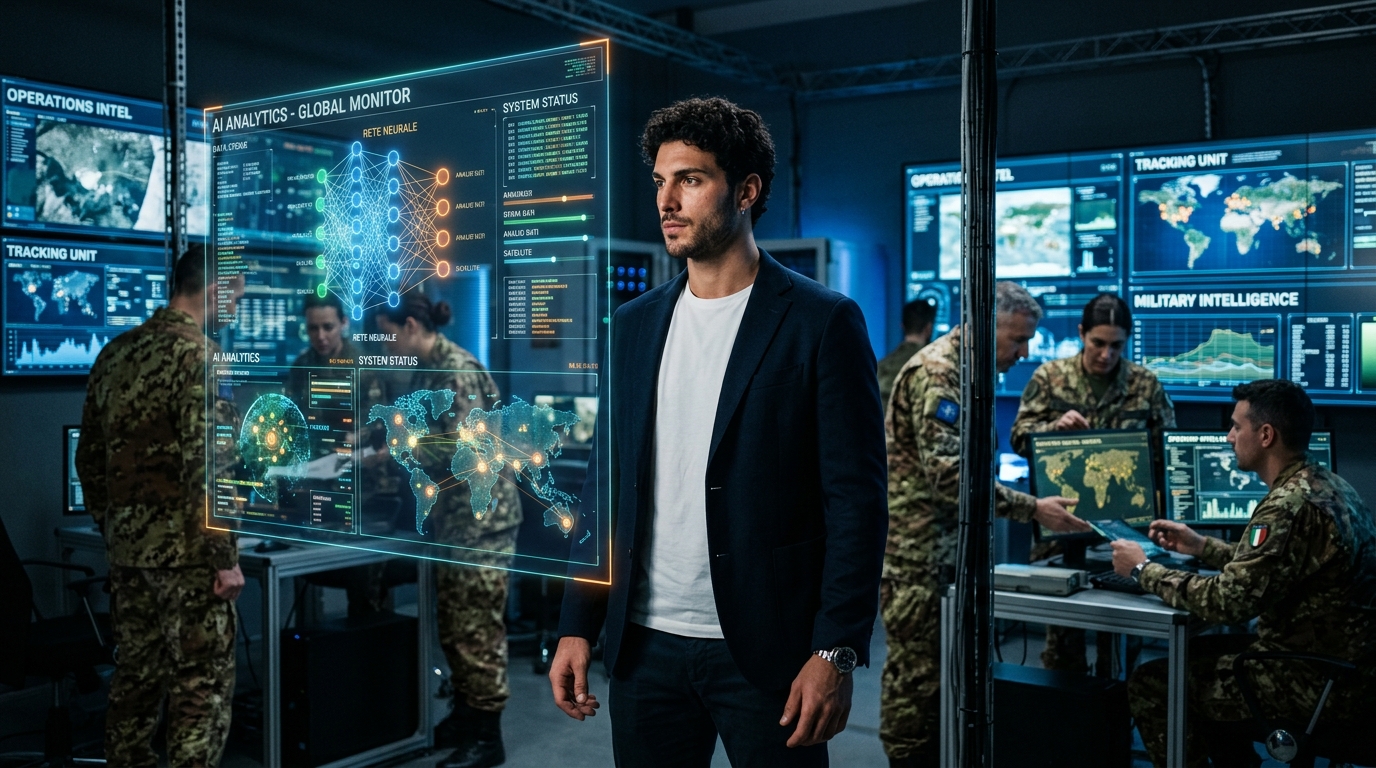
The Pentagon’s AI Arsenal Expands: US Military Deploys Custom ChatGPT, Grok, and Gemini Across the Force
Published: September 2, 2026
In what is rapidly becoming one of the most significant enterprise AI deployments in history, the United States Department of War has taken a decisive leap into the age of artificial intelligence. As of this week, over 1.7 million of the Department’s 3 million personnel have been onboarded onto GenAI.mil — a bespoke generative AI platform that now offers frontline AI models from Google, OpenAI, and Starshield AI (xAI’s Grok), all tailored specifically for military use. The implications are staggering: the world’s most powerful fighting force is now being augmented by the world’s most powerful AI models, in what the Pentagon describes as a “force multiplier” for the Joint Force.
GenAI.mil: From Pilot Program to Full-Scale Deployment
When the Department of Defense first launched GenAI.mil in late 2025 with Google’s Gemini as its cornerstone offering, it was seen as a cautious experiment in bringing generative AI to the military enterprise. The platform was initially designed for unclassified work — summarizing policy handbooks, generating compliance checklists, and extracting key terms from statements of work. But the adoption curve has been nothing short of explosive.
Within nine months, GenAI.mil has onboarded more than 1.7 million unique users out of the Department’s roughly 3 million personnel. That’s a 56% adoption rate — a figure that would make any enterprise SaaS company envious. The platform is now accredited for Controlled Unclassified Information (CUI) at Impact Level 5 (IL5), meaning it meets the military’s stringent security requirements for handling sensitive but unclassified data.
This week’s announcement that Starshield AI’s Grok for Government has been added to the platform marks a new chapter. The Grok model brings “deep-thinking inference, adaptive reasoning modes (Auto, Fast, and Expert), customizable workspaces, persistent projects, and reusable ‘playbooks’ that capture and scale institutional knowledge,” according to the Department of War’s official release.
No More Vendor Lock-In: A Multi-Model Military AI Strategy
One of the most strategically significant aspects of GenAI.mil is its multi-model approach. Rather than betting the house on a single AI provider, the Pentagon has deliberately created a platform that can host multiple frontier models from different vendors. Google’s Gemini was first. Now Starshield AI’s Grok has joined the roster. And with OpenAI’s ChatGPT also reportedly being integrated for “tailored warfighter needs,” the Department of War is building what amounts to an AI app store for the military.
This strategy serves multiple purposes. First, it eliminates vendor lock-in — a critical concern for any organization, but especially for the military, which cannot afford to become dependent on a single technology provider. Second, it creates a competitive environment where different AI models can be evaluated against each other for specific use cases. Third, it promotes what the Pentagon calls “a vibrant American AI ecosystem,” ensuring that taxpayer dollars support multiple domestic AI companies.
The move comes as the White House pushes forward with its AI Action Plan, which emphasizes the need for federal agencies to rapidly adopt AI technologies while maintaining security and American leadership in the field.
From the Battlefield to the Boardroom: How the Military Is Using AI
The use cases for GenAI.mil span the full spectrum of military operations. While the most headline-grabbing applications involve combat and intelligence, the reality is that much of the initial deployment focuses on the vast administrative and logistical machinery that keeps the military running.
According to the Department of War, personnel are using the platform for:
- Market research analysis for acquisition professionals who need to evaluate defense contractors and technology vendors
- Supply chain management for logisticians managing complex global supply chains
- Policy summarization — distilling thousands of pages of regulations into actionable briefs
- Compliance checklist generation for complex procurement and operational requirements
- Risk assessment creation for operational planning
- Contract analysis — extracting key terms from statements of work and legal documents
But the ambitions extend far beyond administrative efficiency. The addition of Grok’s “deep-thinking inference” capabilities suggests that the military is also exploring more sophisticated applications, including strategic analysis, threat assessment, and operational planning. The reusable “playbooks” feature, in particular, points to an effort to capture and institutionalize knowledge that currently resides in the heads of experienced personnel — a critical capability as the military faces retention challenges in key technical roles.
The Privacy and Security Question: What Happens to Military Data?
Any discussion of AI in the military inevitably raises questions about data security, privacy, and the potential for misuse. The Department of War has addressed these concerns head-on, and both Google and Starshield AI have made clear commitments about how military data is handled.
For Google’s Gemini, the company has explicitly stated that data from GenAI.mil “is never used to train Google’s public models.” This is a critical distinction from consumer AI services, where user data often feeds back into model training. The military-grade deployment creates a clean separation between the government’s data and the public AI ecosystem.
Starshield AI’s Grok for Government is similarly accredited for Controlled Unclassified Information at Impact Level 5, which is the highest security level for unclassified information. The platform runs on dedicated infrastructure that is separate from the consumer-facing Grok service, ensuring that sensitive military data never leaves the government’s secure environment.
Additionally, the platform operates behind the Department of Defense’s network authentication. Even visiting GenAI.mil from outside the DoD network results in an access denied message — a deliberate design choice that ensures only authorized personnel can interact with the system.
AI Slop Hits the Military: The Pentagon’s Quality Control Challenge
While the military’s AI ambitions are impressive, they are not immune to the challenges that have plagued AI adoption across every sector. The rise of “AI slop” — low-quality, machine-generated content that impersonates human work — has become a significant concern, and the military is no exception.
In a striking parallel to recent events in the corporate world, where even Microsoft’s own Office and LinkedIn chief Ryan Roslansky publicly expressed frustration with AI-generated content, the military faces the challenge of ensuring that its AI tools are used to augment human intelligence rather than replace it with automated mediocrity. Roslansky recently posted a warning about AI slop “happening in the day to day of work” after receiving a fully AI-generated document from a colleague — a scenario that could easily play out in military contexts as well.
LinkedIn’s response to the AI slop problem offers a potential model for the military. The professional network’s “Seems like AI slop” reporting button has been clicked by over 1 million users, and the platform reports that users are now seeing 40% less views on what they classify as AI slop. The Department of War may need to implement similar quality control mechanisms as GenAI.mil scales to ensure that the platform enhances rather than degrades the quality of military work.
The Legal Minefield: AI Hallucinations in the Courtroom
The military’s AI deployment comes at a time when the legal profession — and by extension, any organization relying on AI for document generation and analysis — is grappling with the consequences of AI hallucinations. This week alone, two high-profile incidents have highlighted the risks.
First, Sullivan & Cromwell, the prestigious law firm representing President Trump, was forced to apologize to a federal judge after filing documents filled with fake case citations hallucinated by AI. The error list ran three pages long. Second, state officials in Mississippi are asking an appeals court to overturn a decision blocking restrictions on school DEI programs, citing an “error-plagued” ruling that was drafted with the help of AI tool Perplexity, which included made-up citations and bogus quotations.
For the military, where the stakes are infinitely higher, these incidents serve as a stark warning. An AI-generated supply chain analysis that hallucinates a vendor’s capability, or an AI-drafted operational plan that cites nonexistent intelligence, could have catastrophic consequences. The Pentagon’s Chief Digital and AI Office (CDAO) will need to implement rigorous validation protocols to ensure that GenAI.mil’s outputs are accurate and reliable.
Perplexity’s Hybrid Compute: A Privacy-First Alternative
As the military goes all-in on cloud-based AI, a fascinating alternative approach is emerging from Perplexity. The company’s recently announced “Hybrid Compute” feature, rolling out to Perplexity Computer on Mac, takes a fundamentally different approach to AI privacy. Instead of sending all data to the cloud, Hybrid Compute uses a “privacy gate” to control which information leaves the device. Cloud-based AI models handle reasoning, web search, and planning, while an on-device model works with tasks involving sensitive information and private files.
This split architecture could have significant implications for military AI deployments. While the GenAI.mil platform is designed for controlled unclassified information, there are countless scenarios where military personnel need AI assistance with information that is too sensitive even for IL5-accredited systems. Perplexity’s approach — keeping sensitive data on-device while leveraging cloud AI for less sensitive tasks — could provide a template for higher-security military AI deployments in the future.
The concept is reminiscent of the “air gap” approach used in classified computing environments, where different security domains are physically or logically separated. A hybrid approach that keeps sensitive data local while still providing AI capabilities could bridge the gap between the unclassified GenAI.mil and the classified systems that handle the military’s most sensitive information.
The Cultural Impact: AI as Entertainment and Warning
The military’s embrace of AI is unfolding against a broader cultural backdrop that is simultaneously fascinated and terrified by artificial intelligence. This week, it was announced that Luca Guadagnino’s film “Artificial” — starring Andrew Garfield as OpenAI CEO Sam Altman — will have its world premiere at the New York Film Festival on October 5th. The film dramatizes the chaotic five-day period in 2023 when Altman was fired and then rehired by OpenAI, a saga that captured the world’s attention and revealed the internal tensions within the AI industry’s most prominent company.
The juxtaposition is striking: at the same time that Hollywood is dramatizing the trials and tribulations of AI leadership, the U.S. military is deploying the very same technology across its entire force. The film serves as both a mirror and a warning — a reminder that the AI revolution is being driven by fallible humans operating in a high-stakes, high-pressure environment.
OpenAI itself has been making moves to ensure its technology is used responsibly. The company recently joined Anthropic and Google in signing an open letter calling for a “global surge in cyber defense,” warning that “AI-enabled cyber attacks will become far more widespread and sophisticated.” The letter, signed by over 100 companies and organizations, calls for putting “cyber-capable AI in the hands of defenders” — a sentiment that aligns perfectly with the military’s GenAI.mil initiative.
The OpenClaw Factor: Democratizing AI Development
While the military’s AI ambitions are playing out at the enterprise level, the open-source AI ecosystem continues to evolve at a breakneck pace. OpenClaw, the often-imitated AI agent framework, recently released version 2.0, which founder Peter Steinberger described as a cleanup that “touched every area of the bot’s framework with simplified installs, setup, and a rebuilt browser app.”
Steinberger touted the use of shared cloud sessions for development, with “Multiplayer coding + infinite compute” that kept the entire team synchronized. This approach — collaborative, cloud-native, and agent-driven — represents a stark contrast to the centralized, enterprise-focused approach of the military’s GenAI.mil platform.
Yet the two trajectories are not as divergent as they might seem. The same AI technologies that power OpenClaw’s agent framework are being deployed inside the Pentagon’s GenAI.mil platform. The difference lies in the governance, security, and scale of deployment. The open-source community moves fast and breaks things; the military moves deliberately and secures everything. Both approaches have their merits, and both are pushing the boundaries of what’s possible with AI.
Google Courts Hollywood: The AI Content Licensing Battle
As the military deploys AI for security and operational advantage, Google is simultaneously fighting a different kind of battle — one for the hearts and minds of Hollywood. The tech giant is reportedly pitching its AI tools to studios like Disney and Universal as a way to streamline production and visual effects. But the effort faces significant pushback from union workers and creators concerned about copyright, job displacement, and artistic control.
The Hollywood negotiations highlight a fundamental tension in the AI industry: the same technology that can help the military analyze threats and optimize supply chains can also generate art, write scripts, and create visual effects that threaten the livelihoods of creative professionals. The Department of War’s AI deployment is unlikely to face the same kind of labor pushback — after all, few people are going to argue that military personnel shouldn’t have access to the best available tools. But the broader societal conversation about AI’s role in the workforce is relevant to every sector, including the military.
For the military, the key question is not whether AI will replace human judgment — it’s how to design systems that augment human capabilities while maintaining human oversight and accountability. The Pentagon’s Chief Digital and AI Office has emphasized that GenAI.mil is designed to support, not replace, human decision-making. But as AI models become more capable and autonomous, maintaining that distinction will become increasingly challenging.
What’s Next: The Road Ahead for Military AI
The GenAI.mil platform is still in its early stages. With 1.7 million users onboarded and three major AI models now available, the foundation is in place for what could become the world’s largest enterprise AI deployment. But significant challenges remain.
First, the platform must prove its value in operational contexts. While administrative use cases are well-established, the real test will come when AI is used to support tactical decision-making, intelligence analysis, and mission planning. Second, the military must address the quality control challenges that have plagued AI deployment across every sector. Third, the security and privacy implications of AI in military contexts will only grow as the platform scales and as AI models become more powerful.
The Department of War’s AI Acceleration Strategy, which includes “enterprise AI applications” as one of its core tenets, is clearly delivering results. The addition of Grok to GenAI.mil, following the earlier deployment of Gemini and the imminent integration of ChatGPT, gives the military a multi-model AI capability that is unmatched in any other organization in the world.
As Secretary of Defense Pete Hegseth — who has renamed his office the Department of War — put it, “The future of American warfare is here, and it’s spelled A-I.” Whether that future is one of unprecedented efficiency and precision, or one of unforeseen consequences and risks, will depend on how carefully the military navigates the complex terrain of AI deployment. The stakes could not be higher.
Kaito Vito Ruocco — Technology correspondent covering AI, defense technology, and the intersection of machine intelligence with society. This article was researched and written with the assistance of AI tools, reviewed and edited by a human editor.