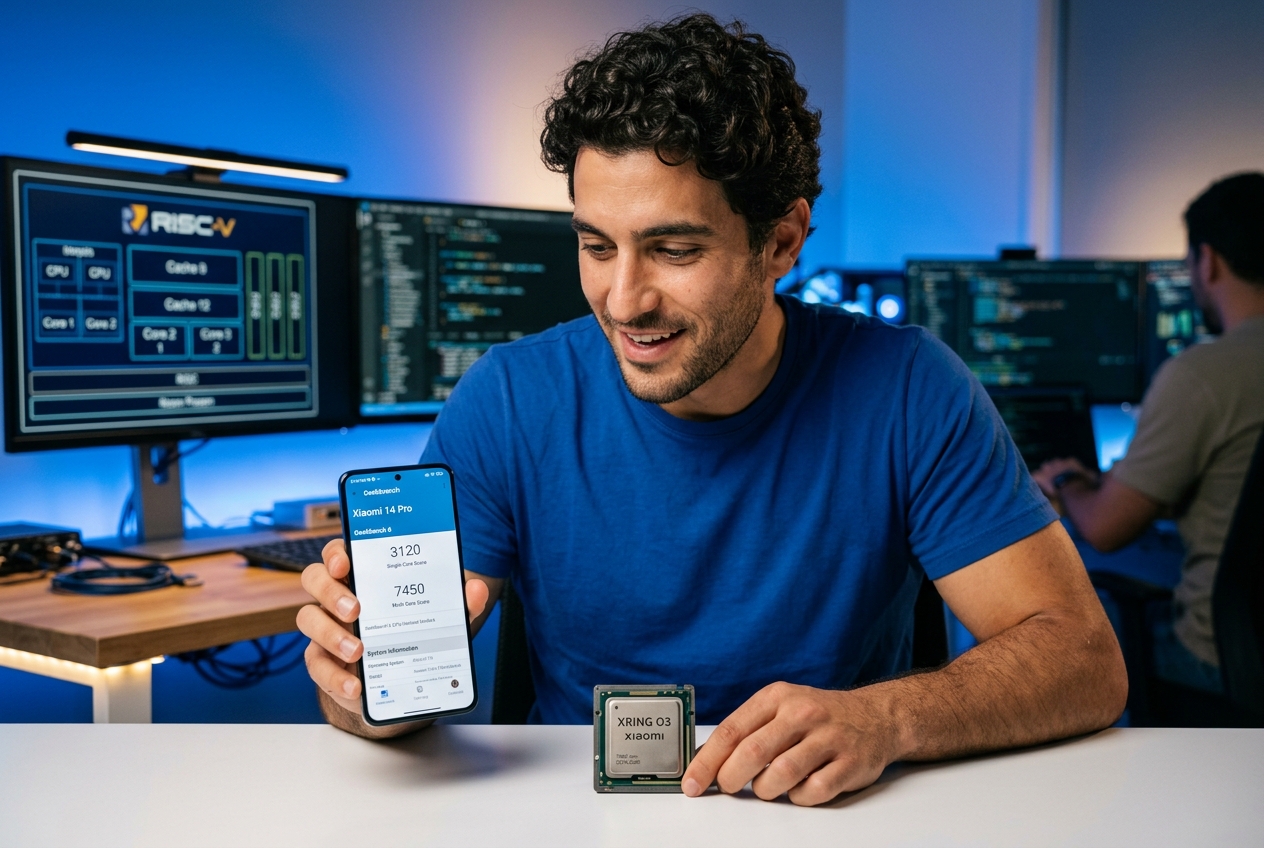
Xiaomi’s Xring O3 Shocks the Mobile World: A Chinese CPU That Matches Apple’s Best
Published on August 25, 2026 by Vito Ruocco
The smartphone processor landscape just shifted under our feet. Xiaomi, long known as the Chinese giant that competes with iPhone on volume and value, has done something nobody outside its labs expected: it built a mobile CPU that goes toe-to-toe with Apple’s legendary silicon — and in some benchmarks, it simply runs away.
The chip, called the Xring O3, is built around ARM’s new flagship C1-Ultra cores, and the early data is jaw-dropping. In single-threaded performance, the Xring O3 roughly matches the latest Apple A-series processor. In multi-threaded workloads, it pulls ahead — significantly. For a company that until recently relied entirely on Qualcomm and MediaTek chips, this is a declaration of independence. And for the rest of the industry, it’s a wake-up call.
But this isn’t the only story making headlines today. From the first confirmed AI-guided drone strike that killed civilians to the revelation that over a third of new web pages are AI-generated, August 25, 2026, is shaping up to be a day that redefines how we think about technology.
The Xring O3: A Deep Dive Into Xiaomi’s Silicon Gambit
Daniel Lemire, a respected computer science researcher, broke the news on X (formerly Twitter), sharing benchmark data that sent shockwaves through the tech community. “Xiaomi’s new CPU roughly matches Apple cores on single-threaded tasks, and is much faster in multi-threaded execution,” Lemire wrote. The post amassed over 842 points on Hacker News within hours, sparking one of the most intense technical discussions of 2026.
Here is what makes the Xring O3 so remarkable:
- 44 MB of total cache — more than most laptop CPUs. If you have an Intel processor in your laptop right now, there is a good chance the Xring O3 has more cache than your desktop machine.
- The C1-Ultra cores are astonishingly wide, with 21 execution ports, six of which support SIMD operations at 128-bit. That is more execution ports than any current Intel or AMD desktop processor.
- SME2 (Scalable Matrix Extension 2) support for matrix and AI acceleration, plus SVE2 for data parallelism — putting serious ML inference capability directly on the CPU.
To put those numbers in perspective: AMD’s Zen 5 architecture has the edge in raw SIMD width (4x 512-bit vs 6x 128-bit), but on ARM, no chip — not even Apple’s — has this many parallel execution units. The C1-Ultra core is, by some measures, the widest ARM core ever built.
What This Means for the Mobile Industry
The immediate implication is brutal for Qualcomm and MediaTek. Xiaomi is the world’s third-largest smartphone manufacturer by shipment volume, and it is still growing. If Xiaomi can build its own chips at scale, it no longer needs to negotiate with Snapdragon or Dimensity pricing.
One analyst on Hacker News put it bluntly: “This is bad news for MediaTek and Qualcomm.” The same C1-Ultra cores are used in MediaTek’s Dimensity 9500, which scored over 4,000 points in Geekbench 6 lab tests. But inside an actual phone with real-world cooling constraints, that score drops to around 3,300. Xiaomi’s Xring O3, built for its own devices, may achieve better thermal integration and sustained performance.
For consumers, the promise is real: more performance, better power efficiency, and potentially lower prices as vertical integration cuts out the middleman. For the industry, it signals the end of the era where only Apple could design truly world-class mobile silicon. Samsung’s Exynos division will be watching closely.
Benchmark Reality: The Thermal Throttle Problem
As impressive as the specs look on paper, the smartphone form factor remains the great equalizer. As one commenter on Hacker News noted: “The age-old problem of mobile chips is that they have brilliant performance for about 15 seconds until they thermal throttle.”
This is the same challenge every high-performance mobile chip faces. Apple’s A-series processors, for all their architectural brilliance, throttle under sustained load. The difference is that Apple’s chips reach idle faster, minimizing the impact for everyday tasks. Xiaomi’s challenge will be matching that efficiency curve, not just the peak benchmark numbers.
Nevertheless, the architectural achievement is undeniable. The chip’s 21 execution ports, massive cache pool, and AI-focused instruction set extensions represent a level of investment and engineering that was, until yesterday, considered exclusive to Cupertino and Austin.
A Line Has Been Crossed in AI Warfare
In a chilling reminder of technology’s dual-use nature, The New York Times reported on August 24 that a Russian drone fitted with an Nvidia chip and guided entirely by AI killed three Ukrainian civilians in July. The Verge calls it “a line crossed” — the first documented instance of an AI system both guiding a drone and selecting a target without human intervention.
Though AI is already a standard feature in modern warfare, experts warn that removing humans from the kill chain entirely marks a dangerous escalation. The drone, equipped with an Nvidia system-on-chip, used computer vision to identify and engage targets autonomously. Both sides of the Ukraine conflict have experimented with battlefield automation, but this incident is the first confirmed case of lethal AI autonomy against civilians.
Anthropic, the AI safety company, has been fighting to preserve two “red lines” in its Pentagon contracts: bans on domestic mass surveillance and on weapons that can identify, track, and kill targets with zero human involvement. But the pressure to deploy these systems is immense, and the technology is already here.
Alibaba’s Wan3.0: AI Video Comes of Age
On a lighter note, Alibaba released its Wan3.0 AI video model to the general public on August 24. The model can generate 30-second clips from text, image, video, and audio inputs — including web pages, PDFs, and slide decks. The quality is impressive enough to raise familiar copyright concerns, especially given promotional materials featuring Tom Cruise.
The model joins a growing field of AI video generators including OpenAI’s Sora, Runway’s Gen-3, and Kuaishou’s Kling. What sets Wan3.0 apart is its multi-modal input capability: you can feed it a PDF presentation and get a narrated video summary, or provide a reference image and extend it into a moving scene.
For content creators, this is both a powerful tool and a threat. The ability to generate short-form video from almost any input will accelerate the already rapid shift from text to video content. For platforms like TikTok, YouTube, and Instagram, it means an incoming tsunami of AI-generated video that will strain moderation systems.
The Internet Is Now One-Third AI-Generated
Pew Research released a landmark study on August 20 that quantifies something many of us have felt intuitively: the web is being flooded with AI-generated content. By analyzing nearly half a million English-language webpages from the Common Crawl archive using the Open Pangram detection tool, Pew found that over one-third of pages published after ChatGPT’s November 2022 launch show significant signs of AI authorship or editing.
The distribution is uneven. On .com domains, roughly one in ten pages in 2026 shows signs of AI authorship — double the rate on .org domains (4.6%) and ten times the rate on .edu or .gov domains (around 1%). The pattern is clear: commercial content is being mass-produced by AI, while academic and government content remains largely human-written.
The study also identified telltale linguistic markers of AI text, including heavy use of em dashes, Oxford commas, certain over-represented vocabulary, and a stylistic pattern called “negative parallelism.” These patterns serve as fingerprints that detection tools can spot at scale.
For readers, the implication is stark: you cannot assume anything you read online was written by a human. Trust becomes a premium commodity — and platforms that can verify human authorship may gain a significant advantage.
SiFive’s BigSky: RISC-V Finally Goes to the Server Room
In another sign of the rapidly diversifying chip landscape, SiFive announced its first server platform, the BigSky SF-2U870. It’s a standard 19-inch 2U server packing 32 P870-D RISC-V cores running at 2.2 GHz, 256 GB of DDR5-5600 memory, 64 lanes of PCIe 5.0, and support for double-wide GPUs up to 450W.
The most important feature isn’t the hardware — it’s the software compatibility. The BigSky supports the RVA23 standard, meaning it can run Ubuntu 26.04 out of the box. As the Chip and Cheese analysis notes, this is a “boring” platform, and that is a good thing: developers can write code instead of chasing firmware bugs.
The BigSky compares favorably to Intel’s Xeon 6532P-B in core count and clock speed, with the advantage of lower power consumption. It’s not trying to beat x86 or ARM in raw performance — at least not yet. It’s offering a development platform that just works, allowing software engineers to build the RISC-V ecosystem. And that may be exactly what the architecture needs to finally break into the data center.
Framework Laptop 13 Pro: Modular Dream, RAMageddon Nightmare
Framework’s new Laptop 13 Pro received glowing reviews this week for its exquisite build quality, bright touchscreen, best-in-class haptic trackpad, and user-replaceable LPCAMM2 memory. But there is a catch that perfectly encapsulates the state of hardware in 2026: RAMageddon.
The Laptop 13 Pro’s price jumped by $800 before a single customer received a unit, driven by the ongoing PC memory shortage that has gripped the industry. The review unit that was meant to cost $2,299 now carries a nausea-inducing $3,099 price tag. It is a painful reminder that even the most innovative hardware is at the mercy of global supply chains and commodity pricing.
Framework’s commitment to repairability and modularity has never been more important — or more expensive. The Laptop 13 Pro features Intel’s new Panther Lake chips, a 16-core Core Ultra X7 358H with a 12-core Arc B390 integrated GPU, 32GB of LPCAMM2 RAM, and a gorgeous 13.5-inch 2880×1920 IPS touchscreen running at 120Hz with 700 nits of brightness. It’s arguably the best laptop Framework has ever built. It’s also, thanks to forces beyond anyone’s control, nearly impossible to recommend at its current price.
What August 25, 2026, Tells Us About the Future
Looking at today’s headlines as a whole, a clear picture emerges. We are living through a period of unprecedented technological acceleration — and unprecedented tension.
Xiaomi’s Xring O3 shows that the semiconductor playing field is leveling. The days when only Apple and Intel could build world-class processors are ending. RISC-V is entering the server room. Chinese companies are matching American silicon. The monopoly on high-performance chip design is over.
At the same time, AI is reshaping the internet and warfare in ways that are simultaneously impressive and terrifying. Alibaba’s Wan3.0 can generate video from a PDF. AI drones can kill without human input. One in three new web pages is written by a machine. These are not future scenarios — they are today’s reality.
For technologists, the message is clear: build responsibly. For consumers, the message is equally clear: stay informed, think critically, and never assume that what you’re reading, watching, or buying was made by human hands.
The future isn’t coming. It arrived this morning.
Follow Vito Ruocco for daily technology analysis and breaking AI news. This article was researched and written on August 25, 2026.