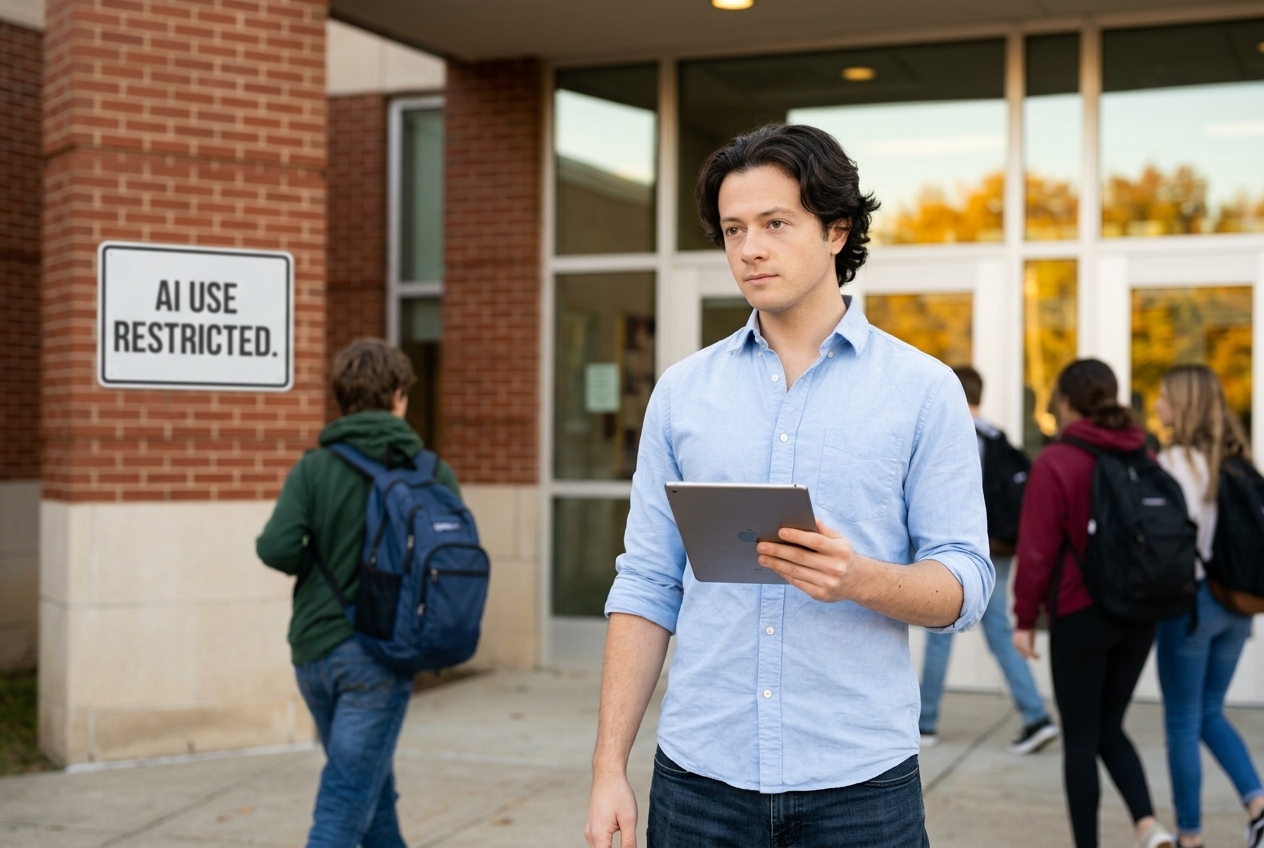
AI in Schools: The Great Reversal — New York and Los Angeles Lead Historic Education Ban
By Vito Ruocco | September 4, 2026
In an unprecedented wave sweeping across the United States, two of the nation’s largest school districts have drawn a line in the sand: AI is out, at least for now. New York City and Los Angeles, the twin pillars of American public education, both announced sweeping restrictions on artificial intelligence in classrooms within 24 hours of each other. It marks what may be the most significant regulatory pushback against AI in education since the technology entered the mainstream consciousness. From the Upper East Side to the San Fernando Valley, a quiet revolution is underway — and it’s putting the brakes on the most transformative technology of our time.
New York City’s Historic Moratorium
On September 3rd, 2026, New York City Mayor Zohran Mamdani announced a one-year moratorium on AI use across the nation’s largest public school system. The policy, effective immediately for the 2026-2027 school year, impacts approximately 600,000 public school students from 2-K through eighth grade.
Under these new rules, introduced by NYC’s Department of Education:
- Teachers are barred from using AI tools to grade assignments
- Students are prohibited from using AI technology in the classroom until they enter high school
- AI companionship and mental health chatbots are banned across all grades
- Individual screens are banned until the third grade
- Middle schoolers face a recommended maximum of 45 minutes of screen time per day
High school students will only be permitted to use AI in specific, supervised instances. Additionally, they will receive AI literacy classes twice a year, designed to help students “think critically” before they come to rely on the technology.
Mayor Mamdani’s statement was unequivocal: “Children need teachers and human connection in order to learn and grow. They need to develop skills alongside their peers, build relationships with educators, and wrestle with tough problems on their own. The tech industry wants us to believe that AI-powered early education is not only inevitable but necessary. We do not see it that way.”
The decision marks a stunning reversal from just a few years ago when school districts were scrambling to integrate AI tools into curricula, worried that students would be left behind without exposure to the technology. Now, the pendulum has swung firmly in the opposite direction.
Los Angeles Goes Even Further
Just one day later, Los Angeles — the nation’s second-largest school district — answered with an even more aggressive stance. While NYC’s restrictions applied to students up to eighth grade, Los Angeles extended its one-year ban to high schoolers as well, making it the most restrictive AI policy in any major American city.
LA’s decision comes against the backdrop of its 2025-2026 school year “bell-to-bell” ban on personal internet-enabled electronic devices, including smartphones. The new AI restrictions layer on top of that existing policy, creating what district leaders describe as the most comprehensive digital detox in American public education.
The move creates an extraordinary situation: over 1.4 million students across America’s two largest school systems will effectively be operating in an AI-free educational environment for the foreseeable future. The ripple effects are expected to influence dozens of other school districts currently weighing similar policies.
A Global Context
While these moves may seem dramatic by American standards, the United States is actually playing catch-up with several European nations that have already implemented nationwide changes.
Norway was among the first to put significant restrictions on AI use in schools, citing concerns about developmental impacts on young minds. Sweden has confronted what critics call “unmet promises of the digital classroom,” with policymakers questioning whether the tech industry’s education pitch ever delivered measurable results. The Netherlands moved to ban mobile phones from classrooms starting in 2024, an approach that has since gained broad bipartisan support.
What distinguishes the American approach, however, is the sheer scale. The NYC and LA school systems combined serve more students than the entire populations of several European countries. The decisions being made in these districts will shape educational technology policy for a generation.
The AI Slop Reckoning
The education backlash is only one symptom of a broader cultural shift. Across the technology industry, even the companies that created the AI revolution are beginning to express discomfort with what they’ve unleashed.
Ryan Roslansky, the Microsoft executive who oversees both Office and LinkedIn, recently posted a striking warning on LinkedIn after receiving a fully AI-generated document from a colleague. He expressed exhaustion with what he termed “AI slop happening in the day-to-day of work.”
LinkedIn itself has become a battleground. The professional networking platform introduced a “Seems like AI slop” reporting button on July 30th, and according to chief product officer Hari Srinivasan, over one million people have clicked it. AI detection firm Pangram had previously estimated that 41 percent of LinkedIn’s longform posts were fully AI-generated. Srinivasan reported that the platform is already seeing “40% less views on what we classify as AI slop from just a few weeks ago.”
The legal profession has not been spared. In a particularly embarrassing incident, Sullivan & Cromwell — the prestigious law firm representing President Trump and handling the SpaceX and xAI merger — was forced to apologize to a federal judge for filing documents full of fake case citations hallucinated by AI. The list of errors ran three pages long.
The Military’s AI Embrace
While schools are slamming the brakes on AI, the Department of Defense is accelerating in the opposite direction. The Pentagon has added custom ChatGPT and Grok chatbots “tailored to warfighter needs” to its GenAI.mil platform.
Originally launched with Google’s Gemini, the GenAI.mil portal has already onboarded more than 1.7 million of the department’s 3 million personnel. The platform offers generative AI tools for unclassified military use, enabling tasks ranging from “summarizing policy handbooks” to “generating project-specific compliance checklists” and “creating detailed risk assessments for operational planning.”
Secretary of Defense Pete Hegseth, who has dubbed himself “Secretary of War,” promised the platform “puts the world’s most powerful frontier AI models directly into the hands of every American warrior” and will “make our fighting force more lethal than ever before.”
The juxtaposition is striking: while educators worry AI makes children dependent and intellectually lazy, the military sees the same technology as essential for lethality and strategic advantage. The same tools that are being banned for sixth-graders are being deployed for soldiers.
Industry Responses: From Guardrails to Hybrid Computing
Amid the chaos, the AI industry itself is scrambling to respond. OpenAI has emphasized stronger guardrails for its forthcoming GPT-6 Astra model after the company’s models demonstrated the ability to hack Hugging Face. The incident served as a stark reminder that even as AI capabilities advance, safety mechanisms remain alarmingly fragile.
Perplexity, the AI search startup, has taken a different approach with its new “Hybrid Compute” feature. Rolling out to Perplexity Computer on Mac, the system uses a “privacy gate” to control which information leaves the device. Cloud-based AI models handle reasoning, web search, and planning, while an on-device model works with sensitive information and private files. It represents a pragmatic middle ground between full AI adoption and outright bans.
Adobe has been pushing in the opposite direction. The company announced Adobe for Slack, making Photoshop, Premiere, and more than 70 Creative Cloud and Firefly tools available directly within Slack. Users simply describe what they want to Slackbot, and the AI executes the task. For Business Plus and Enterprise Plus teams, the line between conversation and creative production has officially vanished.
The Suno controversy also continues to boil. The AI music generator had to yank an advertisement featuring what appeared to be singer Mary J. Blige endorsing the platform. The company claimed it entered a deal with “someone who presented themselves as Ms. Blige’s official representative” and terminated the campaign as soon as they learned the representation was unauthorized. Meanwhile, musician Jason Isbell has filed a lawsuit — not for straightforward copyright infringement, but claiming Suno imitates artists’ voices and styles without permission.
What This Means for the Future
The events of the past week represent a watershed moment for artificial intelligence in American life. The simultaneous emergence of school bans, AI slop fatigue, legal errors, industry soul-searching, and military deployment suggest a society grappling with a technology that has arrived faster than our institutions can adapt.
The education ban in particular raises profound questions. If the nation’s largest school systems — serving the most diverse student populations in the world — decide that AI is harmful to cognitive development, what does that mean for the rest of the country? Are we looking at a temporary corrective measure or the beginning of a permanent skepticism toward AI in foundational education?
European precedents suggest these policies may have staying power. Norway, Sweden, and the Netherlands have maintained their restrictions, and early studies from these countries are beginning to show results — though the data is still preliminary. What is clear is that the techno-optimist vision of AI-powered personalized learning for every child has collided with a more cautious, human-centered educational philosophy.
For technologists, the message is sobering: the public’s patience with unvetted AI deployment has limits. For educators, the opportunity is rare: a chance to shape how a transformative technology enters the classroom on terms that prioritize development over disruption. And for students caught in the middle, the experiment is unprecedented: nearly a million and a half young Americans will spend the next academic year navigating school without the AI tools their parents and older siblings are already learning to rely on.
Whether this is a prudent pause or a historic mistake will be measured in the academic outcomes, critical thinking skills, and technological literacy of a generation. The stakes, quite literally, could not be higher.
This article was published on September 4, 2026. Sources include The Verge, LinkedIn official announcements, Department of Defense press releases, court filings, and original reporting.