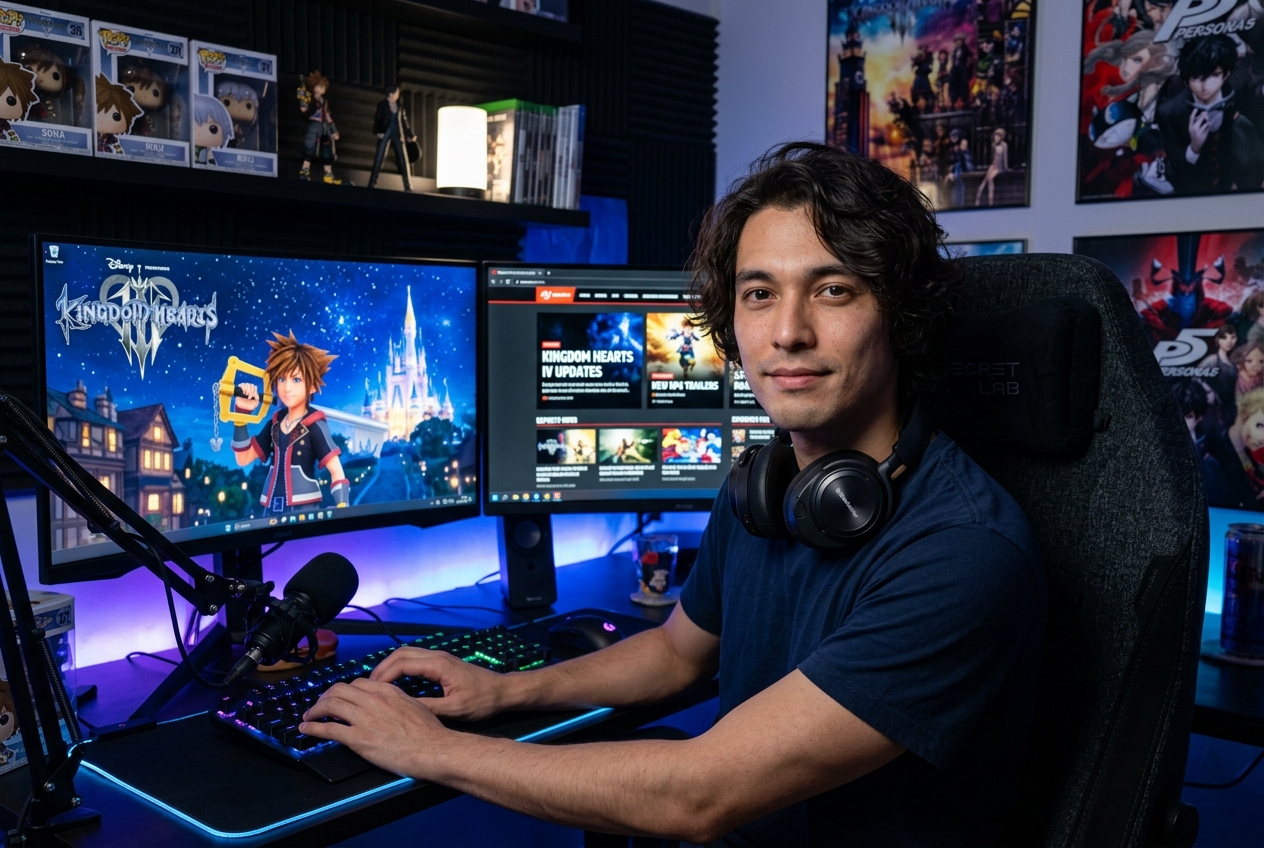
Kingdom Hearts 4 Gets 2027 Release Date, Coco World, and an Anime Series — This Week’s Biggest Gaming News
August 15, 2026 — Disney’s D23 fan expo in Anaheim delivered a tidal wave of gaming announcements that will shape the industry for years to come, led by a long-awaited release window for Kingdom Hearts 4 and the surprise reveal of a Kingdom Hearts anime series. But the excitement didn’t stop there. In a week packed with major news, Nintendo quietly confirmed one of the most requested remakes in gaming history, Steam posted its highest-ever first-half revenue, Capcom flexed its financial muscle, and Pokémon Pokopia became a certified Switch 2 phenomenon. Here’s everything you need to know.
1. Kingdom Hearts 4: Late 2027 Release Window, Coco World, and Multi-Platform Launch
Square Enix and Disney took the stage at D23 2026 on Friday to unveil a brand-new trailer for Kingdom Hearts 4, and it was worth the wait. The trailer confirms that the next chapter in Sora’s journey will launch in “late 2027” — a release window that places it squarely in the holiday season of next year. The game is headed to Nintendo Switch 2, PlayStation 5, Windows PC (via Steam and the Epic Games Store), and Xbox Series X|S, making it the most widely available Kingdom Hearts title to date and the first numbered entry ever to debut on a Nintendo platform and PC simultaneously.
The 90-second trailer opens with Sora in Quadratum, the real-world Tokyo-inspired setting teased in the 2022 reveal. But the showstopper is the reveal of a brand-new world based on Pixar’s Coco. Sora appears in Día de Muertos face paint, wielding a stunning keyblade composed of guitars, sugar skulls, bones, and marigolds — a design that instantly became the most discussed weapon in the franchise’s history on social media. Miguel and Héctor make fully rendered appearances, and the three team up to fight Heartless Shadows during what appears to be a festive musical performance in Santa Cecilia. The visual fidelity is a massive leap forward, with Pixar’s art style translated faithfully into the Kingdom Hearts engine, and the trailer’s mix of celebration and Heartless carnage captures the tonal tightrope the series has walked for 24 years.
Fans also caught glimpses of Mickey Mouse monologuing, a tense conversation between Goofy and Hades, and spectral versions of Goofy and Donald Duck — suggesting that the story will continue to explore the boundary between life, death, and the afterlife first introduced in Kingdom Hearts III‘s Re Mind DLC. The Kingdom Hearts 4 announcement at D23 follows a surprise gameplay trailer that dropped during a Nintendo Direct livestream earlier this year, ending years of radio silence from the development team. Director Tetsuya Nomura has described the game as the beginning of the saga’s “lost episodes” arc, one that will reshape everything fans think they know about the Keyblade War and the true nature of the worlds.
2. Kingdom Hearts: The Series — An Anime for Disney+
In perhaps the most unexpected announcement of the entire expo, Disney and Square Enix revealed that a Kingdom Hearts anime series is officially in development for Disney+ and the Disney Channel. The series, titled Kingdom Hearts: The Series, is being developed with the direct involvement of franchise creator Tetsuya Nomura and the creative team at Square Enix — a level of authorial control that should reassure fans terrified of a loose adaptation.
The official description promises a series that “reimagines the iconic adventure with a brand-new story that will expand on the universe of Kingdom Hearts while celebrating the characters that have captured the hearts of millions of fans around the world.” In plain terms: this is not a shot-for-shot retelling of the 2002 original, but a new story set within the same mythos, which gives Disney+ subscribers an entry point while offering veterans genuinely new lore to chew on. No release date or episode count has been announced, but the mere existence of an animated series marks a historic moment for a franchise that has been primarily narrative-driven through games for 25 years — a storytelling beast so dense that its timeline charts are a genre of internet content unto themselves. The timing aligns with the franchise’s 25th anniversary celebrations, which kick off with a special deep-dive panel at D23 this weekend — featuring key developers and voice actors — and continue through 2027 alongside the release of Kingdom Hearts 4. Notably, Square Enix said the panel will only be watchable live on YouTube, adding a layer of event urgency for the fanbase.
3. The Legend of Zelda: Ocarina of Time Remake Officially Confirmed for Switch 2
Nintendo used the summer 2026 Nintendo Direct to confirm what fans have been dreaming of for years: a full remake of The Legend of Zelda: Ocarina of Time is in development for the Nintendo Switch 2. Widely regarded as one of the greatest video games ever made — it holds a 99 on Metacritic and routinely tops “greatest of all time” lists — the 1998 N64 classic is being rebuilt from the ground up for Nintendo’s latest hardware.
The original Ocarina of Time revolutionized the action-adventure genre with its pioneering 3D gameplay, Z-targeting lock-on system, and context-sensitive controls — mechanics that have since become industry standards used in everything from Dark Souls to God of War. The remake promises to bring the land of Hyrule, from Kokiri Forest to Ganon’s Castle, to life with modern visuals while preserving the core experience that made it a masterpiece. This follows a pattern of major Zelda re-releases, including HD remasters of The Wind Waker, Twilight Princess, and Skyward Sword, as well as the complete graphical overhaul of Link’s Awakening on the original Switch. Earlier this year, Nintendo and Lego even released a 1,003-piece buildable diorama of the game’s iconic final battle against Ganondorf, proof that Ocarina’s iconography remains culturally omnipresent.
The announcement lands in a year of rampant speculation: fan ports of The Minish Cap, A Link to the Past, and even Mario Kart have been making waves on PC, showing an appetite for classic Zelda in modern form that Nintendo is finally answering officially. Nintendo also has massive plans for the franchise in 2027: a live-action Legend of Zelda movie directed by Wes Ball, starring Benjamin Evan Ainsworth as Link and Bo Bragason as Princess Zelda, is slated for release on April 30, 2027. The Ocarina of Time remake, plus the film’s marketing campaign, makes 2027 the year of Zelda across both gaming and cinema — and gives Nintendo a perfect one-two punch for its flagship fantasy IP.
4. Steam Posts Record $11.1 Billion in First-Half 2026 Revenue
Valve’s PC platform Steam continues its seemingly unstoppable growth trajectory. According to estimates from analytics firm Alinea Analytics, Steam generated roughly $11.1 billion in revenue during the first six months of 2026 — the highest-ever first-half result in the platform’s history. The figure exceeds what Valve made during the game-heavy holiday quarter of last year and represents nearly five times the revenue Steam posted in H1 2017.
Alinea’s head of market analysis, Rhys Elliott, attributes the growth to multiple factors: the continued dominance of the Chinese market (where over 50% of Steam accounts are now Chinese-speaking, a milestone reached as far back as February 2025), higher price points on new releases, and the return of major third-party publishers who previously maintained their own storefronts. Ubisoft’s return to Steam after years of pushing its own launcher is cited as a key example of a broader trend. “Zoom out over the last decade and things get really crazy,” Elliott noted. “There’s obviously a visible dip as the market normalised after the pandemic sugar-high, but the long arc is relentlessly up, with seven half-years of growth.”
The biggest games on Steam in 2026 so far tell a compelling story about the state of PC gaming:
- Forza Horizon 6 — $197.7 million in under two months
- Resident Evil Requiem — $194.5 million, 3.4 million units sold on Steam alone (including $1.3 million from its cosmetics pack)
- Crimson Desert — $190 million since its March launch
- Slay the Spire 2 — $141.7 million
- Subnautica 2 — $133.6 million
- Meccha Chameleon — $71.3 million
Notably, three of the top six earners this year are indie titles, underscoring the health of the indie game ecosystem on PC. The data paints a stark contrast with the console market, where both PlayStation and Xbox are struggling with declining hardware sales, shrinking software revenue, and mounting consumer backlash (more on that below).
5. Capcom Posts Stellar Results: Pragmata and Resident Evil Requiem Lead the Charge
Capcom’s Q1 2026 financial report delivered outstanding numbers across the board. The company’s latest major releases — Pragmata and Resident Evil Requiem — both exceeded expectations, while the publisher’s legendary franchises continue to rack up staggering lifetime sales figures.
Pragmata, the ambitious sci-fi action-adventure title that launched in April after a famously long gestation, has sold over 2.5 million copies worldwide. Capcom described the performance as “favorable,” noting that “robust promotional activities” helped build a strong fanbase for the new IP. The report states the game “performed well” and that “strong new and catalog title performance led to [year-on-year] growth in unit sales” — a meaningful signal that a brand-new franchise can still break through commercially in 2026, especially when backed by a publisher with Capcom’s marketing muscle.
Resident Evil Requiem, which launched in February, has now surpassed 8 million units sold globally — and its momentum continues months after release. The game continues the momentum of the Resident Evil franchise, which remains Capcom’s crown jewel with a staggering 213 million lifetime sales across the entire series. Other milestone figures from the report are equally striking: Monster Hunter comes in at 131 million total sales, while Street Fighter has crossed the 60 million mark. Resident Evil 4 was also recently confirmed as the best-selling remake of the current console generation, a generation arguably crowded with remakes.
Capcom’s digital-first strategy is paying off handsomely. The company recently noted that approximately 90% of its unit sales are now digital, and it has shrugged off concerns about PlayStation’s move toward an all-digital future, saying the shrinking physical market will not have a “significant impact” on its operations. With the upcoming Onimusha: Way of the Sword release drawing closer and the company’s catalog performing like a dividend stock, Capcom’s trajectory shows no signs of slowing down.
6. Crimson Desert Expands: Switch 2 Port, Multiplayer, and DLC Plans
Pearl Abyss has confirmed that Crimson Desert is coming to the Nintendo Switch 2, targeting a release in the first half of 2027. The developer stated in its Q2 2026 earnings letter that the game is “currently playable at a foundational level” on the Switch 2, with technical evaluations underway to ensure optimization and performance meet the company’s quality standards. “Platform expansion is not merely a straightforward port,” the company cautioned; “the key requirement is ensuring that the game’s graphics, combat action, and seamless open-world experience are fully preserved on each target device.”
Beyond the platform expansion, Pearl Abyss revealed that it sees “significant potential” for multiplayer modes in what is nominally a single-player open-world fantasy game. “Given Crimson Desert’s dynamic action combat and expansive open-world structure, there is significant potential for expansion into multiplayer modes,” the company remarked, while acknowledging that “integrating multiplayer functionality is far more complex than simply adding a new game mode; it represents a major technical initiative that requires comprehensive evaluation of server architecture, game balance, cross-platform stability, and live service operation models.” Translation: multiplayer is coming — but it will take time and care. The first Crimson Desert DLC is also in development, targeting a release within this year, with further details expected during the current financial quarter.
Crimson Desert sold 2.11 million units in Q2 2026 alone, bringing its total past the 5 million mark since its March launch. The game has received a string of substantial updates — dozens of new equipment pieces, new pets, mini-games, and skills — and Pearl Abyss has even pledged to alter the story based on player feedback. The company is positioning Crimson Desert as its “core flagship IP” for the long term, with plans for add-on content, platform expansion, and potential sequels. For a brand-new franchise from a developer best known for MMOs, it’s a remarkable commercial and critical performance.
7. Pokémon Pokopia Surpasses 5 Million Sales on Switch 2
Nintendo and The Pokémon Company have announced that Pokémon Pokopia has sold over 5 million units globally in just over four months since its launch. The math is striking: with Nintendo having sold over 20 million Switch 2 units as of May 2026, roughly one in four Switch 2 owners now has a copy of Pokopia.
The game, developed by the team behind Dragon Quest Builders, has become a sleeper hit for the platform — and its success carries a lesson the industry keeps needing to relearn: creative spin-offs of beloved IP can be as commercially potent as mainline sequels. Only Mario Kart World (with a staggering 15.39 million sales) has outsold it on the Switch 2 — three of every four Switch 2 owners own Mario Kart World, a phenomenal attach rate by any measure. Pokopia even outsold Pokémon Legends: Z-A (3.99 million) on the Switch 2 specifically, a remarkable achievement for a spin-off sharing shelf space with a flagship.
Recent sales momentum has been bolstered by the release of “Part 1: Bubbly Basin”, the first installment of the Pokopia Expansion Pass, which introduces an underwater town with new Pokémon to discover, furniture to build, food to prepare, and more. The game is co-published by Nintendo and Koei Tecmo, and its success is helping the latter diversify away from its traditional reliance on major titles — a strategy Koei Tecmo has explicitly committed to, prioritizing “portfolio balance” with ports, remasters, and smaller passion projects.
8. Industry Trends: PC Gaming’s Golden Age vs. Console Turbulence
August 2026 finds the gaming industry at a fascinating inflection point. While PC gaming — led by Steam — is experiencing what can only be described as a golden age, the console side of the industry is navigating turbulent waters.
Microsoft’s gaming division is facing headwinds. Gaming revenue is down seven percent year-on-year, and a recent round of layoffs and restructuring — described internally as a “reset” — has impacted studios including Double Fine, Compulsion Games, and Ninja Theory. Consumer sentiment has been damaged by the human cost of these cuts, reports suggest morale at studios like Bethesda has cratered, and the future of Xbox hardware remains uncertain as the company pivots toward a multiplatform strategy. The free-to-play and Game Pass levers that once seemed unstoppable have not fully offset declining hardware attach rates.
Sony is grappling with its own challenges. First-party software sales have been in decline since 2020, and the company’s recent announcement that it will cease production of physical game discs in 2028 has sparked backlash from preservationists and physical media enthusiasts — a petition against the move has amassed significant support. Sony has also stated it will not bring future single-player exclusives to PC, closing off a proven revenue stream (Horizon and God of War PC ports sold millions) at a time when the company needs it most. Both console manufacturers are feeling the impact of rising hardware costs driven by the AI-fueled RAM crisis, which has forced price increases and squeezed margins.
Meanwhile, Capcom’s financial report reveals that 90% of its unit sales are now digital — a figure that suggests the industry’s transition to digital distribution is accelerating faster than many anticipated, and one that will only grow more consequential as PlayStation’s disc production winds down. The console market isn’t dying — Mario Kart World‘s 15.39 million sales prove physical-attach-rate magic still exists on Switch 2 — but it is undeniably changing, and the companies that fail to adapt are paying the price. Steam, by contrast, keeps compounding: seven straight half-years of growth, a Chinese player base larger than any single console audience, and a storefront that has become the industry’s default global marketplace.
9. Summer Games Done Quick 2026 Raises $2.4 Million for Charity
On a lighter note, Summer Games Done Quick 2026 concluded this week, raising over $2.4 million for Doctors Without Borders. The week-long speedrunning marathon featured standout runs of Kirby Air Riders, Balatro, and Resident Evil: Requiem, drawing hundreds of thousands of concurrent viewers on Twitch despite the usual late-night chaos of donation incentives and couch commentary. SGDQ remains one of the gaming community’s most anticipated annual events, and the 2026 edition proved that the appetite for high-skill, high-energy speedrunning content shows no signs of diminishing — and that the community still knows how to turn its passion into real-world good.
10. What to Watch Next: Upcoming Releases and Sales
With the fall season approaching, the release calendar is heating up. Agent 64: Spies Never Die launched earlier this week for fans of retro-inspired FPS action, while the horror-adventure The Sinking City 2 arrives on August 17. The following week brings S.T.A.L.K.E.R. 2: Cost of Hope on August 20 — the first major expansion for GSC Game World’s open-world survival shooter. On the deals front, Humble Choice for August 2026 is live, led by Like a Dragon: Infinite Wealth in a packed month of games, and Humble’s 2K Megahits bundle offers 15 top titles including Borderlands 3 at a steep discount. Sony’s Days of Play sale is also running again for 2026, with surprisingly good deals on first-party titles for those who haven’t gone fully digital yet.
Beyond the calendar, one of the week’s most fascinating trend stories is the continued surge of free-to-play and service games. A Steam MMO in development for ten years launched for free this week and is somehow working — joining a wave of ambitious projects that bet on player goodwill and long-term live service economics over upfront box sales. Whether that model scales remains one of the defining questions of the second half of the decade.
Looking Ahead
If this week is any indication, the second half of 2026 is shaping up to be one of the most exciting periods in recent gaming history. Kingdom Hearts 4’s 2027 release window gives Square Enix and Disney an entire year to build anticipation — a runway the company will surely fill with crossovers, merch, and the new anime series. The Ocarina of Time remake promises to introduce a new generation to one of gaming’s most sacred texts, timed perfectly with the live-action Zelda movie. Steam’s continued dominance reinforces the primacy of PC gaming, and the success of titles like Crimson Desert and Pokémon Pokopia proves that compelling new IP — and bold spin-offs — can still break through in a crowded market.
With Gamescom 2026 just around the corner, the fall release season looming, and the Zelda 40th anniversary and Kingdom Hearts 25th anniversary celebrations both on the horizon, the momentum shows no signs of slowing. Whether you’re a Kingdom Hearts loyalist, a Zelda purist, or simply someone who loves watching the industry evolve, August 2026 is shaping up to be a fantastic time to be a gamer — and the next few months should be an absolute rollercoaster.
— Vito Ruocco, Gaming Editor