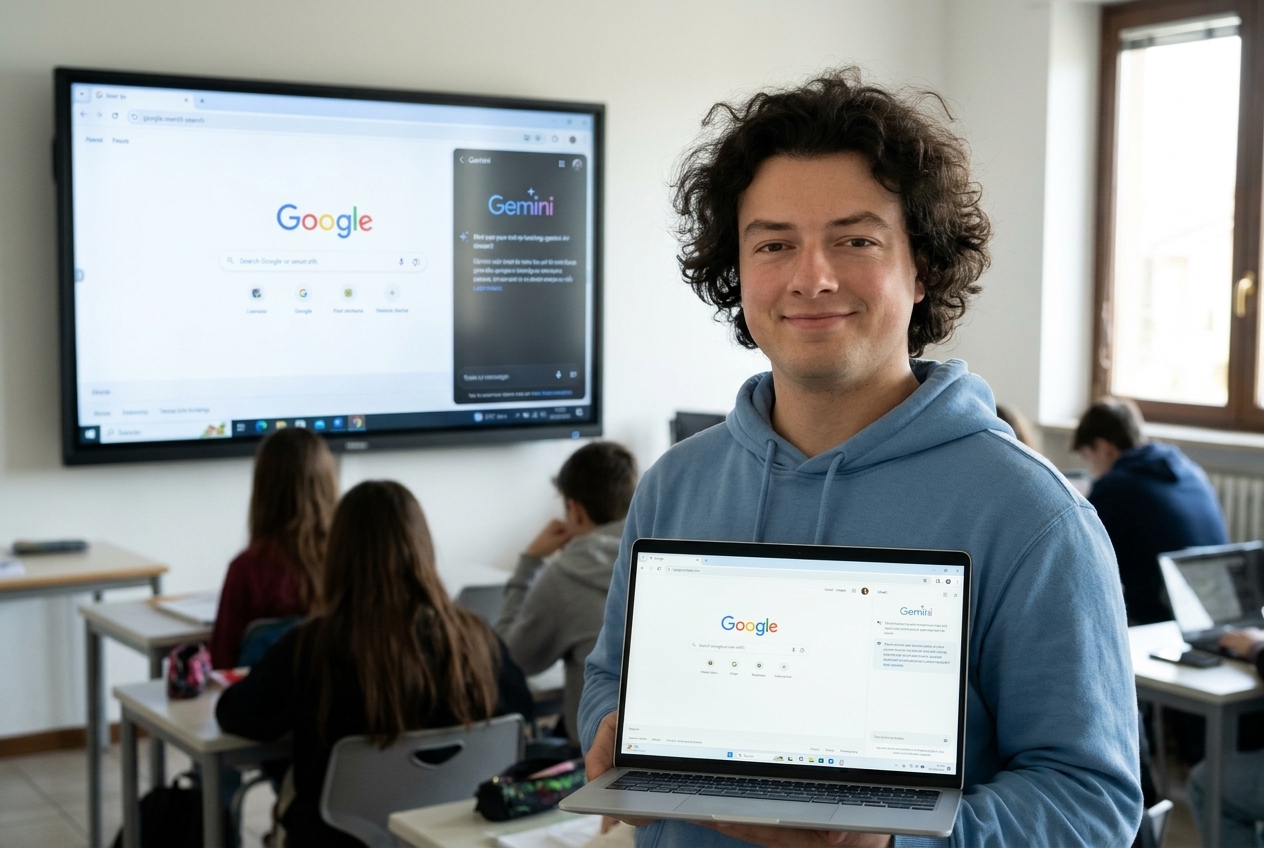
No AI, No Search: Google’s Ultimatum to Schools Ignites a National Backlash
Published November 4, 2026 — by Vito Ruocco
For more than two decades, Google Search has been the quiet backbone of American education. Homework begins with a query. Research projects start with a search bar. Teachers plan lessons with it, librarians teach with it, and students — from kindergarten to senior year — treat it as the default gateway to human knowledge. This week, Google made a declaration that changes that relationship forever: there is no Google Search without artificial intelligence anymore. And if a school wants to keep AI out of its classrooms, Google says those students will lose Search entirely.
The announcement, delivered Tuesday as part of a sweeping new AI education policy, has triggered something this industry rarely sees: a genuine, bipartisan-style public backlash against the most powerful company in technology. The mayor of New York City called it an abuse of monopoly power. The former chair of the Federal Trade Commission accused Google of coercion. Parent advocacy groups described it as “bullying” and a “hostile ultimatum.” And at the center of the storm is a single, almost absurdly simple phrase from Google’s vice president for education, Chris Phillips: “Search and AI are deeply integrated.”
This is the story of how artificial intelligence stopped being an optional feature of the world’s most-used website — and became mandatory infrastructure. It is also a story about schools, power, and the moment when a technology company’s decisions stopped being about products and started being about who gets to decide how children learn.
“Access Will Be Entirely Off”: What Google Actually Announced
Google’s Tuesday blog post was framed, at first glance, as a concession to educators. “After listening to schools, teachers, leading researchers, and policymakers, we are now updating our approach to controls for Gemini, Gemini Notebook, Gemini in Classroom, and Google Search,” the company wrote. The headline promise: AI access will be “entirely off for K-12 student accounts until school administrators explicitly turn them on.”
On its face, that sounds like exactly what privacy advocates and parent groups have been demanding for years — an opt-in model for AI in schools, rather than the silent, default-on rollout that characterized the first wave of generative AI. Administrators would finally have a single dashboard to control which AI tools students could touch. Teachers would get granular controls. Districts worried about plagiarism, data privacy, and age-appropriate use would have real levers to pull.
But buried in the fine print was the catch that turned the announcement into a firestorm: the controls for Google Search are bundled with the controls for AI. Because Google Search is now, in the company’s own words, inseparable from its AI systems, a school that blocks AI features is not just disabling chatbots — it is disabling the search engine itself.
“Access to these products will be entirely off for K-12 student accounts until school administrators explicitly turn them on,” the company wrote — and in Google’s product architecture, Search is one of those products.
The result is a binary choice that no school district asked for: accept Google’s AI stack wholesale, or lose the most fundamental research tool in modern education. There is no middle path, no “Search without AI” toggle, no legacy mode. Chris Phillips was unambiguous when asked directly whether a school could block AI while keeping Search: “Search and AI are deeply integrated. [Students] will not have access to search, and they’ll see a message from their school that indicates it’s not available.”
The question educators are now asking is whether that integration is a technical necessity or a commercial strategy. Google’s answer — that the two are simply inseparable now — is technically defensible: AI-powered ranking, retrieval, summarization, and personalization are woven through every layer of modern Search. But the timing, the bundling, and the captive audience have convinced many observers that this is less about engineering and more about leverage.
The New AI Classroom Stack: Gemini Everywhere
For schools that do opt in, Google is offering what it describes as a complete AI-powered learning environment. The centerpiece lineup includes:
- Gemini — the company’s flagship AI assistant, now integrated into student accounts with age-appropriate guardrails and educator-controlled settings.
- Gemini Notebook — a research and note-taking tool that lets students upload source material and have the AI organize, summarize, and quiz them on it.
- Gemini in Classroom — AI features embedded directly into Google Classroom, the platform used by tens of millions of teachers and students worldwide, including AI-assisted lesson planning, rubric generation, and feedback drafting.
- Guided Learning — a brand-new study tool designed to “coach students through the process of problem solving” rather than handing them answers, which Google plans to integrate directly into Google Search.
- Expanded Search AI — AI Overviews, conversational follow-ups, and now Guided Learning prompts woven into the core search experience.
The Guided Learning feature is the most interesting product of the batch, because it represents Google’s attempt to answer the critique that has dogged AI in education from day one: that chatbots let students cheat by generating answers instead of learning. Google’s pitch is that Guided Learning does the opposite — it refuses to give the answer and instead walks students through the reasoning process.
“For example, if a student pastes a complex physics problem or asks for help writing a book report in Search, they’ll see prompts to help them think critically and work through the concepts, without going directly to the answer,” the company explained in its blog post.
In theory, this is the Socratic ideal applied to the world’s largest search engine: a tutor that asks questions back, scaffolds thinking, and builds understanding. In practice, it is also a profound shift in what Search is. Google is no longer describing a tool that retrieves information — it is describing a tool that teaches. That is a much bigger claim, and a much bigger responsibility, than ranking web pages.
The Captive Classroom: Why Schools Can’t Just Walk Away
The most explosive element of this story is not the product lineup — it’s the leverage. Google does not enter American classrooms as one competitor among many. It enters them as infrastructure. The company’s education ecosystem is so deeply embedded that for many districts, “Google” and “school technology” are nearly synonymous.
The numbers tell the story:
- ChromeOS dominates the K-12 device market; Chromebooks are the default laptop in the vast majority of American school districts, prized for their low cost, centralized management, and security.
- Google Classroom is the de facto learning management system for tens of millions of students and teachers across the United States and much of the world.
- Gmail, Google Docs, Google Drive, and Google Meet form the communication and collaboration backbone of school districts, often provided free or at heavily subsidized prices through Google Workspace for Education.
This is the strategy Google has perfected over fifteen years: give schools software that is better and cheaper than anything else, integrate it into daily workflows until it becomes invisible, and then — when the moment is right — evolve the platform in a direction that competitors cannot follow. The free suite was never a charity; it was a moat. And this week, the moat became a gate.
A district that rejects Google’s AI terms does not simply lose a chatbot. It faces the prospect of reconfiguring or replacing its entire technology stack — every Chromebook, every classroom workflow, every teacher’s lesson plan archive. For a cash-strapped school board, that is not a decision; it’s a sentence. The practical effect of Google’s bundling is that most districts will have no realistic choice but to accept the AI stack, whatever their misgivings.
This is precisely why the reaction has been so fierce. Critics argue that Google has converted a technical decision into a policy decision and then removed the alternatives — using market dominance in one category (search, hardware, classroom software) to force adoption in another (AI).
The Backlash: Mayors, Regulators, and “A Hostile Ultimatum”
The political response was swift, and it cut across the usual lines. No one captured the mood better than New York City Mayor Zohran Mamdani, who has already imposed a one-year moratorium on generative AI tools in city schools through the eighth grade. Reacting to Google’s announcement, Mamdani posted on X:
“Google is trying to use its monopoly power to force AI into our public schools. No corporation should have the power to dictate how we teach our children. Our public schools exist to serve students, not to grow the profit margins of Big Tech.”
The mayor’s intervention matters because New York City is the nation’s largest school district — a bellwether whose technology decisions ripple across the country. If New York holds its line against Google’s bundling, it will create a live test case of whether a major district can actually function without Google Search, and whether Google will really hold the line on cutting off a city of 900,000 students.
Lina Khan, the former chair of the Federal Trade Commission who built her reputation on confronting Big Tech’s market power, was equally direct, accusing Google of using its search monopoly “to coerce schools into adopting AI.” Khan’s framing — coercion, not choice — is now the dominant lens through which the announcement is being analyzed, and it lands with particular force given the FTC’s long-running antitrust scrutiny of Google’s search dominance.
Lila Byock, founder of Schools Beyond Screens, a national coalition of parents and teachers advocating for student-centered screen policies, went further still, calling the announcement a “hostile ultimatum.”
“This kind of bullying has no place in our schools. Educational value — not shareholder value — must determine which products are used by students, and regulators must intervene to prevent big tech from exploiting schoolchildren for profit.”
What makes these reactions notable is not just their intensity — it’s their convergence. A sitting big-city mayor, a former federal regulator, and a parent advocacy coalition rarely agree on anything. They agree on this. And their argument has a clean, powerful logic: when a company controls the infrastructure of knowledge and uses it to compel adoption of its newest product, that is not a product decision. It is a governance decision — made by a corporation, for a corporation, in a domain — public education — where governance is supposed to belong to the public.
Why This Is Different From Every Other AI Controversy
The AI era has produced no shortage of contentious moments: artists fighting generative models, writers suing over training data, regulators fining companies for deepfakes. But the Google schools story is different in kind, not just degree. It is the first time a major AI company has tied access to a universal, non-AI essential service to acceptance of its AI products.
Consider what Search actually is in 2026. It is not a luxury or a novelty. It is how students access the internet — how they check facts, find primary sources, complete assignments, and develop the information literacy that modern curricula treat as a core skill. For many students, especially in under-resourced districts, it is effectively their library. Cutting off Search is not like removing a feature; it is like closing the library, and telling the school the library will reopen only if it accepts the new AI reading program.
The stakes are amplified by what Google has become in the schools market. The company has spent years positioning itself as education’s most trusted technology partner, with extensive privacy promises, student-data safeguards, and a public commitment to serving educators. Districts have built their entire digital infrastructure on the strength of those promises. This week’s announcement asks them to extend that trust to AI — or lose the foundation underneath it.
There is also a generational dimension that the company’s critics are quick to note. The students affected by these decisions are children — in many cases, children whose parents have no seat at the table when Google updates its terms. A school board can vote; a nine-year-old cannot. The moral weight of the story comes from the fact that the “captive audience” here is quite literally a captive audience of minors, whose cognitive development, privacy, and relationship with technology are being shaped by decisions made in Mountain View.
Google’s defenders — and there are some — make a reasonable counter-argument: the company is offering the most sophisticated safety controls in the industry, with AI default-off for K-12 accounts, and it is being transparent about the integration. They note that AI-powered search is genuinely better for students in many ways: more accurate answers, better organization, natural-language access for younger children and English-language learners who struggle with keyword search. They point out that Google could have rolled out AI in schools with no controls at all, as it did in the consumer market, and that this announcement is, in that light, a step toward responsibility.
But even that defense concedes the central fact that has outraged critics: the controls only work if you accept the product. There is no “off” that leaves you where you were before. The status quo — search without AI — no longer exists as an option. And in a democracy, the party that removes an option from the table is often the party that ends up explaining itself in hearings.
Meanwhile, the AI Economy Is Having a Panic Attack
It is worth stepping back from the classroom to note that this fight is happening at a moment of profound financial turbulence in the AI industry itself. The schools controversy is a policy story, but it is unfolding against the backdrop of the most leveraged, most expensive technology buildout in history — and the people who finance it are starting to get nervous.
The clearest alarm this week came from Emmanuel Roman, CEO of PIMCO, the legendary bond firm that has been one of the biggest financiers of the AI infrastructure boom. Speaking at the Global Financial Leaders’ Investment Summit in Hong Kong, Roman told the audience he expects a downturn in the AI market — “and then things are going to break.”
Roman’s warning carries weight because PIMCO is not an outsider to this trade. It was among the financiers behind the first CoreWeave chip-based financing in 2023, parlayed a $29 billion Meta data-center bond package into roughly $2 billion in paper gains, and scooped up $4 billion of SpaceX’s enormous AI debt package just last month. When the firm that helped build the AI debt machine starts warning about its structural soundness, the market listens. Roman has estimated the AI buildout could create $2 trillion in financing needs over the next five years — against a total U.S. bond market of roughly $12 trillion.
The warning signs are everywhere in the numbers:
- Meta drew $58 billion in orders for a bond offering expected to raise $15-20 billion, in a push to fund AI investments — enormous demand, but also a sign of how much debt the AI buildout requires.
- Oracle said Monday it would need another $20 billion in bonds, on top of its already steep commitments to the AI data-center boom.
- Alphabet kicked off a €6 billion bond sale (about $6.7 billion), testing investor appetite for tech debt.
- Microsoft sold $25 billion in bonds — its first bond sale in a decade.
- Wall Street banks lined up to finance $63 billion in debt for Anthropic — a company that isn’t even a hyperscaler yet.
Apollo Global Management, another giant of the AI-finance complex — and lately in talks with SpaceX about a $40 billion chip deal — is sounding a similar note. Apollo president Jim Zelter told analysts that while society will use “dramatically more computing power in the future” and AI is improving quickly, “what we don’t know is how pricing and economics will evolve.” Meanwhile, reports from China suggest its AI bubble has already burst, and the bond market has begun to choke on the sheer supply of AI-linked debt.
The connection to the schools story is not incidental. Google’s education announcement is, in part, a growth strategy for a company under pressure to show that its enormous AI investments — investments financed with borrowed money at unprecedented scale — are generating adoption. Free access for students is the classic funnel: today’s classroom users become tomorrow’s paid users, and today’s AI-native students become the generation that never questions an AI-integrated web. The same company that is borrowing €6 billion to fund its AI buildout is now using its classroom dominance to guarantee those systems a captive user base. Whether that is a wise educational policy or a desperate financial strategy — or both — is the question hanging over the entire industry.
Around the AI World: Researchers, Soldiers, Modders, and Deepfakes
The Google story dominated Wednesday’s coverage, but the rest of the AI news cycle was unusually rich, and several items are worth watching closely.
Google’s own researchers are fighting the company over AI transparency. The Washington Post reported that Google researchers are battling internal restrictions to tell the world what they know about AI. The report paints a picture of a company where scientists believe significant findings about AI capabilities and risks are being suppressed or delayed for commercial reasons — a tension that has existed since the departure of the company’s AI ethics leaders years ago, but which appears to have reached a new intensity as the search giant races to integrate AI everywhere. The irony of the timing — researchers fighting to speak while the company fights to compel adoption — was not lost on observers.
A former CENTCOM AI adviser warned that troops are asking AI the wrong questions. In remarks reported by Military.com, a former adviser to U.S. Central Command cautioned that soldiers relying on AI targeting and analysis tools could point weapons at the wrong targets if they frame their queries incorrectly. The warning highlights a problem that extends far beyond the military: AI systems are exquisitely sensitive to how questions are phrased, and in high-stakes environments, the cost of a poorly framed query is not a bad search result — it is a catastrophic error. The Pentagon has embraced AI-assisted targeting at a rapid pace, and the adviser’s comments are among the most senior public acknowledgments that the human-machine interface remains the weakest link.
Nexus Mods, the biggest modding site in PC gaming, took a hard stance on AI. The platform, home to millions of user-created game modifications, announced that AI disclosures will now be mandatory for new mod uploads. Mod authors must declare “whether AI has been used in their work,” in response to what site owner Victor “Foledinho” Folmann called “one of the most consistent concerns we’ve heard” from the community. It’s a significant moment for the cultural debate over AI: a massive, community-run creative platform choosing transparency as its governing principle, and betting that its users would rather have the information than have it hidden.
And the deepfake machine churned out a viral absurdity. Photographs of Jeff Bezos with a suspiciously full head of hair — apparently post-“hair transplant” — swept social media this week. As The Verge documented, the images are very fake, almost certainly AI-generated, and they spread exactly the way such fabrications always do: fast, far, and with very few people stopping to check. It’s a reminder that even in 2026, with detection tools everywhere, a good fake of a famous person still travels the world before the truth can put its shoes on. For schools — where students will now be required to interact with AI tools that can produce such images effortlessly — the Bezos episode is a preview of the information environment the next generation is being asked to navigate.
What Happens Next
Google’s announcement has opened a fight that will define the politics of AI in 2027. Several battlegrounds are already visible.
The first is New York City. Mayor Mamdani’s moratorium and his public confrontation with Google create a high-stakes test case: if the nation’s largest school district holds firm, does Google actually pull Search from 900,000 students? The optics of that — a trillion-dollar company switching off the research tool for children in the middle of a policy dispute — are so bad that some observers suspect Google is quietly hoping most districts simply capitulate and the standoff never gets tested. But Mamdani has shown no signs of backing down, and the mayor’s office is already exploring whether existing antitrust and consumer-protection law applies to a school’s “choice” under these conditions.
The second is Washington. Lina Khan’s language — “coerce” — will echo in any future antitrust proceeding, and the FTC’s long-running case against Google’s search monopoly gives regulators a ready-made vehicle for examining whether the schools bundling constitutes an abuse of dominance. Congress, for its part, has shown intermittent interest in children’s online safety and school-data privacy; a hearing on “AI in the classroom” is the kind of issue that unites legislators who agree on almost nothing else. The phrase “hostile ultimatum” from Byock, and “monopoly power” from Mamdani, are the kind of soundbites that hearings are built from.
The third battleground is the market. If schools push back and districts defect — even symbolically — to alternatives, Google faces a reputational cost in exactly the demographic it needs to seed for the next decade. If, on the other hand, districts quietly accept the AI stack, Google will have demonstrated something even more valuable than revenue: that it can move a captive market at will. Every other company with an education footprint — Apple, Microsoft, Amazon, and a fast-growing field of AI-native tutoring startups — is watching this experiment closely, because its outcome will determine whether platform leverage or product quality is the winning strategy in the AI era of education.
And beneath all of it is the deeper question that no politician, executive, or regulator has yet answered: who should decide what role AI plays in the lives of children? Google’s answer, this week, was that the decision belongs to school administrators — while simultaneously engineering the product architecture so that the only real decision is whether to accept everything or lose everything. The backlash suggests that answer was not acceptable. But the company’s market position suggests it may not need to be. In the coming months, one of those forces will bend. The only question is which one.
Vito Ruocco covers artificial intelligence and technology. This article was compiled from reporting by The Guardian, The New York Times, The Washington Post, The Verge, Bloomberg, Reuters, Military.com, and company announcements, on November 4, 2026.