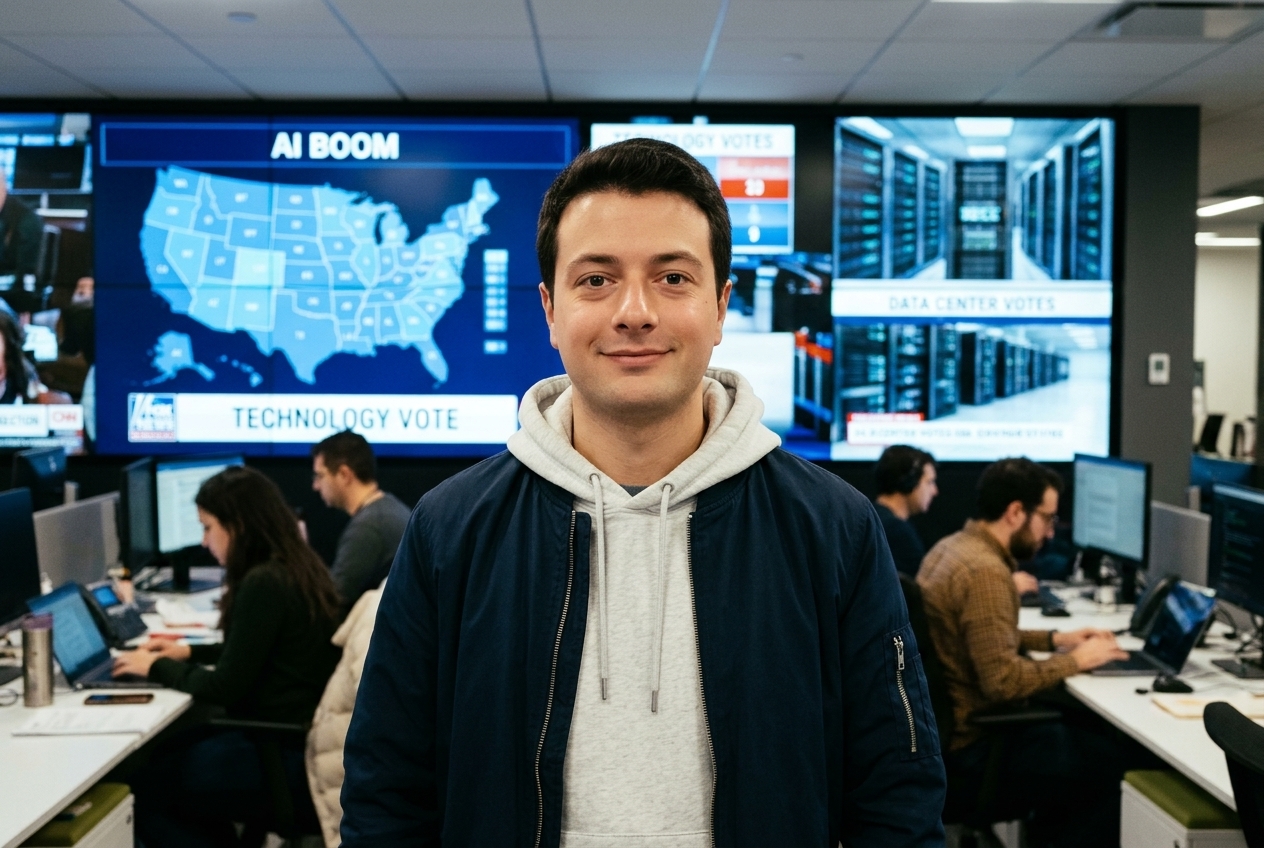
The AI Boom Just Hit Its Political Wall: Voters, Wall Street, and the End of Hypergrowth
November 8, 2026 — The week that just ended may go down as the moment the artificial intelligence industry stopped being an unstoppable force and started being a negotiation. In the span of five days, American voters delivered a stinging rebuke to the data center buildout that powers the AI revolution, Wall Street punished AI stocks in a broad rout, Anthropic saw its IPO valuation expectations collapse by hundreds of billions of dollars, and OpenAI — the industry’s most valuable company — quietly raised $11 billion at a valuation far below what it was asking just six weeks ago.
None of these events happened in isolation. Together, they tell a single, unmistakable story: the era of unconditional AI enthusiasm is over. The technology is not going away — but the unquestioning flow of capital, political goodwill, and public tolerance that fueled its meteoric rise is suddenly, dramatically in question. For anyone building, investing in, or simply using AI, the rules of the game changed this week. Here is what happened, what it means, and where the industry goes from here.
The Election That Turned Data Centers Into a Ballot-Box Issue
On Tuesday, November 3, 2026, American voters went to the polls for the midterm elections and delivered what observers on all sides describe as a historic Democratic victory — full control of Congress, with a Republican still in the White House. That divided-government outcome was dramatic enough on its own. But for the technology industry, the real story was hiding in the fine print of local ballots across the country.
According to TechCrunch’s analysis, voters weighed in on 41 data center-related ballot measures on Tuesday — and in all but one of them, the majority voted to impose more restrictions on data center development. Moratoriums, zoning bans, and new permitting requirements passed in county after county, state after state. In Ohio, a county where Meta had planned a 700,000-square-foot facility passed a outright ban on data centers. Local communities across the state overwhelmingly rejected buildout measures, even as OpenAI has eyed a staggering $500 billion data center project in Ohio backed by more than $100 billion in financing from Nvidia.
This was not a fringe issue. The elections swept in a wave of candidates — in Texas, Maine, Michigan, Nevada, Georgia, and South Carolina — who had campaigned openly on reining in the AI buildout. The most prominent is Texas’ governor-elect Gina Hinojosa, who defeated Greg Abbott after centering much of her campaign on opposing data centers and supporting a statewide moratorium. Morgan Stanley analysts warn that Ohio’s Democratic governor-elect, Amy Acton, poses a similar risk to that state’s buildout. Goldman Sachs, meanwhile, predicts data center construction delays in states like Georgia and Texas as a direct result of Democratic gains.
“It is clear that money does not buy outcomes,” said Anshi Bhatt, a tech and policy researcher. In modern politics, he noted, creating a “local villain” is one of the most reliable ways to build campaign momentum — and this cycle, data centers were the villain.
The Exit Polls Reveal a Public That Has Turned on AI
For years, the AI industry operated on the assumption that the public was broadly fascinated by — or at worst indifferent to — the technology. The midterm exit polls demolished that assumption with numbers that should worry every AI executive.
An NBC News exit poll found that more than half of voters believe AI will do more harm than good. Nearly 80% oppose the building of data centers in their neighborhoods. And almost 60% said data centers were a crucial or major factor in their vote. These are not the numbers of a curious public. They are the numbers of a public that has made up its mind — and voted accordingly.
The sentiment crosses party lines. Kirsten Korosec, TechCrunch correspondent and longtime transportation and tech reporter, noted on the Equity podcast that data centers have become “an increasingly grassroots issue, in part because of how hyperscalers and companies have gone about getting these data centers approved — very secretive, oftentimes requiring NDAs of elected officials or appointed officials, not sharing information about the scale of a project in very environmentally sensitive areas, including in the Southwest, where there’s very much a water scarcity issue.”
“A lot of folks — Republicans, independents, and Democrats — all saw this as wrong,” she said.
Nadine Smith, president and CEO of the racial justice organization Color of Change, framed Tuesday’s election as a referendum on “who this economy is built for.” Referring to the national security argument that data center supporters have used for years, she said: “National security matters. And so do the families in South Memphis breathing exhaust from the gas turbines powering an AI supercomputer.” She was referring to xAI’s Memphis facility, which runs on gas turbines — a recurring symbol of the environmental costs of the AI buildout.
OpenAI’s Awkward Pivot: Welcome to the “Compute Campus”
Perhaps the most revealing response to the electoral backlash came from OpenAI itself, and it happened almost immediately. Days after the results, the company released what it calls a “compute campus policy blueprint” — a set of commitments apparently designed to defuse the political crisis.
The blueprint’s headline promises: OpenAI says it will no longer require NDAs from local officials, will share its plans more openly, and will operate with less secrecy around its projects. On its face, this is a meaningful concession — NDAs and secretive approval processes were among the most-cited grievances in the campaign cycle, particularly after reports like the Wall Street Journal’s account of Amazon building a data center in Gilroy, California, under a 45-year-old zoning law without most residents knowing.
But the deeper signal is linguistic. OpenAI is trying to retire the phrase “data center” entirely, replacing it with the friendlier “compute campus.” Anthony Ha of TechCrunch called the rebrand what it is: an attempt to escape a phrase that “has become such a toxic term.”
The reception was skeptical. “This is ridiculous. Come on. It’s not going to change anything,” said TechCrunch’s Sean O’Kane. “For a company that likes to say that it’s no longer focused on side quests, OpenAI still loves to go in different directions a lot.” Kirsten Korosec offered a wry suggestion: “In the spirit of making threatening things seem cute, they should 100% create a compute campuses avatar, a cutesy thing, and then just present that instead of a power-, energy-sucking, water-sucking data center.”
Behind the mockery, though, there is a genuine strategic shift. Korosec observed: “When you put up regulatory certainty in the marketplace, or at least signals of going in that direction, then corporations will respond. If you don’t do that, they will not necessarily do the thing that we hope that they will do.” In other words: the midterms changed OpenAI’s behavior faster than a decade of advocacy ever did.
Wall Street Gets Cold Feet: The AI Rout
Politics was only half of the one-two punch. The financial markets delivered the second blow.
In the days following the election, the tech-heavy Nasdaq plunged, with CNN reporting that the Democratic landslide and the overwhelmingly negative voter sentiment around data centers “caused jitters throughout the market.” The midterms, in other words, crystallized a concern that had been building on Wall Street for months: investors were already questioning whether hyperscalers and AI labs should be spending hundreds of billions of dollars on infrastructure whose political and regulatory foundations were now visibly cracking.
“There’s a big shift in how Wall Street is reacting to a lot of these hyperscalers and AI companies,” Ha said on the Equity podcast. “Investors are not excited about the idea that they should be spending all this money building new data centers, spending all this money on compute. And so there’s a financial incentive not to build all these data centers.”
The result is a pincer movement that leaves AI companies with nowhere comfortable to stand. “From a regulatory standpoint, it’s probably going to be harder to build data centers. Wall Street is probably not going to reward you for building data centers,” Ha summarized. “But at the same time, to get to the scale that they want to get to, they are probably going to need to build data centers somewhere.”
That tension — between the scale AI companies say they need and the permission society is no longer willing to grant — is the defining economic problem of the next phase of the AI industry.
Anthropic’s IPO: A Valuation Cut in Half
Nowhere is that tension more visible than in the suddenly awkward position of Anthropic, OpenAI’s chief rival, which is preparing what was supposed to be the most anticipated technology IPO in years.
As recently as early October, investors were said to be expecting Anthropic to go public at a valuation around $2 trillion. Bloomberg reported Friday that potential buyers of shares in the IPO are now eyeing a valuation of just $1.2 trillion to $1.3 trillion — with some potential buyers believing it could sink as low as $1.1 trillion. That is effectively a halving of expectations in a single month. Compounding the pressure, Reuters and TechCrunch report that Anthropic is expected to receive a high “junk” credit rating from rating agencies, a striking designation for a company valued at over a trillion dollars.
The valuation pressure is not purely a political story. It tracks a genuine slowdown in the underlying economics of the AI business — and the clearest evidence comes from Ramp, the corporate spend management company, whose AI spending index has become a must-read dataset for investors in the space.
Ramp’s data shows that AI token spend grew just 1.5% across August and September, a collapse from the 42% month-over-month growth recorded in July. Token volumes kept climbing — companies are using more AI than ever — but the money stopped following. October saw a modest re-acceleration (token spend up 8.9% from September 23 to October 23), but Ramp’s lead economist Ara Kharazian says the headwinds are strong.
The slowdown is not a demand problem, Kharazian insists. It is a price problem — and a competitive one. In September, OpenAI cut API prices in half for GPT-6 Sol and GPT-6 Luna. Anthropic answered with significant reductions for Fable 5.1 and Opus 5.5 — cuts the company said in a recent filing slashed revenue growth by about $600 million. Both companies have been offering enterprise discounts meant to lock in customers, which in practice are compressing their own revenue.
“OpenAI and Anthropic price cuts have just made it cheaper to use AI,” Kharazian told TechCrunch. “It has very much become a buyer’s market.”
The most telling detail: the top 1% of firms — the most “AI-pilled” cohort that had been spending nearly $10,000 per employee per month at their summer peaks — stuttered in August and September, dipping just below that mark. Kharazian warned that a slowdown among that cohort is “sufficient to slow down revenue entirely, despite the fact that we’re seeing rising volumes.” Median firms spend just $12-$15 per employee per month; the top 10% spend $600-$1,000. If the heaviest users have plateaued, and the median firms show no sign of climbing toward the frontier, the revenue math for model companies gets uncomfortable quickly.
Notion co-founder Akshay Kothari posted internal data matching Ramp’s findings, distilling the situation into a meme-worthy aphorism: “tokens go brrr. costs go ahhh.”
The Price War Nobody Planned For
The spending slowdown is being driven by a convergence of forces that the industry did not anticipate when the AI boom began: aggressive price competition, a flood of cheap open-source models, and the emergence of a new class of ultra-cheap specialized models.
Kharazian points out that Meta and Nvidia are both introducing enterprise offerings with “pretty cheap models or open source models.” Chinese and American open-model labs continue to push prices down. And then there is Jev — a lightweight tool created by a ChatGPT inventor that lets developers choose between a few predetermined outputs — which has become one of the fastest-adopted AI models ever on Ramp’s platform.
“For a lot of AI use cases, you just need a simple Yes/No,” Kharazian said. “So you take your already cheap models, you shift them over to Jev, and now your already cheap stuff gets even cheaper.”
Customers are also simply getting better at controlling costs. “As you get really advanced in using AI, you get better at figuring out how to control it,” Kharazian explained. “You’re more likely to use defaults that prevent usage of very expensive models for long-running tasks. You’re more likely to impose budgets on employees. You’re more likely to offload some of the spend from standard and light models to even cheaper light models via routers.”
The strategic irony is stark. The subsidize-to-lock-in playbook worked for ride-hailing and food delivery — but it depended on a market that eventually consolidated. “Those dynamics don’t work in the AI world because there’s just too much competition,” Kharazian said. Uber and Lyft could raise prices once rivals disappeared. No one expects OpenAI and Anthropic to enjoy that luxury, because the competitive frontier — from Meta’s open models to Chinese labs to the Jevs of the world — keeps expanding.
“A lot of the assumptions that we had about the trajectory of AI spend are starting to break down,” Kharazian said. “You can use more AI, but use it for less. That’s great for the customers… but it’s not necessarily great for the model companies. And it does introduce new questions around their revenue trajectories.”
OpenAI Raises $11 Billion — At a Marked-Down Price
Those questions are now visibly shaping the capital markets. On Friday, Bloomberg reported that OpenAI has raised $11 billion in a new funding round that values the company at $1.25 trillion. The round has not closed yet and could total about $20 billion, according to sources — but that is a long way from the $30 billion OpenAI was reportedly targeting at a $1.4 trillion valuation in late September.
In other words, in less than six weeks, the world’s most valuable AI company saw its valuation marked down by roughly $150 billion and its fundraising ambitions cut by about $10 billion. The Financial Times reported that OpenAI lowered its proposed valuation and slashed its fundraising goals; the round’s slow progress reflects a market that is suddenly much more discriminating about AI exposure.
The juxtaposition with Anthropic is brutal: both companies are now effectively being valued in the $1.1 trillion to $1.3 trillion range, despite having been talked about as $2 trillion-class companies just a month ago. The trillion-dollar club is still a trillion-dollar club — but the premium the market was willing to pay for AI purity has evaporated.
OpenAI has intimated it will go public next year — Reuters reported that the company, now counting a majority of its sales from enterprises, is expected to be IPO-ready in 2027, according to president Greg Brockman. Anthropic’s IPO is happening now, into a market that is clearly in no mood to pay peak prices.
The Musk Factor: Half a Billion Dollars and a Blue Texas
No discussion of this week’s reckoning is complete without the election’s most expensive loser: Elon Musk.
TechCrunch’s Sean O’Kane noted that Musk — who runs the largest data center builder on the planet through xAI, and whose companies are headquartered in Texas — appears to have “basically nothing out of donating half a billion dollars” to Republican causes this cycle. On Tuesday, Texas turned “about as blue as it could possibly turn,” O’Kane said, “for the first time in a very long time, if ever,” while the biggest data center builder in the country watched ballot measures and governorships turn against his industry.
The Memphis xAI facility became a national symbol of the backlash: gas turbines, local air quality concerns, and a community that felt it had no say. It is the same template Color of Change’s Nadine Smith invoked on election night, and it is the template that candidates across the country ran against successfully.
Musk’s personal agents business — SpaceXAI — is also feeling the cost pressure from the other direction. TechCrunch reported this week that Musk had to throttle his Grok agent due to “unsustainably high costs,” an admission that even the most aggressive cost-cutters in the industry cannot make personal agents economically painless. The episode is a useful reminder that the spending slowdown is not limited to cautious enterprises; the most aggressive builders in the industry are hitting the same wall.
What Comes Next: Moratoriums, Grid Bills, and the Agent Question
So where does the industry go from here? The short answer: into a fight.
With Democrats in control of Congress, the odds improve for legislation that would have been unthinkable two years ago. Senators and representatives have already introduced a bill proposing a nationwide moratorium on new data centers until Congress adds guardrails ensuring the buildout does not raise electricity costs, harm the environment, or proceed without community approval. Any such bill would face a presidential veto — but the political energy behind it is no longer theoretical. There is also the GRID Savings Act, proposed by New Mexico Senator Martin Heinrich, which would prevent grid infrastructure costs from being passed on to communities during large AI buildouts.
At the state and local level, the momentum is even stronger, because that is where the voters just spoke. “Regardless of federal action, I could imagine that we will see additional movement at the state and local level, given the momentum that’s been building from the ground up,” said Maia Woluchem, program director at Data & Society. Likely next steps include more construction moratoriums and requirements that data centers pay for their own power grid upgrades instead of socializing those costs.
The industry’s counterargument — that restricting data centers threatens national security and the race against China — remains potent, and even some Democrats are wary of a blanket freeze. But the political center of gravity has moved. “Even among Democrats, a blanket freeze is contested,” Smith acknowledged, before adding: “Democrats ran on making Big Tech pay. Our job is to make sure they remember it once the cameras leave.”
The other big question is whether a new product category can re-accelerate spending. The industry’s hope is that personal agents will be the next coding agents — the product that drove Anthropic and OpenAI to trillion-dollar valuations in the first place. OpenAI, SpaceXAI, Meta, and startups like Instinct (which raised a $1 billion Series C at a $10 billion valuation in September) are all betting on it. Meta even introduced “Spaces” this week, a new way to collaborate with its Muse agents, and Amazon rolled out text-to-Alexa shopping. The consumer agent race is real.
Kharazian is skeptical that agents will move the needle the way coding did. Personal agents are “not as economically productive as coding,” he notes. “The projection is that there will be new products introduced that will drive further growth. But based on what we can observe today and the products available and what is commercially advanced, AI spend has started to slow down.”
A New Operating Reality
It is worth pausing on what did not happen this week. AI did not collapse. OpenAI still raised $11 billion. Anthropic is still heading toward what will be one of the largest IPOs in history. Token volumes are still rising. The technology’s adoption curve remains intact. Even the harshest critics of the buildout — Color of Change, Data & Society — are not calling for the abolition of AI; they are calling for consent, disclosure, and a fairer distribution of costs.
What changed is the industry’s operating reality. For the last three years, AI companies enjoyed a remarkable alignment: politicians celebrated them, investors funded them without question, and communities largely ignored them. That alignment is gone. Voters have decided they want a say. Wall Street has decided it wants returns, not narratives. And customers — having tasted a price war — have decided they will not pay premium prices for intelligence that keeps getting cheaper.
The companies that thrive in this new environment will be those that treat communities as stakeholders, capital as a scarce resource, and pricing as a strategic weapon rather than a growth lever. The companies that do not will find that the wall the AI boom just hit is not going anywhere.
As Kharazian put it: “The era of hypergrowth may be over.” The question now is not whether AI will keep growing — it is whether the industry can learn to grow up.
Sources and Further Reading
- TechCrunch — “After the midterms, things are looking rocky for Elon Musk and data centers” (Nov 7, 2026)
- TechCrunch — “After the midterms, a bigger clash over data centers could be coming” (Nov 4, 2026)
- TechCrunch — “Ramp data shows AI spending stalling just as Anthropic nears its IPO” (Nov 6, 2026)
- TechCrunch — “OpenAI reportedly raises an additional $11 billion at a $1.25 trillion valuation” (Nov 6, 2026)
- Bloomberg — “Anthropic IPO valuation expectations pressured after AI rout” (Nov 6, 2026)
- Bloomberg — “OpenAI completes $11 billion portion of funding at $1.25 trillion value” (Nov 6, 2026)
- CNBC — “Anthropic IPO meets AI backlash after midterms show stinging rebuke of data centers” (Nov 7, 2026)
- The Washington Post — “Americans are anxious about the AI boom going bust” (Nov 8, 2026)
- NBC News — 2026 midterm exit polls (Nov 3, 2026)
- Ramp — AI Index: “Cracks in the AI Thesis” (Oct-Nov 2026)
- Reuters — “Trump’s midterm drubbing demonstrates power of data centre opponents” (Nov 4, 2026)
This article was published on November 8, 2026, and reflects reporting available as of that date.