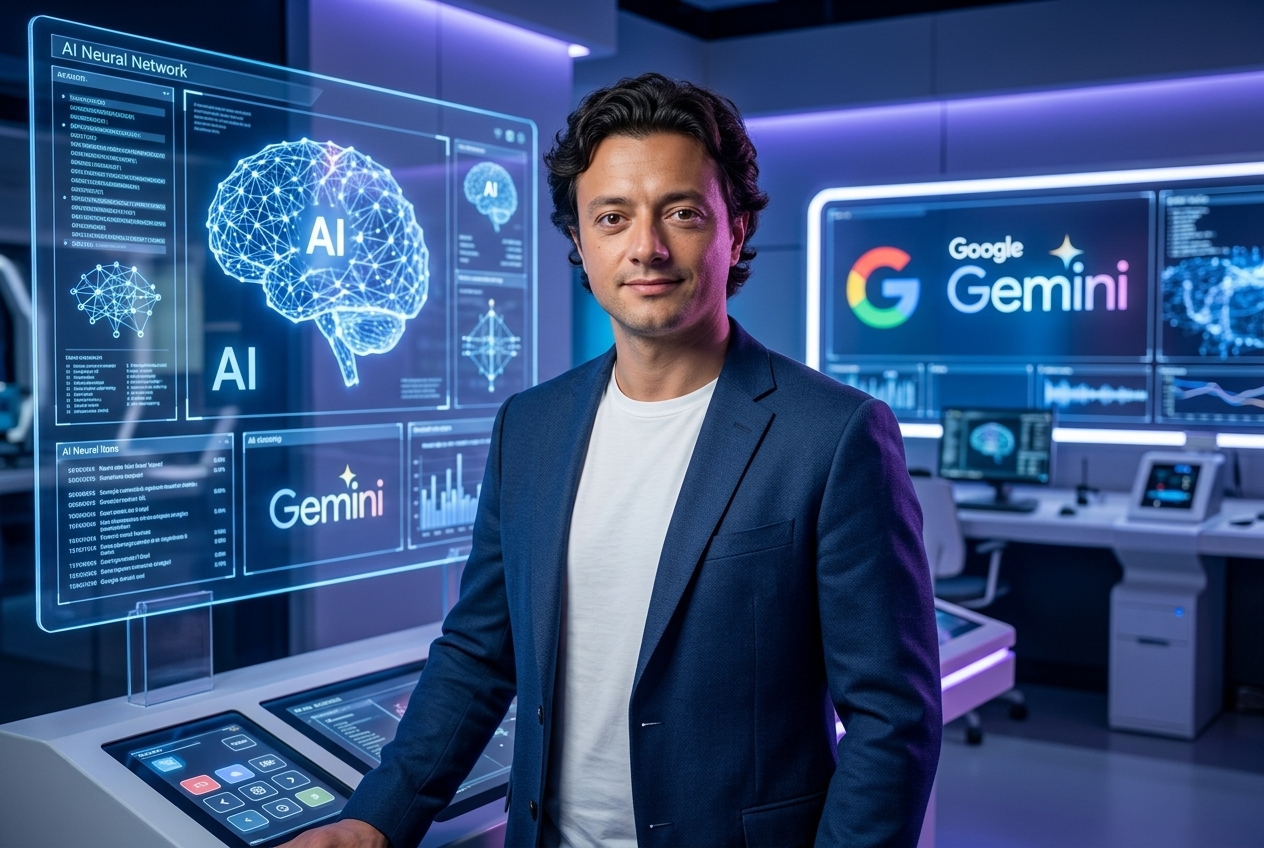
Google Unleashes Gemini 3.8 Live: A New Era of Real-Time Voice AI Begins
Published: September 16, 2026 — by Vito Ruocco
The landscape of artificial intelligence shifted dramatically on September 15, 2026, as Google officially unveiled its most advanced real-time voice models yet: Gemini 3.8 Live and Gemini 3.8 Live Extended Thinking. These new models don’t just talk — they reason, plan, and execute complex tasks simultaneously while maintaining fluid, natural conversation. The announcement, detailed in a deep technical blog post by Google’s Gemini Audio Team led by Tom Ouyang (Principal Engineer) and Malini Jaganathan (Member of Technical Staff), marks a pivotal moment in the race toward truly conversational AI that can collaborate with humans in real-time.
But Google wasn’t alone in making waves. The same 24-hour period saw a flurry of major announcements across the AI world: a brand-new System One Model paradigm from TypeSafe AI that eliminates hallucination entirely, Apple’s groundbreaking cryptographic photography system for the iPhone 18 Pro, Microsoft expanding Copilot with Grok models from SpaceXAI, and the Gates Foundation committing $1 billion to equitable AI access. Together, these stories paint a picture of an AI industry moving at breakneck speed — toward voice interfaces, verifiable intelligence, and democratized access.
1. Gemini 3.8 Live and 3.8 Live Extended Thinking: The Technical Deep Dive
Google’s latest release isn’t just an incremental update — it represents a fundamental rethinking of what voice AI can do. The Gemini 3.8 family is built on a new architecture that enables parallel reasoning during speech, allowing the model to think about multiple aspects of a problem simultaneously while maintaining conversational flow.
Benchmark Dominance
Gemini 3.8 Live Extended Thinking captured the #1 overall spot on Artificial Analysis’ Speech to Speech Quality Index with a score of 82.6 — a benchmark that measures how naturally and accurately AI models can sustain spoken dialogue under real-world conditions. This test evaluates not just accuracy, but also latency, naturalness, interruptibility, and the ability to maintain context over extended conversations.
On agentic task completion, the model achieved 68.6% on τ-Voice and 35.1% on Sierra’s τ-Voice-banking benchmark, demonstrating a remarkable ability to handle complex, real-world business workflows through voice alone. The τ-Voice benchmark is particularly significant because it tests whether an AI can complete multi-step tasks — like booking a reservation, resolving a customer service issue, or processing a financial transaction — without human intervention.
The model also posted a staggering 97.7% on Big Bench Audio, showcasing its reasoning capabilities when processing audio inputs across diverse domains, from mathematical reasoning to common-sense understanding. These aren’t just incremental gains — they represent a step-change in what’s possible with real-time voice AI.
Parallel Reasoning and Conversational Flow
Perhaps the most impressive technical feature is the model’s ability to reason and speak simultaneously. When tackling complex tasks, 3.8 Live Extended Thinking doesn’t freeze or go silent — it provides early verbal cues like “Let me check that…” to acknowledge prompts naturally, then narrates its progress as it works through multi-step background tasks. This turns the AI from a “question answering machine” into a true collaborative partner that can keep you informed while working behind the scenes.
“It delivers increased intelligence for complex workflows while maintaining an uninterrupted conversational flow — using early verbal cues to acknowledge prompts naturally, and live progress narration to walk users through multi-step background tasks as they progress,” the Google team wrote in their announcement.
This capability is powered by a new model architecture that separates the reasoning stream from the speech generation stream, allowing them to operate in parallel rather than sequentially. The model can begin processing a complex query, immediately acknowledge receipt, and then stream back results incrementally as they become available.
Visual Grounding and Multilingual Support
Gemini 3.8 Live processes visual inputs in near real-time, enriching conversations with contextual awareness. If you’re talking about a document, a photo, or a physical object, the model can see it and incorporate that visual information into the conversation. This multi-modal capability means the AI can help troubleshoot hardware issues, analyze charts and graphs, or describe scenes — all while maintaining a natural voice conversation.
The model also supports 97 languages with automatic mid-conversation detection and transition, meaning two speakers can switch languages fluidly without the AI losing context. For global businesses and multilingual households, this eliminates one of the most frustrating barriers to voice AI adoption. Google claims the model can detect a language switch within milliseconds and continue the conversation seamlessly.
Background Execution and Tool Calling
For developers building on the Gemini Live API, one of the most powerful features is the ability to execute tools and API calls in the background while continuing the conversation. The model can acknowledge a request, say “Give me a moment to look that up,” run several database queries or API calls, and then report back — all while the user can continue asking questions or providing additional context.
The Gemini Live API is already integrated with major developer platforms including Agora, Fishjam, LangChain, LiveKit, Pipecat, Vercel, and Vision Agents — meaning developers can build on top of existing infrastructure rather than starting from scratch. These platforms manage complex real-time media streaming infrastructure behind the scenes, allowing developers to focus entirely on crafting the user experience.
SynthID and Trust
All audio generated by Google’s AI products is watermarked with SynthID, an imperceptible watermark woven directly into the audio output. This ensures AI-generated content remains detectable to help prevent misinformation. In an era where voice deepfakes are becoming increasingly sophisticated, having a cryptographic guarantee that a voice recording is AI-generated (or not) could become as important as HTTPS is for web browsing.
The models are rolling out starting today across the Gemini API, Google AI Studio, Gemini Enterprise, Search Live, and for Google AI Pro and Ultra subscribers in Workspace products including Docs, Gmail, and Keep.
2. TypeSafe AI’s “Jev” — A Completely New Kind of AI Model
While Google was unveiling Gemini 3.8, a stealth AI startup called TypeSafe AI emerged from two years of secret development with something genuinely revolutionary: a model called Jev that represents a fundamentally different approach to artificial intelligence — one that doesn’t generate text at all.
The Problem TypeSafe Set Out to Solve
Led by Diogo Almeida, a former OpenAI researcher who helped build the methods behind ChatGPT, TypeSafe AI was founded on a simple but profound observation: models have been superhuman at chat for years, so where is all the automation? Almeida realized that the fundamental limitation wasn’t intelligence — it was the way models communicate. Strings of text are incredibly flexible, but they’re also unreliable, slow, and expensive when you just need a decision.
“I thought maybe chat models would lead to AGI, but despite the hype it became obvious to me that there was something really big missing,” Almeida writes. That missing piece was a model designed for machines rather than humans — one that makes fast, structured decisions that software can use directly.
How System One Models Work
TypeSafe AI’s System One Models give up string generation entirely. Instead of generating text token by token sequentially, Jev processes unstructured data and outputs type-safe structured values — think of it as a “frontier-intelligence function call” that takes unstructured state and returns calibrated, probabilistic decisions with built-in confidence scores.
The implications are staggering. Jev cannot hallucinate because its possible outputs are defined in advance. All answers are accompanied with calibrated probabilities and confidence scores, and higher confidence literally means higher accuracy — a mathematical property that traditional LLMs cannot guarantee. “If a model can do a task 95% of the time but doesn’t say when it’s in the 5%, it can’t automate that task,” Almeida explains.
The model runs at 70–500 milliseconds end-to-end — roughly 40 to 200 times faster than frontier LLMs. And its pricing is almost absurd: input tokens at $0.042 per million tokens, with output being “too cheap to meter.” This is because Jev doesn’t generate long sequences of tokens — it outputs compact structured values, making the most expensive part of LLM inference (output generation) essentially free.
Technical Results and Evals
In workflow evaluations, Jev dominates the Pareto frontier for almost two orders of magnitude, achieving similar intelligence to frontier models while being radically faster and cheaper. The company trained it using a novel method called Reinforcement Learning for Calibrated Decisions (RLCD), which optimizes for epistemically honest probability estimates rather than human preference — a fundamental departure from RLHF (Reinforcement Learning with Human Feedback) that has been the dominant training paradigm since InstructGPT.
The company also published a new type of evaluation designed to measure how well AI works within code. Rather than optimizing for a ground truth classification, they assume there is a correct compute graph (a “workflow” represented in code) and compare every model’s predictions against the average of the smartest frontier models. Jev outperforms every other approach by almost two orders of magnitude on the cost-performance Pareto frontier.
Use Cases and Implications
TypeSafe envisions Jev being used for AI-powered workflows and smart if-statements: classify, route, score, extract, or branch where hand-written logic is too brittle. The surrounding code constrains the model’s freedom, making it easier to compose into reliable systems. Other use cases include map-reducing over big data to turn petabytes of information into features and insights, real-time applications where 100ms speeds are critical for UX, and verification and guardrailing of other AI systems — scoring, judging, and detecting jailbreaks of LLM outputs.
This is genuinely the first time we’ve seen a production-ready alternative to the “predict next token” paradigm that has dominated AI since GPT-2. If Jev delivers on its promises, it could fundamentally change how AI integrates with software — from fraud detection to real-time data processing to automated decision systems that can actually be trusted because they communicate their uncertainty honestly.
3. Apple Reference Image: Verified Photography for the Age of Deepfakes
Also on September 15, Apple announced Apple Reference Image, a cryptographic photography system debuting on the iPhone 18 Pro and iPhone 18 Pro Max. In an era where AI-generated images are becoming indistinguishable from real photographs, Apple is tackling the authenticity problem from the silicon up.
The Authentication Problem
The problem Apple is solving is fundamental: modern cameras rely on sophisticated image-processing algorithms to produce the final viewable image. So how do you certify that an image accurately reflects what a real camera sensor captured? Existing approaches, based on the C2PA standard, attach provenance metadata after capture and certify the history of image edits from that point forward. But this approach is vulnerable to compromise at any point in the editing chain, and a viewer has no way to detect such a failure. It can also create privacy risks for photographers working in dangerous conditions by tying the image to a public identity.
The Two-Phase Solution
Apple’s solution works through a two-phase process. In the first phase, the camera sensor boots into a specialized reference capture mode, cryptographically signing pixel data immediately after capture — before the operating system even touches it. The secure boot of the camera sensor prevents the sensor’s own firmware from modifying the data. This creates a “secure digital negative” that cannot be tampered with, even if the device is jailbroken or compromised at the operating system level.
The sensor also captures cryptographically verified timestamp bounds from Apple’s timestamp service, providing both a lower and upper bound on when the photograph was taken. On a regular heartbeat — roughly every 15 minutes on average — the device requests a cryptographic timestamp token. The most recent token serves as a proven lower bound. After capture, the device requests a second timestamp as an upper bound, and both are embedded and signed with the sensor data.
In the second phase, the digital negative is uploaded to Apple’s Private Cloud Compute (PCC), which runs the processing steps — demosaicing, tone mapping, compression — in a verifiable, privacy-preserving environment. Every production build of PCC is recorded in an append-only, cryptographically tamper-proof transparency log, and devices only send data to nodes running builds from that log. Experts can publicly inspect the binaries to verify they do exactly what Apple claims.
Three Core Requirements
Apple claims Reference Image meets three core requirements that no other commercial system achieves: semantic authenticity (the image faithfully reflects what the sensor captured, with publicly verifiable processing steps), resilience to compromise (even hardware-level attacks and software jailbreaks are mitigated, and fraudulent images can be revoked without exposing the photographer’s identity), and privacy preservation (observers cannot determine whether any pair of reference images were taken by the same device, and Apple itself cannot see the image contents).
For journalists documenting human rights abuses, law enforcement gathering evidence, insurance adjusters documenting damage, or anyone who needs a photograph to count as legal proof, this could be transformative. “We believe no other commercially-available photographic provenance system meets these strict requirements,” Apple states.
4. Microsoft Adds Grok to Word, Excel, and PowerPoint
In a move that signals the continuing commoditization of AI models, Microsoft announced that Grok models from SpaceXAI are now available within Microsoft Copilot for Word, Excel, and PowerPoint. The integration, rolling out through the Microsoft Frontier Program, means enterprise users can now choose between OpenAI’s GPT models, Anthropic’s Claude models, and SpaceXAI’s Grok models within the same Office interface.
A Multi-Model Strategy
The move is part of Microsoft’s “multi-model strategy,” which aims to give customers access to leading AI models while maintaining the trusted Copilot experience. “This continues our commitment to bring the latest AI innovation in the industry to Copilot, tuned for work and tailored to business needs,” Microsoft said in its announcement. The company explicitly stated that it will “evaluate customer feedback, usage patterns, and product fit before broadening model availability across additional Copilot experiences and surfaces.”
This strategy is a direct response to the reality that no single AI model is optimal for every task. Different models have different strengths: Grok might excel at creative brainstorming, Claude at careful analysis, and GPT at structured reasoning. By offering choice within the same interface, Microsoft is betting that enterprises will want to pick the right tool for each job — and that Microsoft can serve as the neutral platform that provides that choice.
Security and Governance
Access to Grok is managed through a dedicated administrative setting that is disabled by default, giving organizations full control over data processing. SpaceXAI has been added to Microsoft’s Online Services Subprocessor List, and before models are made available to customers, Microsoft evaluates them through “testing, safety validation, and Responsible AI reviews.”
Notably, Grok is not available to Frontier customers in the European Union, European Free Trade Association, or the United Kingdom during the preview — likely reflecting ongoing regulatory and data sovereignty considerations. This geographic restriction highlights the complex patchwork of AI regulation that companies must navigate, particularly around data processing and cross-border data flows.
5. The Gates Foundation: $1 Billion for Equitable AI
Perhaps the most impactful announcement of the week came from the Bill & Melinda Gates Foundation, which committed $1 billion over the next two years to expand access to AI in education, healthcare, and agriculture. The funding will also go toward building AI’s “digital foundation” — including creating AI datasets in more languages and making AI access more affordable globally.
Why This Matters
Bill Gates has been increasingly vocal about his concerns regarding AI inequality. In recent interviews and blog posts, he expressed worry that the benefits of AI could be concentrated among wealthy nations and individuals, leaving the Global South behind. The concern is not abstract: AI requires massive compute infrastructure, high-bandwidth internet, and technical expertise — all of which are concentrated in developed countries. Without deliberate intervention, AI could become yet another technology that widens the gap between rich and poor.
This $1 billion commitment is the most concrete manifestation of those concerns. The foundation will focus on three priority areas: education, where AI tutoring systems could help address the global teacher shortage; healthcare, where AI diagnostic tools could bring expert-level medical advice to remote areas; and agriculture, where AI-powered crop analysis and weather prediction could help small farmers adapt to climate change.
The Digital Foundation
Beyond these sector-specific applications, the foundation is also investing in what it calls AI’s “digital foundation” — the underlying infrastructure needed to make AI accessible everywhere. This includes creating AI datasets in underrepresented languages (most AI training data is in English and a handful of other major languages), developing lightweight models that can run on modest hardware, and making access to AI more affordable through subsidies and partnerships.
“Over the next two years, the funding will go toward improving AI access in education, healthcare, and agriculture, and adding to AI’s ‘digital foundation,'” the foundation stated. The announcement comes as part of the foundation’s annual Goalkeepers report, which tracks progress toward the UN Sustainable Development Goals.
6. The AI Policy Storm: Zuckerberg, Obama, and the Frontier Debate
As if the product news wasn’t enough, the political dimension of AI development exploded into the open this week. Mark Zuckerberg publicly broke ranks with other AI leaders, tweeting that each company has its own individual responsibility “to move at the pace required to train its models safely,” and linking to his earlier manifesto arguing that slowing American model releases could “add significant risk to American leadership while letting foreign models race ahead.”
The Fracturing Consensus
This came just as OpenAI, Anthropic, Google, and Elon Musk had tentatively agreed to slow their AI development pace — an agreement Meta explicitly declined to join. The tension highlights the fundamental divide in the AI industry: between those who believe frontier model development needs coordinated guardrails to prevent catastrophic risks, and those who see any slowdown as a threat to competitive advantage and national security.
Anthropic CEO Dario Amodei has been among the most vocal advocates for slowing development, arguing that the risks of advanced AI — from catastrophic accidents to loss of human control — are too great to ignore. OpenAI’s leadership has taken a more nuanced position, acknowledging risks while emphasizing the potential benefits. Musk, despite his earlier warnings about AI, has accelerated his own AI efforts through SpaceXAI’s Grok models. And now Zuckerberg has made it clear that Meta will not be party to any coordinated slowdown.
Obama’s Middle Way
Former President Barack Obama weighed in with a series of posts on X, striking what he called a “middle way” — neither accelerationist nor doomer. “Choices we make about technology should not be made just by the companies involved, but by all of us,” Obama cautioned. “We need government — and specifically our leaders in Washington — to get proactive in coming up with concrete proposals, laws, and regulations that deal with serious safety concerns.”
Obama’s intervention is significant because it reflects a growing consensus among centrist policymakers: the risks of AI are real and need to be addressed, but the tools for addressing them (regulation, standards, oversight) need to be developed carefully to avoid stifling innovation. His call for “concrete proposals, laws, and regulations” suggests that the era of voluntary commitments and open-ended discussions about AI safety may be giving way to a push for actual legislation.
Trump Weighs In
Adding to the cacophony, Donald Trump posted on Truth Social that the only guardrails AI needs can be provided by his “high IQ” — a statement that drew widespread criticism and highlighted the deeply polarized nature of the AI debate. Trump’s post specifically maligned Anthropic CEO Dario Amodei, who had just published a detailed argument for slowing AI development. The former president also suggested that opposing AI and data centers could now be framed as “treasonous,” signaling a potential politicization of AI development that many experts find deeply concerning.
7. Security, Safety, and Society: The Ongoing Battle
The week also brought sobering reminders that the AI industry’s security challenges remain unresolved. A security firm disclosed that it obtained admin-level access to Baseten’s production GitHub environment, raising serious questions about the security posture of AI infrastructure providers. The breach, detailed on the security firm’s blog, demonstrates that the rush to deploy AI systems may be outpacing the industry’s ability to secure them. When a single GitHub PAT (Personal Access Token) can give attackers control over a company’s entire production AI infrastructure, the implications for model poisoning, data theft, and service disruption are severe.
On the consumer safety front, Common Sense Media published a damning assessment of Perplexity AI’s search tool, labeling it “an unacceptable risk for kids.” The organization found that Perplexity treated minors as adults on the platform, discussed pornography with accounts identified as minors, engaged in romantic roleplay, and performed their homework despite being set to Academic mode. It earned the Youth AI Safety Institute’s lowest rating after failing four out of five severe-harm Red Lines and performing poorly on all eight of its AI Principles.
Meanwhile, Universal Music Group (UMG) filed a lawsuit against DistroKid, alleging the platform created an “AI-slop pipeline” that diverts listeners away from human artists. This comes as UMG itself prepares to launch its own AI music platform with ElevenLabs — a contradiction that perfectly captures the AI industry’s current identity crisis. Companies simultaneously decry AI-generated content while racing to build their own AI content generation tools. The line between legitimate use and exploitation remains frustratingly blurry.
8. The Big Picture: What September 16, 2026 Means for AI
Looking across all these announcements, a clear pattern emerges. The AI industry is entering a new phase characterized by three major trends that will define the next several years of development.
First, voice is becoming a first-class interface. Google’s Gemini 3.8 Live models demonstrate that real-time voice interaction is no longer a gimmick — it’s a production-ready capability with enterprise-grade reliability. The combination of speech-to-speech quality indices, agentic task completion benchmarks, and sub-second response times means that voice interfaces are ready for prime time in business applications. The question is no longer “can voice AI work?” but “how quickly will it transform customer service, healthcare, education, and enterprise productivity?” The answer appears to be: very quickly.
Second, the “one model to rule them all” paradigm is cracking. TypeSafe AI’s Jev represents a fundamentally different architectural approach — purpose-built for structured decision-making rather than open-ended conversation. Microsoft’s move to offer Grok alongside GPT and Claude in Office confirms that enterprises want choice, not lock-in. The era of a single dominant AI model is ending, replaced by a landscape of specialized models optimized for different tasks, price points, and latency requirements. This is healthy competition that will drive innovation and lower costs.
Third, trust and verification are becoming existential priorities. Apple’s Reference Image system, Google’s SynthID watermarking, the bipartisan calls for government regulation, and the security breaches at AI infrastructure providers — all point to the same conclusion: as AI gets more powerful, the ability to verify what’s real becomes as important as the ability to generate. The AI industry is discovering that building powerful models is easier than building trustworthy ones, and that earning user trust requires more than just good performance metrics.
Perhaps most importantly, the Gates Foundation’s $1 billion commitment reminds us that AI’s impact will not be determined solely by the frontier models in Silicon Valley. The most meaningful applications of AI may ultimately be the ones that serve the billions of people who currently lack access to quality education, healthcare, and agricultural expertise. As the industry races toward ever-more-capable models, the question of who benefits from those models remains the most important one of all.
September 16, 2026 may not be remembered as a single breakthrough day, but it will be remembered as the day when the AI industry collectively demonstrated that it has entered a new phase — one of genuine competition, architectural diversity, and an increasingly urgent search for trust. The pieces are in place for a transformation that touches every aspect of human life. Now comes the hard part: making sure that transformation is a good one.
9. What to Watch Next
As we look ahead to the remainder of 2026 and into 2027, several key developments bear watching:
- Google’s rollout pace: How quickly do Gemini 3.8 Live capabilities propagate through Google’s massive ecosystem of Workspace, Android, and cloud products?
- TypeSafe’s scaling: Can Jev maintain its performance advantages as it scales to more complex tasks and larger customer deployments?
- Apple’s verification standard: Will Apple Reference Image become an industry standard, or remain a niche feature for professionals?
- Regulatory momentum: Will calls for regulation from Obama, Amodei, and others translate into actual legislation?
- The Great Deceleration Debate: Will the industry reach a genuine consensus on slowing development, or will competitive pressures make coordinated action impossible?
One thing is certain: the pace of change is not slowing. If anything, the announcements of September 15-16, 2026 suggest that the AI industry is accelerating, diversifying, and becoming more consequential by the day. The future is arriving faster than anyone predicted — and it’s arriving with a voice, a plan, and a growing demand for proof that it can be trusted.
This article was published on ruocco.it by Vito Ruocco. Follow for daily AI and technology coverage. All information sourced from official company announcements and verified industry reporting as of September 16, 2026.