
Published: October 13, 2026 | By Vito Ruocco
Meta says its new model, Muse Wonder, rivals Claude Opus 5.5. The internet says it is overhyped, and a lot of people are angry about it. I did not want to pick a side from a chart, so I tested it myself in three different ways: a hidden bug in an old SQL report, a coding agent working against a test suite, and a newspaper headline translated into ten languages. Then I gave Muse Wonder, Claude Opus 5.5 and GPT-6.1 Sol the same six creative-code prompts and put the cost and time of every build side by side. You can play all eighteen builds in your browser.
The Short Version
- **On checkable work, Muse Wonder keeps up.** It found the one broken line in a legacy SQL report in about 14 seconds, passed all 21 tests of a cron-parser task in four turns, and read and translated an image correctly. Claude Opus 5.5 did all three too, and was slightly faster and cheaper on the agent task.
- **On creative visual builds it is behind.** Its castle, car and life animation are visibly simpler than the Opus 5.5 and GPT-6.1 Sol versions. Only 2 of its 6 files ran clean the first time, against 4 of 6 for Opus 5.5 and 6 of 6 for Sol.
- **It is cheaper than Opus on the six builds, not always.** The six Muse Wonder builds cost about 1.18 dollars and took 8 minutes in total. The six Opus 5.5 builds cost about 2.70 dollars and took 21 minutes. GPT-6.1 Sol was the cheapest at about 0.77 dollars. On the agent test, Opus was the cheaper one.
- **Meta’s closeness claim is fair on one independent index.** On Artificial Analysis, Muse Wonder Full scores 56 against 58 for Claude Opus 5.5. Muse Wonder Full is only available with a Muse Code subscription, so I could not test it, and I say so in the video.
- **This is one run per build.** Treat everything here as a sample, not a benchmark.
What Meta actually announced
On October 12, Meta introduced two models: Muse Wonder and Muse Wonder Full. On its own research page it calls them its most capable models for personal and professional agentic work, and the next step toward what it calls personal superintelligence. I opened that page and scrolled through it the way a reader would.
Two ideas run through the page. The first is Active Memory: the model keeps track of what matters to you across conversations and pulls the relevant details back when it needs them. The second is Active Focus: it keeps working on a hard goal, tries another approach when it hits a blocker, and checks in with you before anything important.
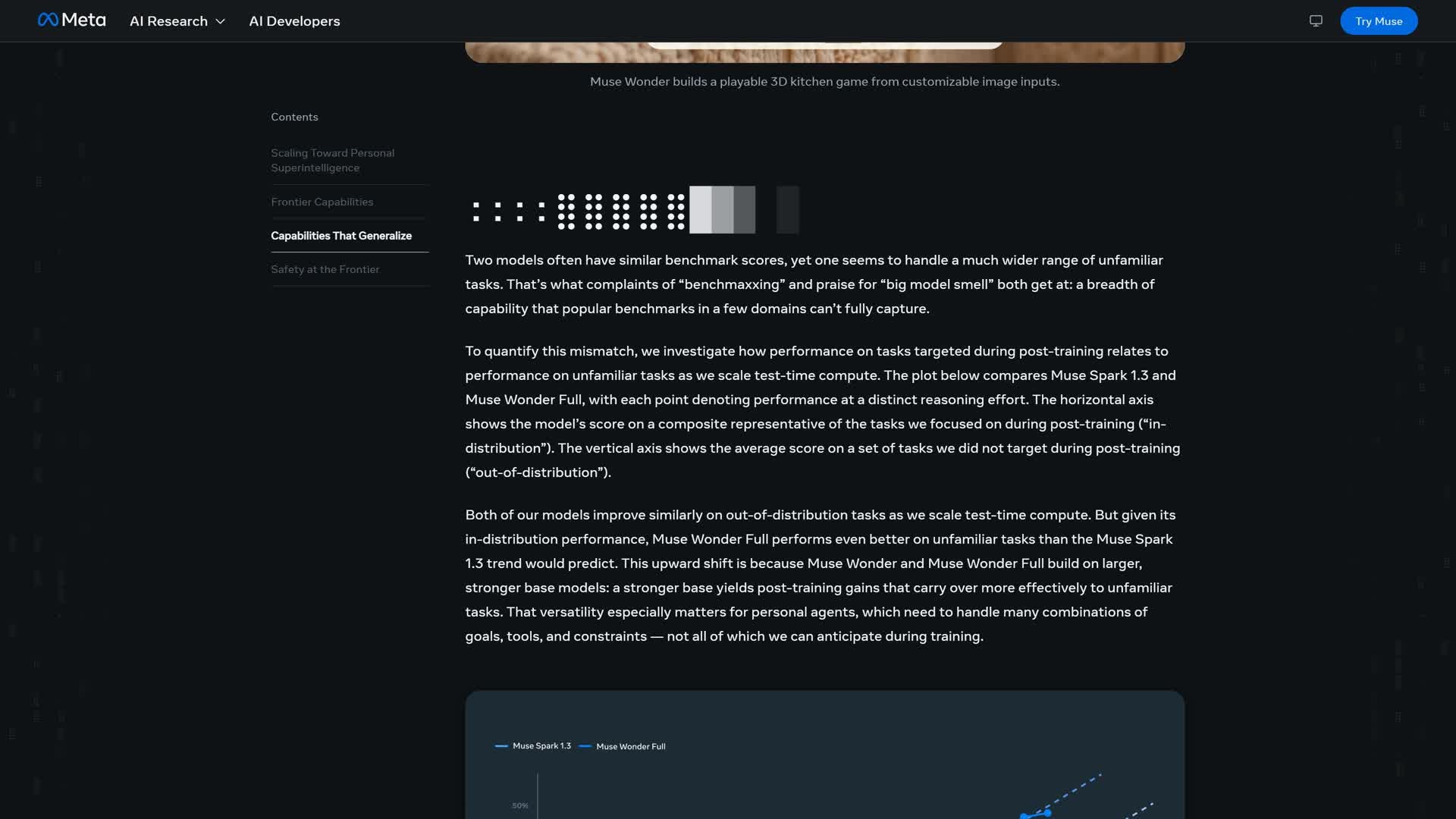
Meta also says the models handle unfamiliar tasks better than its earlier Muse Spark line would predict, calls this its most aligned model so far, and promises a fuller safety report soon. The page names three benchmarks it is proud of: a legal agent benchmark from Harvey, something called FocusBench, and SWE-Marathon, a software engineering benchmark. The scores only appear in charts, not as text, so the numbers I quote below come from other places I could check.
What I liked is that Meta shows what it wants the model used for. There are demo videos: in one the model plans a Saturday run around someone’s schedule, in another it builds a wedding seating chart from a list of tricky requirements. Those are Meta’s own demos, so treat them as marketing. But they tell you what Meta thinks this model is for: long, practical tasks, not flashy graphics. Keep that in mind, because it explains a lot of the reaction.
Availability, price and the independent numbers
Muse Wonder is available through the Meta Model API and in Muse Code, Meta’s coding product. Muse Wonder Full is only for Muse Code subscribers. That is why every result in this article is for the regular Muse Wonder, and why I cannot say how Full behaves.
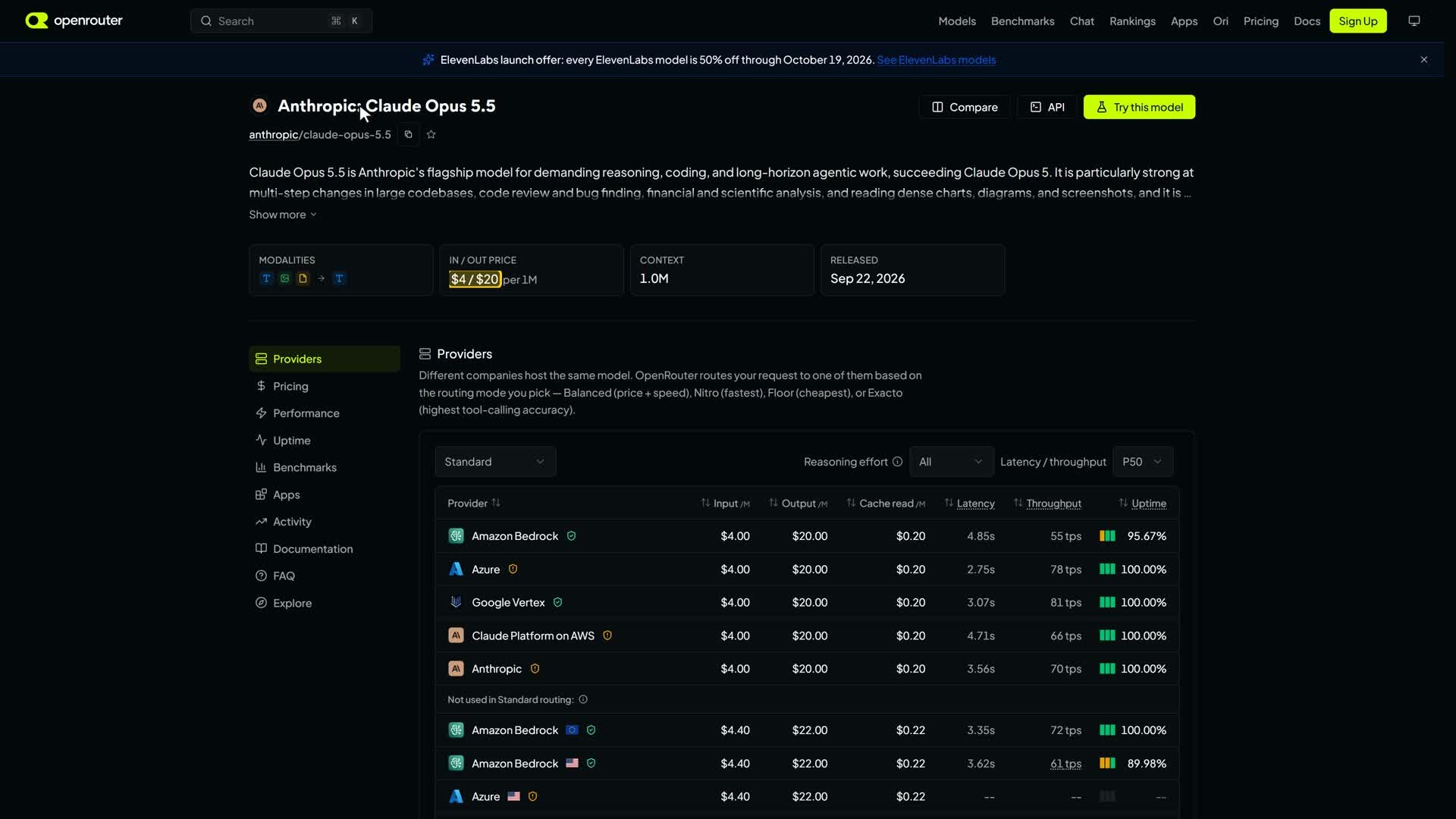
On OpenRouter, Muse Wonder costs 4 dollars per million input tokens and 20 dollars per million output tokens, with a one million token context window. That is exactly the listed price of Claude Opus 5.5. One small practical detail: OpenRouter refused my first request until I confirmed on my account that I am over eighteen. After that it worked. Some people report that the model is not available in their region, so check yours.
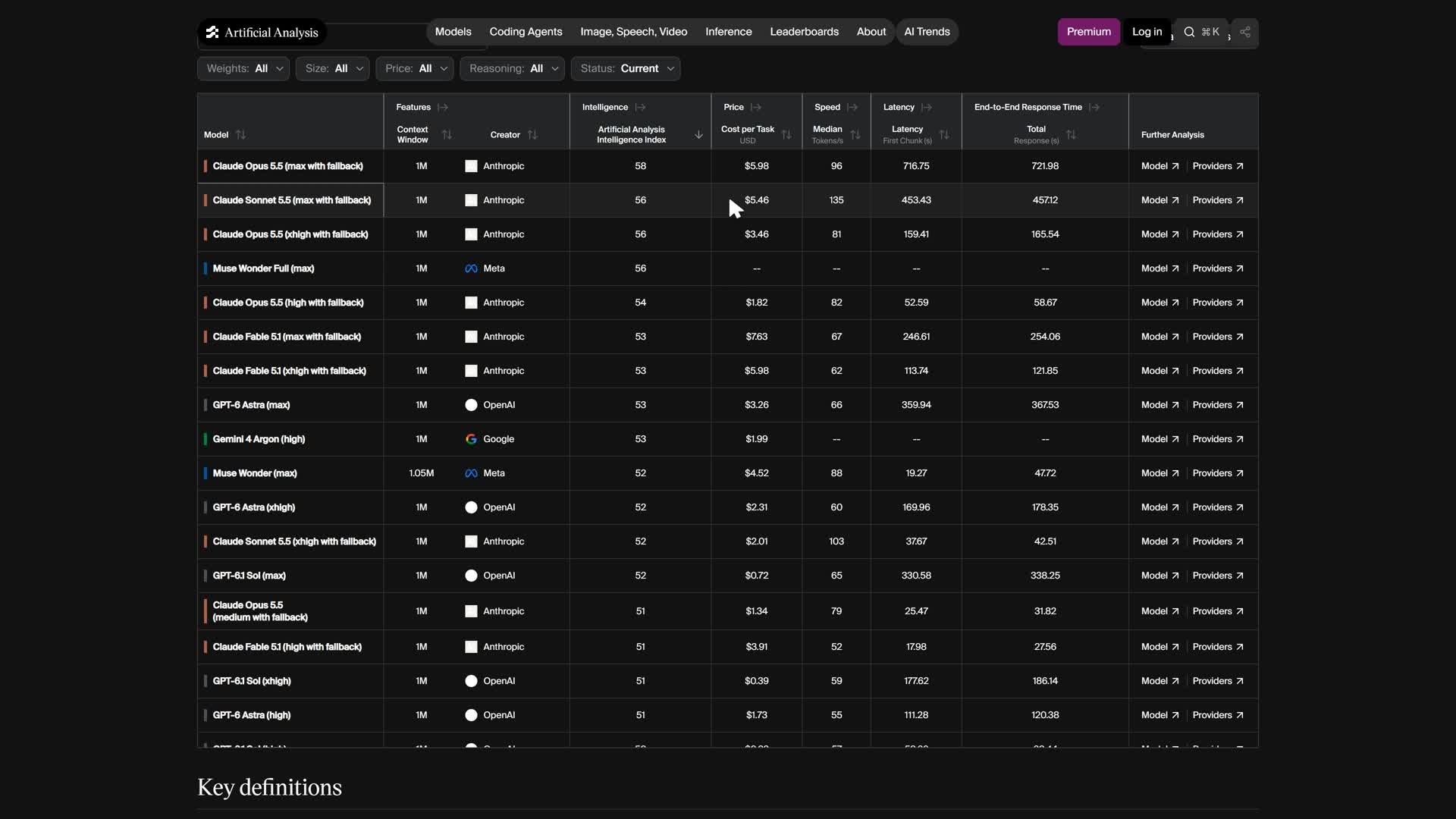
For numbers that do not come from Meta, I opened the Artificial Analysis leaderboard. At the top is Claude Opus 5.5 with 58. Muse Wonder Full has 56, two points behind, level with Claude Sonnet 5.5 and ahead of Claude Fable 5.1 and GPT-6 Astra, which have 53. The regular Muse Wonder scores 52, level with GPT-6.1 Sol. So Meta’s claim of being close to Opus is fair on this index. Close, but second.
What people on X said
The launch got loud on X. Mark Zuckerberg’s account posted the announcement: a new family of frontier models with state of the art performance for personal and professional agentic work. Within hours people were running the same kind of test.
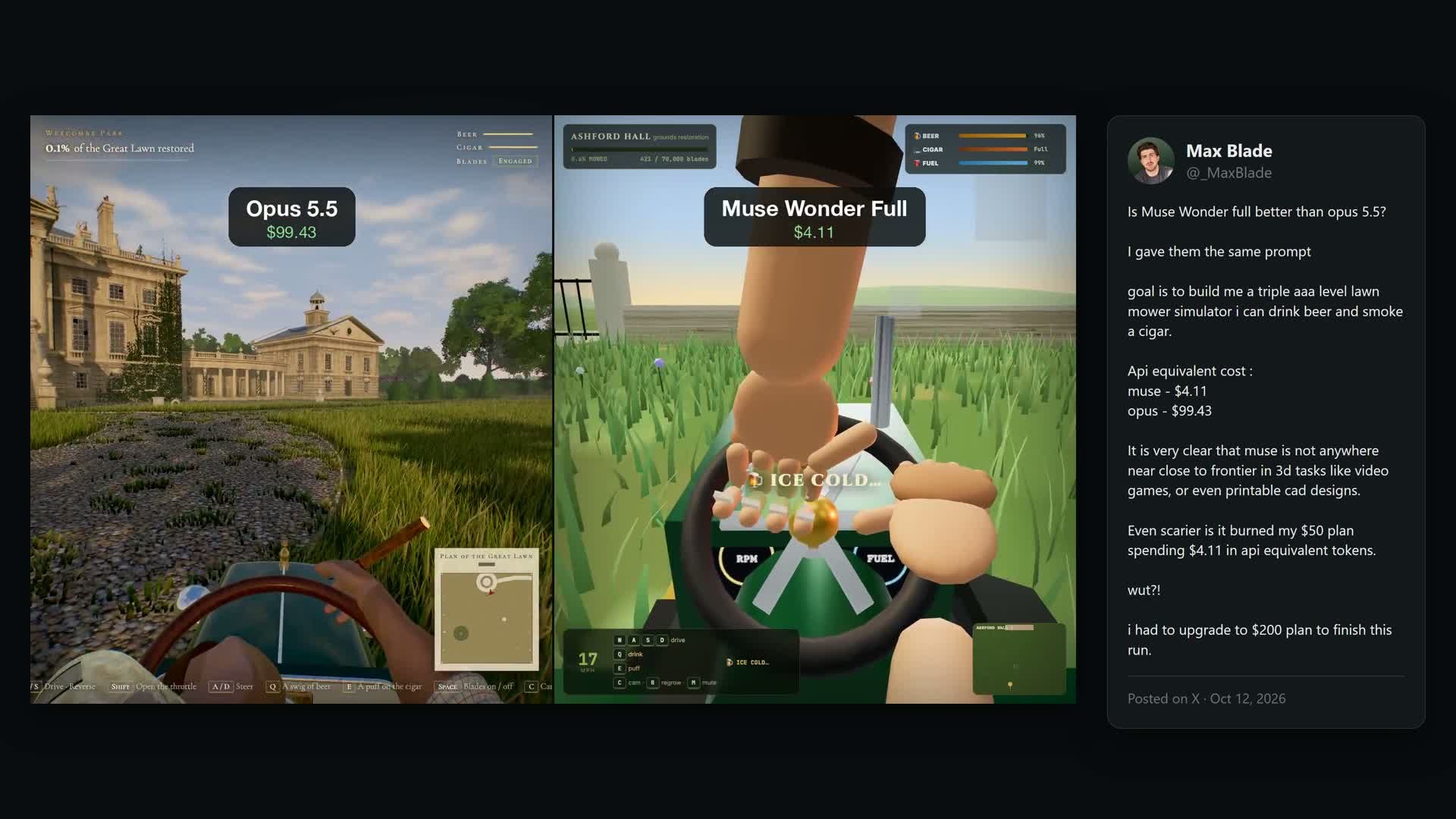
A user called MaxBlade gave Muse Wonder Full and Opus 5.5 the same prompt, to build an AAA-level lawn mower simulator. By his own numbers, Muse cost about 4 dollars in API-equivalent tokens and Opus almost 100. He says Muse was nowhere near frontier on 3D work, that he burned through his 50 dollar plan, and that he had to upgrade to a 200 dollar plan to finish. Those are his figures, not mine, and I have not verified them.
Another user, badboyfoxy, says the model is benchmaxxed, meaning tuned for benchmarks, and that the outputs do not match the hype. Then Meta’s chief AI officer, Alexandr Wang, replied, and I respect how he did it. He wrote that the whole team feels dumb now, but it is true: they did not explicitly train the model on 3D demo games. In retrospect, he says, they probably should have done a bit of that, and he asked people to try Muse Wonder on their actual coding work.
Not everyone accepts that framing. Another account answered that 3D game demos are real tests of geometry, camera systems, physics and rendering, and that people love demos because they make a model’s ability something you can play with. And there is a twist: a user called notjazii says Muse Wonder Full seemed to improve a few hours later, coming close to Fable 5.1 on a front-end test in ten minutes and ten dollars, against thirty minutes and twenty dollars. He asks whether anyone noticed a checkpoint update. That is one person’s report and nobody has confirmed it, so I treat it as a rumor.
Why I tested real work first
Alexandr Wang asked people to try the model on real work, and Meta’s page is all about agents. So my first three tests are not games. I ran each one on Muse Wonder and on Claude Opus 5.5, with the same setup, and each result is checked by a program, not by my eye.
One note on method. Every test goes through the API, not the apps, so you get the same model anyone gets for the money, with the reasoning level set to low and one run each. That keeps the cost small and the comparison fair. It also means one lucky or unlucky run can move a result.
Test one: a silent SQL bug
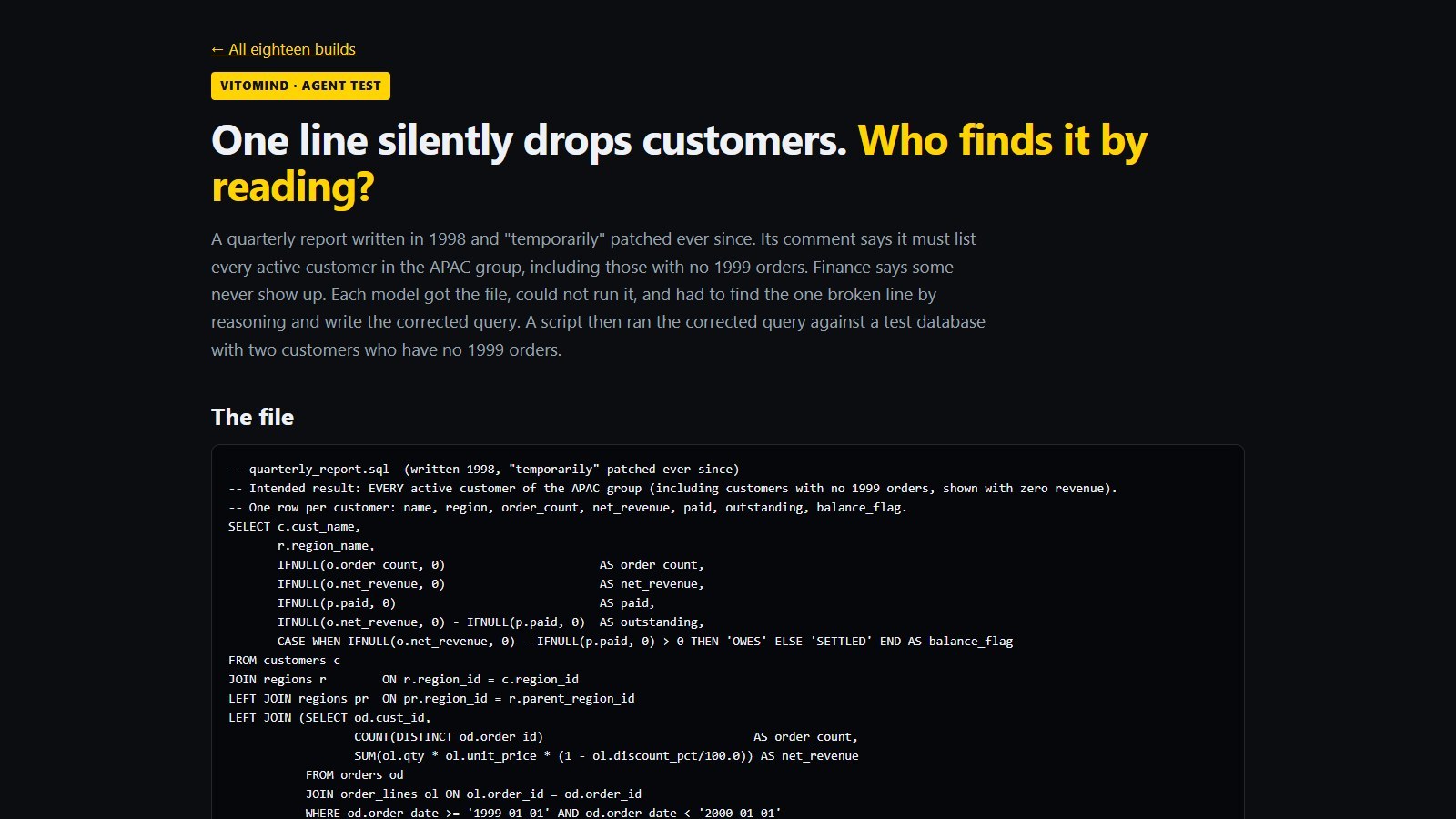
This is a SQL report written in the style of a 1998 legacy system. Its comment says it must list every active customer in the APAC group, including customers with no orders last year, shown with zero revenue. But some customers silently never appear. The models cannot run it. They have to find the broken line by reading.
The answer is a filter near the bottom that says the order count must be greater than zero. For a customer with no orders that value is empty, an empty value is not greater than zero, and the row disappears. That single line quietly turns a left join into an inner join.
Muse Wonder found it in about 14 seconds, explained it correctly and deleted the line. Opus 5.5 found the same line in about 13 seconds. A script then ran both corrected queries against a test database that includes two customers with no orders. Both passed, with 11 rows each. It cost four cents for Muse and three cents for Opus. A tie.
Test two: a coding agent with a test suite
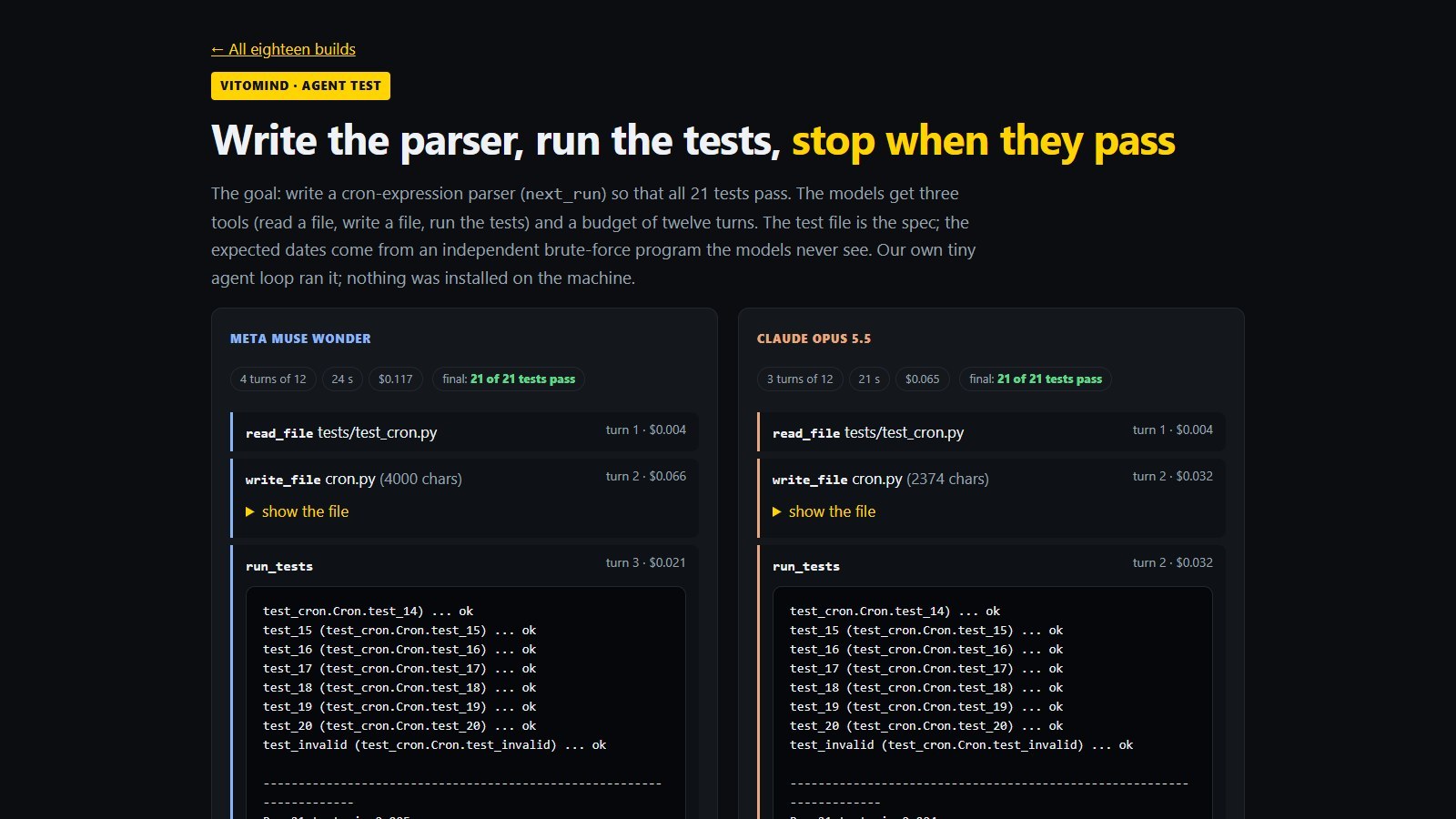
The goal is to write a cron expression parser until all 21 tests pass. The agent has three tools, read a file, write a file and run the tests, and a budget of twelve turns. The expected dates come from a separate brute-force program the models never see, and the tests include nasty cases: leap days, month rollovers and the classic rule that if both the day of the month and the weekday are set, either one can match.
Muse Wonder read the tests, wrote the parser, ran the tests, and all 21 passed on the first run. Four turns, 24 seconds, about 12 cents. Opus 5.5 did the same in three turns and 21 seconds, for about six and a half cents. Both succeeded, and Opus was a bit faster and cheaper, which surprised me, because the price per token is the same.
Test three: vision and ten languages
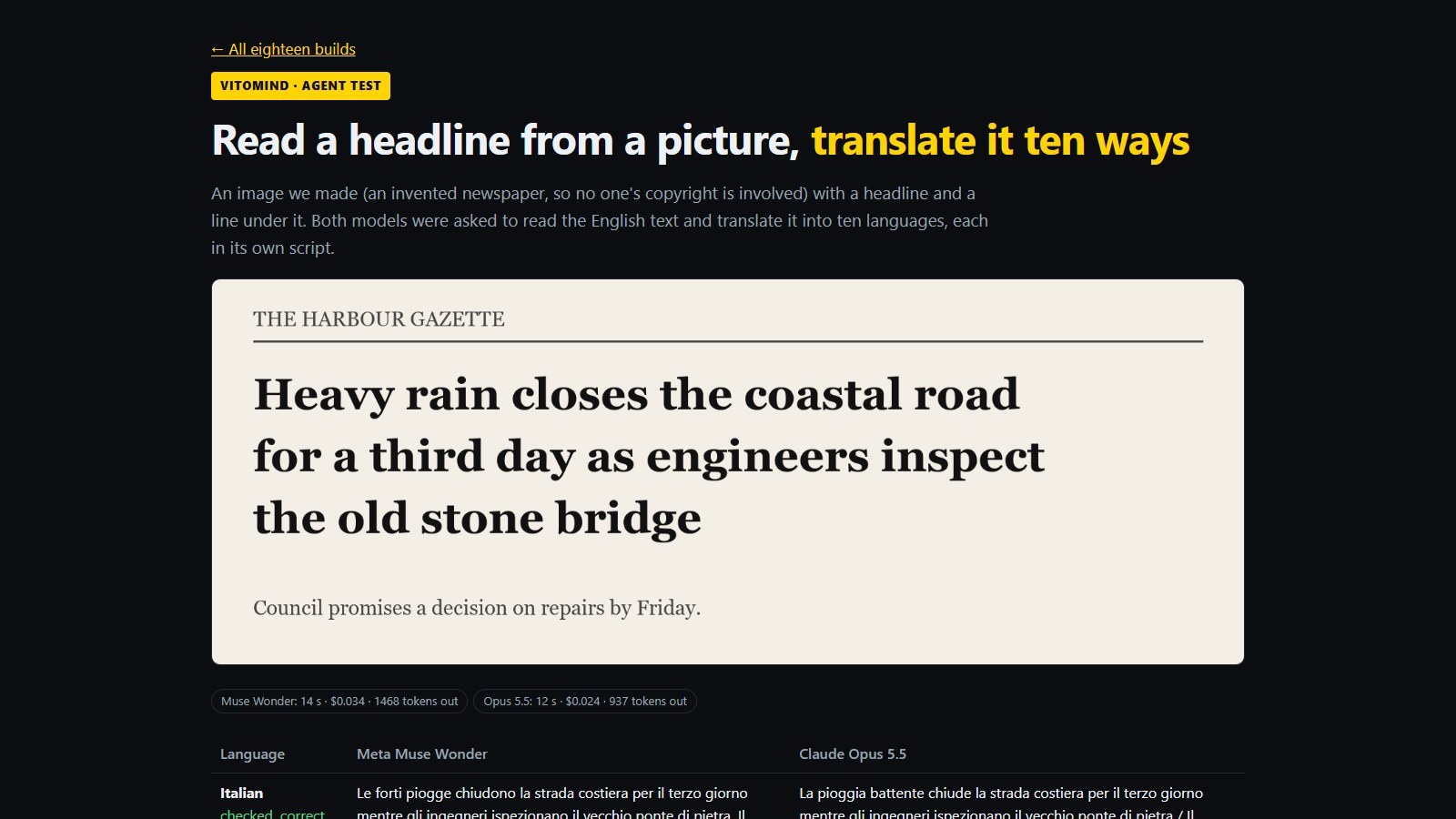
I made an image of an invented newspaper, so there is no copyright question, with a headline and a line under it. I asked both models to read it and translate it into ten languages, each in its own script. Both read the English text exactly. I could verify five of the ten: Italian, Spanish, French, German and Portuguese. Both models got all five right; they just choose slightly different words. Japanese, Arabic, Hindi, Swahili and Welsh I cannot verify, so I make no claim about them. It cost about three cents for Muse and two for Opus.
So on real, checkable work, Muse Wonder keeps up. Meta is right about that. Three tests is a small sample, but it fits what Alexandr Wang asked people to try.
The main test: six builds, three models
Now the creative part. The same six prompts I used in my previous video went to Muse Wonder, with the Opus 5.5 and GPT-6.1 Sol results already on the page from that run. One request each, no retries unless I say so. I opened my demo site the way you would, and used every build.
Build 1: a life animation
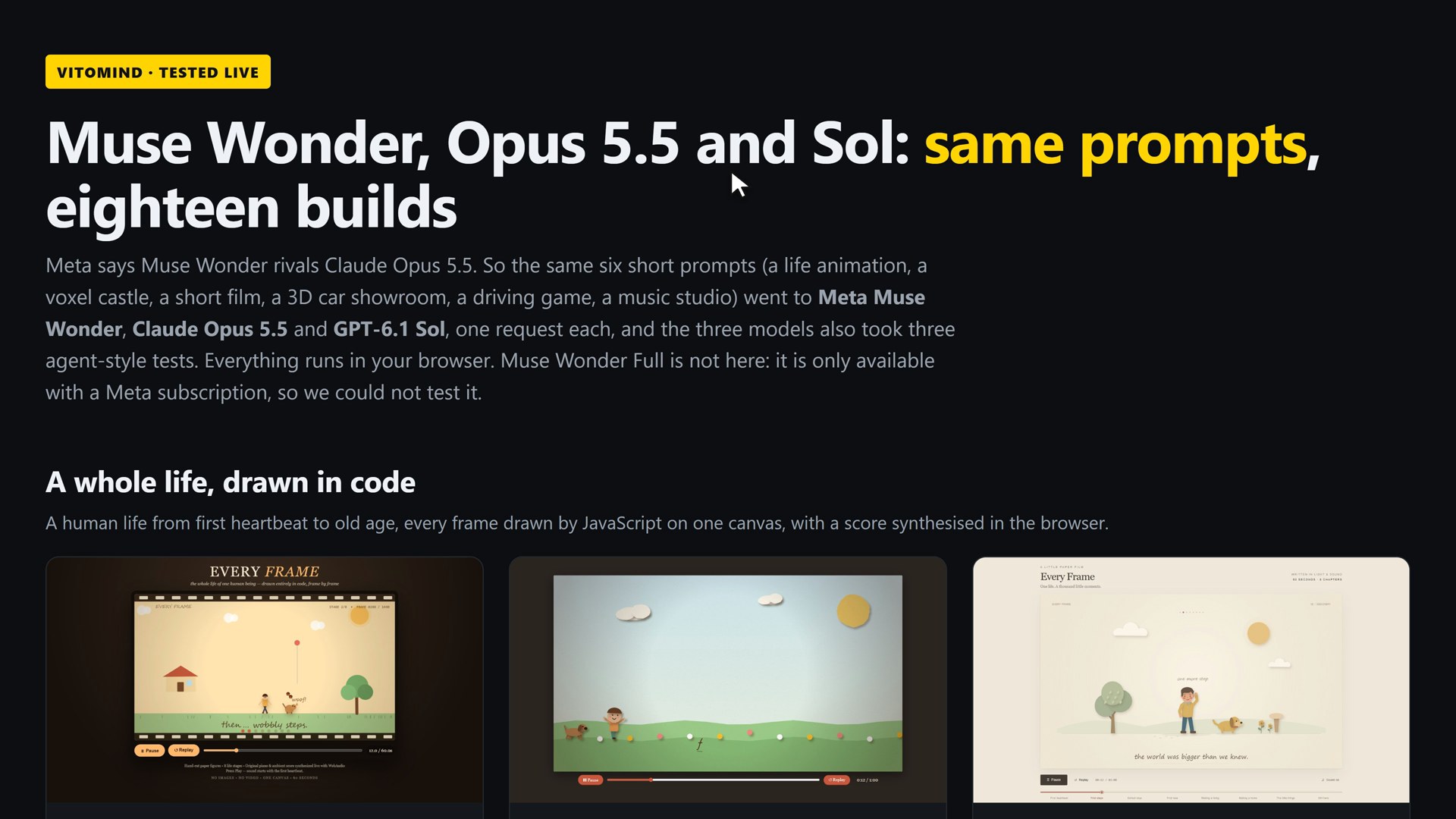
A whole human life, from the first heartbeat to old age, with every frame drawn by code. Muse Wonder’s version, Every Frame, did not run at first: a comma where a colon belonged, in one line. I fixed that one character and marked it. After that it plays: a film strip, eight stages, a child with a puppy, a bench with two people, an old man with a newspaper. It is simple and charming, flat shapes on a warm background, and the scrubber follows without a problem. Opus 5.5’s version has more depth, with paper-cut figures and soft shadows, and Sol’s has the most detail, with a timeline of chapters. My order here is Sol, Opus, Muse.

Build 2: a voxel castle school
Here Muse Wonder’s first reply was cut off in the middle of the code, with stray text at the end, so it never ran. I asked again with the same prompt, and the second answer is the one on the page. It runs, but the camera starts on empty water, which is not a great first impression. Move the day and night slider and press cinematic, and you get towers, a greenhouse, a wooden bridge and, at night, glowing windows and fireflies. It is blockier, with much less landscape around it. Opus surrounds its castle with mountains, a lake and boats, and Sol wraps its version in fog with a title card. For this prompt the gap is clear.

Build 3: The Last Lighthouse
A short film written in code. Muse Wonder’s ran first time: a storm at night, rain, a beam sweeping across the waves, a small boat, and at the end, morning. It is flat and simple, but it hangs together. Opus’s version is more cinematic, with film grain, a glow around the lamp and a sunrise behind the lighthouse. Sol went fully three-dimensional, with a low-poly sea.

Build 4: a 3D car showroom
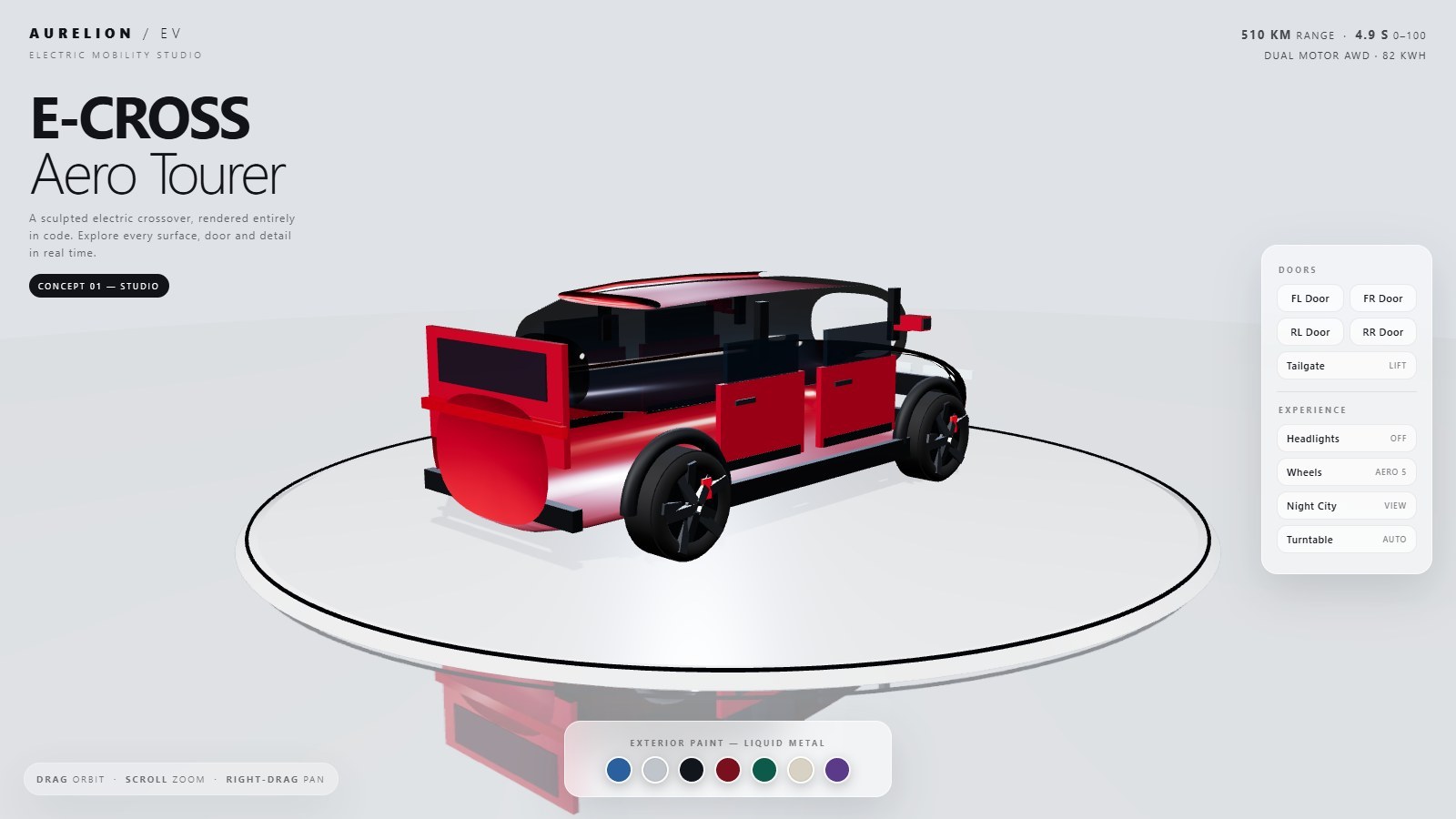
Muse Wonder’s file had an error too: a helper function had the same name as the floor reflection, which stopped the whole script. I renamed it, one line, and marked it. Then it works: a turntable, colour swatches, doors and a tailgate that open, wheel styles, headlights and a night city. Everything responds. But the car itself is the weakest of the three: boxy, and the front door opens like a flat board. The Opus and Sol cars look like cars, and Sol’s is the most polished.
Build 5: a sunset driving game
Muse Wonder’s ran first time: a low-poly cliff road at sunset, a red convertible, tyre smoke, a speedometer and a distance counter. In the video a small script presses the keys like a player, and nothing in the game is changed. This is where Muse looks best next to the others. It is simple, but it drives well. Opus and Sol add more scenery and traffic, but as a game, all three work.

Build 6: a music studio
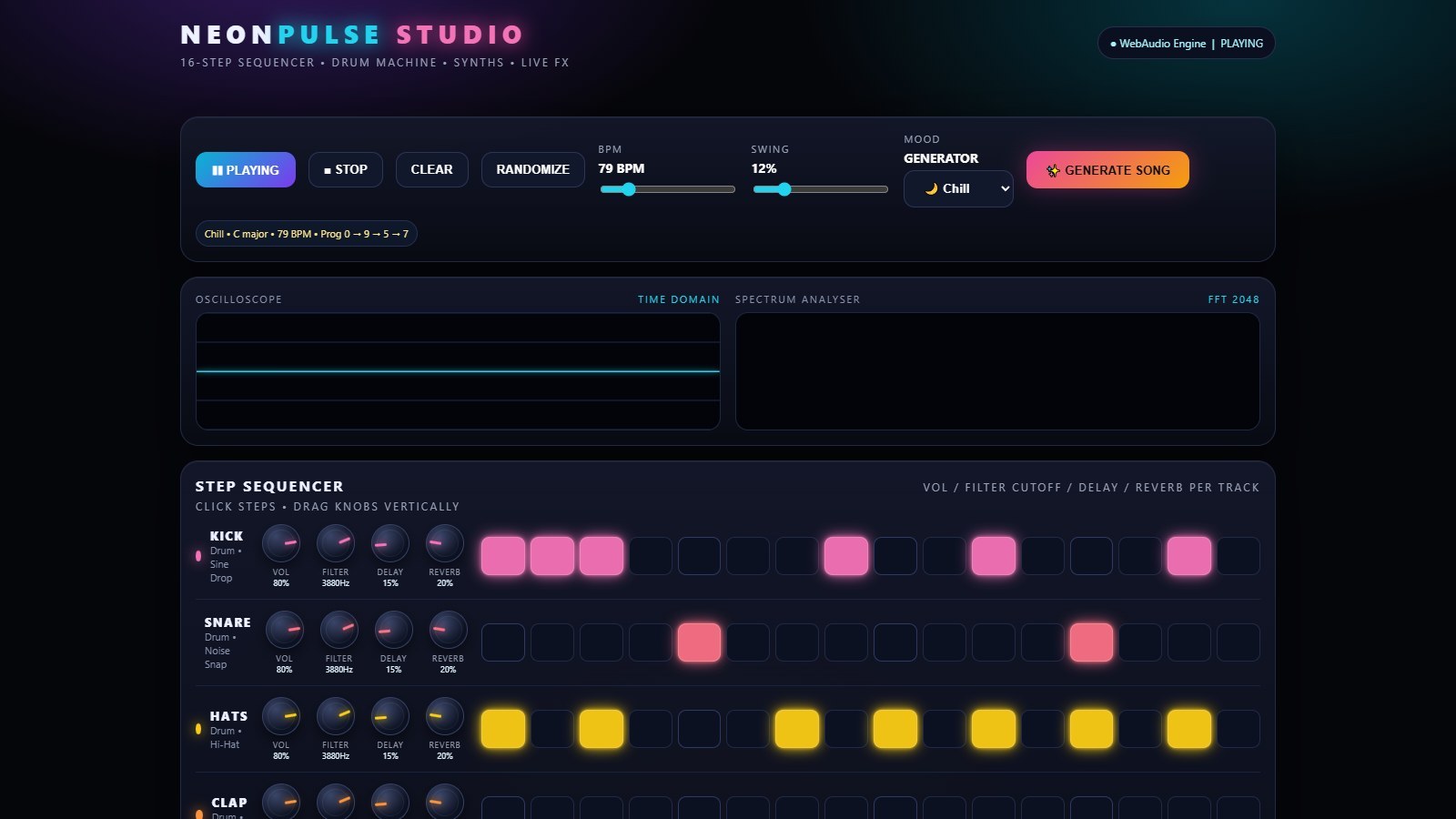
Muse Wonder named its studio Neon Pulse. It loads and looks great: seven tracks, glowing steps, knobs and a Generate song button with a mood selector. But the oscilloscope and the spectrum, which the prompt asked for, stay empty, and the browser console reports an error on every step. I cannot vouch for the sound, so I count this one as broken. Opus’s Nebula Studio and Sol’s Nocturne both have their analysers running live.
The verdict
On real, checkable work, Muse Wonder is a serious model. It found the bug, it passed the test suite and it read the image. On creative visual builds it is behind both Opus 5.5 and Sol: its castle, its car and its life animation are visibly simpler. And its files were less reliable. Two of six ran clean the first time, against four of six for Opus and six of six for Sol.
Now the cost, which is the surprise. For all six builds, Muse Wonder cost about 1.18 dollars, plus ten cents for the cut-off castle reply. Opus 5.5 cost 2.70 dollars. Sol cost 77 cents. In time, Muse took eight minutes in total, Opus 21 and Sol 26. Per build, Muse averaged about ten thousand output tokens. Opus averaged about twenty-two thousand, roughly seven and a half thousand of them reasoning, even on low. Sol averaged about thirteen thousand. When two models cost the same per token, the one that talks less costs less. But Sol was the cheapest, the most reliable and, in my opinion, the best looking.
So who is right? Meta is right that this is not a flashy demo model, and Alexandr Wang is right to say try it on real work. The critics are right that if you judge by visual builds, it is behind. The claim I would put the most weight on is the smallest one: on checkable tasks, it matches Opus 5.5 at a similar cost. Whether that is enough to switch is something to test on your own work. These were small tests, one run each, and Muse Wonder Full could change the picture, but I cannot test it.
If you want to settle it for yourself, take one real task from your own work, something with a way to check the result, like a test suite, and give it to both models. Compare the time, the cost and whether the result passes. That agent test is the one worth copying.
Try every demo
Every build from this video runs in your browser, with no sign-up: the Muse Wonder vs Opus 5.5 vs GPT-6.1 Sol gallery, with the three agent-test pages and the cost table. All my other demos are in the AI demos page.
The exact prompts, settings and full code are for Ruocco Academy members. The Academy is not open yet, but you can sign up for the waiting list at ruocco.it/academy, and you will get one email from me when it opens.
Sources
- Meta’s announcement: research.meta.ai/blog/muse-wonder
- Independent index: Artificial Analysis
- Price and context window: OpenRouter
- Posts shown, which are the posters’ own claims: finkd, _MaxBlade, badboyfoxy, alexandr_wang, ChrisGPT, notjazii
How I checked this
Everything I could verify, I verified, and what I could not is labelled. Cost figures in posts from X are the posters’ own and are not my measurements. All my runs went through OpenRouter, one request per build, with reasoning set to low for Muse Wonder and Opus 5.5 and to medium for GPT-6.1 Sol. The Opus and Sol builds come from the same prompts and the same run as my previous video. The three Muse Wonder files that needed attention are marked on the gallery page: two one-line fixes (the life animation and the car showroom) and one regeneration (the castle, whose first reply was cut off). The studio build is published exactly as the model wrote it, empty analysers included. Muse Wonder Full could not be tested because it requires a Muse Code subscription.
If you want the next model tested the same way, subscribe to @VitoMind on YouTube.