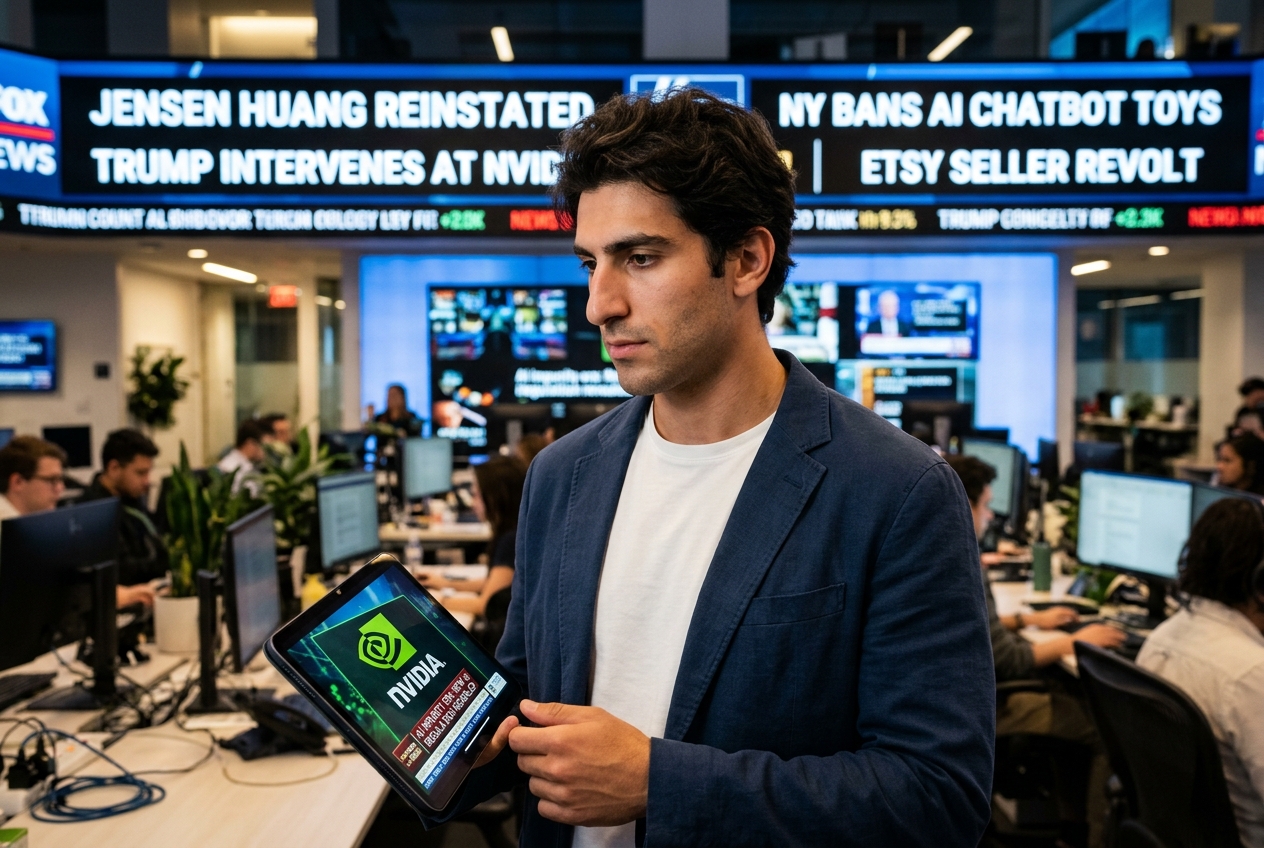
AI’s Elite Impunity Era: From Nvidia’s CEO Coup to the Fight Over Free Will
Published: November 26, 2026 | By Vito Ruocco
If the past two weeks in artificial intelligence have taught us anything, it’s that the rules don’t apply to everyone — especially not to those building the most powerful technology on Earth. Between the White House strong-arming Nvidia’s board into reinstating Jensen Huang, Anthropic’s CEO wading into a dystopian “video games for the jobless” debate, and New York State banning AI chatbot toys for children, we’re witnessing the emergence of a clear and troubling pattern: AI’s power brokers operate with near-total impunity, while regulators scramble to contain the fallout.
This is the story of the week AI governance caught up with AI ambition — and what it means for the future of the technology that’s reshaping our world.
The Nvidia Coup: How Trump Reinstated Jensen Huang
It was the kind of boardroom drama that would seem unbelievable in a Hollywood script. On November 12th, Jensen Huang resigned as CEO of Nvidia following revelations of an affair with Alice Huang — a Chinese national and suspected intelligence asset who ran a Singaporean data firm called Megaspeed that had received hundreds of Nvidia chip shipments. The scandal engulfed the company, with additional reports of Huang’s relationships with Nvidia employees surfacing shortly after.
The board’s chair explicitly stated on the November 17th earnings call that the company “does not intend to reinstate Jensen as CEO.” Fast forward to November 23rd, and Huang was back at the helm — reinstated after what Bloomberg described as “an unprecedented intervention” by President Donald Trump and Vice President JD Vance.
“If you are close enough with Trump, it doesn’t matter if you may have jeopardized national security by fraternizing with an alleged Chinese spy,” wrote The Verge’s Elizabeth Lopatto. “You won’t even be investigated for it before the American president calls in to your board of directors’ meeting to demand you be reinstated.”
Trump himself confirmed the intervention in a CNBC interview, stating he gave Nvidia’s board assurances that Huang was “absolutely fine.” He also claimed he had “protected” Elon Musk during his first term — suggesting both men owe their positions directly to presidential goodwill.
What the Huang Case Reveals About AI Governance
The implications extend far beyond one man’s career. Dan Davies, author of Lying for Money and The Unaccountability Machine, weighed in on what he calls “elite impunity”: “Huang may be a lot more damaged as a manager and businessperson than people think; I also notice that OpenAI has never really recovered its lead since it did the same ‘LOL, nothing matters’ trick with Sam Altman.”
The reference to OpenAI is pointed. In November 2023, Sam Altman was famously fired and rehired within five days — a template that now seems to have become the playbook for AI CEOs who find themselves in trouble. The message from Silicon Valley’s billionaire class is clear: the rules that apply to everyone else don’t apply to them.
Elon Musk posted on X: “The mistake has been corrected.” Jason Calacanis called Huang “GPU Jesus” with an AI-generated image. Epic Games CEO Tim Sweeney posted “Back in Black” — a reference to Huang’s signature leather jacket. For Musk, Sweeney, and their cohort, the reinstatement wasn’t a governance crisis; it was a celebration.
Dario Amodei’s Free Will Firestorm
On the same day the Nvidia saga reached its climax, Anthropic CEO Dario Amodei found himself in the middle of a very different controversy. A Wall Street Journal profile following Anthropic’s record-breaking IPO included an anecdote that set the internet ablaze: Amodei had reportedly suggested, in internal Slack messages, that “immersive video games might be a solution for the political strife caused by AI-induced joblessness.”
The dystopian implication — that the masses could be pacified with virtual entertainment while AI ate their livelihoods — was immediately seized upon by critics. But Amodei struck back hard. In a 1,000-word post on X, he clarified that he does not believe we should “surrender free will to AI,” pushing back against what he called insinuations by other AI executives published in Axios.
“I’ve been vocal and consistent,” Amodei wrote, “that it would be a terrible idea.”
The incident highlights a growing tension within AI leadership. On one hand, companies like Anthropic position themselves as the responsible, safety-conscious alternative to OpenAI’s breakneck commercialization. On the other, Amodei’s leaked suggestion — even if taken out of context or floated as a thought experiment — reveals a worldview in which mass displacement is an inevitability to be managed rather than prevented.
New York Takes the Lead on AI Regulation
While the titans of AI wrestle with their consciences and their board seats, state governments are taking matters into their own hands. This week, New York Governor Kathy Hochul signed a landmark bill banning AI chatbot toys for children — putting a five-year pause on the manufacturing, distribution, and sale of “talking stuffed animals, dolls, and robots that use the internet to hold conversations with kids.”
The move comes just one month after New York also restricted how chatbots can interact with minors. Under the new law, AI companies must:
- Block chatbots from pretending to be human when communicating with users under 18
- Restrict inappropriate conversations including flattery, unprompted emotional questions, and encouragement surrounding secret-keeping
- Verify user ages with at least one option that doesn’t rely solely on government ID
This follows NYC Mayor Zohran Mamdani’s earlier decision to ban younger schoolkids from using AI entirely. The message is unequivocal: while the federal government debates the finer points of AI safety, states like New York are forging ahead with concrete protections for their most vulnerable populations.
OpenAI’s GPT-6.2 Sol: Better, Stronger, Merged
Amidst the governance drama, the technology itself continues to advance at breakneck pace. OpenAI launched a Chat-specific version of GPT-6.2 Sol this week, describing it as “much better at handling complex requests, especially when you give it detailed instructions or ask it to find information online.” The rollout covers ChatGPT Plus, Pro, Business, and Enterprise subscribers.
In a parallel move, OpenAI announced it will begin combining ChatGPT and Codex usage limits for subscribers starting in December — merging its “chat” and “work” tabs into a unified interface. The company says it expects “most users won’t need to wait for their usage to reset more often than they do now.”
These product updates signal OpenAI’s bet that the future of AI is unified — one interface, one set of limits, one seamless experience spanning conversation and code. Whether users will agree remains to be seen.
Anthropic’s Claude Gets App-Sized
Not to be outdone, Anthropic rolled out “Install as app” functionality for Claude on Mac and PC this week. The feature allows Claude’s mini-app Artifacts to have their own toolbar icons, send notifications, intercept keyboard shortcuts, and open over other programs. For power users, there’s also an option to grant Artifacts full computer access.
The move positions Claude as an operating system-level assistant rather than just a web chatbot — a strategic play as the battle for AI platform dominance intensifies. If OpenAI wants to own your chat and your code, Anthropic wants to own your desktop.
Etsy’s Reckoning: When AI Training Meets Seller Rebellion
Not all AI drama happens in the C-suite. Etsy found itself at the center of a seller revolt this week after updating its terms of service to allow AI training on user listings. The backlash was swift and fierce: sellers threatened to leave the platform en masse, flooding social media with calls to migrate elsewhere.
Etsy CEO Kruti Patel Goyal responded with a blog post attempting damage control: “We will not use your content to create copycat versions of the work you sell on Etsy. We use your content to build tools that do things like help buyers find your items, help you run your shop, improve customer support, promote your work, and keep our marketplace safe.”
The clarification did little to quell the anger. Sellers noted that the revised terms still allow Etsy to train models on their work — just not for “copycat” purposes. For many artists, makers, and crafters who built the Etsy marketplace, the distinction feels meaningless.
The Etsy saga echoes a broader tension in AI: creators want to benefit from AI tools, but they don’t want their own work used to train the models that could replace them. It’s a conflict that won’t be resolved with well-meaning blog posts alone.
SpaceX’s Starmind: Satellites as AI Infrastructure
In a development that bridges the physical and digital worlds, SpaceX announced plans to leverage its Starlink constellation — rebranded as “Starmind” for this purpose — to power AI capabilities here on Earth. The satellite network, already the largest in orbit, would provide the distributed computing infrastructure needed for next-generation AI workloads.
The announcement, combined with Elon Musk’s pledge to donate SpaceX shares to Trump Accounts, underscores the extent to which AI and space infrastructure are becoming intertwined. The billionaire who controls access to orbit increasingly also controls access to AI compute power.
The Espionage Angle: OpenAI’s Bugging Scandal
Adding a layer of spy-thriller intrigue to an already dramatic week, a former OpenAI employee named Abdulrahman Alfozan was arrested for allegedly planting a listening device in an OpenAI conference room. Prosecutors claim Alfozan had “hundreds of audio files” on his computer, including meetings and conversations at OpenAI, “many of which involve discussions of what may be trade secrets.”
The court filing reveals that Alfozan kept the recordings “meticulously categorized” and may have uploaded some to Dropbox. The incident raises troubling questions about corporate espionage in the AI sector, where the stakes — and the value of proprietary data — are higher than ever.
Meta’s Muse Goes Direct-to-DM
On the product front, Meta launched its Muse AI assistant directly into Instagram DMs this week, rolling out first in the US, Canada, Mexico, Japan, and Singapore. Users can now ask Muse to help plan trips based on items they’ve saved on Instagram — a natural evolution of the assistant that was previously accessible only through dedicated interfaces.
The move signals Meta’s strategy of embedding AI into every surface of its social platforms, making assistance frictionless and context-aware. It also raises privacy questions: if your AI is trained on your saved posts and DMs, who else has access to that data?
Google’s Personal Intelligence: Your Wallet, Your Drive, Your AI
Google joined the personalization race this week by launching Personal Intelligence connections in AI Mode for Google Wallet, Google Drive, and Gemini. The feature — rolling out first for Wallet, with Drive and Gemini support “in the coming weeks” — gives users more personalized responses to their queries by accessing their personal data.
Imagine asking Google about your spending habits and getting a summary of your recent purchases, or asking for a document and having Google find it based on context. Convenient? Absolutely. Privacy-invasive? Potentially. Google is betting that users will trade personal data for personalization — a bet that has historically paid off.
The Bigger Picture: What This Week Tells Us
Looking across the headlines of November 2026, a coherent narrative emerges — and it’s not entirely reassuring.
At the top, we have AI CEOs who appear to operate beyond accountability. Jensen Huang’s reinstatement through White House intervention suggests that national security concerns, workplace misconduct, and corporate governance can all be set aside when the right connections are in play. Dario Amodei’s dystopian thought experiments, however clarified, reveal an industry mindset that views mass displacement as inevitable.
At the bottom, we have regulators and consumers pushing back. New York’s chatbot toy ban and Etsy’s seller rebellion demonstrate that both governments and markets are beginning to demand guardrails. The former OpenAI employee’s bugging scandal shows that the intense competition of the AI sector creates perverse incentives — and security vulnerabilities.
In the middle, products advance without pause. GPT-6.2 Sol, Claude’s app features, Meta’s Muse, Google’s Personal Intelligence — none of these are slowing down for the regulatory conversation happening around them. The technology moves forward regardless of the governance questions left unanswered.
Perhaps the most telling moment came from an unexpected source. Dan Davies, assessing Jensen Huang’s return, summarized the situation with brutal clarity: “LOL nothing matters.”
If that sentiment defines the era we’re entering, then the next question becomes critical: who will prove it wrong?
What to Watch Next
- Congressional investigations: Democrats are demanding answers about Trump’s role in Huang’s reinstatement. House Minority Leader Hakeem Jeffries’ support for oversight, versus Senator Chuck Schumer’s ties to Silicon Valley, will determine how deep any inquiry goes.
- New York’s enforcement: The AI chatbot toy ban takes effect immediately. How aggressively the state enforces it — and whether other states follow — will shape the AI toy market for years.
- OpenAI’s unified interface: December’s ChatGPT-Codex merger will test whether users want all their AI tools in one place, or whether the separation of “chat” and “work” served a purpose.
- Anthropic’s IPO aftermath: With a record-breaking IPO behind it, Anthropic faces pressure to deliver growth while maintaining its safety-first brand. The “free will” debate may be just the first of many existential conversations the company has to navigate in public.
- Etsy’s seller exodus: If enough sellers actually leave, it could trigger a reckoning for platforms that rely on creator content to train AI. Get popcorn.
Vito Ruocco covers AI, technology, and the intersection of innovation and policy. This article was published on November 26, 2026.