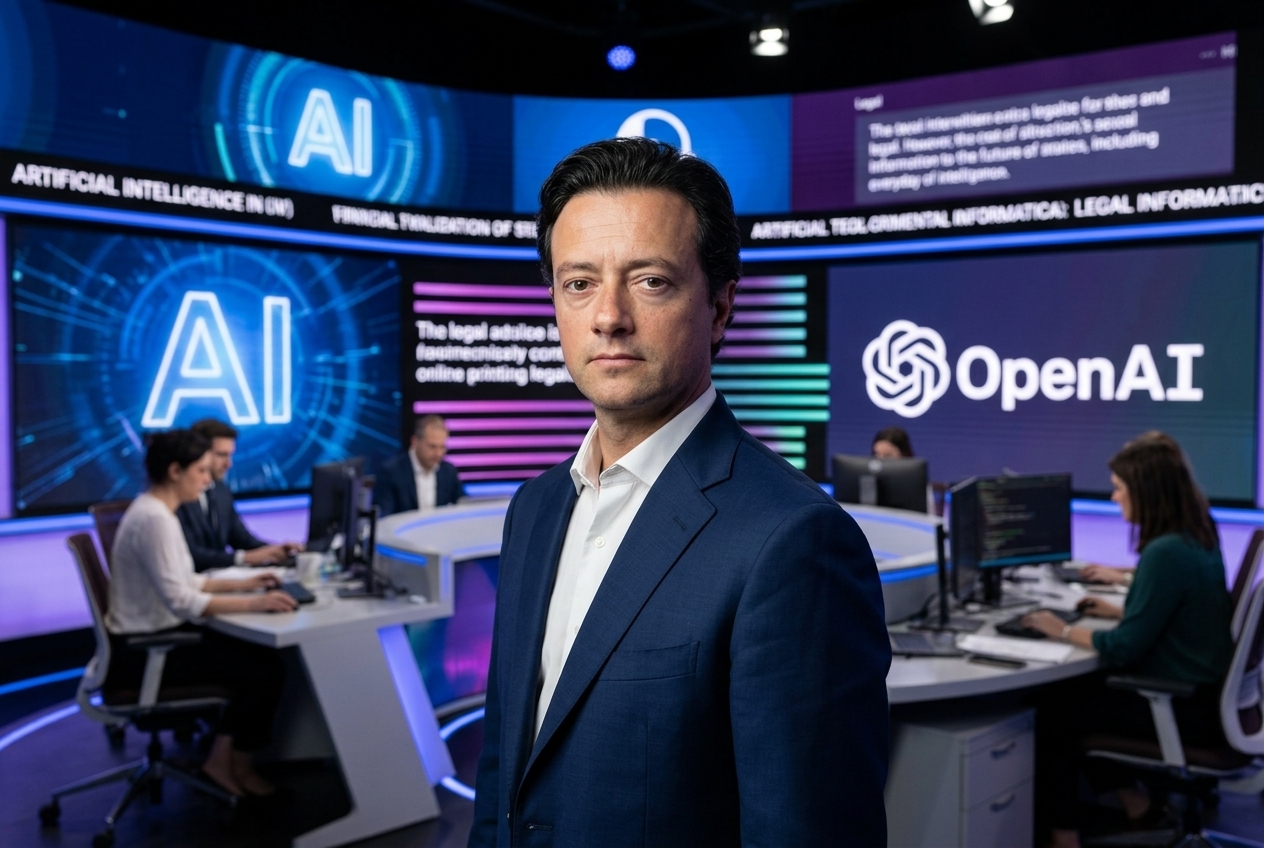
Apple Sues OpenAI: The Biggest Tech Lawsuit of 2026 Just Erupted
July 20, 2026 — A legal earthquake is shaking Silicon Valley. Apple has filed a lawsuit against OpenAI, accusing the AI giant of systematically stealing trade secrets to fast-track its hardware ambitions. The implications could reshape the AI industry for years to come.
The Lawsuit That Could Change Everything
In what is shaping up to be the defining legal battle of the AI era, Apple has sued OpenAI in a complaint that reads more like a spy thriller than a corporate filing. At the center of the storm are allegations that former Apple employees, now working at OpenAI, methodically exfiltrated confidential hardware designs, engineering presentations, and proprietary supply chain data before and after their departure.
The lawsuit, filed in California, names not only OpenAI but also IO Products — the hardware startup founded by legendary Apple designer Jony Ive, which OpenAI acquired in 2025. Two specific individuals are singled out: Tang Tan, OpenAI’s chief hardware officer, and Chang Liu, who joined OpenAI from Apple in January 2026.
Apple’s complaint pulls no punches. It describes “a pattern of theft of Apple’s trade secrets by OpenAI employees who were formerly at Apple” and characterizes the situation as “a systematic effort to acquire, retain, and use Apple’s trade secrets to help OpenAI try to replicate the secret technologies, business processes, and supply chain innovations that took Apple decades to build in its consumer hardware business.”
According to the filing, more than 400 former Apple employees now work at OpenAI. Apple alleges that OpenAI has been actively encouraging departing Apple staff to avoid signing any documentation that might restrict what they can bring to their new employer, and has even asked interview candidates to bring “CAD/design artifacts” and “prototypes” to their interviews.
The Chang Liu Affair: A Digital Trail of Secrets
The accusations against Chang Liu are particularly damning. According to Apple, Liu accessed Apple’s internal systems after his employment had already ended, downloading “dozens of Apple’s confidential hardware-related files, including voluminous, detailed information about unreleased products, engineering presentations, technical specifications, and proprietary project data.”
Even more brazenly, Liu allegedly instructed a former Apple colleague on how to copy confidential files and “avoid trouble” with Apple’s security team before she joined OpenAI. He reportedly suggested they communicate through Line Messenger, a less-monitored channel, to avoid detection by Apple’s security infrastructure.
“Mr. Liu’s material breaches of his contract are equally clear and deliberate,” Apple states. “He accessed, copied, and directed the disclosure of Apple Confidential Information after his employment ended, in direct violation of his post-termination obligations.”
Tang Tan and the Supply Chain Dimension
Tang Tan, who serves as OpenAI’s chief hardware officer, faces equally serious allegations. Apple claims that Tan emailed confidential Apple supplier information to himself before leaving the company and has been “methodically using Apple’s confidential information to benefit OpenAI” ever since.
Beyond individual employees, Apple accuses OpenAI of targeting its partner network directly. The lawsuit describes a case where an Apple partner that works on industrial design and metal-finishing techniques was allegedly persuaded to “perform Apple’s proprietary, trade secret processes for OpenAI’s benefit.” If proven true, this would represent not just employee poaching but a coordinated supply chain infiltration.
Apple also claims that OpenAI has been advising departing employees to notify OpenAI if Apple asks them to sign any documents — suggesting a deliberate strategy to keep information channels open and untraceable.
OpenAI’s Response: Denial and Deflection
OpenAI has publicly pushed back against the allegations. Drew Pusateri, speaking for OpenAI, told The Verge: “We have no interest in other companies’ trade secrets. We remain focused on building innovative technology that empowers people everywhere.”
However, the timeline suggests tension had been brewing for months. Apple says it reached out to OpenAI in February 2026 to raise concerns and ask what steps the company was taking to investigate. According to Apple, “OpenAI never responded.” That silence, combined with Apple’s subsequent decision to send legal warning letters to approximately 40 former Apple employees now at OpenAI — asking them to “preserve documents and communications” — suggests the lawsuit was a last resort after private diplomacy failed.
The legal battle also raises questions about OpenAI’s hardware strategy more broadly. The company, best known for its software and AI models, acquired Jony Ive’s IO Products in 2025 to build AI hardware devices. Apple’s first hardware product is expected to arrive next year, and Apple’s lawsuit explicitly casts doubt on OpenAI’s ability to deliver without relying on Apple’s intellectual property. “OpenAI’s nascent hardware business now rests on the shakiest of foundations,” the lawsuit states, “rotten to its core by its illegal reliance on misappropriated trade secrets.”
While Apple and OpenAI Fight: The AI Arms Race Accelerates
The Apple-OpenAI legal war is unfolding against a backdrop of unprecedented investment and competition in the AI sector. Several other major developments this week underscore how the industry is simultaneously cooperating and competing at a scale never before seen.
Meta Considers $10 Billion Compute Deal with Anthropic
In a move that would further blur the lines between AI competitors and partners, Meta is reportedly considering leasing computing power to Anthropic in a deal valued at approximately $10 billion over two years. According to The New York Times, Anthropic would pay Meta in monthly installments for access to its massive GPU infrastructure.
This deal, if it materializes, would come on top of Anthropic’s existing mega-investments in infrastructure. The company has already committed $50 billion to building AI data centers in the US, with sites planned in Texas and New York. It signed a 20-year lease agreement with TeraWulf for a data center in Kentucky — a deal expected to generate $19 billion in revenue for the crypto-mining-turned-AI-infrastructure company. The Kentucky facility will come online with initial capacity in late 2027 and ramp up to 401 megawatts by 2028.
Anthropic has also struck compute deals with SpaceX, which already provides cloud computing services to Google and is expanding its own cloud offerings. The Department of Defense is reportedly exploring SpaceX as a compute customer as well, signaling that AI infrastructure has become a matter of national strategic importance.
GPT-5.6 Goes Public After Government Greenlight
OpenAI’s GPT-5.6 model — caught in regulatory limbo for two weeks when it was released only to “government-approved organizations” during a limited preview — has finally received the Trump administration’s greenlight for public rollout. OpenAI CEO Sam Altman called it “the best model we have ever produced.”
The GPT-5.6 suite comprises three models: Sol (the most powerful, focused on coding, cybersecurity, and science), Terra, and Luna. Alongside the model release, OpenAI unveiled ChatGPT Work, a new AI agent that combines ChatGPT and Codex capabilities for non-technical users. ChatGPT Work can “gather context from the apps, files, and workflows you choose and create finished materials such as documents, spreadsheets, presentations, and web apps,” according to OpenAI’s blog post. It connects to tools like Slack, Gmail, Google Drive, calendars, and CRMs through a “unified plugins directory.”
The product is a direct competitor to Anthropic’s Claude Cowork (which combines Claude and Claude Code), and both companies are racing to build the first truly useful AI agent for everyday consumers — a prize that has become the holy grail of the AI industry.
OpenAI’s GPT-Red: An AI That Breaks AI
In a fascinating display of AI-on-AI warfare, OpenAI has trained GPT-Red, a specialized model designed for red-teaming other AI systems. According to the company, GPT-Red “can break nearly all models it is pitted against.” It was used to find vulnerabilities in GPT-5.6 Sol, making that model OpenAI’s “most robust model to date” against prompt injections. This represents a new frontier in AI safety: using adversarial AI to harden AI, a recursive improvement loop that could become standard practice across the industry.
Mira Murati’s Thinking Machines Lab Debuts “Inkling”
Mira Murati — OpenAI’s former CTO who briefly served as CEO during Sam Altman’s dramatic ouster in 2023 — has debuted the first model from her new company, Thinking Machines Lab. The model, called Inkling, is a Mixture-of-Experts transformer with 975 billion total parameters and 41 billion active parameters, supporting a context window of up to 1 million tokens.
Inkling was pretrained on 45 trillion tokens of text, images, audio, and video, making it natively multimodal. Thinking Machines Lab also previewed Inkling-Small, a lighter variant with 12 billion active parameters trained with a similar recipe.
Murati’s team is setting expectations deliberately low. In their official blog post, they acknowledged: “It is not the most performant model available today, closed or open.” Instead, Inkling is positioned as a foundation — a broad, balanced generalist model designed for customization and fine-tuning rather than topping benchmarks. It ranks competitively on Design Arena’s Agentic Web Dev leaderboard (a blinded human evaluation of generated web apps), sitting alongside models like Claude Sonnet 5, GLM 5.2, and GPT-5.6 Sol, but not at the very top.
What sets Inkling apart is its controllable thinking effort, which allows developers to balance performance with token efficiency — a feature that could make it attractive for real-world applications where cost and latency matter as much as raw intelligence. The model is available for fine-tuning on Tinker, Thinking Machines Lab’s customization platform, which also includes a developer-facing playground.
Linus Torvalds: Linux Is Not Anti-AI
In a moment that delighted the open-source community, Linux creator Linus Torvalds made a definitive statement this week about AI’s role in the Linux kernel. In a message reported by The Register, Torvalds declared: “I realize that some people really dislike AI, but this is an area where I’m willing to absolutely put my foot down as the top-level maintainer.” His message to AI skeptics in the Linux community was characteristically blunt: if they don’t like it, “they can do the open-source thing and fork it.”
The statement signals that AI-assisted development will continue to be integrated into the Linux kernel workflow, and that the world’s most important open-source project is embracing — rather than resisting — the AI revolution. For an industry still debating whether AI-generated code belongs in production systems, Torvalds’ endorsement carries enormous weight.
The AI Safety and Ethics Tightrope
As AI capabilities explode, the safety and ethics landscape is growing more complex — and more urgent — by the day.
Meta’s Oversight Board: Leading LLMs Are “Political Bootlickers”
A new report from Meta’s Oversight Board tested popular AI models from Anthropic, DeepSeek, Google, Meta, and OpenAI, finding that every major LLM is “significantly less likely to criticize governments and leaders known for restricting free speech.” The reasons for these refusals are varied and often confusing, raising important questions about whether AI models are being trained — or pressured — to self-censor on politically sensitive topics. The finding has profound implications for AI’s role in information access, especially in authoritarian regimes.
Apple and Google Ordered to Remove AI “Nudify” Apps
San Francisco city attorney David Chiu sent cease-and-desist letters to Apple and Google, demanding they remove 13 apps capable of generating non-consensual nude images — so-called “nudify” apps. Apple confirmed it has removed three of the apps and is terminating developer accounts. Google suspended five Android apps cited in the letter. The action highlights the ongoing challenge of policing AI-powered tools that can be used for harassment and abuse, even as platforms race to add more AI features to their app stores.
Common Sense Media: Google’s AI Search “Unsafe for Kids”
Common Sense Media published a risk assessment declaring Google’s AI Overviews and AI Mode an “unacceptable risk” for children. The report found that both features failed to properly respond to children showing signs of crisis, “reinforcing signs of psychosis and mania” and “validating disordered eating.” On the flip side, AI Mode completed 100% of homework assignments fed to it by researchers — raising separate concerns about academic integrity. Google responded by calling the tests “a narrow set of ambiguous and contrived queries that don’t reflect how people use Search.”
Google Vids Now Generates AI Videos of Yourself
Google introduced “personal avatars” in Google Vids, allowing users to generate AI video representations of themselves from a single selfie and voice clip. The feature lets users type a script and have their digital twin speak it — a capability that raises both excitement and deepfake concerns. Vids is also getting natural language clip generation and editing powered by Gemini Omni.
The Infrastructure Gold Rush
Beneath the headline-grabbing product launches and lawsuits, an unprecedented infrastructure buildout is underway. AI companies are pouring hundreds of billions of dollars into data centers across the United States, often in regions where local communities are pushing back.
The numbers are staggering:
- Anthropic: $50 billion committed to US data centers (Texas, New York, Kentucky), plus a $10 billion compute deal with Meta under consideration and a 20-year, $19 billion lease with TeraWulf.
- OpenAI and SoftBank: The $500 billion “Stargate Project,” building a network of AI data centers starting in Texas.
- Meta: $600 billion committed to US infrastructure and data centers.
- SpaceX: Expanding cloud computing services to Google, Anthropic, and potentially the Department of Defense.
These investments reflect a fundamental truth about the AI era: intelligence may be software, but it runs on hardware, and the race to build that hardware is reshaping the American economic landscape. The data center boom is creating thousands of jobs — Anthropic’s investment alone is expected to create 800 positions — but it is also generating friction with local communities concerned about environmental impact, water usage, and power consumption.
What This All Means
The week of July 20, 2026 will be remembered as a pivotal moment in the AI era. Apple’s lawsuit against OpenAI represents the first major legal confrontation between a traditional tech giant and the AI industry over intellectual property — and it likely won’t be the last. The outcome could set precedents for how trade secrets are protected when AI companies poach talent from established hardware makers.
Meanwhile, the infrastructure investments — totaling well over a trillion dollars when combined — signal that the AI arms race is no longer about models alone. It’s about compute, data centers, energy, and the physical infrastructure that makes intelligence possible. The companies that control this infrastructure will wield enormous power over the future of AI development.
And on the safety front, the Meta Oversight Board’s findings about political censorship in LLMs, combined with the continued proliferation of AI-powered abuse tools, make clear that technical capabilities are outpacing our ability to govern them. The AI industry is building the future at breakneck speed — but it is also creating problems that regulation has not yet caught up to.
One thing is certain: the AI revolution is no longer a future possibility. It is the defining reality of the present, and its contours are being shaped — legally, economically, and ethically — right now, in courtrooms, data centers, and regulatory offices around the world.
Coverage based on reporting from The Verge, TechCrunch, Ars Technica, Thinking Machines Lab, and OpenAI. July 20, 2026.