
The Dawn of Self-Improving AI: How Google’s AlphaEvolve Is Reshaping Science
July 19, 2026
Imagine an artificial intelligence that doesn’t just answer questions or generate text, but actively evolves its own algorithms, discovers new mathematical proofs, and optimizes the very infrastructure it runs on. This isn’t a distant sci-fi scenario — it’s happening right now. Google DeepMind’s AlphaEvolve, first unveiled in May 2025 and now broadly accessible via Google Cloud, represents a fundamental shift in how AI systems are built, trained, and deployed. It marks the beginning of what many researchers call the self-improvement era of artificial intelligence.
What Is AlphaEvolve?
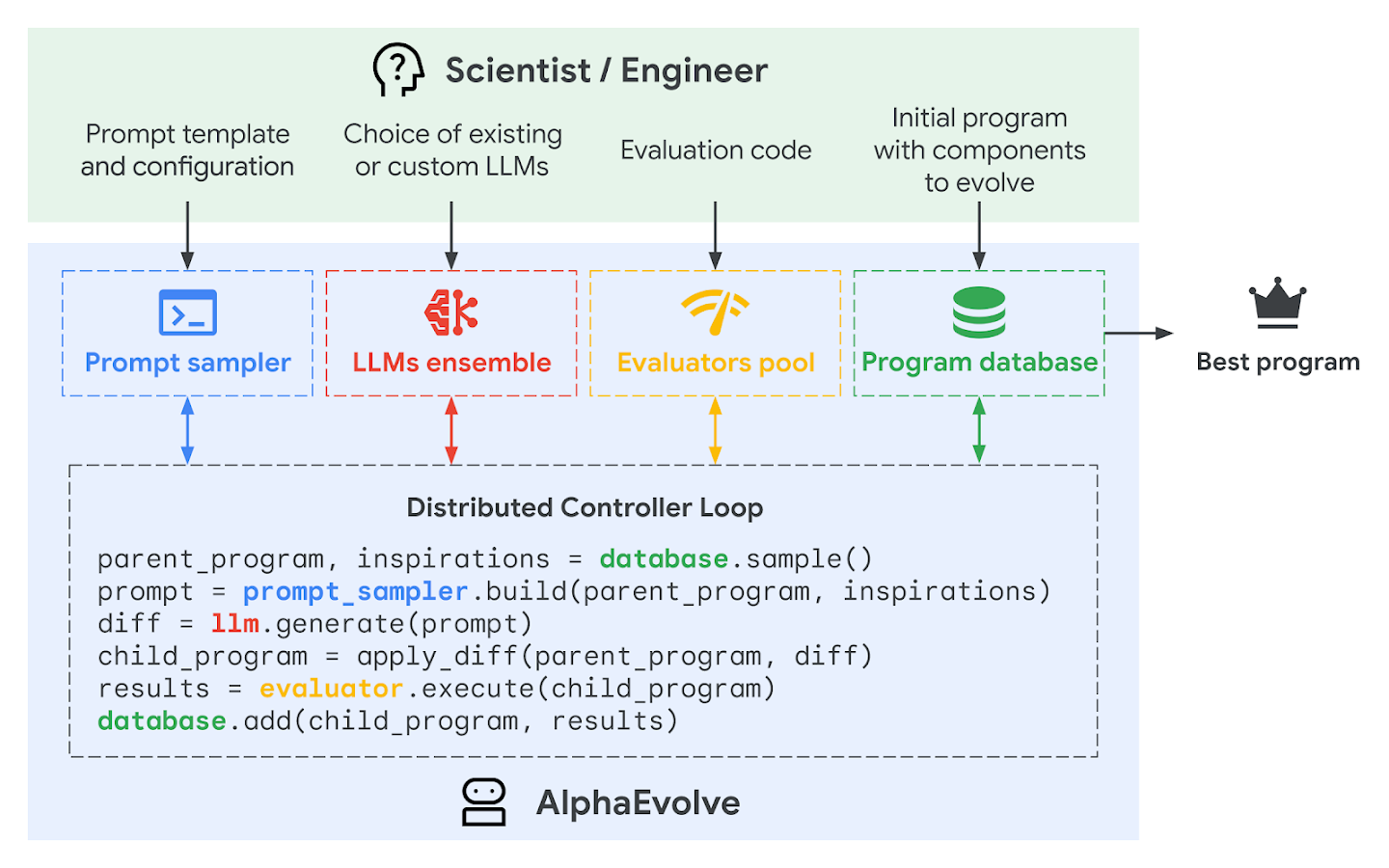
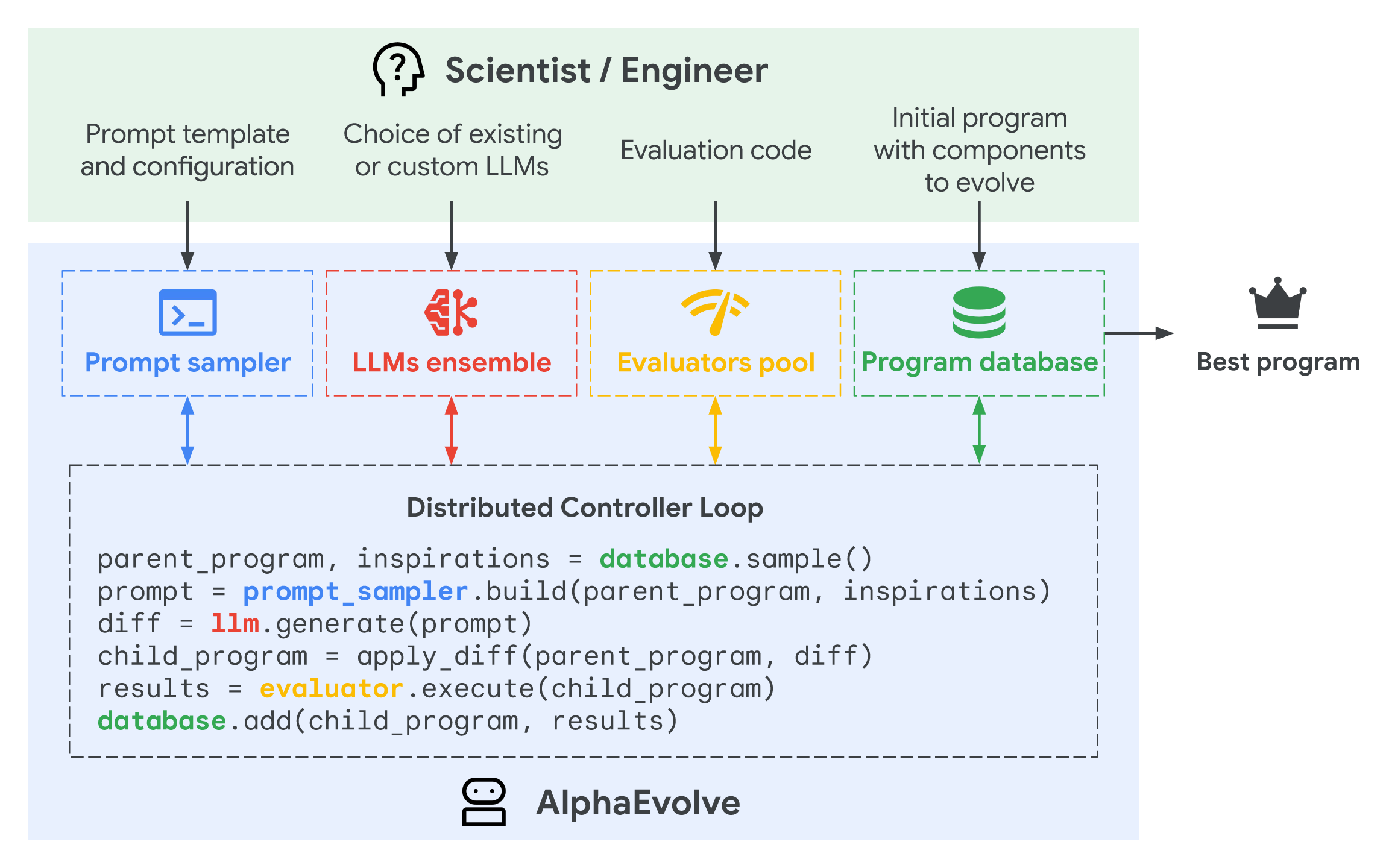
AlphaEvolve is an evolutionary coding agent powered by large language models — specifically, Google’s Gemini family. Unlike domain-specific predecessors such as AlphaFold (which predicts protein structures) or AlphaTensor (which optimizes matrix multiplication), AlphaEvolve is designed as a general-purpose system. It can operate across a wide array of scientific and engineering tasks by automatically modifying code, evaluating results, and iteratively improving upon the most promising solutions.
The architecture is elegantly simple yet profoundly powerful. AlphaEvolve leverages an ensemble of Gemini models: Gemini Flash maximizes the breadth of ideas explored by generating numerous creative variants, while Gemini Pro provides depth with insightful, carefully reasoned suggestions. Together, these models propose computer programs that implement algorithmic solutions as code. An automated evaluation framework then verifies, runs, and scores each proposal using objective metrics — dramatically reducing the hallucination risks that plague standard LLM outputs.
At each evolutionary step, the system produces variants of existing algorithms, selects the most effective ones, and iterates. It’s Darwinian evolution applied to code — survival of the fittest algorithm.
Self-Improvement: The AI That Trains Its Own Next Version
Perhaps the most mind-bending aspect of AlphaEvolve is its capacity for recursive self-improvement. The system has already been used to optimize Gemini’s own training pipeline — including the matrix multiplication kernels that are fundamental to how large language models process information. By finding smarter ways to divide large matrix operations into manageable subproblems, AlphaEvolve sped up a critical kernel in Gemini’s architecture by 23%, leading to a 1% reduction in total Gemini training time.
This creates a feedback loop of unprecedented nature: an AI system that improves the efficiency of the training process used to build the next version of itself. Each iteration produces a smarter model that can, in turn, find even better optimizations. It’s the technological equivalent of a runner who trains by inventing better training methods — and then uses those methods to become even faster.
Beyond matrix multiplication, AlphaEvolve achieved up to a 32.5% speedup for the FlashAttention kernel implementation in Transformer-based models. This is a domain so complex and heavily optimized by compilers that human engineers typically don’t modify it directly. The fact that an AI agent can find improvements here — where human experts have already squeezed out every obvious optimization — signals something profound about the trajectory of machine intelligence.
Real-World Impact: From Data Centers to Chip Design
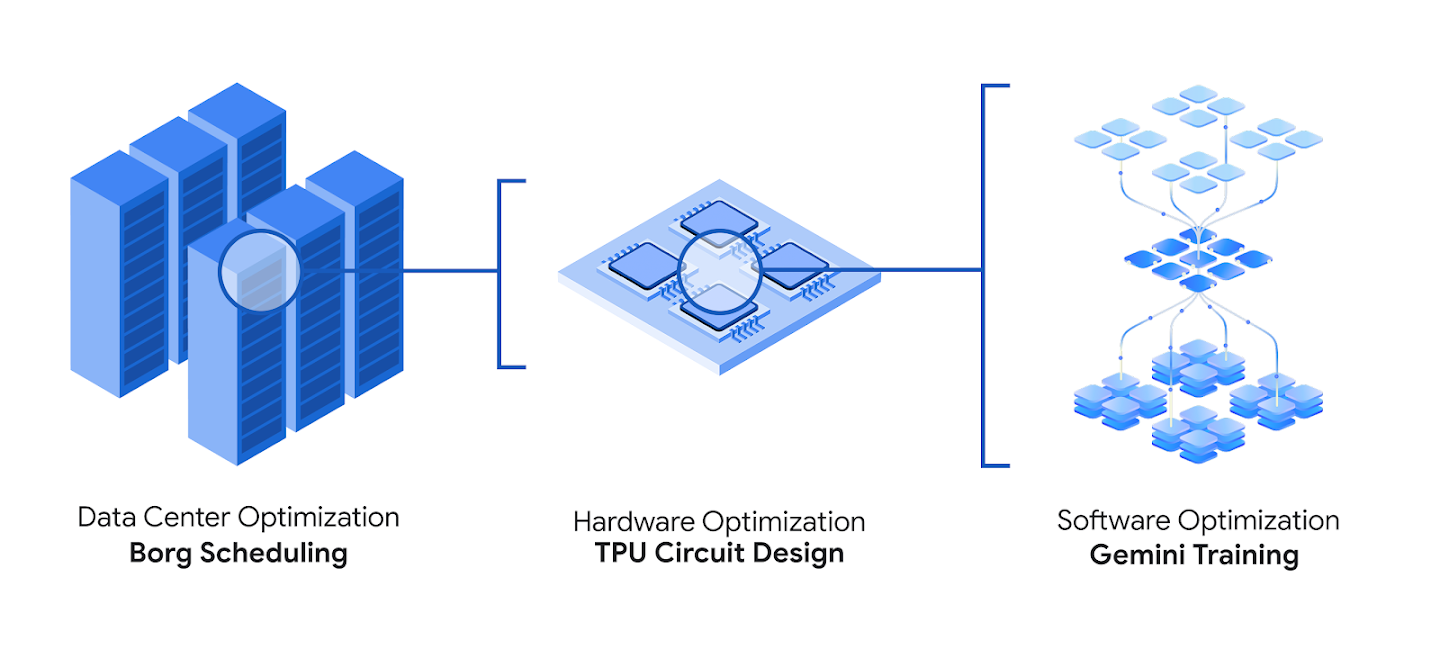
AlphaEvolve isn’t a laboratory curiosity. Over the past year, Google has deployed algorithms discovered by AlphaEvolve across its entire computing ecosystem:
- Data Center Scheduling: AlphaEvolve discovered a simple yet remarkably effective heuristic for Borg, Google’s cluster management system. This solution, now in production for over a year, continuously recovers an average of 0.7% of Google’s worldwide compute resources. At Google’s scale, that translates to an enormous amount of additional computing capacity — essentially getting a massive data center for free.
- Hardware Design: AlphaEvolve proposed a Verilog rewrite that removed unnecessary bits in a highly optimized arithmetic circuit for matrix multiplication. This proposal passed robust verification methods and was integrated into an upcoming Tensor Processing Unit (TPU) — Google’s custom AI accelerator chip.
- AI Training Optimization: Beyond the 23% kernel speedup mentioned above, AlphaEvolve significantly reduces the engineering time required for kernel optimization — from weeks of expert effort to days of automated experiments.
The implications are staggering. An AI system that can design better chips, optimize the data centers those chips run in, and improve the training of the AI models themselves creates a virtuous cycle of technological acceleration that no human team could match.
Breaking New Ground in Mathematics
AlphaEvolve’s capabilities extend well beyond engineering optimization. Google applied the system to over 50 open problems in mathematical analysis, geometry, combinatorics, and number theory. The results are nothing short of extraordinary:
- In roughly 75% of cases, AlphaEvolve rediscovered state-of-the-art solutions — matching the best known human answers.
- In 20% of cases, it actually improved upon the previously best known solutions, making genuine progress on open mathematical problems.
One standout achievement involves the kissing number problem, a centuries-old question in geometry that asks how many non-overlapping spheres can simultaneously touch a central sphere in n-dimensional space. AlphaEvolve discovered a configuration of 593 outer spheres and established a new lower bound in 11 dimensions — a feat that demonstrates the system’s ability to contribute to theoretical mathematics, not just applied engineering.
Even more impressively, AlphaEvolve designed a novel gradient-based optimization procedure that discovered a new algorithm for multiplying 4×4 complex-valued matrices using only 48 scalar multiplications — improving upon Strassen’s 1969 algorithm, which had held the record in this setting for over five decades. This finding surpassed AlphaTensor, DeepMind’s earlier specialized system, which could only find improvements for binary arithmetic in the same matrix size.
The Research Paradigm Shift: Humans as Navigators
One of the most fascinating implications of AlphaEvolve is how it transforms the scientific research process itself. The video that inspired this article paints a vivid picture of this future: researchers will work with a graph of exploration paths, where each node represents a research direction and each edge represents a possible technique or approach.
In this model, the human researcher’s role shifts from executing experiments to choosing directions. You start at a node and ask: “What if instead of this technique, we try that one? What if we use a different dataset? What if we train multilingual first, then specialize in Italian?” Each question opens a new path in the graph, and the AI autonomously explores it — running experiments, evaluating results, and reporting back.
This is already happening inside leading AI laboratories. It explains why model release cycles have compressed dramatically: from one model every six months, to every two months, to monthly, and now weekly. We are, as the video’s narrator puts it, on the vertical wall of the curve — the steep part of an exponential growth that, theoretically, could lead to superintelligence.
Google Cloud for Science: Democratizing AI-Driven Discovery
The accessibility of AlphaEvolve through Google Cloud represents another critical development. What was once an internal DeepMind tool is now available to researchers, companies, and institutions worldwide. This democratization means that the self-improving AI paradigm isn’t confined to a single lab with infinite resources — it’s becoming a platform.
In practical terms, Cloud-based access to AlphaEvolve enables:
- Drug Discovery: Pharmaceutical companies can use evolutionary algorithm discovery to identify novel molecular structures and optimize drug candidates orders of magnitude faster than traditional methods.
- Quantum Computing: Researchers can discover new error-correction patterns and optimize quantum algorithms, potentially accelerating the path to fault-tolerant quantum computing.
- Forecasting Models: Climate scientists, financial analysts, and logistics companies can evolve increasingly accurate predictive models tailored to their specific domains.
- Materials Science: The system can propose new composite materials with desired properties — stronger, lighter, more conductive — by evolving molecular arrangements.
The key insight is that AlphaEvolve’s general-purpose architecture means it can be applied to any domain where progress can be clearly and systematically measured. If you can define an evaluation function, AlphaEvolve can optimize against it.
The Chinese Parallel and Global AI Self-Improvement Race
The video also highlights an important global dimension. Chinese AI labs are independently developing similar self-evolving AI techniques, where an AI orchestrates and controls the training pipeline of other AI models. The central training experiment phase — traditionally the domain of human researchers — is being increasingly delegated to AI systems.
This parallel development suggests that self-improving AI isn’t a single company’s breakthrough but an emergent paradigm that multiple research communities are converging upon simultaneously. The competitive dynamics between Western and Chinese AI labs may accelerate this trend, as each side races to demonstrate capabilities that the other is also pursuing.
The open-source community has responded as well. Projects like OpenEvolve have implemented distributed evolutionary algorithms with multi-language LLM support, integration with various model providers, and automated discovery of high-performance GPU kernels that outperform expert-engineered baselines. This means that even organizations without Google’s resources can begin experimenting with evolutionary AI agents.
The Path to Superintelligence
Here’s where the conversation gets both exciting and unsettling. If an AI system can improve the algorithms that govern its own training, and each improvement makes the system better at finding further improvements, we enter a regime of recursive self-improvement. The theoretical trajectory from here is steep.
Current AI systems already beat humans in specific domains: chess, Go, protein folding, mathematical theorem proving. The gap between AI and human performance in general intelligence is narrowing. If self-improving systems like AlphaEvolve continue to compress the cycle of model development — from months to weeks to days — we approach what AI safety researchers call the intelligence explosion: a rapid, potentially discontinuous jump in AI capabilities.
Whether this leads to true superintelligence — an AI that surpasses human intelligence across every domain — remains an open question. But the building blocks are now visible. AlphaEvolve isn’t just a better algorithm; it’s a meta-algorithm — a system that improves algorithms, including potentially the algorithms that define its own intelligence.
Challenges and Ethical Considerations
Despite its transformative potential, AlphaEvolve raises significant challenges that the AI community must address:
Alignment and Control: As AI systems become capable of self-improvement, ensuring that their objectives remain aligned with human values becomes both more critical and more difficult. A system that can rewrite its own code has more avenues to drift from intended behavior.
Evaluation Integrity: AlphaEvolve’s reliability depends on the quality of its evaluation functions. If the metrics being optimized don’t perfectly capture what humans actually want, the system may optimize for the wrong things with increasing effectiveness.
Concentration of Power: The organizations with the most computing resources can run the most evolutionary cycles, potentially creating a feedback loop where the leading AI labs pull further ahead of everyone else. Democratization through cloud access and open-source implementations helps, but the raw compute advantage remains significant.
Verification: While AlphaEvolve’s automated evaluation reduces hallucination risks, the solutions it produces still require human oversight — especially in domains like hardware design or mathematical proofs where errors could have cascading consequences.
The Road Ahead
We stand at the beginning of what may be the most consequential technological transition since the invention of the computer. AlphaEvolve and systems like it represent a qualitative shift from AI as a tool to AI as a researcher — an entity that doesn’t just apply existing knowledge but generates new knowledge autonomously.
The laboratories already have such tools operating internally. The compressed release cycles of AI models — weekly rather than biannually — are the visible evidence of this shift. As these systems become more capable and more widely accessible, the pace of scientific and technological progress will likely accelerate beyond what most people currently imagine.
The question is no longer whether AI can improve itself. It can, and it does. The question is how we — as researchers, as societies, as a species — choose to navigate this transition. The graph of exploration paths stretches before us. It’s time to choose our direction.
What do you think about the self-improving AI revolution? Are we on the path to superintelligence, or are there limits we haven’t yet hit? The conversation is just beginning.