The Gaming World in July 2026: A Month of Record-Breaking Revenue, Massive Layoffs, and the Most Anticipated Release in History
July 19, 2026 — From Steam’s unprecedented $11.1 billion revenue milestone to Xbox’s brutal restructuring, from GTA 6 pre-orders finally going live to Capcom’s candid AI admissions, the gaming industry is experiencing its most turbulent and exciting summer in years.
If you stepped away from the gaming world for even a week this July, you missed an earthquake. The ground beneath the industry is shifting in ways that will define the next decade of interactive entertainment. Valve is shattering records while console makers bleed. Rockstar has finally opened the gates for Grand Theft Auto 6 pre-orders. Microsoft has gutted Xbox with 3,200 layoffs and four studio departures. Capcom is quietly admitting that generative AI is now part of its development pipeline. And through it all, Summer Games Done Quick raised another $2.4 million for charity, reminding everyone that gaming’s heart still beats strong.
This is not a slow news week. This is a tectonic moment. Let’s break down everything that matters right now in the world of video games.
GTA 6 Pre-Orders Are Finally Live — November 19 Can’t Come Soon Enough
After what feels like an eternity of trailers, leaks, delays, and speculation, Rockstar Games has finally opened pre-orders for Grand Theft Auto 6. The biggest entertainment release in history — and yes, that title is not hyperbole at this point — is set to launch on November 19, 2026, for Xbox Series X|S and PlayStation 5. The standard edition retails for $79.99/£69.99, and the Ultimate Edition comes in at $99.99/£89.99.
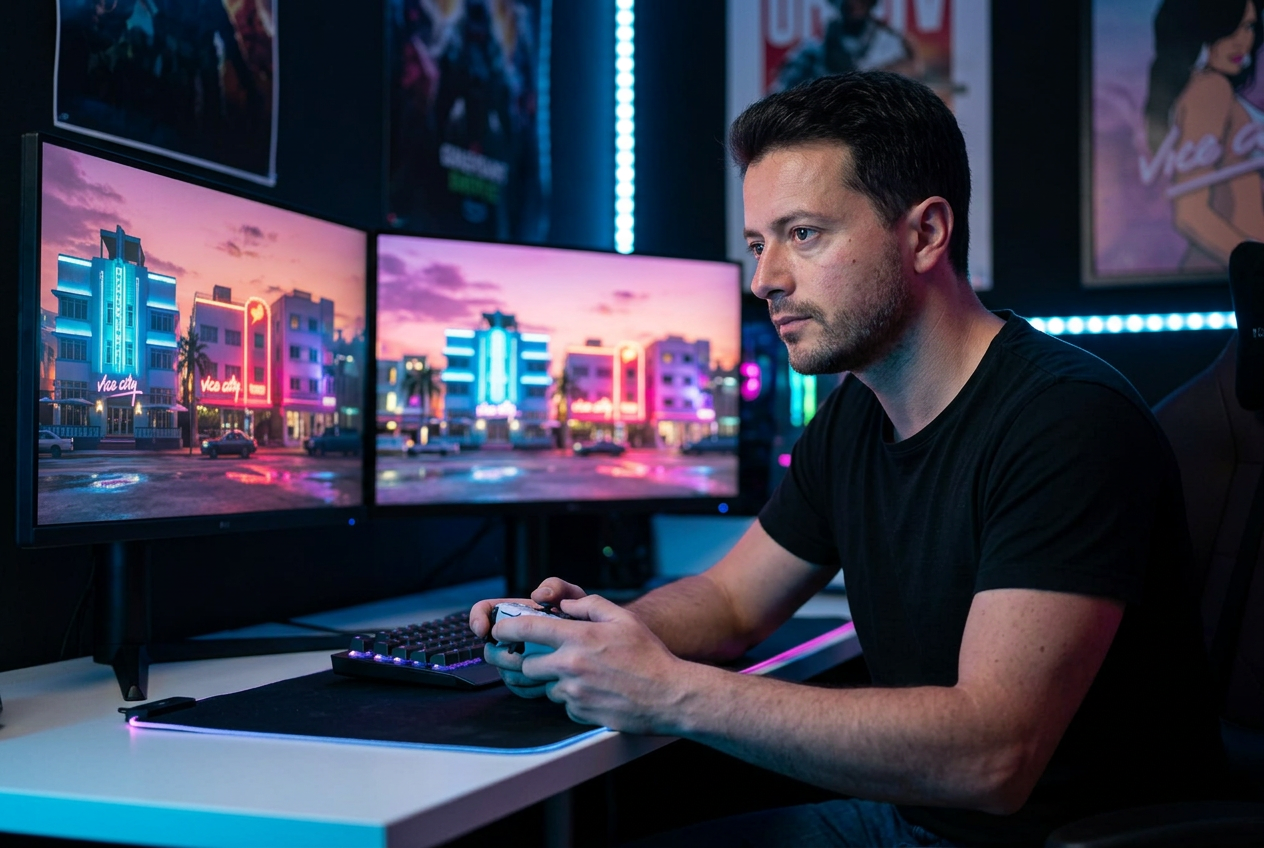
The road to this moment has been anything but smooth. The first trailer dropped in December 2023, promising a return to Vice City with dual protagonists Jason and Lucia. Originally targeting an Autumn 2025 release, Rockstar pushed the launch to May 2026, and then delayed it again to November. But now, with cover art revealed, pricing confirmed, and pre-order bonuses detailed, it finally feels real.
Rockstar is offering two main editions. The standard edition comes with the “Vintage Vice City” pack for anyone who pre-orders before November 20th. This bundle is a love letter to the original Grand Theft Auto: Vice City, featuring the timeless two-tone ’55 Vapid Stanier sedan, the Shore Court Garage, and a collection of neon-soaked outfits and hairstyles for both Jason and Lucia. There’s also an exclusive weapon pattern channeling Tommy Vercetti’s iconic palm tree aesthetic — a detail that will not be lost on anyone who grew up in the PS2 era.
The Ultimate Edition, however, is where things get extravagant. It includes a ’67 Vapid Dominator Buggy for off-road adventures, a ’95 Grotti Cheetah sports car, two exclusive vehicle mod shops (Rideout Customs in Vice City and One-Eyed Willie’s in Lake Leonida), a classic car collection with restoration quests, the Shitzu Squalo boat, personalized revolvers with palm-tree-etched grips, and an enormous selection of exclusive outfits, tattoos, and cosmetic options. Rockstar has also confirmed that physical editions will be essentially a code in a box — no disc — allegedly to prevent leaks. Physical buyers can pre-load the game starting November 12th, one week before launch.
Take-Two CEO Strauss Zelnick had previously shot down rumors of a digital-only release, and he was right — but the reality is that “physical” in this case means a box with a download code inside. Whether that counts as a true physical release is a debate for another day. What’s certain is that GTA 6 will be the single biggest entertainment launch in history, and the pre-order numbers — which Rockstar has not yet disclosed — will likely be staggering.
Steam’s Record-Breaking $11.1 Billion First Half of 2026
While console makers struggle, Valve’s Steam platform is thriving like never before. According to estimates by Alinea Analytics, Steam generated an extraordinary $11.1 billion in revenue during the first half of 2026 — its highest-ever result for that period, and a figure that surpasses even the game-heavy second half of 2025.
Rhys Elliott, head of market analysis at Alinea, noted that multiple factors are driving this growth: the massive expansion of the Chinese market (as of February 2025, 50% of all Steam accounts belonged to Chinese-speaking users), higher prices on new releases, and third-party publishers returning to Steam after abandoning their own launchers. The trend is unmistakable — over the past decade, Steam has nearly quintupled its revenue.
“Zoom out over the last decade and things get really crazy,” Elliott wrote on Alinea’s website. “There’s obviously a visible dip as the market normalised after the pandemic sugar-high, but the long arc is relentlessly up, with seven half-years of growth.”
The biggest revenue drivers on Steam this year have been remarkably diverse. Forza Horizon 6 raked in $197.7 million in under two months. Resident Evil Requiem managed $194.5 million since its February launch, with 3.4 million sales on Steam alone — and interestingly, $1.3 million of that came from a cosmetics pack, proving that the microtransaction model has found its way into even single-player horror games. Crimson Desert, Pearl Abyss’s new open-world franchise, pulled in $190 million since March, making it one of the most successful new IP launches in recent memory.
But perhaps the most encouraging sign for the industry is the performance of indie games. Slay the Spire 2 earned $141.7 million, Subnautica 2 brought in $133.6 million, and Meccha Chameleon generated $71.3 million. These are not established franchises with decades of brand recognition — they are independent creations that found massive audiences on Steam’s platform. In an industry increasingly dominated by blockbuster budgets and risk-averse sequels, the indie scene continues to prove that creativity still sells.
Xbox’s “Reset”: 3,200 Layoffs and Four Studio Departures
If Steam’s story is one of triumph, Xbox’s is one of reckoning. Microsoft has announced what it calls its “most significant” Xbox restructuring in history: 3,200 layoffs and the departure of four studios from its roster. Double Fine (Psychonauts), Compulsion Games (South of Midnight), Ninja Theory (Hellblade), and Undead Labs (State of Decay) are all leaving the Xbox family. Arkane Lyon, the studio behind Deathloop and Dishonored, is reportedly in talks for departure as well.
The studios aren’t necessarily closing. Double Fine and Compulsion Games will return to independent status, taking their IP and catalog with them. Ninja Theory and Undead Labs are joining new ownership with funding to complete their current projects — Senua: Hellblade III and State of Decay 3, respectively. Arkane is entering a consultation process to review strategic options.
Xbox leader Asha Sharma was brutally honest in her internal email, published on Xbox Wire. She described the Xbox business as “not healthy” and operating at margins three to 10 times lower than comparable platform and publishing businesses. She acknowledged that Xbox entered this generation with a smaller installed base and higher cost structure, and that the bets on Game Pass, multi-platform publishing, and a broader portfolio of content didn’t grow at the expected pace.
“History is full of companies that mistake longevity for inevitability,” Sharma wrote. “We will not be one of them.”
The scale of the restructuring reveals just how bloated Xbox had become. Sharma noted that work in some parts of the company passes through as many as 14 layers of management, and that platform teams are 40% larger than they were at the start of the generation, even as the player base and playtime have declined. The layoffs will remove 1,600 jobs immediately and another 1,600 over the course of fiscal year 2027. A chief operating officer position — never before existed at Xbox — will be filled by Helen Chiang, a 20-year Xbox veteran.
The human cost is devastating. These are people who poured years of their lives into building games that defined the Xbox brand. Sharma acknowledged this: “Today’s decisions do not reflect their talent or dedication.” But in a corporate environment where “we lost 64 cents for every dollar we invested” in studios, the math was always going to win eventually. The question now is whether a leaner, more focused Xbox can compete — or whether this is the beginning of a slow exit from the hardware business entirely.
PlayStation’s Troubles: No PC Ports, No Discs, No Goodwill
Microsoft isn’t the only console maker facing headwinds. PlayStation is having its own crisis of confidence. Sony has announced that it will not bring future single-player exclusives to PC — a reversal of the strategy that saw games like God of War, Spider-Man, and Horizon find new audiences on Steam. The decision closes off a significant revenue stream and frustrates PC players who had grown accustomed to eventually playing Sony’s first-party catalog.
More controversially, Sony has confirmed it will cease production of physical PlayStation game discs by 2028. The announcement has sparked outrage among collectors and physical media advocates, with a petition against the decision gaining significant traction. Combined with the broader industry’s shift toward digital-only distribution — exemplified by GTA 6’s “code in a box” physical edition — the era of the game disc is rapidly approaching its end.
Sony’s first-party sales have been declining since 2020, and the company is feeling the bite of increased hardware costs driven by what Eurogamer describes as an “AI-fueled RAM crisis.” The PS5 Pro, launched at a premium price point, has struggled to gain traction, and rumors of a PlayStation 6 remain speculative at best. Meanwhile, consumer sentiment towards both Sony and Microsoft has tanked, while Valve — a private company with no shareholders to please — continues to print money.
Capcom Addresses Generative AI: “A Certain Degree of Effectiveness”
Capcom has finally clarified its position on generative AI, and the statement is a carefully balanced one. In a recent investor Q&A, the company behind Resident Evil and Pragmata said its policy is “to improve the efficiency of routine operations so that our developers can devote more time to essential value creation.”
The key distinction Capcom drew is that creativity remains a human endeavor. “We believe that what games must deliver most is an experience that exceeds users’ expectations, and that the creativity at the core of such experiences should be handled by humans,” the company stated. However, it admitted that it is “actively incorporating [generative AI] into each stage of the development process and making concrete advancements to fully implement it for some parts of development.”
This is a more nuanced position than the extremes of the AI debate would suggest. Capcom is not replacing its creative teams with algorithms. It is using AI to handle the tedious, repetitive aspects of game development — the kind of work that eats hours without adding creative value. The company was careful to note that game development is “multifaceted and complex,” and that it will “take some time before we can quantitatively demonstrate the results of this improved development efficiency.”
The broader industry context is worth considering. A 2024 Unity report claimed 62% of studios using its tools used AI at some point during development, with animation being the top use case. A GDC survey from the same year found that roughly a third of industry workers used AI tools. By 2025, a Tokyo Game Show survey reported that over half of Japanese game companies were using AI in development. Epic Games CEO Tim Sweeney went so far as to say that AI disclosure requirements “make no sense” — comparing them to asking developers what shampoo they use.
Not everyone agrees. Konrad Tomaszkiewicz, game director of The Witcher 3 and co-director of Cyberpunk 2077, believes games made with AI “will have no soul.” Aloy actress Ashly Burch has acknowledged AI’s utility while insisting it should never replace human creativity. The debate is far from settled, but Capcom’s measured approach — AI for efficiency, humans for creativity — may become the industry’s de facto standard.
Resident Evil Requiem: Capcom’s Biggest Hit and the Future of the Franchise
Capcom has had an extraordinary 2026. Resident Evil Requiem, released in February, quickly became the fastest-selling entry in the series’ 30-plus-year history. By April, it had surpassed 7 million sales. On Steam alone, it generated $194.5 million in revenue. Eurogamer awarded it five stars, calling it “legendary horror at an all-time high.”
The game features series mainstay Leon Kennedy in a lead role, now in his early 50s but still capable of action heroics. Director Koshi Nakanishi told Eurogamer that Leon could remain a compelling character even at 70 — a statement that suggests Capcom has no intention of retiring its most iconic protagonist anytime soon.
But it’s the future of the franchise that has fans most intrigued. Producer Masato Kumazawa revealed that the development team has considered setting a future Resident Evil game in Japan — something that has never happened in the series’ history despite Capcom being a Japanese studio. “I think a Japanese setting is something every Japanese Resident Evil fan has thought about,” Kumazawa said. “Since the development team is primarily based in Japan, I think every member has given it some thought.” He added that while Japan hasn’t been a setting yet, “it might make an appearance at some point in the future.”
A story expansion for Resident Evil Requiem is already planned, and it may answer one of the game’s most discussed mysteries: who Leon is now married to. Capcom is playing coy, but director Nakanishi has promised “the answer will become clear some day.”
Crimson Desert: The New IP That’s Actually Working
Pearl Abyss’s Crimson Desert launched in March 2026 and has been a quiet sensation. With $190 million in revenue on Steam alone, it’s one of the most successful new IP launches in recent years — a rare win for a brand-new franchise in an industry increasingly dominated by sequels and remasters.
The game’s latest update, version 1.13.00, rolled out across all platforms in early July, adding substantial new content. Oongka and Damiane can now enter the Abyss — a previously restricted area — and the update adds 39 new pieces of equipment for Kliff and Oongka, including boss equipment from five new outfit sets. Damiane gets 8 new armor pieces, and there are new crafting recipes for carpets, plate armor, and more.
Quality of life improvements include the ability to hide the minimap and status HUD, a “Hunter’s Sigil” item that lets bird pets retrieve prey and gatherable items, and expanded dyeable equipment options. Summoned pets can now rest in bed alongside the player character — a small but charming detail that has delighted the community.
The update also addresses a long-running community complaint: missing outdoor furniture. For a game that prides itself on immersion and player expression, this fix is more significant than it might sound. Crimson Desert’s success proves that there’s still room in the market for ambitious new open-world franchises, even alongside titans like GTA 6.
Summer Games Done Quick 2026: $2.4 Million for Doctors Without Borders
In a week dominated by corporate restructuring and industry turmoil, Summer Games Done Quick 2026 provided a much-needed reminder of what makes gaming culture special. The annual speedrunning marathon, held in Minneapolis, raised $2.4 million (£1.8 million) for Doctors Without Borders / Médecins Sans Frontières.
Approximately 2,500 attendees joined in person, with thousands more watching via livestream. Standout runs included a world record-breaking Kirby Air Riders run by Bluekandy, a Balatro run that “beat all odds,” and an impromptu beatboxing session during the Resident Evil Requiem speedrun. The event also featured panels, community rooms for board games and music, a vendor’s alley with game-inspired artwork, and demo booths for upcoming titles.
Since 2010, Games Done Quick has collectively raised more than $62 million for charities worldwide, supporting organizations including Malala Fund, Organization for Autism Research, Prevent Cancer Foundation, and Doctors Without Borders. A short documentary about MSF’s humanitarian work in Gaza was shared with attendees, grounding the event’s charitable mission in real-world urgency.
SGDQ 2025 had raised a nearly identical $2,436,614, and Awesome Games Done Quick 2026 raised $2.44 million for Prevent Cancer Foundation earlier this year. The consistency of these figures, year after year, is a testament to the generosity and dedication of the speedrunning community — a corner of gaming culture that doesn’t always make headlines but consistently demonstrates the positive power of collective enthusiasm.
New Releases on the Horizon: Halo, Splatoon, and Marvel Tokon
The back half of July is bringing a wave of new releases that could shake up the charts. Halo: Campaign Evolved is set for July 23rd — a reimagining that has generated enormous discussion among Halo veterans. Splatoon Raiders arrives the same day, expanding Nintendo’s ink-splattering franchise into new territory. And on July 24th, Marvel Tokon: Fighting Souls enters the ring, bringing the Marvel universe into the fighting game genre.
These releases span three platforms (Xbox, Nintendo Switch 2, and multiple platforms respectively) and three completely different genres — a reminder that despite the industry’s consolidation and financial pressures, the actual output of creative games remains vibrant and diverse.
On the deals front, Humble Choice July 2026 is live, with Sea of Stars and Tunic leading a packed month of PC games. Sony’s Days of Play sale has returned for 2026 with surprisingly good deals, and Prime Day component sales have made it possible to build an entire gaming PC from discounted parts — a rare bright spot in an era of inflated hardware costs.
The Big Picture: An Industry in Transition
Step back and look at the trends, and a clear picture emerges. The PC gaming market, led by Steam, is consolidating its position as the dominant platform for game distribution and revenue. Console makers are facing a convergence of crises: rising hardware costs, declining first-party sales, physical media dying, and consumer backlash against platform exclusivity. The studio system is fracturing — Microsoft is shedding studios, and the indie scene is producing million-dollar hits that rival AAA budgets in revenue.
Generative AI is quietly embedding itself into development pipelines across the industry, with companies like Capcom adopting pragmatic positions that balance efficiency gains with human creativity. Meanwhile, the charitable side of gaming culture continues to thrive, with SGDQ’s $2.4 million raising serving as a counterpoint to the narrative of a purely profit-driven industry.
And looming over everything is GTA 6. When it launches on November 19th, it will not just be a game release — it will be a cultural event that defines the holiday season and likely breaks every entertainment sales record in existence. The industry that receives it will look very different from the one that celebrated GTA V’s release in 2013. But the core of what makes games matter — creativity, community, and the desire to experience something extraordinary — remains intact.
July 2026 will be remembered as the month when the old order began to crack and the new one started to take shape. The question now is what that new order will look like — and who will be left standing when the dust settles.
For more gaming news, reviews, and analysis, stay tuned to ruocco.it.