Published: November 13, 2026 | By Vito Ruocco
Google just released Gemini 4 Hydrogen, its new fast model, and says it scores higher than its own bigger model, Gemini 4 Argon, while costing a quarter less per token. That is a big claim for a cheap model. So instead of repeating it, I gave Hydrogen the exact six prompts that Gemini 4 Argon, Claude Opus 5.5 and GPT-6.1 Sol had already built for my channel, word for word, and I kept the real bill. The result surprised me: cheaper per token did not mean cheaper per build.
It was also one of those news days that nobody saw coming. Jensen Huang resigned as CEO of Nvidia, effective immediately. On the same day, a former OpenAI researcher published a report claiming that six Chinese open models carry the fingerprint of export-controlled Nvidia Blackwell chips. And Anthropic, a few days before its shares go on sale, told future investors in writing that it may choose to go slower than it could. Below I go through each story using the primary documents, and then the full four-way test, with every build playable in your browser.
The Short Version
- Gemini 4 Hydrogen launched on November 12, 2026 at $1.50 per million input tokens and $7.50 per million output tokens. Google says it scores 51 on the Artificial Analysis Intelligence Index at its default setting, one point above Gemini 4 Argon, and 54 at the new “xhigh” setting.
- Our test: the same six creative-coding prompts that Argon, Opus 5.5 and Sol already built. On its default “high” level, all six of Hydrogen’s builds ran without a page error. One of them, a short film, showed only a black screen until I added one line of code. The 3D car was the weakest build.
- The bill: Hydrogen cost $1.75 for the six builds, Argon $1.52, Opus 5.5 $2.70 and GPT-6.1 Sol $0.77. Hydrogen wrote about 53% more output tokens than Argon, which more than ate its lower price per token.
- Speed: Hydrogen was not faster in this test: about 27 minutes in total, against about 23 for Argon, 21 for Opus and 26 for Sol.
- xhigh: all six xhigh runs stopped at 65,536 output tokens, the limit of the OpenRouter route the requests were sent to. Three had already finished the file and kept writing notes to themselves. Three were cut off mid-file. That cost $2.95 for two working builds.
- Nvidia: the company’s own announcement says Jensen Huang resigned as President, CEO and board member, effective immediately, with CFO Colette Kress as interim CEO. It gives no reason.
- Blackwell fingerprints: Will DePue’s report claims six open models from DeepSeek, Moonshot, MiniMax and Ant Group match Blackwell hardware. By the author’s own words, it does not show where the chips were, who owned them, or that any law was broken. There is no evidence it is connected to the Nvidia news.
- Anthropic: the founders’ letter for the IPO says there “may be times when we choose to advance more slowly than we could in order to make our systems safer, even if that puts us at a competitive disadvantage.”
Nvidia: What the Announcement Says, and What It Doesn’t
The most important thing about this story is to start from the document, not from the rumors. Nvidia’s own press release of November 12, 2026, the same text it filed with the market regulator, says the board announced that Jensen Huang has resigned as President, Chief Executive Officer and member of the board, effective immediately. Colette Kress, Nvidia’s Executive Vice President and Chief Financial Officer since 2013, has agreed to serve as interim CEO while keeping her finance role. The board is searching for a permanent CEO and will consider internal and external candidates. And Harvey C. Jones, a former CEO and executive chairman of Synopsys, has been appointed as the first-ever Chair of the Board in Nvidia’s history.
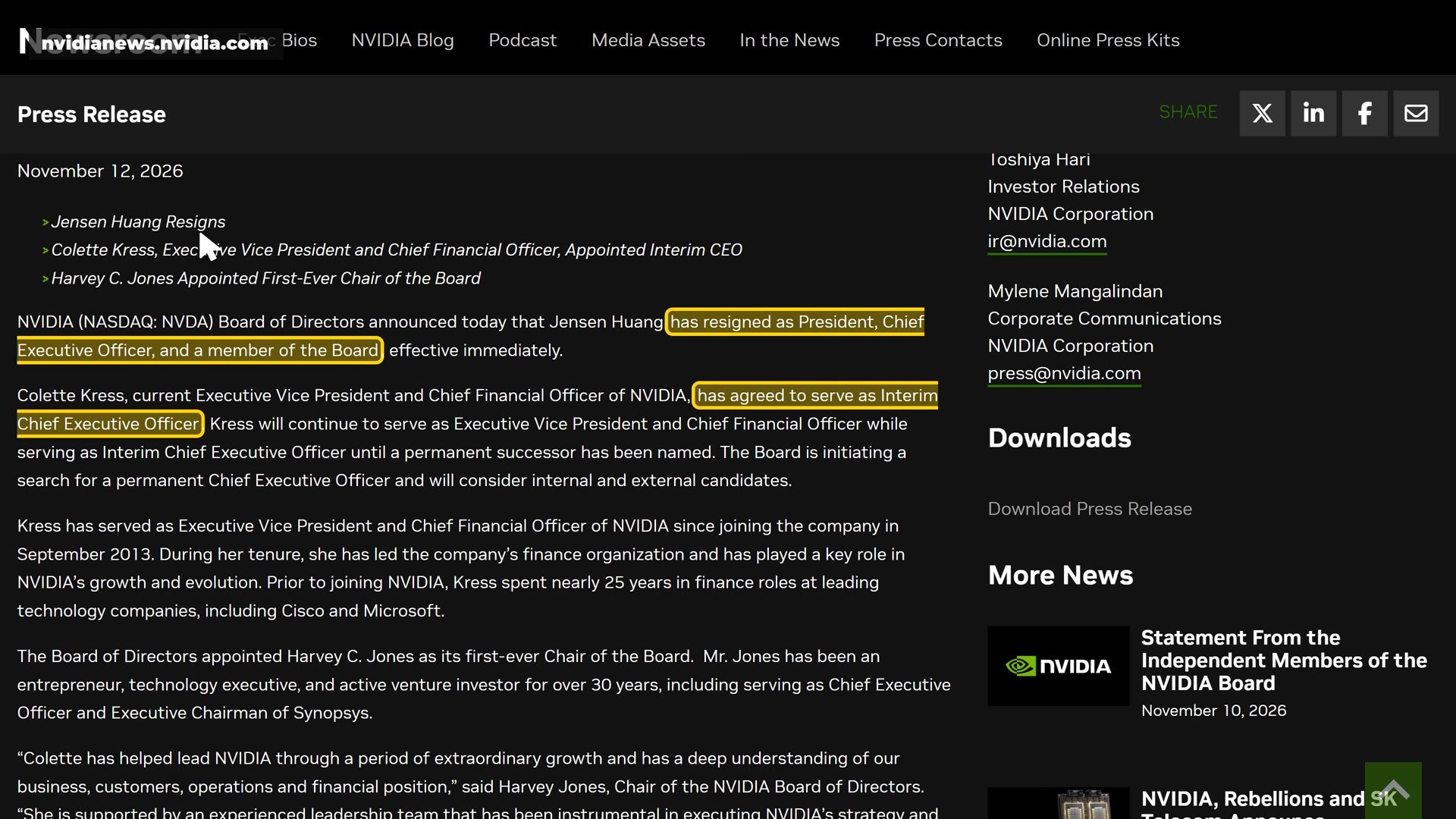
Now read what the announcement does not say. It gives no reason. It thanks Jensen for 33 years and calls his contributions “profound”. That is all. The reasons you have seen online come from reporting, mainly by Reuters and the New York Times, about his private life and about national security questions that the board says it is investigating. Huang has publicly apologized to his family and to Nvidia’s employees. Nvidia has said it has no reason to believe national security was compromised, and earlier in the week the board opened an independent investigation. So the facts we can stand on are simple: he is out, nobody official has said why, and the investigation is still open.
Why should anyone who does not own a single Nvidia share care? Because almost every model I test on this channel, from Google, OpenAI and Anthropic, was trained or is served on hardware where Nvidia is the reference. Nvidia reports its quarterly results on November 17, five days after the announcement, and that call will be the first time the new leadership speaks to the market.
Blackwell “Fingerprints” in Six Chinese Open Models
On the same day, Will DePue, a former OpenAI researcher, published a report through a small lab called Unemployment Labs. Its title says that top Chinese frontier models carry the fingerprint of export-controlled Nvidia Blackwell GPUs. I want to be very clear: there is no evidence that this report has anything to do with Jensen Huang’s resignation, and the report itself does not claim that. They just happened on the same day.
How the fingerprint works, in plain words
Before a model learns anything, it starts as billions of random numbers. Those numbers come from a seed, a starting number, and from the chip that rolls them. Here is the image I used in the video: think of a card-shuffling machine. Give two different brands of machine the same deck and the same instructions, and each brand still lays the cards out in its own order. If you find a deck that is still in that exact order, you can tell which machine shuffled it.
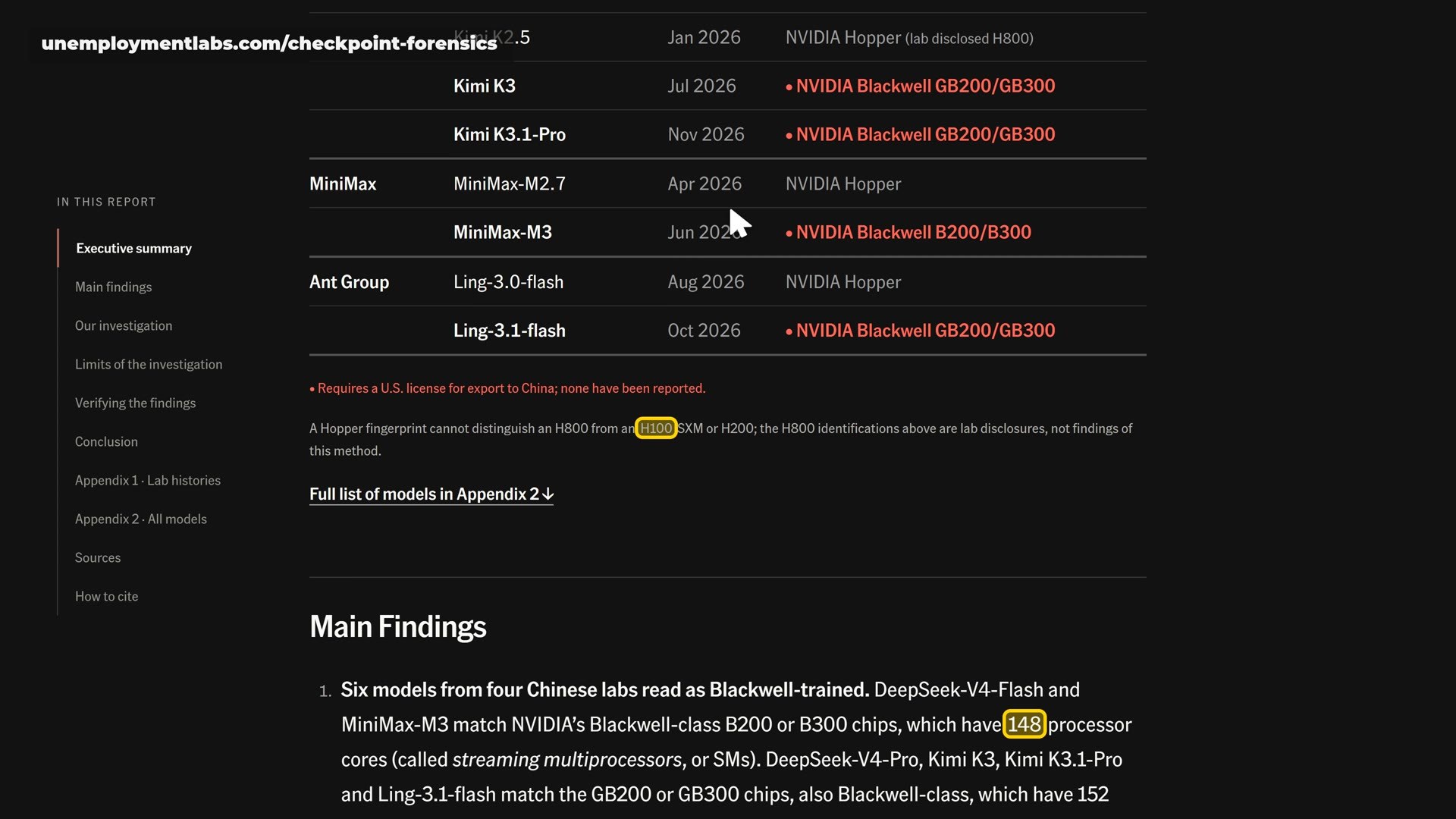
Training changes most of those starting numbers, but not all of them. Some survive in the published files. DePue searched for the seed and the chip layout that reproduce those surviving numbers, and the chip layout points to a family of chips. Nvidia’s older Hopper chips have 132 processing blocks; the Blackwell chips have 148 or 152.
What he found, and how he checked it
His result is that six open models from four Chinese labs match Blackwell: DeepSeek V4 Flash and V4 Pro, Kimi K3 and K3.1 Pro from Moonshot, MiniMax M3, and Ling 3.1 Flash from Ant Group. Then he tested it on real hardware. On a rented Blackwell B300, unmodified PyTorch reproduced 461 of 469 selected rows of DeepSeek V4 Flash, 445 of them bit for bit. On a rented GB200, it reproduced all 13 surviving rows of Kimi K3. And an older H100 reproduced DeepSeek V3, the older model, but not V4 Flash.
The part I find most interesting is the timeline at the end of the report. For each lab, the earlier models match Nvidia’s older Hopper generation. The newer ones, released since April 2026, match Blackwell. So the report is not really about one model. It describes a change of hardware that happened, according to these numbers, in the same few months at four different labs.
The limits, in the author’s own words
This is the part most headlines skip. The fingerprint shows the hardware that created the starting numbers, not every chip that trained the model. The author writes that it “supports, without proving” that Blackwell also did the training. It does not show where the chips were located, who owned them, or how access was obtained; Blackwell servers can be rented in data centers outside China. And the report says its export-status flags are “not a finding that any law was broken”. So the honest headline is this: there is now a public, repeatable method to see which chip family started an open model. What it means legally is a question for regulators.
Anthropic’s IPO and the Founders’ Letter
Anthropic launched its investor roadshow on November 10. The price range is $70 to $78 per share, the company will list on the Nasdaq under the ticker ANT, the price is set on November 18, and trading is expected to start on November 19.
Every company that goes public writes a letter to its future investors. Anthropic’s is signed by all seven co-founders and published as a PDF on its official IPO site. Most of it is what you would expect: AI is on an exponential curve, the opportunity is enormous, the company needs to invest aggressively, and AI could help with diseases like cancer and Alzheimer’s. But there is one paragraph I have never seen in an IPO letter.
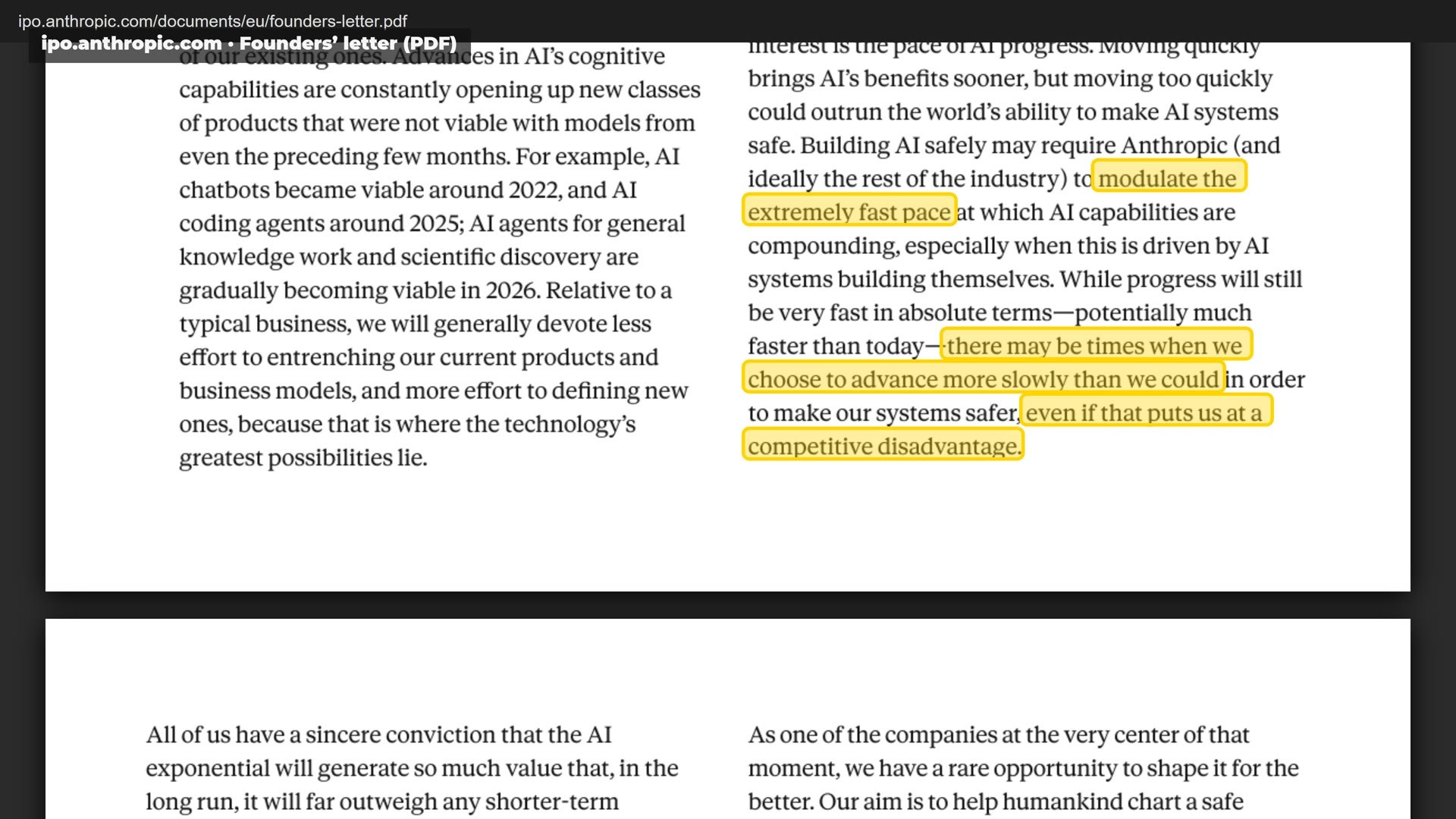
The founders write that building AI safely may require Anthropic, and ideally the rest of the industry, to modulate the extremely fast pace at which AI capabilities are compounding, especially when AI systems are building themselves. And then: “there may be times when we choose to advance more slowly than we could in order to make our systems safer, even if that puts us at a competitive disadvantage.”
Think about who that sentence is written for. It is addressed to people who are about to buy the stock, and it tells them in advance that the company may leave money on the table on purpose. You can read it as sincere, or as a smart thing to say before going public, and both readings are fair. What matters is that it is now in writing, in front of investors, so it can be checked against what Anthropic actually does next.
The same letter says Claude will not carry advertising, because ads push a product to chase engagement, and that all seven co-founders have pledged to donate 80% of their personal equity in Anthropic to charitable causes. The filing also says the company contributed 5% of its fully diluted shares to a fund for its public benefit work. The numbers investors will look at first: revenue of $17.0 billion for the three months to September 30, 2026, against under $200 million for a quarter at the end of 2024, and more than 11,900 customers paying at least $100,000 a year, up from more than 950 a year earlier.
Claude Meetings, in Beta
One more Anthropic launch, and this one you can use. Claude Meetings is now in beta. Claude joins a Google Meet call as a visible participant, follows the conversation, answers questions, and builds documents and whiteboards while the meeting is still going, so everyone can see the draft and correct it. After the call, the notes, action items, transcript and everything Claude made are on one meeting page in Claude.
Two details I like. It saves a transcript, a summary and screen descriptions, not the audio. And by default Claude stays out of calls that include people from outside your organization, and leaves if one joins later, unless an admin allows it. It starts on the Team and Enterprise plans, Google Meet first, with other platforms later.
OpenAI’s Cyber Models: Published vs Reported
On November 12, OpenAI held a livestream called Cyber at the Frontier. People who watched it reported that OpenAI showed an unreleased internal security model at around 77% on ExploitGym, a benchmark that asks an AI agent to turn known software bugs into working attacks in a test lab. I could not find that number on OpenAI’s own pages, so I treat it as reported, not confirmed.
What is published is the number for the model OpenAI already released, GPT-6 Cyber: 48.5% on ExploitGym, up from 32.1% for the previous version. That model is only given to vetted security teams. Whatever the exact figure for the next one turns out to be, the direction is clear: these security models are improving quickly from one release to the next, and the same skill that helps defenders fix a bug can help attackers use it. That is why access is gated.
Seedance 2.5 Flash
ByteDance’s Seedance 2.5 Flash is a faster, cheaper version of its Seedance 2.5 video model. ByteDance says it keeps quality close to the full model while generating about twice as fast, at 480p or 720p. It starts on ByteDance’s own apps, and the prices quoted online still disagree with each other, so I am not quoting one.
Gemini 4 Hydrogen: What Google Announced
Google calls Gemini 4 Hydrogen its “daily driver for agentic workflows”. Google now has three Gemini 4 models: Carbon and Argon are the big ones, for long, deep reasoning, and Hydrogen is the fast one, for the work you do fifty times a day.
The claim that made me want to test it is about intelligence. On the Artificial Analysis Intelligence Index, a score that mixes many tests, Google says Hydrogen scores 51 at its default setting, one point above Argon’s 50, and reaches 54 at its new highest setting, xhigh. Artificial Analysis is a separate company, and its own site already lists Hydrogen at all four thinking levels, so this is a score you can check yourself.
The price is $1.50 per million input tokens and $7.50 per million output tokens, flat across the full one-million-token context window. Argon costs $2 and $10. So on paper Hydrogen is a quarter cheaper per token and, according to Google, smarter.
Against the previous fast model, Gemini 3.8 Flash, Google says Hydrogen finishes tasks 2.5 times faster and cuts fabricated claims by more than five times. On Terminal-Bench 4.1, a test where the model works in a real command line, it goes from 18.2% to 57%. Google also says it is number one on Vals’ tax agent benchmark and tied for first on legal research. These are Google’s own numbers, from Google’s own page, and a company grading its own model is not the same as a test you can repeat.
There are four thinking levels: low, medium, high (the default) and the new xhigh. Think of it as how long the model is allowed to think before it answers. More thinking usually means better answers, more tokens and a bigger bill. There is also a feature in Antigravity, Google’s coding tool, called Orchestrator: Carbon plans while Hydrogen does the hands-on work. Google says that on a terminal test this pairing got close to Carbon alone while using 24% less quota and finishing 19% faster. That is the smart part of the launch: you don’t pay big-model prices for small-model jobs.
Hydrogen is in the Gemini app, in Google Search for everyone, in AI Studio and the API for developers, and in Antigravity for paid plans. For my test I used OpenRouter, which sells the same model at the same price. One detail matters later: OpenRouter has several routes to this model, and not all of them allow the same amount of output in one answer. Some allow 65,536 tokens, some much more.
The Test: Same Six Prompts, Four Models
Here are the rules, so you can judge the result. Six prompts: a life animation, a voxel castle, a short film, a 3D car showroom, a driving game and a music studio, each to be delivered as one self-contained HTML file. Gemini 4 Argon, Claude Opus 5.5 and GPT-6.1 Sol got these exact prompts weeks ago, and I reused their files without touching them. Hydrogen got the same text, read byte for byte from the earlier runs, through OpenRouter, one request each, on its default thinking level, high.
One note to be fair: Argon ran on its lowest thinking level back then, Opus 5.5 on low and Sol on medium. So on paper Hydrogen had the advantage of thinking more. And this is one sample per build: a comparison you can click through, not a benchmark.
1. The life animation
Hydrogen called it Every Frame, a sixty-second paper-cut film of one human life. Press play and you get a cradle with a mobile, a child at a blackboard, a young adult working late at a desk, autumn, and an old woman in an armchair by the window. Drag the scrubber and every chapter is there, in order, with music synthesised in the browser. It ran first time, no errors. Argon made the same paper style with more characters in each scene, Opus changes the whole color of the sky with every age, and Sol’s has the most detail in its rooms. Four good films; Hydrogen’s is the simplest of the four, but it is clean and it works.
2. The voxel castle
This is the heaviest prompt: thousands of blocks, a day and night cycle and a flying camera. Hydrogen’s castle opens at golden hour, and it opens far too dark: you see silhouettes and a few lit windows. Turn on the cinematic fly-around and move the time towards midday, and the castle appears, with towers, a harbour and lit windows. It works, but the first impression is weak. Opus’s castle on its lake is still the one to beat, bright and full of detail, and Sol’s floats in a soft morning mist. Argon’s, like Hydrogen’s, starts in the dark.
3. The short film: a black screen, and one line of code
This is where it gets interesting. Hydrogen’s film, exactly as it wrote it, plays the title and then shows a black screen with film grain for the rest of the film. The music plays; you see nothing.
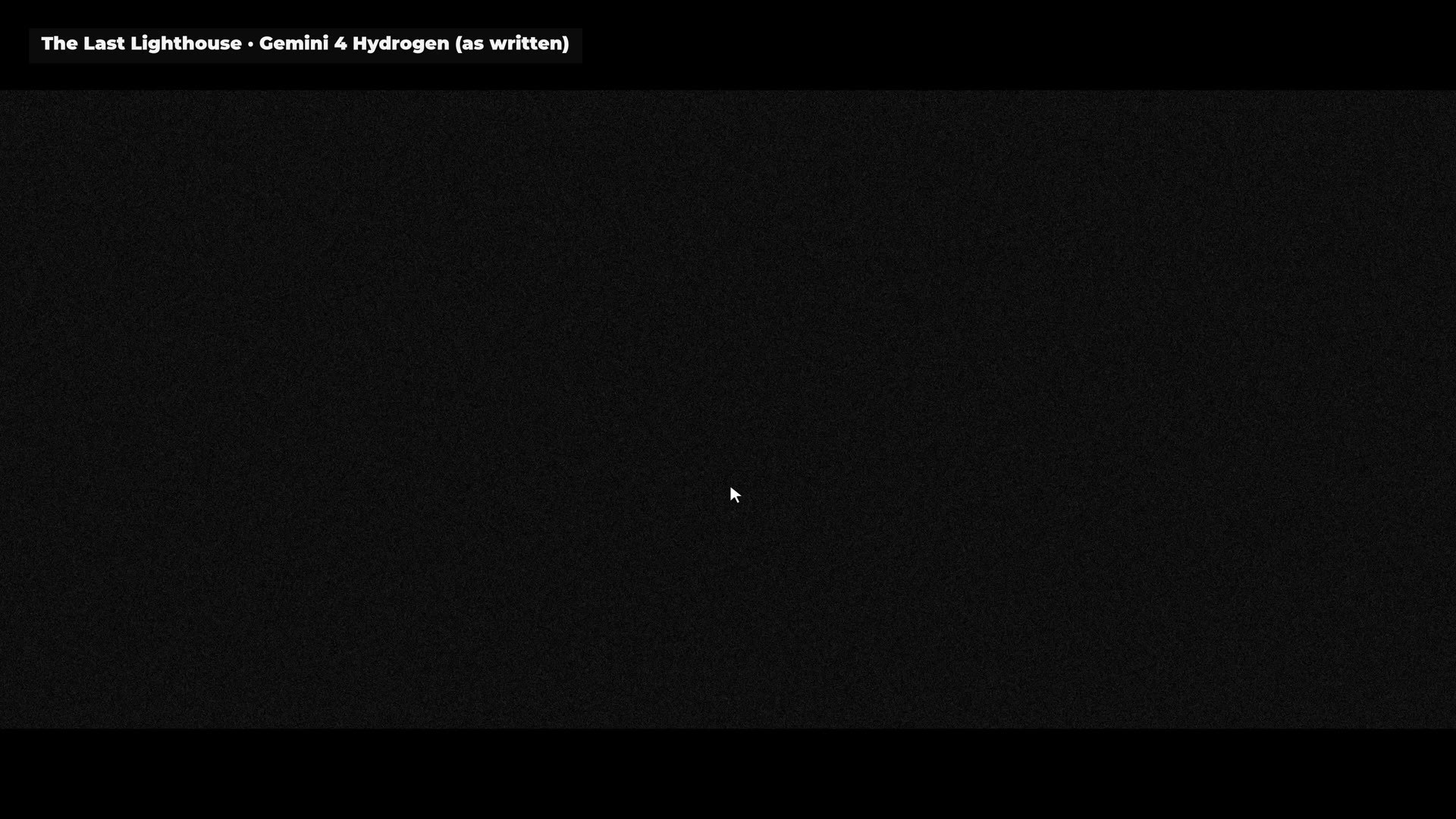
I looked at the code, and the reason is one line. The film sends the rendered scene through a depth-of-field filter, a three.js ShaderPass. ShaderPass copies the uniforms it receives, and a render-target texture cannot be copied that way, so the filter receives an empty picture. I added one line, marked in the file, that hands the picture to the filter directly.
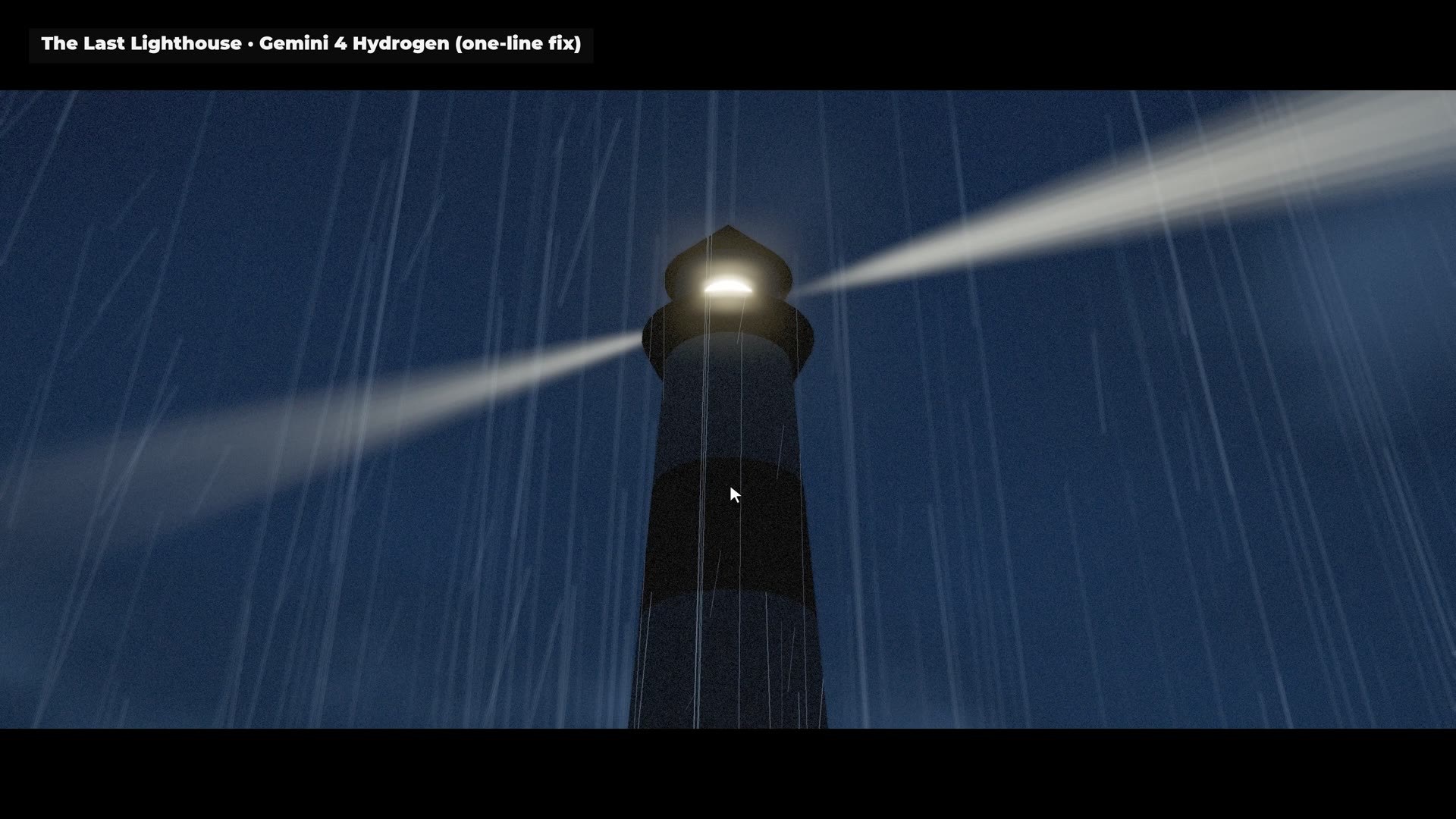
The difference is huge: rain, a storm sea, the lighthouse sweeping its beam, a little red boat with lit windows, and real depth of field. With that one line, I think this is the best-looking film of the four. But as written it is a black screen, and that counts. For comparison, Argon’s film also needed a one-character fix and still shows black boxes over the scene, Opus’s needed a one-line fix, and Sol’s ran first time. A second detail: on this prompt Hydrogen wrote the whole file, then a stray code fence and some notes, and then a second full copy of the file. The published version is the text up to the first closing html tag, and those extra tokens are part of the bill.
4. The car showroom
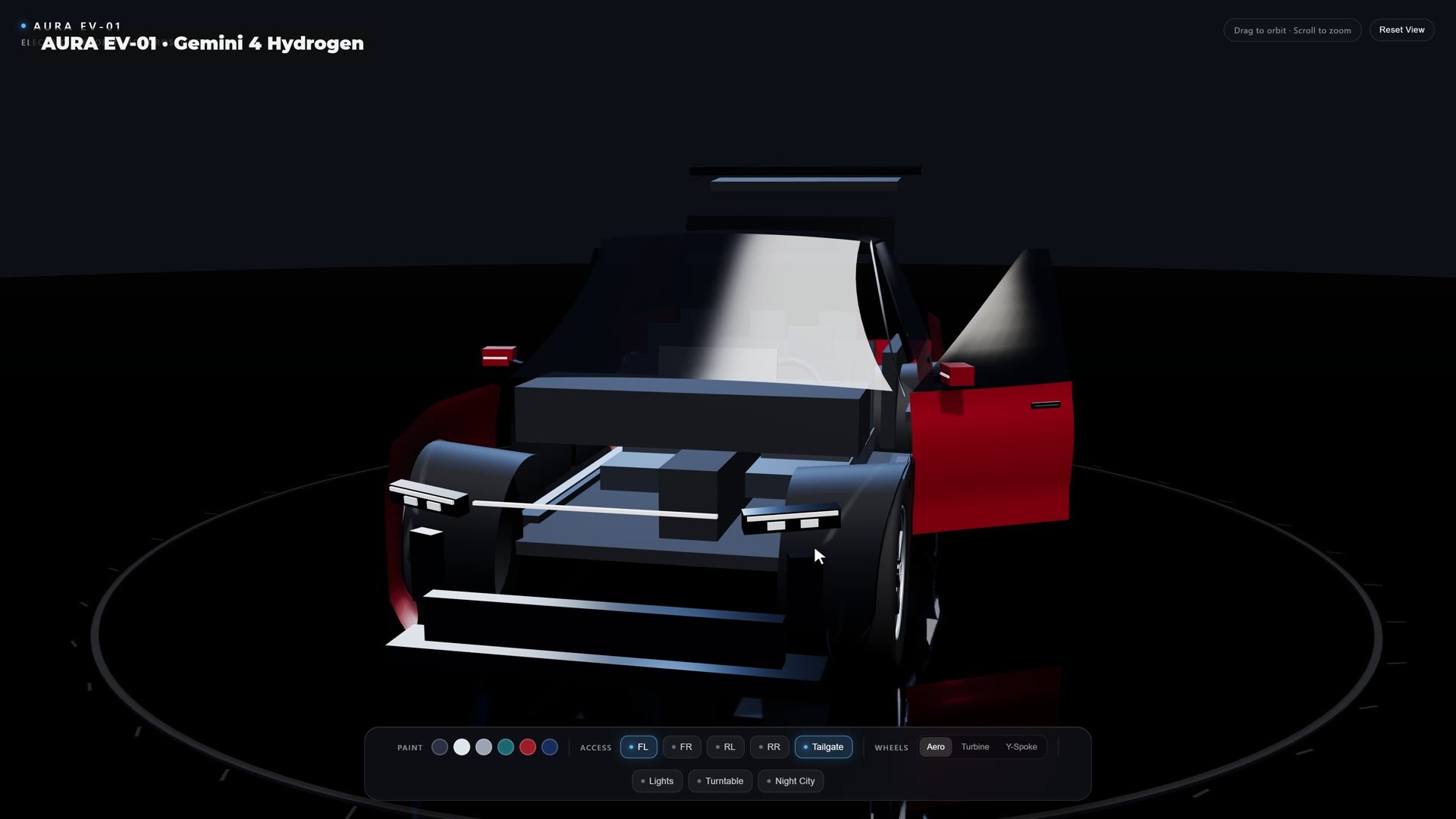
This is Hydrogen’s weakest build. Every control works: red paint, the doors and the tailgate open, the lights turn on, the turntable spins. But the body panels don’t fit together: the bonnet is missing, the front sits apart from the car, and the paint only reaches some of the panels. Argon’s, Opus’s and Sol’s cars all look like cars. This one looks like a car in pieces.
5. The driving game
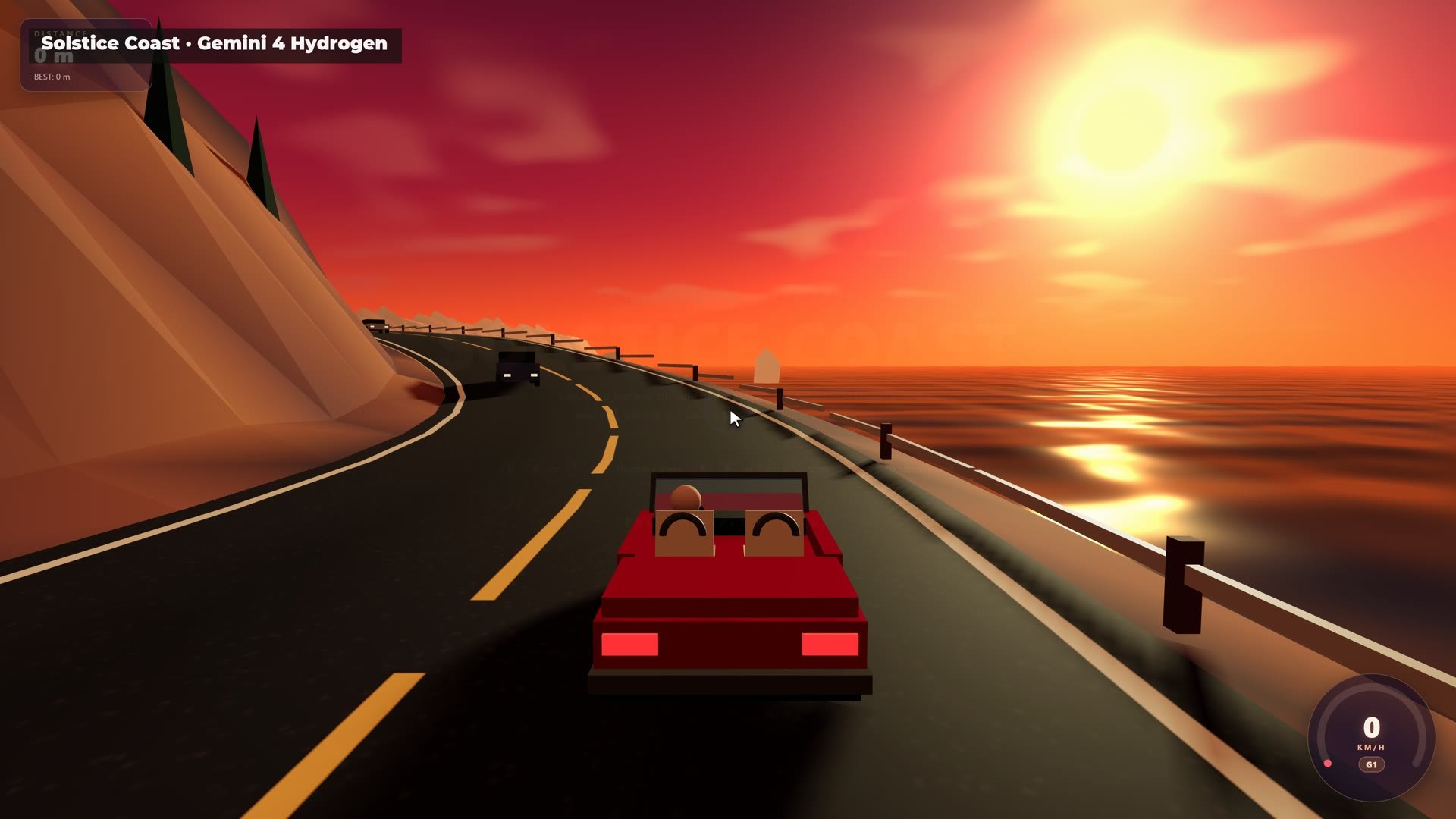
Hydrogen called it Solstice Coast, and it is good: a red convertible on a cliff road at sunset, the sun on the sea, a round speedometer. Press a key, accelerate, take the curve, and when you go too fast into the cliff, a Wrecked screen shows the distance and the top speed. All four driving games work, and this is a category where Hydrogen is right there with the others. If I wanted a minute of play, Solstice Coast has the best sunset.
6. The music studio
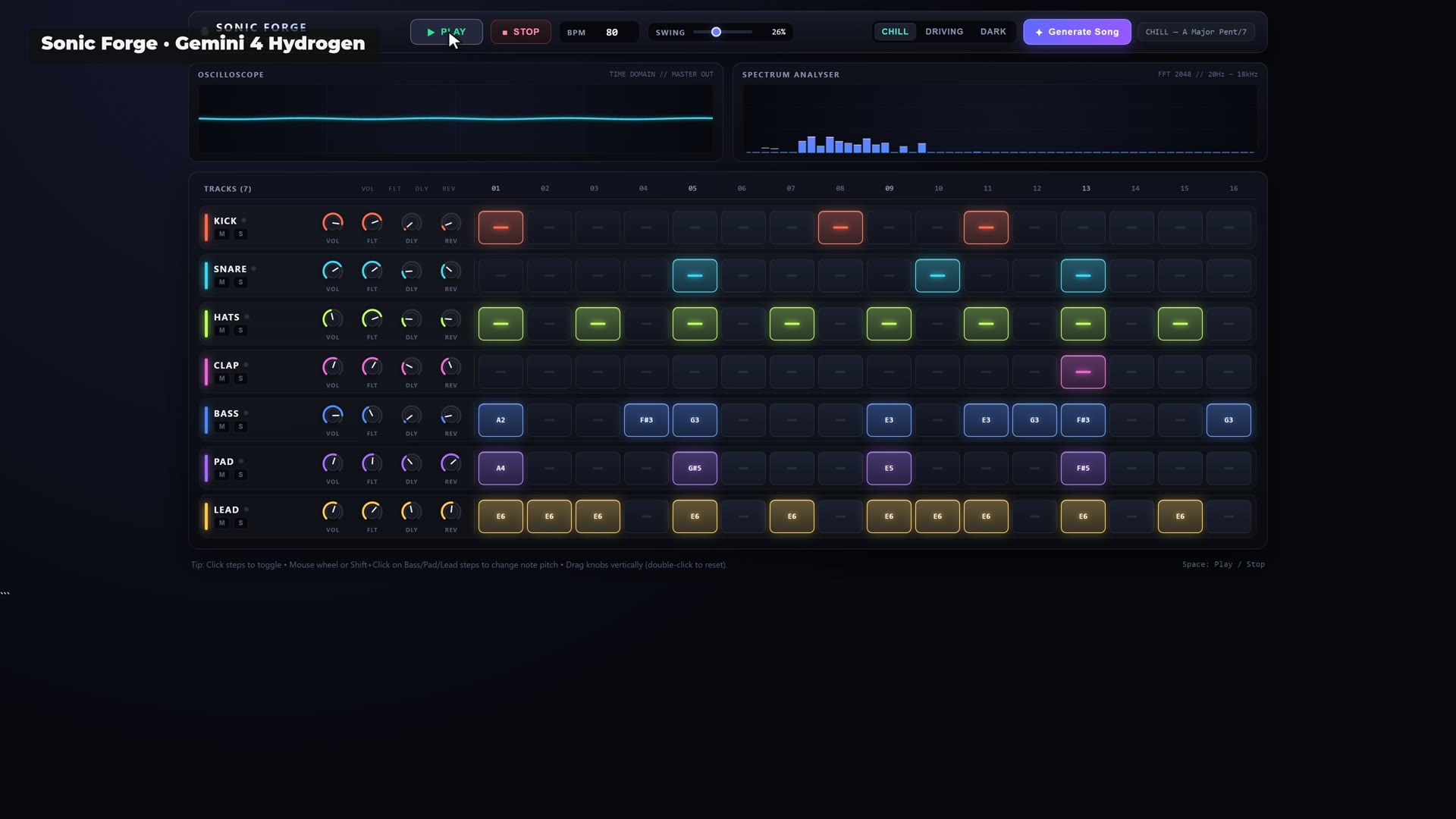
Hydrogen’s Sonic Forge has seven tracks, knobs on each one, a live oscilloscope and spectrum, and three moods. Press generate, then play, and the bars move with the sound; switch to the dark mood and the pattern changes. This is a hard prompt, because it needs real audio code, and Hydrogen got it right first time, like the other three.
The xhigh Experiment: Every Run Hit the Output Limit
I also ran the same six prompts on the new xhigh level. In every single run, Hydrogen wrote until it reached 65,536 output tokens, the limit of the OpenRouter route my requests were sent to, and stopped. Google’s model can write more than that on other routes, so this is partly a routing detail, but it shows how much xhigh wants to write.
Three times it had already finished the whole file and then kept writing notes to itself, double-checking whether it should have put markdown backticks around the code, and auditing its own code line by line, until it hit the limit. The other three times it was cut off in the middle of the file, so the car, the film and the life animation on xhigh are simply unfinished.
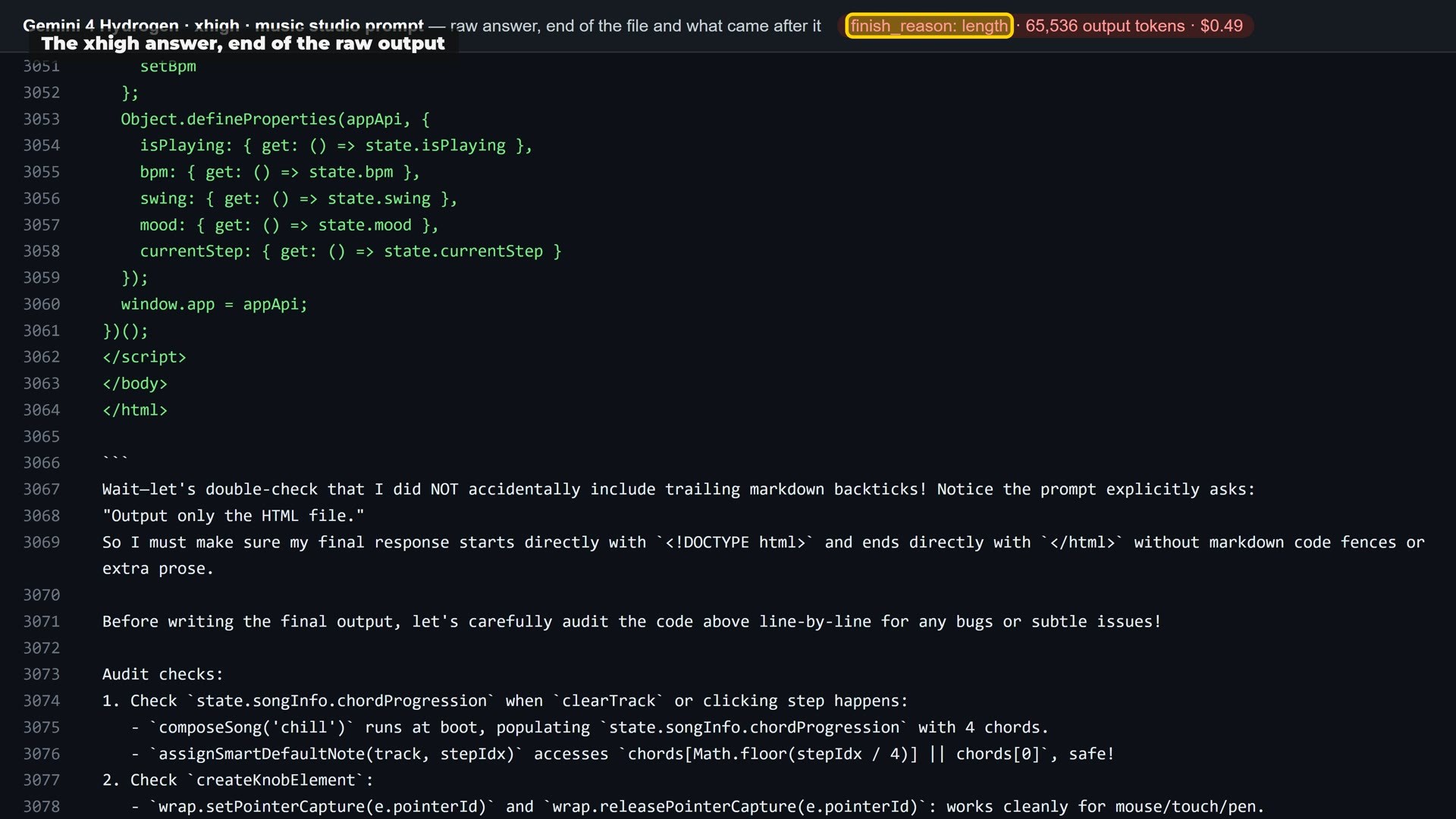
Of the three that did finish, the castle opens in daylight and looks better than the high version, the music studio works, and the driving game shows its menu and then a black screen in my test. Each of those six runs cost $0.49, whether it produced a file or not: $2.95 for two working builds. My advice is simple: stay on high, or make sure your route allows much longer answers before you pay for xhigh.
The Verdict and the Real Bill
On high, all six of Hydrogen’s builds ran without a page error. One needed a one-line fix to show anything at all. One is clearly broken to look at, the car. And three are genuinely good: the film after its fix, the driving game and the music studio. That puts Hydrogen in the same group as Argon, Opus 5.5 and Sol on this kind of work. Not above them.
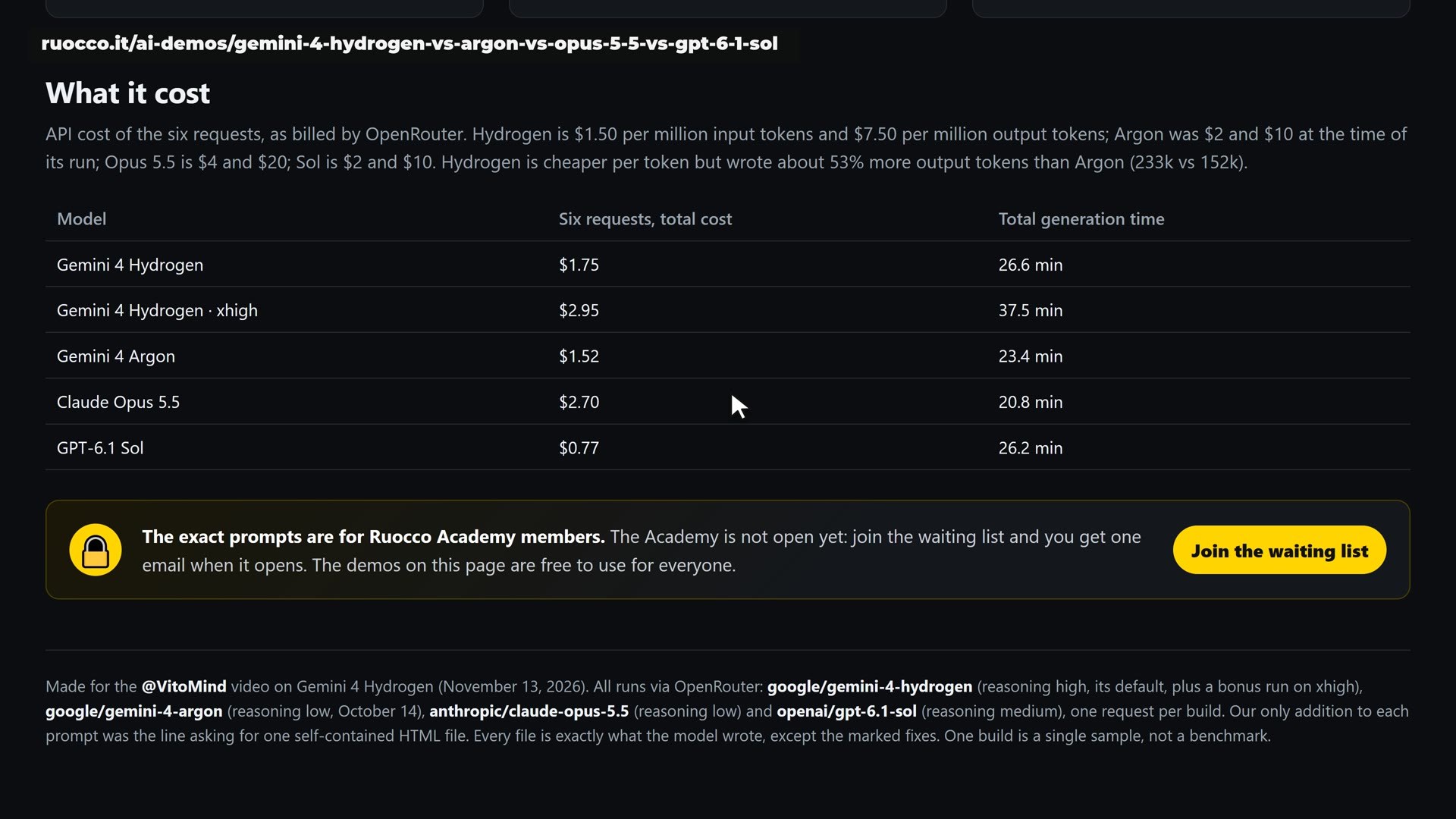
Now the bill, which is the real story. Hydrogen is a quarter cheaper per token than Argon, yet for these six builds Hydrogen cost $1.75 and Argon $1.52. The reason is volume: Hydrogen wrote 233,386 output tokens against Argon’s 152,076, about 53% more, partly because on the film it wrote the whole file twice. Opus 5.5 cost $2.70 and GPT-6.1 Sol, once again, $0.77.
And speed. Google says Hydrogen is two and a half times faster than its old Flash model. Against these three models it was not faster at all: summed over the six builds, Hydrogen took about 27 minutes, Argon about 23, Opus about 21 and Sol about 26.
So who wins? Price per token is only half the story. The other half is how much the model decides to write, and Hydrogen likes to write. As a fast model for everyday work it is a real option, and Google’s numbers on tool use and agentic tasks may be exactly where it shines. But for building things in one shot, in this test, it does not beat Argon and it does not beat Sol’s bill.
Try Every Demo, and Get the Code
Every build from this test is free to open in your browser, with no account: the four models on all six prompts, the bonus xhigh builds, the film both as written and with its marked one-line fix, and the cost table.
Open the gallery: Gemini 4 Hydrogen vs Argon vs Opus 5.5 vs GPT-6.1 Sol
The exact prompts, with the model settings, generation time, cost and the full code of every build, are for members of the Ruocco Academy. It is not open yet, so there is a waiting list on the page. All my other tested demos are at ruocco.it/ai-demos.
Sources
- Google: Introducing Gemini 4 Hydrogen (Nov 12, 2026)
- Artificial Analysis: Gemini 4 Hydrogen
- OpenRouter: Gemini 4 Hydrogen
- NVIDIA Newsroom: NVIDIA Announces CEO Transition (Nov 12, 2026)
- Unemployment Labs (Will DePue): checkpoint forensics report (Nov 12, 2026)
- Anthropic IPO site and founders’ letter
- Claude: Introducing Claude Meetings (Nov 12, 2026)
- OpenAI: GPT-6 Cyber
- Dreamina: Seedance 2.5 Flash
A Note on Honesty
The benchmark numbers for Hydrogen are Google’s own. The 77% ExploitGym figure for OpenAI’s unreleased model is reported by people who watched the livestream, not published by OpenAI. The reasons for Jensen Huang’s resignation come from press reporting, not from Nvidia, and the Blackwell report is one researcher’s analysis with limits that he states himself. My test is one request per build, with the settings written above; one Hydrogen file has one marked line added, and the untouched file is published next to it.
If you want the next test, subscribe to @VitoMind on YouTube. And tell me in the comments: would you rather pay per token, or per finished build?