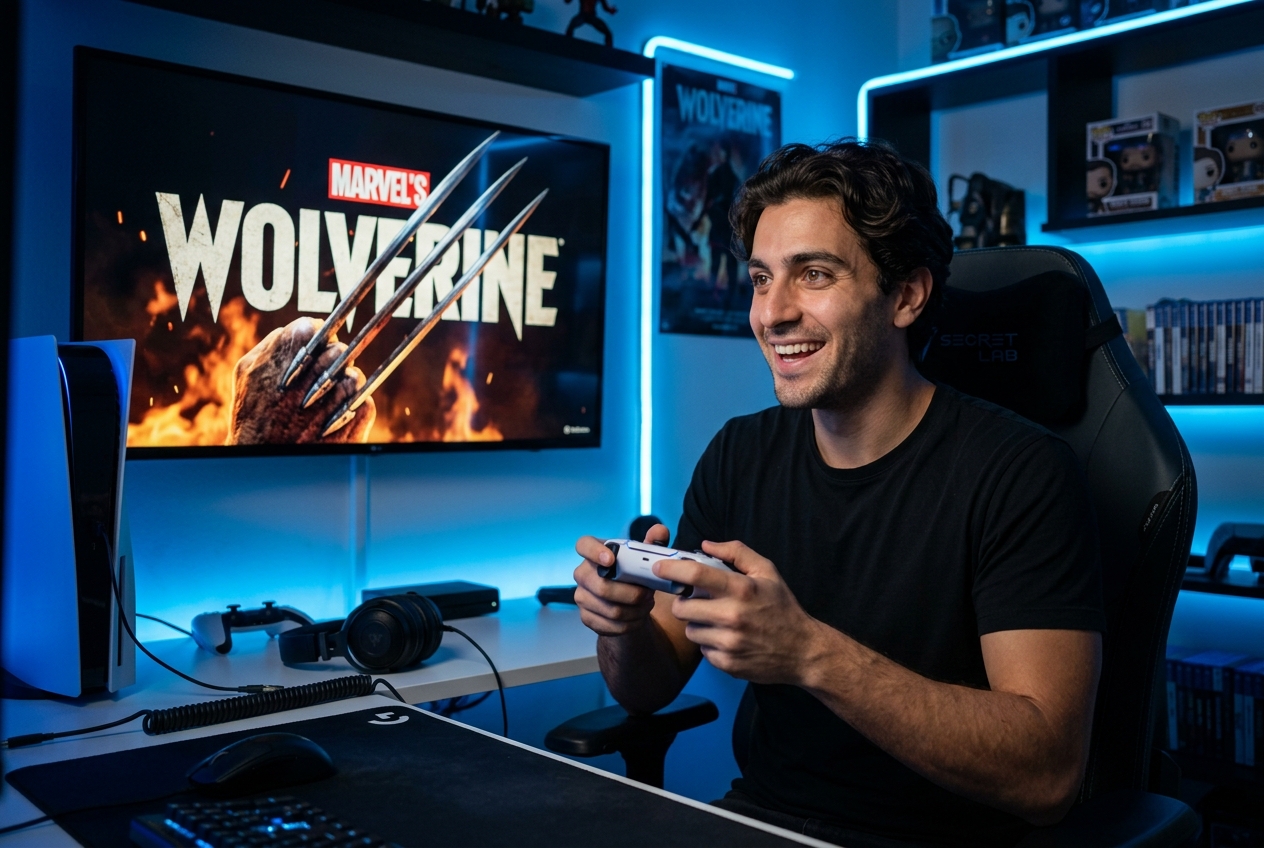
Marvel’s Wolverine: Insomniac Delivers 60 FPS with Ray Tracing, Destructible Environments, and a Fresh Take on Logan’s Origins
Published: August 14, 2026
Insomniac Games is rewriting the superhero gaming rulebook once again. With Marvel’s Wolverine set to launch on September 15, 2026, exclusively for PlayStation 5, the studio behind the critically acclaimed Spider-Man series has pulled back the curtain on what might be their most ambitious project yet. In a sprawling interview with IGN, game director Jess Reiner-Reed and technology head Mike Fitzgerald laid bare the technical wizardry, design philosophy, and narrative ambition powering Logan’s solo debut.
From a jaw-dropping technical first — 60 frames per second with ray tracing as the default mode on the base PlayStation 5 — to a pre-X-Men story that teams Wolverine with Sabretooth and Mystique, this is shaping up to be something genuinely special. Here’s everything you need to know.
60 FPS with Ray Tracing: A First for Insomniac
Let’s start with the headline: Marvel’s Wolverine runs at 60 frames per second with ray tracing enabled on the base PlayStation 5 as the default performance mode. This is a first for Insomniac, a studio that has consistently pushed technical boundaries with every release.
“From early on in development, we knew we wanted to make this 60 FPS, working on the base PS5 in performance mode,” Reiner-Reed told IGN. “And we’ve definitely been able to accomplish that. The game feels super smooth.”
Mike Fitzgerald elaborated on the significance of this achievement: “We’ve always had these fidelity and performance modes, and then we always sort of last minute get the performance mode with ray tracing and like, ‘But this is pretty good…’ And so for this game from the start, we said, ‘You know what? We know we’re confident we can ship this now. This is going to be a 60 frames per second game with ray tracing as the PS5 should have. We’re going to build the game around this and towards this.’ And it’s the default mode for the first time for us in one of our games. It’s important for the presentation.”
For context, Insomniac’s Spider-Man 2 launched with a 60 FPS performance mode that lacked ray tracing, with a ray-tracing mode added post-launch. Wolverine is launching with both from day one — and making the combined mode the default. Given the combat-heavy, fast-paced nature of a Wolverine game, the silky-smooth 60 FPS target is a genuine game-changer for responsiveness during those frenetic claw-based encounters.
Combat: Brutal, Aggressive, and Driven by Rage
Combat in Marvel’s Wolverine is exactly what fans would expect — and then some. Insomniac has designed a system that prioritizes aggression over caution, built around a clever Rage Meter mechanic that rewards players for staying in the thick of battle.
“You want to make sure that it feels brutal. You want to make sure that it feels aggressive,” Reiner-Reed explained. “Wolverine’s somebody who, he’s not going to go run and hide in the corner and wait for his health to go up or anything. You’re incentivized to have that aggression and keep fighting different enemies.”
The Rage system operates across three tiers. At Tier 1, it’s the baseline state. At Tier 2, players gain extra damage on combo finishers and — crucially — access to a “Last Stand” mechanic. This allows Wolverine to trade his entire Rage meter for a full heal when his health hits zero, effectively allowing him to cheat death as long as he’s been fighting aggressively enough.
At Tier 3, the game transforms. The background desaturates to gray, enemies are highlighted in red, and Wolverine enters a full berserker state. Weak enemies become instantly executable, and all attacks deal dramatically increased damage. “It is quite simply the epitome of the Wolverine power fantasy,” wrote IGN’s Mitchell Saltzman in his hands-on preview.
Combat is parry-driven — players need to master the timing of the L1 button to block and counter incoming attacks. Enemies don’t wait their turn. Cybernetically enhanced foes require precise parries to open their defenses. Wolverine has access to a gap-closing leap attack, a powerful kick that can send enemies flying into walls or off cliffs, and a suite of special moves tied to individual cooldowns rather than a shared resource pool.
However, early previews note that the combat may lack some of the creative variety that made Spider-Man‘s encounters so memorable. “Wolverine mostly just angrily stabs things,” Saltzman observed, noting the absence of the web-based environmental creativity that defined Spider-Man’s combat sandbox.
A Pre-X-Men Story: Team X, Sabretooth, and Mystique
Narratively, Insomniac is taking a fascinating approach. Marvel’s Wolverine is set before the formation of the X-Men, in a world where Wolverine, Sabretooth, and Mystique are all members of a covert task force called Team X. Their handler? A man named Nathaniel Essex — before he becomes the villainous Mister Sinister.
“The X-Men haven’t been formed yet,” confirmed Reiner-Reed. The team is led by Essex, who serves as their mentor “and someone looking to help mutants everywhere.” This puts them in direct opposition to Bolivar Trask, the mutant-hating industrialist famous for creating the Sentinel program.
The story is being penned by Walt Williams, the writer behind Spec Ops: The Line — widely regarded as one of the most emotionally devastating narratives in video game history. Early impressions suggest that Williams’ touch is already evident in the character-driven, morally complex direction of the story.
Liam McIntyre voices Wolverine, and the choice has been met with widespread approval. “He wasn’t coming in being like, ‘I’m Wolverine.’ He wasn’t putting on a character. He just was,” Reiner-Reed recalled of the casting process. “Liam was just like, ‘This is who I am in my soul.’ I was like, ‘Dude, you’re it.'”
Troy Baker lends his considerable talents to Nathaniel Essex, and early previews suggest another standout performance from the prolific voice actor. Nicole Pacent and Brett Gipson portray Mystique and Sabretooth, respectively, offering fresh takes on characters traditionally depicted as villains.
The Suit Heals Too — And There’s a Good Reason
One of the most discussed aspects of the June State of Play gameplay reveal was the fact that Wolverine’s suit appears to regenerate alongside his body. The internet, predictably, had a field day with “nanomachines” jokes and “even his suit has a healing factor” memes.
Insomniac’s explanation is refreshingly practical. “You can’t play through most of the game wearing just shredded rags on his body,” Fitzgerald said plainly. “So we find the right balance between clothing that reflects the gameplay you’re doing and this brutal combat and the realities of that, and then finding the right moments to have it restore itself so you get that right cinematic feel of Wolverine.”
Early prototypes actually had the damage persist for too long, making Wolverine feel less powerful. “Early on you would be playing through missions and your clothes are shredded for way too long. You don’t feel as powerful as you’re playing through,” Reiner-Reed added.
Notably, the suit damage system is still present — it just doesn’t linger. Each of the game’s multiple suits has its own damage pipeline, and the tech behind blood splatter is genuinely next-gen. “The blood sprays coming off them are some really interesting fluid tech,” Fitzgerald revealed. “These are actual blood particles coming out. They hit the ground and make the exact splatter mark they would make if they land on Logan. They leave blood there. If he walks through water, it washes off and leaves blood swirls in the water.”
Destructible Environments and Next-Gen Tech
Insomniac has invested heavily in environmental technology that sets Wolverine apart from their previous work. Unlike the urban jungle of Manhattan in Spider-Man, Wolverine takes players to the wilderness of Canada and the fictional Southeast Asian city of Madripoor.
“Spider-Man’s a very urban city based title. We invest a lot in technology to represent that. And then Marvel’s Wolverine takes us outside the city,” Fitzgerald explained. “We spend some time in the wilderness of Canada, in a different nature of city in Madripoor. So we invested in a lot of tech around foliage and the jungles that you start the game in. All that foliage is very reactive to wind and characters and the environment going on around it.”
But the real showcase is the destructibility system. “Logan’s a really destructive character,” Fitzgerald continued. “The aftermath after you fight a big battle, we wanted to make sure you didn’t feel like you were defeating a bunch of The Hand and then walking out of this pristine market that you happened to be in. So most of the props in the game are destructible, react in physically accurate ways. We invested a ton in that technology. So market stalls and tables and everything around you is splintering and flying off as you’re doing combat.”
This commitment to physical destruction and reactive environments promises to make every combat encounter feel consequential — no two battles will leave the same mark on the world.
Lowtown: Where Wolverine Catches His Breath
Perhaps the most surprising element of early previews is the inclusion of what IGN describes as “exhale” moments. In one standout section, Wolverine wanders through Lowtown, a safe haven for mutants. Here, players can strike up conversations with fellow mutants, engage in arm wrestling with Sabretooth, and play a revealing game of “Never Have I Ever” with Mystique.
“It was a welcome reprieve from all of the action,” Saltzman wrote, “and I hope there are more moments like this where I get to learn more about the characters that inhabit the world.”
These quieter interludes suggest that Insomniac is aiming for more than just a non-stop action spectacle. The studio appears committed to character development and world-building, giving players space to breathe between the berserker rage. With Walt Williams at the narrative helm, these moments may prove to be essential emotional grounding for a story that deals with themes of anger, identity, and found family.
Replay Value: New Game Plus From Day One
Insomniac has confirmed that Marvel’s Wolverine will launch with New Game Plus available from day one, along with a host of additional features designed to keep players coming back after the credits roll. While specific details remain under wraps, the studio has emphasized that there’s “plenty in Marvel’s Wolverine to keep people playing after the credits roll.”
The game features a skill tree with a variety of techniques and special moves, along with adaptation points that can be spent on character upgrades. With multiple suits to unlock and collect — each with its own damage modeling system — completionists will have plenty to chase.
The promise of day-one New Game Plus is particularly welcome in an era where many major releases gate this feature behind post-launch patches. It signals confidence from Insomniac that Wolverine is a game players will want to experience more than once.
What About the X-Men?
One question dominates fan discussion: if the X-Men don’t exist yet, will they appear at all? Insomniac has been characteristically cagey on this point. What we do know is that Jean Grey features prominently, and Nathaniel Essex’s connection to the wider Marvel universe leaves the door open for future developments.
Given Insomniac’s track record with post-launch content for Spider-Man, it’s reasonable to expect that Wolverine may receive story expansions down the line. Whether those would introduce the X-Men proper, explore Logan’s Weapon X past, or delve into other corners of the mutant universe remains to be seen.
For now, Insomniac is focused on delivering a self-contained, Logan-centric story that doesn’t rely on the broader X-Men mythology. As Fitzgerald put it, the core question driving every design decision was simple: “What would Logan do?”
Release Date and Pre-Order Details
Marvel’s Wolverine launches exclusively on PlayStation 5 on September 15, 2026. Pre-orders are available now through the PlayStation Store and participating retailers. Standard, Deluxe, and Collector’s Editions have been announced, with the Collector’s Edition including a full-sized replica of Wolverine’s claws — a must-have for any serious Marvel fan.
The game is rated M for Mature, reflecting the visceral, violent combat that fans have been hoping for. Unlike the web-slinging, non-lethal takedowns of Spider-Man, Wolverine’s approach to problem-solving is decisively more permanent.
Our Take: Wolverine Is Ready to Pop His Claws
Based on everything Insomniac has shown and shared, Marvel’s Wolverine is shaping up to be one of the most anticipated games of 2026 — and possibly one of the most important superhero games ever made. The technical achievement of 60 FPS with ray tracing as a default on base PS5 is genuinely impressive. The combat captures the animalistic fury of the character. The story, guided by one of gaming’s best writers, promises emotional depth to match the visceral action.
Questions remain — chiefly whether the combat can maintain its engagement across a full campaign without the creative variety that defined Spider-Man’s toolkit. But early previews suggest that Insomniac has built a solid foundation, and the studio’s track record of post-launch support inspires confidence.
With exactly one month until launch, the hype train is leaving the station. Logan is coming home to PlayStation 5, and he’s bringing his claws. God help anyone who gets in his way.
— Article by Vito Ruocco | August 14, 2026