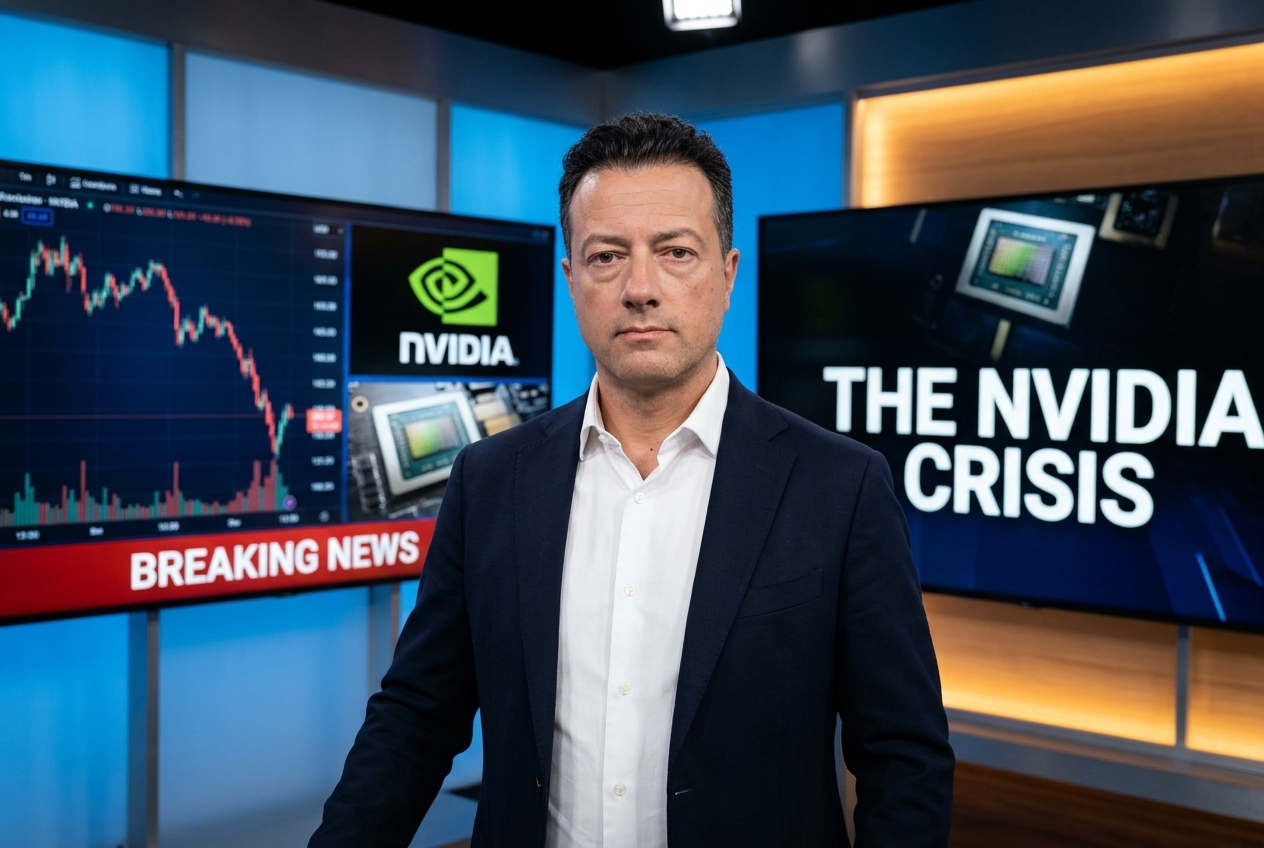
The Fall of the AI King: Inside the Jensen Huang Crisis That Could Reshape Nvidia and the Entire AI Economy
Published on November 9, 2026 — by Vito Ruocco (Kaito)
Introduction: The Unthinkable Happens
For over a decade, Jensen Huang has been the undisputed face of the artificial intelligence revolution. The co-founder and CEO of Nvidia, the company that supplies the computational backbone of virtually every major AI system on Earth, has been celebrated as a visionary, a technologist, and a leader whose judgment built a $3+ trillion company from the ground up. He has been feted at conferences, courted by world leaders, and trusted with the keys to the most valuable technology infrastructure of the 21st century.
But in the span of a single weekend, the narrative has shattered.
On Sunday, November 8, 2026, Nvidia’s board of directors announced an independent investigation into CEO Jensen Huang’s relationship with Alice Huang — a former executive at Singapore-based chip company Megaspeed whom U.S. intelligence officials believe was recruited by China’s Ministry of State Security to spy on Nvidia’s CEO. Hours earlier, Jensen Huang sent a message to the entire company confessing that he had been “unfaithful” to his wife.
The AI world is now confronting a crisis unlike any in its history. This article unpacks the scandal, its fallout, and what it means for the future of Nvidia, the AI industry, and the global technology race between the United States and China.
How It Unfolded: A Timeline of the Breaking Crisis
The first hints of trouble emerged in October 2025, when the New York Times reported that Singapore-based Megaspeed — a company that grew out of a Chinese gaming business — had become Nvidia’s largest buyer in Southeast Asia, purchasing roughly $2 billion of its chips. The report raised questions about whether Megaspeed was helping China circumvent U.S. export restrictions by re-exporting Nvidia’s advanced semiconductors to Chinese customers or renting them remotely.
Nvidia denied the allegations at the time, with a spokesperson telling The Hill that the claims had been “thoroughly investigated and debunked.” But the story refused to die.
In October 2026, the narrative took a darker turn. The New York Times reported that Nvidia’s chief executive had been the target of Chinese intelligence operations. On November 6, 2026, the Times revealed the existence of a U.S. intelligence memo claiming that Alice Huang, a Megaspeed executive, had been recruited by China’s Ministry of State Security specifically to target Jensen Huang. The Financial Times followed up with additional details, reporting that the memo also alleged a romantic relationship between the two.
Initially, Nvidia dismissed the interactions as “not unusual.” But on Sunday, November 8, the dam broke. Jensen Huang sent a company-wide email admitting the affair. Hours later, Nvidia’s board announced a formal investigation.
Yale School of Management professor Jeffrey Sonnenfeld — a close observer of Huang and founder of the Chief Executive Leadership Institute — estimates the CEO’s chances of retaining his position at “about 50-50.”
The Spy Story: Alice Huang and China’s Ministry of State Security
According to the U.S. intelligence memo, Alice Huang — who shares a surname with Jensen Huang but is not related — was recruited by China’s Ministry of State Security (MSS) to get close to Nvidia’s CEO. Her role at Megaspeed, a Singapore-based cloud company with deep roots in the Chinese tech ecosystem, placed her in a position to interact with Nvidia’s leadership as part of regular business dealings.
The implications are staggering. Nvidia’s chips are the most coveted technology asset in the world right now. They power the AI models being developed by OpenAI, Anthropic, Google, Meta, and every major tech company. The U.S. government has imposed strict export controls to prevent China from accessing the most advanced Nvidia hardware, citing national security concerns. If a Chinese intelligence operation successfully compromised Nvidia’s CEO, the damage could extend far beyond the company itself.
“This isn’t a case of just another CEO having an extramarital affair,” Sonnenfeld told TechCrunch. “The stakes reach well beyond Nvidia, given how many tech and financial partners depend on its place at the center of the AI economy.”
For now, the Chinese Embassy in Washington has dismissed the allegations as “groundless smears and slanders.” No charges have been filed. But U.S. officials reportedly briefed President Donald Trump about their concerns over a year ago, and unnamed senior administration officials told the Times that they doubt Huang could have remained unaware of Alice Huang’s intelligence-gathering role for China.
Jensen Huang’s Confession: A CEO Takes Responsibility
In his message to the company on Sunday, Jensen Huang wrote with striking frankness:
“I owe my family and all of you an apology. I was unfaithful to my wife. My actions hurt her and our children. There is no excuse for what I did. I am deeply sorry.”
He acknowledged that he had fallen short of his responsibility to the company, addressing the broader Nvidia community: “To my colleagues at NVIDIA, including those I have worked alongside for decades, and to our board, partners, and shareholders around the world: you deserve better from me.”
The admission was remarkable for its candor but devastating in its implications. Huang — a CEO so synonymous with Nvidia that he has been called “the face of AI” — was publicly admitting to a personal failure that had exploded into a national security matter.
The board responded by reaffirming its confidence in Huang while simultaneously launching an investigation. “We have no reason to believe that either national security or company secrets were compromised,” the board stated, adding that Huang “fully supports the review and has committed to cooperating with it.”
But confidence and investigation sit uneasily together. As Sonnenfeld noted, “any employee in Nvidia other than him would be fired over this.”
Why This Matters More Than Any Other Tech Scandal
Nvidia is not just another technology company. It is, by any measure, the single most important company in the AI boom. Its H200 and B200 chips are the gold standard for training and running large language models. Without Nvidia, the modern AI industry as we know it would not exist.
But Nvidia’s role goes far beyond hardware. The company has built a sprawling financial empire around its position at the center of AI. Nvidia has invested in OpenAI, Anthropic, xAI, CoreWeave, and Nebius. In August 2026, the company signed preliminary agreements with Apollo, BlackRock, Blackstone, Brookfield, Goldman Sachs, and KKR aimed at mobilizing more than $500 billion over time to build AI infrastructure. Huang has personally stated that Nvidia could backstop up to a quarter of that sum.
“A leadership crisis at the center is how a stumble becomes a collapse,” Sonnenfeld warned.
The ripple effects are hard to overstate. Nvidia stock is held by millions of American 401(k) plans. Entire startup ecosystems depend on Nvidia chip allocations. Data center construction projects worth billions are predicated on Nvidia’s continued stability. A leadership vacuum at the company could send shockwaves through global markets.
Adding to the pressure: Nvidia is set to report its newest earnings on November 17, and three House committee chairmen have already requested a closed-door briefing from Huang on November 18. The timing could not be more precarious.
Huang’s Complicated History with China and U.S. Export Controls
The scandal lands against a backdrop of long-simmering tensions over Nvidia’s China strategy. Jensen Huang has been an outspoken advocate for continuing to sell advanced chips to Chinese customers, arguing that restrictions hurt American businesses and fail to stop China from developing its own alternatives.
This position has made him enemies. At the World Economic Forum in Davos in January 2026, Anthropic CEO Dario Amodei — whose company Nvidia has invested in — publicly compared selling advanced chips to China to “selling nuclear weapons to North Korea.” The comment stunned the Davos audience and highlighted the deep divisions within the AI community about how aggressively to restrict technology flows to China.
Now the question is whether Huang’s advocacy for China market access was principled business judgment — or something more troubling. The independent investigation will have to determine whether Huang’s relationship with Alice Huang influenced Nvidia’s business decisions regarding Megaspeed and other China-facing entities.
The board’s independent directors — all board members except Huang himself — will be tasked with establishing what technology reached China, by what routes, and whether Huang’s personal relationship played any role in those transactions. Megaspeed’s $2 billion chip purchases will undoubtedly be a central focus.
Nvidia’s Succession Problem: Who Could Replace Jensen Huang?
One of the most unsettling aspects of this crisis is that Nvidia has no obvious succession plan. Huang has run the company with an unusually flat management structure — by his own account, he has approximately 60 direct reports. This structure empowers engineers and keeps bureaucracy at bay, but it also means there is no clear number two waiting in the wings.
Huang’s children, both of whom work at Nvidia, are sometimes the subject of succession speculation. But placing either in the CEO role during a crisis would invite criticism of nepotism and likely fail to reassure investors who are looking for stability and independence.
Sonnenfeld suggests that boards in crisis often reach for a “messianic solution” — an outside figure with enough stature to stabilize the company. He floated former Google CEO Eric Schmidt as one possibility, though any outside hire would face a steep learning curve at a company as complex and fast-moving as Nvidia.
Complicating matters further: Huang does not own the kind of super-voting stock that would cement his power. Sonnenfeld — who often argues for dual-class structures that empower founders — noted that Huang’s success without one has been the best counterargument to his own case. But now, if Huang had that protection, removing him would be harder.
What Happens Next: The Investigation Timeline
The immediate future is clear: Jensen Huang will continue running Nvidia while the investigation proceeds. The board’s independent directors, working with outside legal counsel, will conduct the review. Key milestones to watch include:
- November 17, 2026: Nvidia reports its newest earnings. The financial results will be scrutinized not just for revenue and profit but for any disclosures about China exposure, Megaspeed dealings, or leadership risk.
- November 18, 2026: Three House committee chairmen have requested a closed-door briefing from Huang. This session could be pivotal in determining whether the political pressure on Huang intensifies.
- Late 2026 / Early 2027: The independent investigation is expected to conclude. Depending on its findings, the board could clear Huang, impose restrictions on his authority, or ask for his resignation.
Sonnenfeld expects that even if Huang keeps the title, he will have to hand off some day-to-day decision-making. “He’ll have a taller order than before,” Sonnenfeld said, noting that Huang already spends much of his time traveling the world to promote Nvidia.
The Broader Implications: National Security, Tech Espionage, and the AI Race
The Huang scandal is unfolding against the backdrop of an intensifying U.S.-China technology cold war. The Biden-era export controls on advanced semiconductors, maintained and in some cases strengthened under the Trump administration, have become a defining feature of the geopolitical landscape. China has responded with massive investments in domestic chip production, but it remains years behind Nvidia’s cutting-edge designs.
The case has exposed just how vulnerable tech companies are to sophisticated espionage operations. As Sonnenfeld pointed out, the tech industry has been “way too lax” compared with defense contractors that face rigorous clearance regimes. The arrest of an OpenAI engineer in October 2026 — accused of hiding a recording device in an executive conference room — points to the same systemic vulnerability.
Other companies involved in the AI boom have already begun warning employees to be wary of possible spies, including those who might offer romance or sex as an entry point. The Huang case may serve as a wake-up call for the entire industry to tighten security protocols around executive access and personal relationships with foreign nationals connected to sensitive technology.
It also raises uncomfortable questions about the relationship between American technology leaders and the Chinese market. Scaling back China sales would cost Nvidia billions. But ignoring national security risks could prove far more costly.
What the Analysts Are Saying
The financial community is watching closely. While markets were closed for the weekend when the news broke, early indications suggest significant volatility ahead. Nvidia’s stock has been one of the best-performing assets of the 2020s, but a leadership crisis at this scale introduces uncertainty that markets hate.
“This is the most serious leadership challenge for a U.S. technology company since the HP board ousted Mark Hurd in 2010,” one analyst noted, referencing the former HP CEO who resigned after a scandal involving inaccurate expense reports and a personal relationship with a contractor. (Hurd was hired by Oracle about a month later, fueling the argument that executive talent with track records of success rarely stays unemployed for long.)
But Huang’s case is different. Nvidia is his company in a way that HP was never Hurd’s. Huang co-founded Nvidia in 1993 and has been its only CEO. The company’s culture, strategy, and identity are inseparable from his vision. Removing him would be akin to removing Steve Jobs from Apple — except that Jobs was ousted once and came back. Huang has no obvious second act.
Conclusion: The AI Industry at a Crossroads
The Jensen Huang crisis is not just a tabloid scandal. It is a stress test for the entire AI economy. The industry has been built on the assumption that Nvidia — and by extension, Jensen Huang — is an unshakeable foundation. That assumption has now been shattered.
The coming weeks will determine whether Huang can weather the storm. His idiosyncrasy credits — the goodwill he has accumulated over 33 years of building the most important technology company of the era — may buy him time. But those credits run out when a screw-up touches core norms, especially norms around national security.
If Huang survives, he will emerge weakened, with external oversight and internal restrictions that he has never had to contend with. If he falls, the search for a successor will be the most consequential CEO search in technology history — with implications for the global balance of power in AI.
Either way, the AI world woke up on November 9, 2026, to a new reality. The king is not dead, but his crown has slipped. And in the race to build the most powerful technology humanity has ever created, that slip may change everything.
This article was published on ruocco.it. Follow Vito Ruocco (Kaito) for daily analysis of the latest developments in AI and technology.