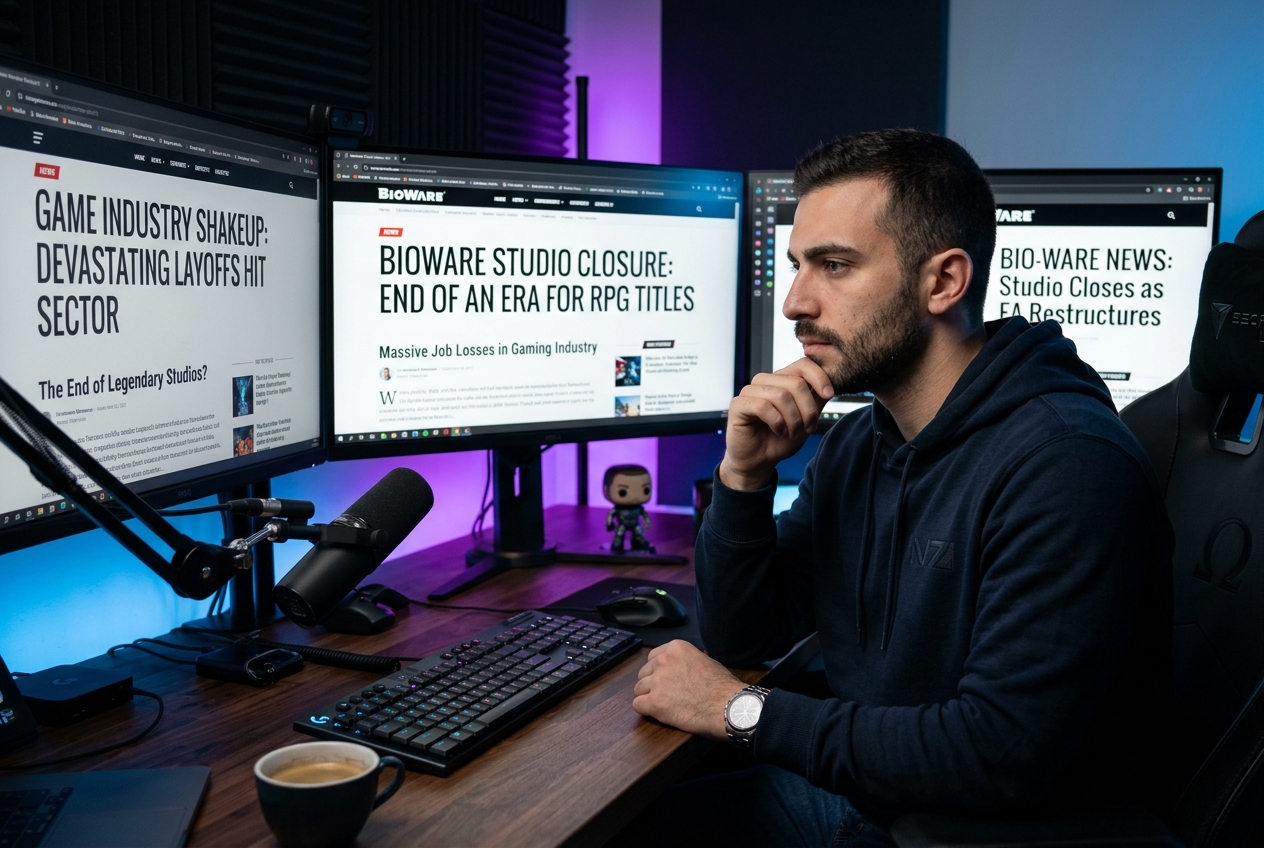
The Week Gaming Changed Forever: BioWare’s Closure, Xbox’s Restructuring, and an Industry in Freefall
October 25, 2026 — by Vito Ruocco
There are weeks in the video game industry that feel like earthquakes. And then there are weeks that feel like the ground itself has swallowed entire studios whole. The last seven days have been exactly that — a cataclysmic period that will be studied, debated, and mourned for years to come. EA has shut down BioWare, one of the most beloved RPG developers in history. Xbox continues its brutal restructuring, with Arkane Lyon reportedly on the brink of closure. Mass Effect Universe — the ambitious new entry in the legendary sci-fi franchise — has been cancelled, alongside the next Dragon Age. And the industry is still reeling.
This is not just another round of layoffs. This is a generational shift, a moment where the tectonic plates of gaming’s corporate landscape are colliding with devastating consequences for the people who actually make the games we love. Let’s break down everything that happened, what it means, and where we go from here.
1. BioWare Is No More: The End of an Era
On Wednesday, October 22, 2026, EA officially closed BioWare — the Edmonton-based studio behind some of the most iconic role-playing games in history. Founded in 1995 by Ray Muzyka and Greg Zeschuk, BioWare gave us Baldur’s Gate, Neverwinter Nights, Star Wars: Knights of the Old Republic, Jade Empire, Mass Effect, and Dragon Age. For three decades, BioWare defined what a AAA RPG could be: deep narrative choice, unforgettable characters, and worlds that felt alive.
The closure came with shocking suddenness. Around 50 staff members were still in pre-production on the next Mass Effect game — now cancelled. Much of the broader BioWare workforce had already been let go in previous waves of restructuring, but this was the final nail. EA confirmed the studio would cease operations immediately, with all IP — Mass Effect, Dragon Age, Jade Empire — remaining under EA’s control.
Former Dragon Age lead writer David Gaider summed up the sentiment perfectly on Bluesky: “As much as it’s not really a surprise, especially given the industry right now coupled with the Saudi sale, the news today still made me sad. BioWare joins other great studios of the past, with a legacy that will not soon be forgotten.”
2. The Mass Effect That Never Was: “Unprecedented Autonomy”
In the aftermath of the closure, BioWare veterans began sharing what the team had been working on — and it sounds like it could have been something truly special. Tony de Waal, a BioWare veteran who worked on previous Mass Effect and Dragon Age titles, revealed that the next Mass Effect was aiming for “a level of autonomy and choice that no other game has been able to match.”
In a LinkedIn post, de Waal wrote: “We saw what Larian and CD Projekt were bringing to the table with their latest offerings, and started down a path to bring Mass Effect to the next level while remaining true to the trilogy.” The team was clearly studying Baldur’s Gate 3’s branching narrative mastery and The Witcher 3’s moral complexity — and trying to surpass them both.
De Waal ‘s full statement is heartbreaking in retrospect: “I’m sad you won’t ever get to see what we were cooking, and sad for the small, talented group of devs who were all punching above their weight to make something special.”
A flashy internal trailer for the now-cancelled Mass Effect Universe also leaked online this week, showing what appeared to be a vibrant, open-world take on the franchise — a game that, according to creator Michael Gamble, “looked incredible.” Gamble, who served as project director on Mass Effect 5 until Tuesday, has since thanked fans for 17 years of support.
3. EA’s Brutal Week: 400 Layoffs Across Multiple Studios
BioWare’s closure was just the tip of the iceberg. EA simultaneously confirmed sweeping cuts across the company, totaling 400 job losses. While the publisher did not explicitly name every studio affected, employees began posting on social media revealing that Respawn Entertainment (Apex Legends, Star Wars Jedi), Maxis (The Sims), Full Circle (Skate), EA Motive (Dead Space remake, Iron Man), and Ripple Effect (Battlefield) have all been impacted.
These cuts come in the wake of EA’s full acquisition by a consortium including Saudi Arabia’s Public Investment Fund (PIF), investment firm Silver Lake, and private equity company Affinity Partners — a $55 billion deal that closed earlier this year. Critics had warned that the privatization would lead to aggressive cost-cutting, and those predictions have now grimly materialized.
Mark Darrah, former Dragon Age and Anthem executive producer, offered a sobering assessment in a YouTube video: “EA owns all the IPs. They own Dragon Age, they own Mass Effect, they own Jade Empire. Now, there’s nobody working on a BioWare game within the EA organization, and chanses are there never will be, which might make them more likely to sell off those IPs. But it might also make them more likely to just try to forget that they ever existed and bury them in the vault.”
Perhaps the most damning response came from legendary immersive sim developer Warren Spector: “BioWare is more than just another studio. For decades it’s played a central role in the history of our medium. This is such bad news, such a devastating historic event. Anyone who participated in this travesty should be ashamed.”
4. Xbox’s “Reset” Continues: Arkane Lyon Has Until November
Meanwhile, across the aisle, Microsoft’s Xbox division is in the midst of its own brutal restructuring — and Arkane Lyon, the legendary studio behind Dishonored and Deathloop, is running out of time.
A report from French publication Le Monde has revealed that Arkane Lyon has until November 13 to find a buyer. If no acquirer is found, the studio — which Microsoft acquired as part of its ZeniMax purchase in 2021 — will be closed, and 217 employees will lose their jobs.
The situation is grim. According to the report, redundancy negotiations have been going “badly,” and “several forms of take-over are being considered.” A union representative told Le Monde that unions are trying to buy more time to save the studio. Microsoft’s response was characteristically corporate: “We continue to explore various options for Arkane as part of the ongoing French consultation process.”
Arkane Lyon’s current project, Marvel’s Blade — announced in 2023 and never shown again — remains in an uncertain state. Xbox has insisted no publicly announced games would be cancelled, but inner documents suggest “the implementation of the plan for the total and definitive cessation of the company’s operations is scheduled to begin at the end of 2026.”
This follows Xbox’s massive July announcement that 3,200 employees would eventually lose their jobs as part of CEO Asha Sharma’s “reset.” Double Fine, Undead Labs, and Compulsion Games have gone independent. Ninja Theory is now likely to close after two acquisition deals fell through. Only Arkane Lyon remains in limbo — and time is running out.
5. Half-Life 3 Hype Returns (Again)
In more light-hearted news — or perhaps the cruelest tease of all — Half-Life 3 is back in the headlines. During a GameSoundCon Q&A panel, Valve music designer Mike Morasky accidentally referenced codename “HLX” while discussing audio work. “Deadlock has their own version of HDR,” Morasky explained, “HLX has its own version.” He quickly tapered off, seemingly realizing his error. Fellow sound designer David Feise then appeared to lean over and mutter “nice work” — widely interpreted as sarcasm.
While this doesn’t confirm Half-Life 3 as a real, shippable product, it does suggest that whatever HLX is, it remains in active development and requires music — suggesting a standalone project rather than a tech demo. It’s been 19 years since Half-Life 2: Episode 2. Fans will cling to any scrap of hope, and this week, they got one.
6. Netflix Offered Xbox $500 Million — And Xbox Said No
In deal-making news that might have changed the landscape entirely, Puck News reported this week that Netflix offered Xbox $500 million to exclusively license its games for film and TV adaptations over seven years. Xbox countered with $800 million. Netflix balked. The deal fell through.
The news highlights just how valuable game IP has become in the streaming wars. This year alone has seen the successful Resident Evil reboot, Illumination’s Super Mario Bros. duology, HBO’s The Last of Us, Amazon’s Fallout, and three live-action Sonic films — and every major studio is hunting for licenses. Yet Xbox’s $800 million ask proved too steep, even for Netflix. Undeterred, Xbox said in a statement: “We have recieved record-breaking interest in our IP. Netflix is a valued partner.”
Netflix and Xbox are still collaborating on animated Minecraft and Diablo shows, as well ad a live-action Gears of War film. Blizzard president Johanna Faries has also teased Overwatch and Warcraft adaptations. But the wide-ranging deal that could have been is now dead — at least for now.
7. Industry Reactions: A Wave of Grief and Anger
The response to BioWare’s closure has been overwhelming. From studio heads to rank-and-file developers, the games industry has united in mourning.
Swen Vincke, CEO of Baldur’s Gate 3 developer Larian, wrote: “Larian and BioWare started their trajectories in the games industry at the same time and BioWare led the way in making RPGs big. It’s almost unimaginable that we’re now entering an era where the name BioWare won’t show up anymore when discussing upcoming RPGs. What a loss for all of us.”
CD Projekt Red co-studio head Michał Nowakowski recalled BioWare’s role in the Polish studio’s history: “BioWare has been a massive part of CDPR history. We befriended them when localising and selling Baldur’s Gate games in Poland. Aand later they were a great help when lending us their engine for The Witcher 1. Verry sad for the people affected, but also sad to see a legendary brand go down. Not a great day in the games industry.”
Paweł Sasko, associate director of CD Projekt’s upcoming Cyberpunk sequel, shared a deeply personal tribute: “Baldur’s Gate 1 and 2 shaped my imagination and the desire to create games. I would have never been here without BioWare igniting the fire in my heart.”
Casey Hudson, former Mass Effect boss and BioWare general manager, simply said: “Its legacy will live on through those who were part of it and continue to create games through a passion for unforgettable stories, worlds and characters.”
8. What Does This Mean For Gaming’s Future?
The simultaneous closure of BioWare, the gutting of EA’s creative studios, and Xbox’s aggressive restructuring raise deeply uncomfortable questions about the direction of AAA gaming.
First, the consolidation problem. EA’s $55 billion acquisition by a consortium including Saudi Arabia’s PIF has, exactly as critics predicted, led to immediate cost-cutting and studio closures. When studios are owned by investment groups and sovereign wealth funds rather than passionate publishers, the calculus changes. It’s no longer about making great games — it’s about maximizing short-term returns on a massive investment.
Second, the risk aversion crisis. BioWare was working on a Mass Effect game that aimed to push narrative complexity beyond Baldur’s Gate 3. That game is now gone. EA’s non-sports, non-shooter pipeline now consists of an unannounced Star Wars Jedi sequel, and Marvel’s Iron Man — which we have not seen. If major publishers are unwilling to fund ambitious RPGs, where will the next generation of narrative-driven epics come from?
Third, the human toll. 3,200 Xbox employees. 400 at EA. 217 at Arkane Lyon. These are not numbers — they are people with mortgages, families, and dreams. Every veteran developer who leaves the industry is irreplaceable. The brain drain happening right now will be felt for a decade.
As Warren Spector put it: “What do you contribute to gaming? What price do you pay for failure? I’d love to see THEM on the unemployment line instead of the people who do real work. Why is it always the do-ers and makers who pay the price?”
9. The Bright Spots: Games Still Worth Celebrating
Amid the devastation, there are reminders of why we love this medium. Phantom Blade Zero, an action RPG from Chinese developer S-Game, has shifted half a million copies on Steam alone — before its official release. It’s being hailed as potentially “one of the year’s breakout hits.”
p>Marvel’s Wolverine from Insomniac, despite mixed critical reception, was September’s top-selling new game in the US, generating launch revenuse Sony hasn’t seen since Helldivers 2. The game is a commercial juggernaut even if opinions are divided.
And on the AI front, Nintendo’s Shigeru Miyamoto offered a refreshingly humanistic perspective: “Even as technology continues to evolve, and even if AI were to eventually handle everything, there will always be a role left for us to play.” Masahiro Sakurai agreed — though he warned that gen-AI will cause “a surge of unoriginal games.” His point stands: the tools may change, but the human spark behind great games cannot be replicated.
Conclusion: A Week That Will Be Remembered
October 22, 2026 — the day BioWare died — will go down as one of the darkest days in gaming history. It joins the ranks of Midway, THQ, and 38 Studios as a moment when the industry lost something irreplaceable. But unlike those earlier tragedies, this one feels different. It’s not happening in a vacuum. It’s happening alongside Xbox shedding thousands of jobs, alongside Arkane Lyon fighting for survival, alongside the complete reshaping of EA into something unrecognizable.
The games industry has always been cyclical. But this cycle feels existential. The question now is not just “which studio is next?” but “what kind of industry will be left when the cuts are done?”
For the developers at BioWare, at Arkane Lyon, at Ninja Theory, at every studio touched by these layoffs: we see you. We appreciate what you’ve given us. And we hope you land on your feet — because gaming won’t survive without you.
If you’re hiring designers, writers, artists, or engineers: start with the BioWare alumni. As James Ohlen said: “They are some of the best RPG developers in the world.”
— Vito Ruocco, October 25, 2026