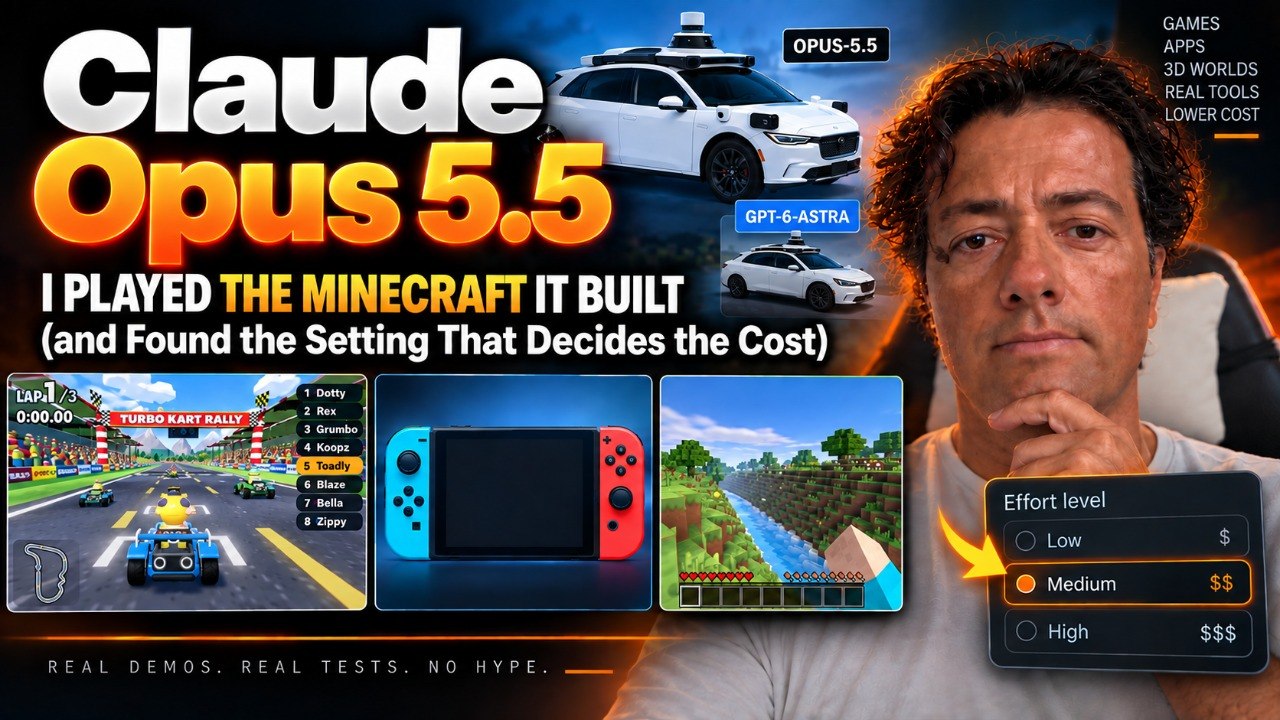
Full breakdown of Anthropic’s new flagship model: real benchmarks, insane demos, pricing, the GPT-6 Astra comparison, and the “effort” setting that can save your subscription.
The Announcement That Shook the AI World
Claude Opus 5.5 was released yesterday, and in less than 24 hours the community has already built things that feel like science fiction. A full Mario Kart-style game from a single prompt. A Nintendo Switch drawn entirely in code. A Waymo-style self-driving car in 3D that makes GPT-6 Astra look simple. And a Minecraft clone running in your browser, playable by anyone.
We’re not talking about concept art or pre-recorded videos. We’re talking about working, AI-generated software that you can open and use right now. Within a day of release, developers, creators, and testers have produced results that would normally take engineering teams weeks to deliver.
In this article, you’ll find the most complete breakdown of Claude Opus 5.5: real benchmarks, pricing, competitor comparisons, the most impressive demos, and — crucially — the secret to using this model without blowing your budget. Because yes, Opus 5.5 can be both the best deal in modern AI and a budget-eating monster. The difference? A single setting.
What Is Claude Opus 5.5?
Opus 5.5 is the first model in Anthropic’s new Claude 5 family. It’s not a full “Claude 5” — Fable 5.5 and Haiku 5.5 will follow in the coming weeks — but the 5.5 release represents a substantial upgrade over the Claude 4 series and especially over Opus 5, which until yesterday was the company’s flagship.
The headline claim is right on the launch page: “It performs at the level of Claude Fable 5.1 on most work, and it costs 40% less to run than Opus 5.”
This is Anthropic’s first release since they called for pacing the frontier. It was tested before launch by external evaluators MER and Frontier Design, and on their automated behavioral audit — the most comprehensive alignment test they run — Opus 5.5 scored as the strongest model they have ever tested.
Pricing: What It Actually Costs
- Input: $4 per million tokens (20% less than Opus 5)
- Output: $20 per million tokens (20% less)
- Cache reads: $0.20 — a 60% drop from Opus 5
- Speed: over 30% faster output generation than Opus 5
There’s also a Fast Mode in Claude Code and the cloud platform: up to 2.5× faster at $8 input and $40 output per million tokens.
The Benchmarks That Matter
| Benchmark | Opus 5.5 | Fable 5.1 | GPT-6 Astra |
|---|---|---|---|
| Terminal Bench 4.0 (agentic coding) | 66.4% | 55.8% | 57.9% |
| Cursor Bench 4.0 | 57.8% | 51.8% | — |
| OS World 2.0 (computer use) | 81.8% | — | — |
| GDP-val (44 occupations) | 1846 | — | — |
| Automation Bench | 40% | — | 41.4% |
| Terminal Bench Science | 15.7% | — | 64.6% |
Opus 5.5 wins most categories, but not all. Anthropic is honest about this: on Automation Bench, GPT-6 Astra edges ahead (41.4 vs 40), and on Terminal Bench Science, Astra wins decisively (64.6 vs 15.7). Anthropic itself notes that at this level, “benchmark margins have become a less reliable guide.”
Coding: The Real Strength
Anthropic ran an internal test asking Opus 5.5 and Fable 5.1 to translate HAProxy — the software that balances web traffic across servers — from C to Rust. Both rewrites passed nearly all of HAProxy’s own regression tests, but Opus 5.5 finished in 9.5 hours instead of 12, costing 51% less.
Early testers report:
- GitHub: Opus 5.5 used among the fewest tokens and steps they’ve ever measured
- Cleo: Ran it overnight on 6 repositories unattended for 18+ hours
- Lovable: Finishes in a third to half fewer steps than previous models
- Quantum: A task requiring 38 prompts over 4 days became 11 prompts in 3 hours
- Optiviver: Matched Opus 5 quality in half the turns, cutting costs 40-50%
One early tester completed a 680,000-line code migration in less than a day. When asked to cut load times across every page of a web app, Opus 5.5 succeeded 39 out of 40 times.
Knowledge Work and Precision
In a clever test, models were asked to write a report on a company’s quarterly earnings using only a web copy where the earnings release was hard to find. A single invented number or quote would fail the report. Opus 5.5 cleared the bar in 16 out of 18 reports. Fable 5.1 and Opus 5 didn’t clear it once.
My favorite quote comes from Walleye Capital: at higher settings, Opus 5.5 noticed that the minute indexing in its own instructions was off by one and corrected it, even noting this would cost it points with the grader. No model they tested had ever caught that.
Communication: The Daily Upgrade
In a side-by-side comparison, Opus 5 jumps straight into code — commits, changes, implementation. Opus 5.5 starts with the answer: “The free tier change explains only $150 of the drop. The other $9.92 come from a bug in one commit” — then explains why.
If you read AI output every day — reports, emails, summaries, documentation — this is the upgrade you’ll feel the most. It’s not just better at writing code; it’s better at communicating.
The Demos That Broke the Internet
Turbo Kart Rally — Mario Kart from One Prompt
Bridgemind on X asked Opus 5.5 in a single shot to create a full Mario Kart-style game. The result: lap counter, eight racers, mini-map, item boxes, speedometer, and a real track with barriers and scenery. It created real characters — Mario and Luigi — playable in the game, something Fable 5.1 never did from one prompt.
Nintendo Switch in Pure Code
Chedasua gave Opus 5.5 the original launch post and asked it to recreate the launch video in JavaScript. No external music, no sound files, no images. Every frame is code. The result looks like a product render.
Waymo Autonomous Vehicle in 3D
Karan Kendra built a Waymo autonomous vehicle in Three.js — once with GPT-6 Astra and once with Opus 5.5. The comparison is stark: Opus 5.5 produced sensors on the roof, correct proportions, cinematic lighting. GPT-6 Astra’s version was functional but flat.
Volcanic Island: $340 of Raw Power
VIP ran the same prompt on Opus 5 ($160) and Opus 5.5 ($340 — more than double). But the result: cutaway water revealing underwater life, vegetation, mammoths, northern lights. The quality is on another planet.
The $682 Cloud Website
Z Miller built an entire interactive site teaching you to read 10 types of clouds with animated skies. Cost: $682. Time: 21 minutes.
The Minecraft Clone
Build with Seed made a Minecraft clone with Opus 5.5 that you can actually play. It’s online. It runs in the browser with WebGL 2. No plugins, no downloads. Main menu, graphics settings, crafting grid, animals, block breaking — all AI-generated. It works.
The Setting That Changes Everything: Effort Level
Anthropic introduced the “effort level” parameter. Levels: Low, Medium, High, X-High, Max.
- At default effort, Opus 5.5 beats Opus 5 at max effort for about a fifth of the cost
- At medium effort, it beats GPT-6 Astra at max effort for about a fifth of the cost
- At its lowest effort setting, it caught 72% of known bugs vs 56% for Opus 5 at high effort
The rule of thumb: Default or Medium for 90% of daily work. High or Max only for that one hard task where you need a Mario Kart.
World of AI Bench: The Verdict
On the independent World of AI Bench leaderboard, Opus 5.5 is #1 with a composite score of 88.0. GPT-6 Astra is at 87.7 — just 0.3 points behind. And in individual columns — frontend, creative, gamedev, and SVG art — Astra actually scores higher. Opus 5.5 wins the composite, but it’s not a knockout.
Availability
- Claude.ai — web and mobile app
- Anthropic API
- Amazon Bedrock
- Google Cloud Vertex AI
- Microsoft Azure
Conclusion
Claude Opus 5.5 is the new #1 — by a narrow but real margin. In coding benchmarks, knowledge work, alignment tests, and practical demos, it shows a clear qualitative leap over Opus 5 and goes toe-to-toe with GPT-6 Astra — often beating it at far lower costs.
But the real secret — the one that actually saves you money — is the effort level. Use it wisely and Opus 5.5 becomes the best value in AI. Crank it to max for every prompt and it’ll eat your subscription before lunch.
Watch the Full Video on YouTube
See all the demos in action — the Mario Kart racing, the Switch assembling, the Waymo lighting up, and the Minecraft clone played live:
Article based on the analysis and demos shown in Kaito’s original video on Claude Opus 5.5. All data and benchmarks from Anthropic’s official launch page and cited sources.