Google Now Runs an AI Data Center in Space — and It Just Wrote a Haiku About It
Published November 2, 2026 — by Vito Ruocco
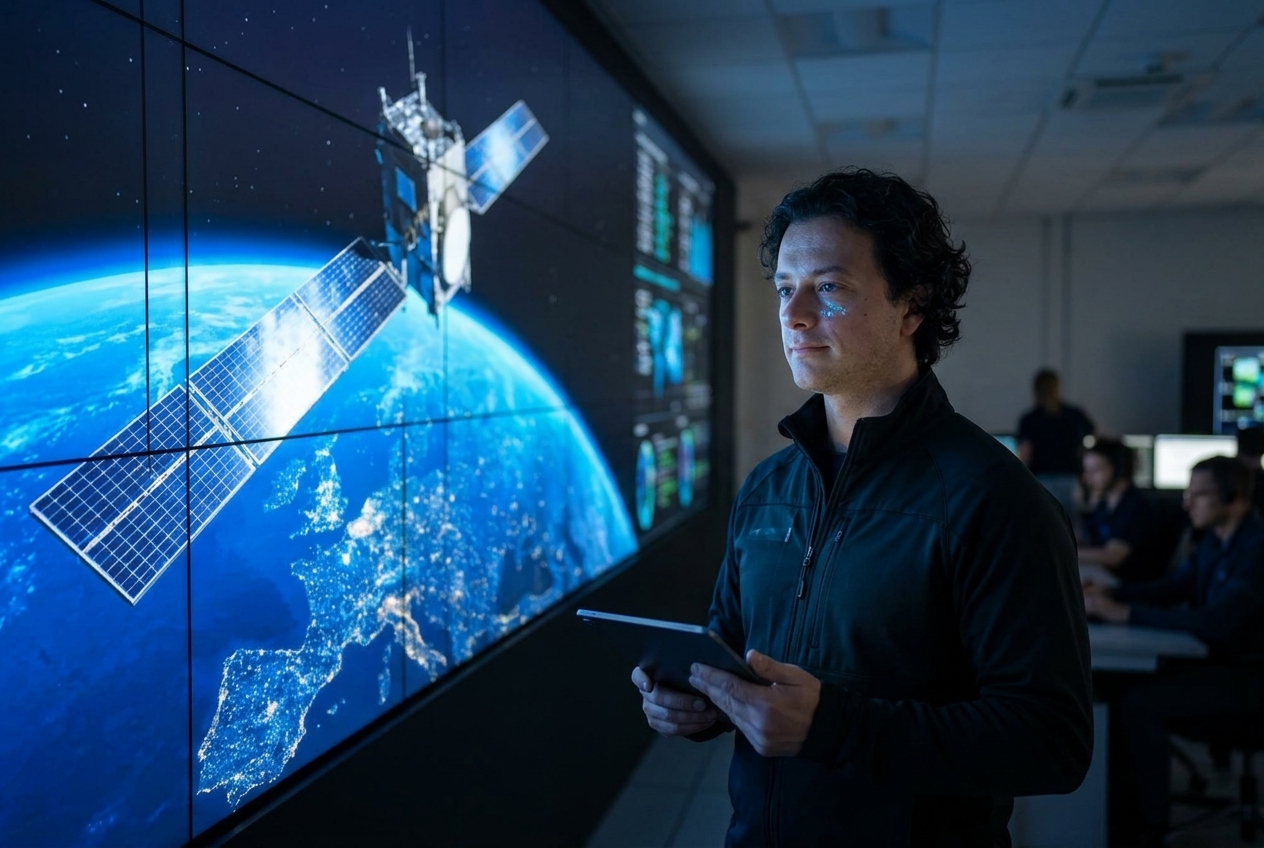
Somewhere roughly 550 kilometers above your head, moving at nearly eight kilometers per second, a small satellite is doing something no machine has ever done before: it is running a large language model in orbit, inside what Google calls its first “space data center.” And the very first thing engineers asked it to produce was a haiku about being in space.
The model, a version of Google DeepMind’s Gemma 4 pre-loaded onto four Tensor Processing Units (TPUs) aboard the Suncatcher prototype satellite, dutifully obliged:
“Blue marble below / Data streams in silent grace / Starlight feeds my core.”
It is, by any measure, a small and poetic moment. But it is also the opening scene of something much larger: a global race to push artificial intelligence infrastructure beyond the surface of the Earth. This week, as Google’s orbital experiment went live, the terrestrial AI industry was simultaneously celebrating and panic-selling its way through one of the most turbulent stretches in its short history. Big Tech pledged more than $740 billion in capital spending this year, markets wiped half a trillion dollars off Alphabet in a single day, and OpenAI quietly floated the idea of rebranding its data centers as “AI compute campuses” to make them more palatable to the public. The story of AI in November 2026 is, in other words, a story about infrastructure — where it lives, who pays for it, and how far companies are willing to go to keep the compute flowing.
The First TPU in Space: What’s Actually Up There
Google’s Suncatcher prototype launched earlier this month aboard a SpaceX Falcon 9 rocket, sharing the ride with more than 100 other spacecraft in one of the company’s regular rideshare missions. The satellite carries four Google Tensor Processing Units — the custom silicon that powers much of the company’s AI work — and generates up to 1 kilowatt of electricity, enough to run a small kitchen appliance but a vanishingly small amount compared with the megawatt-scale demands of a terrestrial data center.
That power constraint shapes everything about the mission. The satellite can only power on one TPU at a time, and even then only for roughly 20 minutes at a stretch. The chips’ appetite for electricity is so large relative to the spacecraft’s generation capacity that engineers must carefully budget every watt, turning the satellite into what is effectively a very expensive, very fast orbiting workstation with a strict time limit.
The mission’s goal is not to do useful work in orbit — not yet, anyway. It is a proof of concept, an engineering testbed designed to answer a single question that will define the next decade of AI: can the chips that power artificial intelligence survive and function in the hostile environment of space? If the answer is yes, Google believes it can eventually build networks of closely-flying satellites capable of performing large inference workloads in orbit, powered by near-continuous sunlight and cooled by the vacuum of space itself. If the answer is no, the entire “space data center” thesis collapses into a very expensive science experiment.
The timing of the launch is telling. Suncatcher represents Google’s long-term bet that the economics of AI infrastructure will eventually push compute off the planet — but it is also a hedge against a very terrestrial problem: the planet is running out of cheap places to put data centers, and the public is increasingly hostile to the ones being built.
Commissioning a Computer in Orbit: Three Weeks of Nervous Engineers
Getting the satellite to the point where it could write poetry was not simple. After launch, the spacecraft went through a commissioning process lasting about three weeks, during which engineers on the ground tested every subsystem — power, thermal control, communications, and the delicate electronics that would eventually carry the AI workload. Spacecraft commissioning is always nerve-wracking; the difference here is that the payload was not a camera or a scientific instrument, but a piece of silicon designed for a server rack in Oregon, not a vacuum at orbital velocity.
When the satellite was finally declared ready, engineers sent their first prompt to the model pre-loaded onboard. They chose a haiku — a deliberately light, playful test that would both verify the inference pipeline worked end-to-end and produce something shareable. Google also tested the model with space-themed limericks, which the company admitted was not its finest artistic moment (“they should have sent a poet,” a spokesperson seemed to concede).
But the more serious work came in parallel: the satellite was asked to report on the orbital conditions around it, feeding back telemetry on radiation levels, temperature swings, and the behavior of its own components. A Google spokesperson told TechCrunch that the satellite is “operating nominally.”
The ongoing test campaign will now focus on how the chips perform under two specific stresses: thermal cycling and space radiation. Every time the satellite crosses from sunlight into Earth’s shadow and back, its temperature swings violently — from hundreds of degrees of solar heating to the deep cold of eclipse. On Earth, TPUs sit in carefully climate-controlled data centers. In orbit, they must survive the kind of temperature whiplash that would crack solder joints and stress every material on the board.
The Radiation Problem: Bit Flips and Silent Corruption
The deeper concern is radiation. Google has spent years testing its TPUs in particle accelerators on Earth, slamming them with high-energy beams to simulate the cosmic ray environment of space. But simulation is not reality. In orbit, charged particles — protons, electrons, heavy ions — constantly bombard electronics, and occasionally one will strike a memory cell and flip a bit from 0 to 1 or vice versa. A single bit flip in the middle of an inference run can corrupt output data without triggering any of the monitoring tools that would normally catch a hardware fault.
These “single-event upsets,” as engineers call them, are the classic silent killer of space electronics. A spacecraft can be functioning perfectly and producing subtly wrong data for months without anyone noticing. For a research satellite, that’s a nuisance. For a satellite running financial models or medical diagnostics, it would be a catastrophe.
Google’s ground testing suggested the impact of radiation would be minimal for inference workloads — the kind of work the Suncatcher satellite is designed to do — and more problematic for training, where trillions of operations amplify even tiny error rates. But now the team gets to test that hypothesis in reality, not in a simulation. Every inference run the satellite performs is, in effect, a radiation experiment.
This is the quiet drama at the heart of the mission. The haiku is the headline; the bit-flip statistics are the science. If the TPUs handle the radiation environment gracefully, Google will have cleared the single biggest technical hurdle on the path to orbital AI. If not, the whole concept may need to be rethought.
Why Space? Because Earth’s Data Centers Are Running Out of Friends
The space data center concept is not purely a physics problem — it’s also a public relations problem. On Earth, data centers have become one of the most contested pieces of infrastructure in the modern economy. They consume enormous amounts of electricity and water, they hum loudly, they require massive grid connections, and they are being built at a pace that has turned once-quiet rural counties into industrial zones.
The backlash has become impossible to ignore. In September, TechCrunch documented how “everyone can find a reason to dislike data center construction” — from environmental groups worried about water usage to residents worried about property values. Amazon and Microsoft have both pledged to stop using non-disclosure agreements in negotiations with local governments, a direct response to accusations that they were steamrolling communities. And this past week, a federal judge allowed an NAACP lawsuit against xAI, the SpaceX-owned AI company, to move forward over allegations that its data center operations violate the Clean Air Act.
Into this fray steps OpenAI, which is reportedly preparing a “PR blitz” for after Tuesday’s midterm elections. According to Axios, the company’s chief global affairs officer Chris Lehane has been discussing a suite of proposals with policymakers — including AI “speed limits,” helping people see AI as empowering, pushing the U.S. to lead global standards, and yes, rebranding data centers as “AI compute campuses.” The theory, presumably, is that “campus” sounds more welcoming than “data center,” with its connotations of diesel generators and noise complaints.
Lehane described the data center debate as “good and healthy,” and argued that “communities should hold companies responsible and accountable so they really and truly get a transformative benefit from these projects.” It is a deft piece of positioning — embrace the criticism, then control the narrative. But the underlying problem remains: AI needs staggering amounts of compute, and the public is increasingly reluctant to host it. Space, for a small but growing group of companies, looks like the ultimate escape valve — a place with unlimited solar energy, unlimited cooling, and no zoning boards.
The $740 Billion Question: Cracks in the AI Spending Boom
The timing of Google’s orbital milestone is almost too on-the-nose, because this week the terrestrial AI economy was having its own crisis of confidence. Over the past two weeks, Alphabet, Amazon, Meta, and Microsoft outlined plans to spend more than $740 billion on capital expenditures this year — a figure Wall Street reads as AI infrastructure spending, including data centers and chips. Earlier in the boom, investors rewarded such outlays as confidence in the technology’s future. Now, entering the fourth quarter, enthusiasm is giving way to anxiety about negative free cash flow, mounting debt, and whether these investments will ever generate returns.
The anxiety spilled across markets on Friday. The Nasdaq fell 2.9%. Chip stocks were hammered: Nvidia dropped 4%, Broadcom more than 5%, and Qualcomm 11%. Alphabet, which had already plummeted 12% on Thursday — its worst day on record, wiping out $500 billion in market value — fell again.
The numbers behind the sell-off are stark:
- Alphabet reported negative free cash flow of $9.1 billion in Q3, its second consecutive quarter in the red, even as quarterly capex grew to $51.4 billion. The company expects to spend up to $205 billion this year, with spending projected to keep rising in 2027.
- Amazon reported negative free cash flow of $42.4 billion over the past 12 months, compared with $14.8 billion in positive free cash flow the year before. It expects $220 billion in capex this year. Even AWS revenue growth of 39% couldn’t stop its stock from tumbling 7%.
- Meta reported negative free cash flow of $2.1 billion in Q3, guiding to as much as $145 billion in capex this year. CEO Mark Zuckerberg admitted its new free AI agent, Muse, is “very compute-intensive to run” — a money pit, in other words — though ad revenue grew 26%.
- Microsoft was the sole exception on cash flow, recording $18.6 billion in positive free cash flow, with capex of $45.2 billion — less than the $50 billion it projected, due to delays in third-party capacity, not a deliberate pullback.
Even more consequential: the money paying for all of this is no longer coming just from profits. According to S&P Global Market Intelligence, Microsoft, Alphabet, Amazon, Meta, and Oracle raised a combined $326 billion in debt in 2026 — triple the amount raised last year. The AI buildout is increasingly a leveraged bet, and leverage makes markets nervous.
Then there’s the slow-motion tragedy at the heart of Google’s own business. The wild success of AI Mode — Google’s AI chatbot feature built directly into Search — is eating into the company’s money-maker. Search advertising, roughly half of Alphabet’s revenue, saw growth slow to 12%, its weakest pace in five quarters. Google is spending billions on AI technology that could undermine the search business that pays for it. That tension — between the transformative potential of AI and its corrosive effect on existing business models — now defines the entire industry.
The Road to Orbital Networks: 2027, Lasers, and a Lot of Starship Flights
If the TPUs aboard the Suncatcher prototype prove themselves, Google’s next step is already planned: launching two more satellites equipped with advanced chips in 2027, with higher power generation and — crucially — the ability to demonstrate inter-satellite optical links. Laser links between satellites would allow a network of spacecraft to function as a single distributed computer, splitting inference workloads across multiple nodes in orbit.
This is what sets Google’s Suncatcher apart from the other concepts floating around. Most proposed space data centers — from companies like Starcloud and Cowboy Space — plan to run inference loads on individual satellites, treating each spacecraft as an isolated server. Google is building toward something more ambitious: a constellation-scale computer, where data flows between nodes at the speed of light in vacuum, with no fiber, no latency-inducing hops through terrestrial networks, and no national borders.
SpaceX’s own data center plans are expected to use laser links as well, but its satellites would orbit too far apart to share processing effectively. Google’s vision, by contrast, requires satellites to fly in close formation — a formation-flying problem that is itself a significant engineering challenge, on top of the radiation and thermal issues.
Both companies’ visions are deeply intertwined. Alphabet holds a significant investment stake in SpaceX, and both depend on Starship, the still-in-development heavy-lift rocket at the center of Elon Musk’s space ambitions, becoming fully and rapidly reusable. In a peer-reviewed analysis published earlier this month, Suncatcher researchers estimated that SpaceX would need to fly Starship 1,800 times to achieve the same learning-driven cost reductions it saw with its earlier vehicles. For comparison, Starship has flown a tiny fraction of that so far — the point being that orbital data centers are a 2030s proposition, not a 2027 one, no matter how optimistic the timelines sound.
Suncatcher is, in the truest sense, a Google moonshot: the company is designing infrastructure that will be economical in the 2030s, accepting that the near-term economics make no sense. Getting there, however, depends on how the rest of the company weathers the AI transition on Earth — and this week’s $500 billion one-day drop was not a reassuring sign. The boldest infrastructure vision in the history of computing is being built on top of a business model that AI itself is destabilizing.
Agents, Scams, and the Human Cost of the Boom
Away from the orbital ambitions and the trillion-dollar balance sheets, the AI boom is also producing a more human set of stories this week. Theranos whistleblower Tyler Shultz warned that the AI boom is “a great opportunity to go deceive people” — a pointed reminder, from someone who lived through the last great tech con, that companies that have never turned a profit are raising capital at trillion-dollar valuations on the strength of promises. DoorDash revealed it has received only “several hundred” orders from AI agents — a sobering data point for anyone who believes agentic commerce is about to reshape the economy overnight. And a University of Kentucky administrator won a religious exemption from using AI in the workplace, testing the boundaries of a new class of accommodation that will only grow more common.
Meanwhile, Apple’s new CEO defended the company’s cautious approach, saying the company doesn’t “want to ship AI for AI’s sake” — a thesis that sounds increasingly contrarian in an industry where every earnings call is now a referendum on AI spending. And Intel’s stock crashed this week, knocking $12 billion from the U.S. government’s stake in the company, as the AI industry’s appetite for memory and components drives up PC prices and squeezes the traditional semiconductor market.
What It All Means: The Infrastructure Era of AI
The financial turbulence is also complicating the industry’s next big event: Anthropic’s highly anticipated IPO. The company filed to go public earlier this week, and its future growth depends on securing enormous amounts of compute. The Financial Times reported Friday that Blackstone has warned investors the company might not qualify for an investment-grade rating after its IPO — a “high junk” outcome that would make it more difficult and costlier for Anthropic to raise the money needed to fund its massive spending. In an era when even the most hyped AI companies are being priced on the margins, the bond market’s verdict may matter more than the equity market’s.
Put it all together and a coherent picture emerges: the AI industry has entered its infrastructure era, and it is an era of extremes. At one extreme, Google has a computer the size of a dishwasher orbiting the Earth, running a language model on sunlight and starlight, testing the very limits of where computation can live. At the other extreme, the terrestrial economy is struggling to pay for the data centers it has already committed to build, with the five biggest hyperscalers tripling their debt in a single year and markets punishing every sign of financial strain.
Both extremes are responses to the same pressure: the insatiable demand for compute. Cloud revenue is booming — Google, Amazon, and Microsoft all posted cloud gains — but the cost of meeting that demand is consuming the profits that paid for everything else. The result is an industry that is simultaneously the most ambitious and the most fragile it has ever been.
The haiku written by a Gemma 4 model in orbit is a lovely artifact, but the real message of this week is simpler and starker: the race to build AI infrastructure has left the ground. Whether the next battleground is orbital laser-linked constellations or the debt markets of New York, one thing is certain — the era of cheap, easy AI expansion is over. From now on, every breakthrough comes with a bill attached, and increasingly, the bill is denominated in gigawatts, credit ratings, and orbital mechanics.
For the engineers at Google’s Suncatcher program, the immediate future is full of bit-flip statistics and thermal curves, limericks and telemetry. For investors, it is a ledger of cash burn and debt covenants. For the rest of us, it is the spectacle of an industry that has decided the answer to its problems is to build faster, bigger, and — quite literally — higher than anyone thought possible. Whether that bet pays off will be one of the defining stories of the decade. For now, at least, there is a small satellite humming a haiku above our heads, and it is working.
Starlight may feed the core of Google’s little satellite. The question is whether the industry’s balance sheets can survive the gravity.