October 8, 2026: The Day AI Went Geopolitical — From Mistral’s Trillion-Parameter Beast to Trump’s Golden Age Summit
Published: October 8, 2026 | By Vito Ruocco
If you blinked this week, you missed a seismic shift in the technology landscape. On October 7th and 8th, 2026, three monumental stories converged to reshape the AI world in a single 48-hour window: the French AI startup Mistral unveiled a trillion-parameter model that threatens the American oligopoly, President Donald Trump convened his “Science: A New Golden Age” summit at the White House with over $1 billion in AI commitments, and Anthropic quietly dropped its fastest, cheapest small model ever. Meanwhile, Microsoft’s Surface Laptop Ultra — powered by Nvidia’s RTX Spark — went up for pre-order, bringing local 280-billion-parameter AI to a sleek aluminum chassis. Let’s break down what happened and why it matters.
1. Mistral Large 4: Europe’s Trillion-Parameter Answer to American AI Dominance
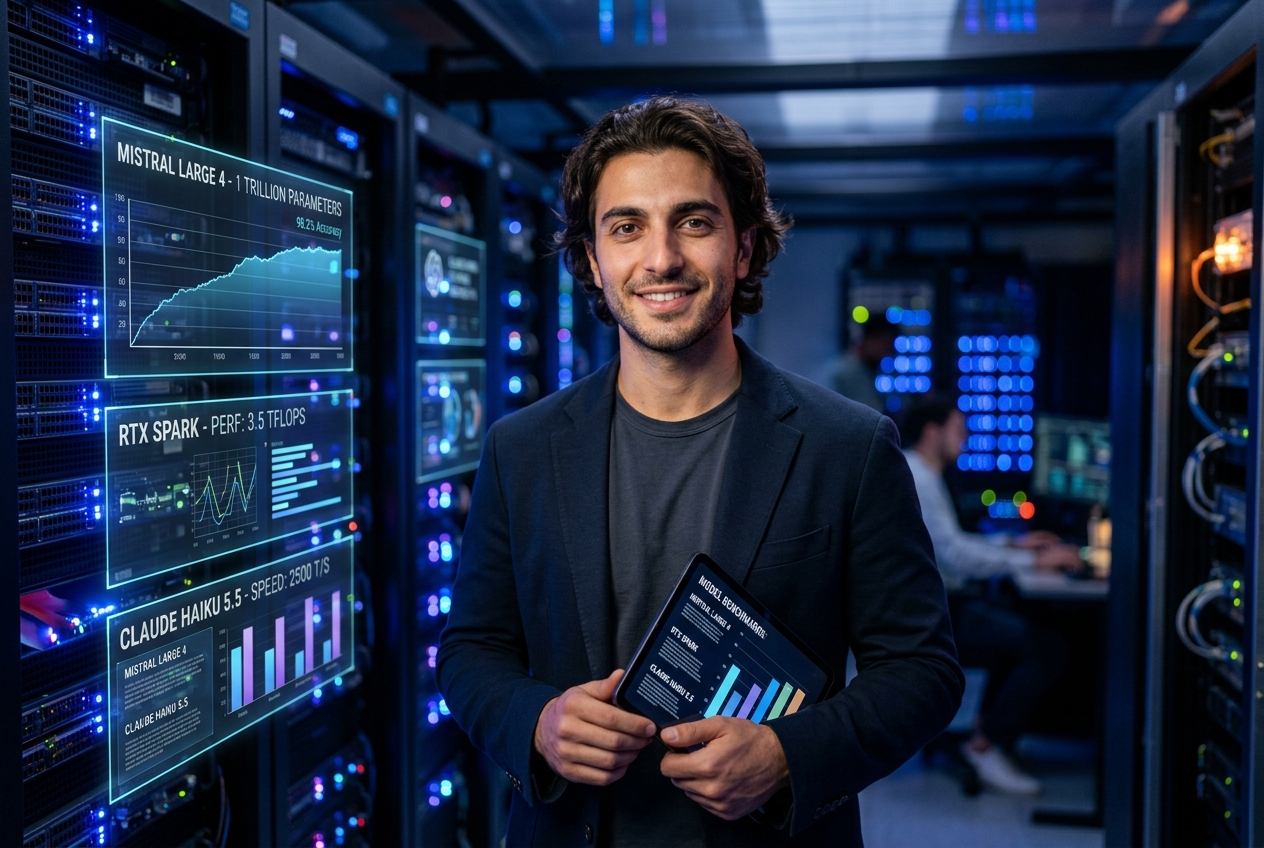
The headline that set the tech world abuzz on October 7 came from Paris. Mistral AI, the French startup that has positioned itself as Europe’s champion of open-weight AI, released a public preview of Mistral Large 4 — internally nicknamed “le Chonk” — a natively multimodal model with 1 trillion total parameters and 49 billion active parameters.
To put that in perspective: the model was trained from scratch on 3,800 NVIDIA Grace Blackwell GPUs in Mistral’s own European datacenters. The training corpus spans more than 160 languages, including every official language of the European Union. At a reported scale of 3,000 GPUs, a single training run produces roughly 33 billion tokens per day, with about 16 billion trainable completion tokens after filtering and masking.
“We are red-teaming the model in real-world settings with cybersecurity leaders, vetted partners, and state authorities,” Mistral stated in its announcement, signaling an aggressive deployment strategy that includes private cloud and on-premise operation via an open-weight release scheduled for the end of October 2026.
Mistral Large 4 Preview is already available via Mistral Studio’s API, and the company says it will release full architecture details, additional benchmarks, and its post-training methodology alongside the weights.
Benchmarks That Matter
Mistral’s numbers are impressive, though they don’t topple the absolute state-of-the-art on every metric. Here’s where Large 4 stands:
- Cybersecurity: Ranked among the top five models on the Artificial Analysis Cyber Index. Achieved an 82% score on a test requiring models to reproduce a real vulnerability in open-source software and then patch it — the highest score of any model on that test. Solves 93% of Cybench’s 40 security-competition exercises.
- Coding: 61.7% on DeepSWE v1.1, 59.4% on SWE-Atlas-QnA, and 28.3% on Terminal-Bench 4. Combined Coding Agent Index score: 49.8%.
- Blind Human Evaluation: Professional coders rated Large 4 Preview 3.74 out of 5 (with model identities hidden), ranking second behind Claude Opus 5 at 4.22, but ahead of GPT-6-class models.
- Business Automation: 59.9% on AutomationBench, covering 657 business workflows across Gmail, Google Sheets, Slack, and Salesforce.
- Visual Grounding: 42% on the Dense 200 benchmark, compared to 41% for GPT-6-Astra in Mistral’s testing.
- Safety: Resisted 93.3% of attacks on Lakera’s public B3 AI Security Benchmark.
The reinforcement learning run behind the preview remains in progress, meaning the final model — and its open-weight release — could improve further. “The RL run behind the preview remains in progress,” Mistral confirmed, hinting that we haven’t seen the final version yet.
2. Trump’s AI Genesis: The White House Summit That Changed Everything
While Mistral was making waves from Europe, President Donald Trump convened the “Science: A New Golden Age” Summit at the White House on October 8th, bringing together the most powerful figures in American technology. The event marks the first time Trump has awarded the National Medal of Science and the National Medal of Technology and Innovation during either of his administrations.
The honorees read like a who’s-who of the tech pantheon:
- National Medal of Science: Elon Musk (Tesla/SpaceX), Sergey Brin (Google co-founder), Jensen Huang (Nvidia CEO), Lisa Su (AMD CEO)
- National Medal of Technology and Innovation: Michael Dell (Dell Technologies CEO), Satya Nadella (Microsoft CEO)
White House spokesperson Liz Huston told Fox News Digital: “The Trump administration is grateful for the contributions of these incredible leaders in science and technology. These recipients are helping ensure America keeps leading the world in innovation.”
But the ceremony was just the public face of something much bigger. The summit announced over $1 billion in commitments for the Trump administration’s “Genesis Project” AI push, including investments from the National Science Foundation (NSF) and the Department of Energy. Axios reported that $100 million in computing credits will be distributed through a new entity called “National Compute” — effectively a government-backed cloud voucher program for researchers and startups.
Elon Musk’s presence at the summit is particularly notable. After a high-profile departure from the administration and a public feud over Trump’s signature tax-and-spending bill (which Musk called “a disgusting abomination”), the Tesla CEO has returned to Trump’s orbit. He now co-leads the Pentagon’s Project Meridian, which studies the future of warfare and the technologies the U.S. military needs to maintain its technological edge.
The message from the White House is unmistakable: the United States is treating AI as a national security priority, not just a commercial opportunity. With the Genesis Project, federal compute credits, and the highest civilian science honors going to tech CEOs, the administration is signaling that American AI dominance is a bipartisan, existential imperative.
3. Anthropic’s Haiku 5.5: Speed Demon for the Masses
Adding to the model avalanche, Anthropic quietly released Claude Haiku 5.5 on October 7th — its cheapest, fastest, and most capable small model ever. The numbers are striking:
- Speed: Anthropic’s fastest model to date. Early testers report over 30% reduction in latency for task completions and up to 2.5x faster inference per agent turn.
- Price: Around 75% cheaper on average than last year’s Haiku 4.5. Input tokens cost just $0.10 per million for prompts up to 100K tokens.
- Performance: Scores 57.4% on Humanity’s Last Exam (with tools), 46.4% on Chartography visual reasoning, and 39.2% on Terminal-Bench 4.0 — a massive leap from Haiku 4.5’s 0.0%.
Haiku 5.5 is also the first Haiku-class model with an adjustable effort setting, allowing developers to optimize for either cost or intelligence depending on the task. It’s designed for high-volume, cost-sensitive workloads: summaries, database queries, classification, live customer support, and browser use.
Asana’s Aaron Vinh, Staff Software Engineer, said: “We ran it through our eval suite for AI Teammates, covering use cases like triaging bugs, setting up projects, and searching large portfolios. Compared with the model we use today, we saw over a 30% reduction in latency for task completions and up to 2.5x faster inference per agent turn. It’s a noticeably snappier experience.”
Alongside the Haiku release, Anthropic cut the price of Sonnet 5.5 cache reads by 50% (now $0.10 per million tokens), reducing the cost of Sonnet 5.5 on most agentic tasks by around 20%. The company also announced new monthly API credits for Claude Max and Team subscribers — up to $500 per month — designed to encourage experimentation with building tools, apps, and agents.
4. Microsoft Surface Laptop Ultra: The RTX Spark Era Begins
Microsoft held its Windows and Surface event on October 7th, and while the software announcements were incremental, the hardware was anything but. The Surface Laptop Ultra — Microsoft’s long-awaited MacBook Pro competitor — is now available for pre-order with a starting price of $2,599 and shipments beginning October 16th.
The star of the show is the Nvidia RTX Spark chip, an Arm-based processor that combines CPU and GPU in a single die. The Surface Laptop Ultra features an 18-core version with 24GB of unified memory (up to 128GB in the top configuration). The result is a laptop that can handle compressed 280 billion-parameter AI models running locally — models that required cloud infrastructure just a year ago.
Microsoft’s Brett Ostrum, corporate vice president of Surface, was candid about the strategy: “The Copilot Plus PC initiative from 2024 was really aimed at MacBook Air. We knew that was not going to reach MacBook Pro-level compute.” Nvidia began privately showing its RTX Spark capabilities around that time, and “it literally made a ton of sense for us in terms of how to go and compete with the MacBook Pro.”
The device itself is a marvel of industrial design: a CNC-machined aluminum body, haptic-feedback trackpad, 15-inch HDR touchscreen with up to 2,000 nits of peak brightness, and a built-in magnetic USB-C charging port — the world’s first, which the company is patenting. Microsoft’s design team reportedly went through 300 iterations on the charging mechanism alone.
HP accidentally revealed that competing RTX Spark laptops will start at $2,999 (16-inch OmniBook X with 18-core CPU, 32GB RAM) and go up to $4,999 (OmniBook 16 with 64GB), suggesting the RTX Spark platform will occupy the ultra-premium segment of the Windows laptop market.
5. Samsung’s AI-Fueled Record Profits
Underpinning all of this AI activity is the hardware that makes it possible. Samsung reported its latest quarterly results on October 7th, and they’re staggering: projected operating profit is 782% higher than the same period last year, with revenue forecast at about 195 trillion won — up nearly 127% year-over-year.
The driver? Insatiable demand for Samsung’s memory chips, particularly the high-bandwidth memory (HBM) used in AI training infrastructure. Every model mentioned in this article — Mistral Large 4, Claude Haiku 5.5, and the RTX Spark’s training runs — depends on the kind of memory fabrication that Samsung and its Korean rival SK Hynix have perfected.
The semiconductor industry’s AI boom shows no signs of slowing. Samsung’s numbers confirm that the AI infrastructure buildout is accelerating, not peaking.
6. Google’s SynthID Goes Global: The Invisible Watermark
Amid the model releases and hardware announcements, Google quietly rolled out its SynthID AI content detector globally. The tool scans images, video, and audio files for Google’s SynthID watermark — a near-invisible marker embedded into AI-generated content at the point of creation.
This is significant for two reasons. First, it represents the first large-scale deployment of a practical AI provenance system, potentially giving platforms a technical mechanism to label AI-generated content automatically. Second, it arrives as governments worldwide are grappling with AI-generated misinformation ahead of major elections.
SynthID works by embedding a digital watermark into the pixels or audio frequencies of AI-generated output. The watermark is imperceptible to humans but detectable by Google’s scanner. The technology was first demonstrated in May 2024 and has been refined over two years of testing. Its global rollout means that billions of AI-generated images, videos, and audio clips passing through Google’s ecosystem will now carry a detectable fingerprint.
7. Meta’s Muse Comes to Windows
Meta’s AI agent Muse is getting a native Windows app, Windows and Surface chief Pavan Davuluri announced at Microsoft’s event. No timeline was given, but the move follows Meta’s launch of a Mac Muse app in September 2026.
Muse represents Meta’s bet on AI agents — not just chatbots, but proactive assistants that can browse the web, interact with applications, and perform multi-step tasks on behalf of users. The Windows-native version suggests Meta sees enterprise productivity as a key battleground for AI agents, competing directly with Microsoft’s Copilot and Anthropic’s Claude.
What It All Means
October 8, 2026, may be remembered as the day the AI landscape became unmistakably geopolitical. Europe is no longer content to consume American AI: Mistral Large 4, trained on European soil with European data and released as open weights, is a sovereign AI play as much as a technical one. The White House’s Genesis Project and National Compute initiative signal that the U.S. government is fully committed to maintaining American AI supremacy through direct investment, not just regulation.
Meanwhile, the cost of AI continues to plummet. Anthropic’s Haiku 5.5 offers GPT-6-class performance (on some benchmarks) at 75% less than last year’s small model. Nvidia’s RTX Spark brings 280-billion-parameter models to a laptop. The democratization of AI capability is accelerating at a pace that makes even last year’s predictions look conservative.
For developers, the takeaway is clear: the AI toolkit has never been more powerful, more affordable, or more diverse. Mistral offers open-weight sovereignty, Anthropic offers raw speed and cost efficiency, and the U.S. government is offering compute credits. The barrier to building world-class AI applications has never been lower.
Stay tuned. If the last 48 hours are any indication, we’re in for a wild ride through the rest of 2026.
Date: October 8, 2026 | Author: Vito Ruocco | Categories: AI, Technology