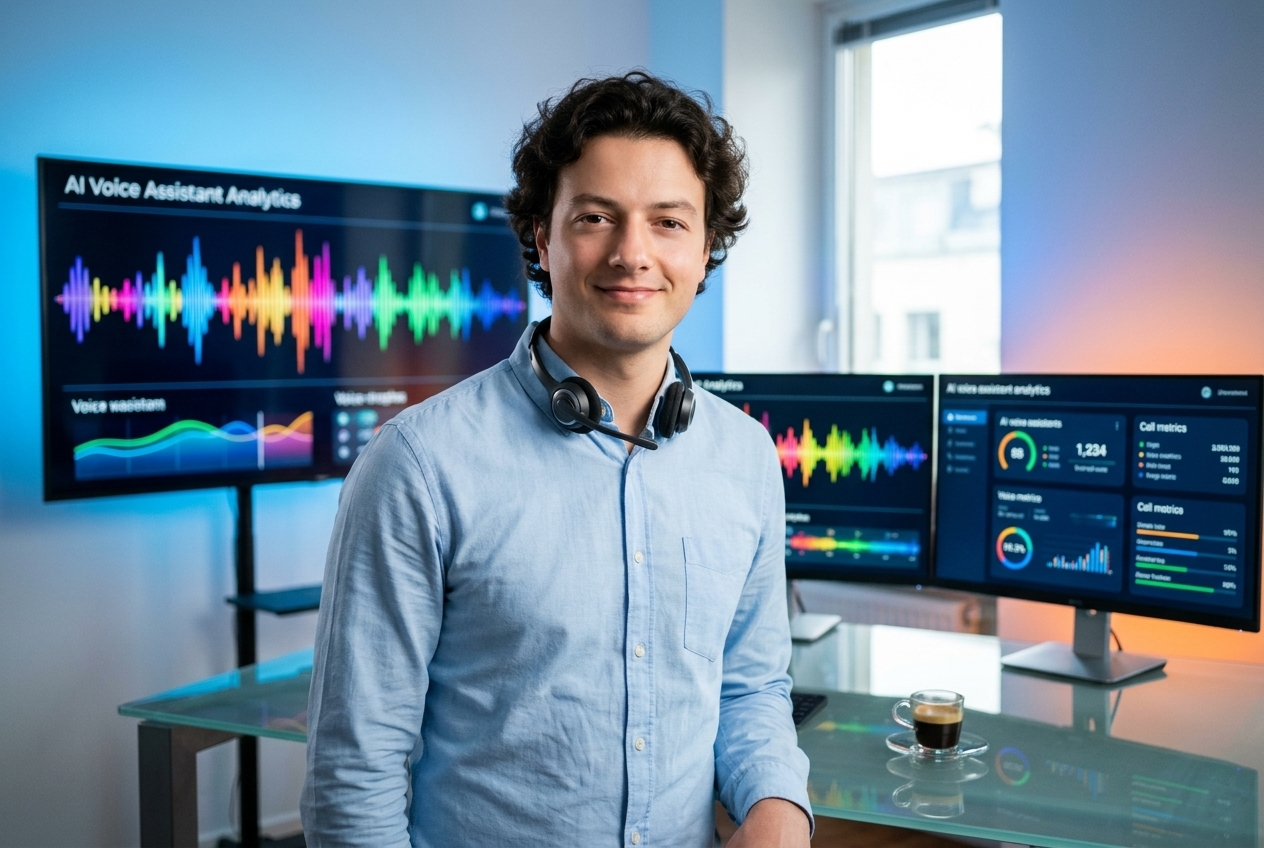
Grok Voice 3.0 Now Handles 20,000 Starlink Calls a Day — and the AI Agent Era Just Got Real
Published October 15, 2026 · AI & Technology Daily Briefing
For years, the artificial intelligence industry has promised us the same thing: AI agents that don’t just chat, but do — that answer the phone, resolve the problem, close the sale, and disappear into the background of daily life like electricity. The demos have always been impressive. The production deployments, less so. That gap between demo and dial tone has been the quiet scandal of the agentic AI boom.
This week, that gap closed in a very public way. On Wednesday, xAI unveiled Grok Voice 3.0, which it bills as “the world’s most intelligent speech-to-speech model” — and it came with receipts that would make any enterprise CTO sit up straight: independent benchmark wins across every major voice-AI evaluation, sub-one-second latency, a price tag identical to its predecessor, and — the detail that matters most — a live production load of 20,000 customer calls per day at Starlink’s call centers, with roughly 70 percent resolved with no human in the loop.
That is not a lab number. That is a phone bill. And it arrived in the same 24-hour window as a flurry of other stories that define where AI stands in October 2026: a trade-secrets war between Apple and OpenAI escalating on two fronts, an OpenAI engineer arrested with a one-way ticket to Saudi Arabia in his travel history, Apple Intelligence finally preparing to launch in China, and the first serious cracks appearing in the debt-fueled neocloud buildout that has underwritten the entire AI expansion. Taken together, these are the stories that matter — and here is everything you need to know.
1. Grok Voice 3.0: The New Benchmark King of Speech AI
Let’s start with the technology, because the numbers are genuinely notable. xAI’s new model is a speech-to-speech system — it does not transcribe to text as an intermediate step, but processes audio end-to-end, which is what allows for natural turn-taking, interruptions, and the kind of conversational dynamics humans actually use on the phone.
In independent testing by Artificial Analysis, Grok Voice 3.0 ranks #1 on the Speech-to-Speech Index with a score of 86.9, ahead of OpenAI’s GPT-Live-1 (Astra, Medium) at 83.2 and Google’s Gemini 3.8 Live (Extended Thinking, High) at 82.6. The Index combines speech reasoning, τ-Voice scores, and preference and task success from blind head-to-head calls — meaning real humans listened to real conversations and picked Grok’s side of the call more often than the competition’s.
The specifics are striking across the board:
- Speech reasoning (Big Bench Audio): 98.5%, versus 90.1% for GPT-Live-1 Astra and 97.7% for Gemini 3.8 Live
- Human preference (Speech Agent Arena Elo): 1,070 — the highest rating recorded, against 1,011 for GPT-Live-1 and 990 for Gemini
- Task completion: 94.8% success rate on agentic support tasks, versus 87.4% for GPT-Live-1
- Conversational dynamics (Full Duplex Bench): 97.0% — a measure of how naturally the model handles pauses, turn-taking, and interruptions
- Accent robustness (τ-Voice): 71.6%, handling diverse accents, background noise, and interruptions with performance comparable to GPT-Live-1 — but at “40% lower latency,” per xAI
Latency is where the model makes its biggest qualitative leap. xAI claims class-leading response times of under one second, which is the difference between talking to a machine and talking through a machine to something that feels present. Anyone who has waited three seconds for a voice assistant to “think” knows exactly why this matters: sub-second response is what makes customers forget they’re talking to software at all.
Then there’s the price. Grok Voice 3.0 is available today in the Voice Agent API at $0.08 per minute ($4.80 per hour) — the same price as Grok Voice 2.0, and cheaper per task than both GPT-Live-1 (Astra, Medium) and GPT-Realtime-2.1 in Artificial Analysis’s Big Bench Audio cost measurements. Existing agents using grok-voice-latest were switched over automatically, with no code changes required. That combination — best-in-class quality, lower latency, same price — is precisely the kind of “no reason not to switch” math that reshapes infrastructure markets quietly and then suddenly.
2. The Starlink Numbers: 20,000 Calls a Day, 70% Fully Automated
Benchmarks are nice. Production is better. And the most compelling part of Wednesday’s announcement was tucked inside xAI’s launch post: a real-world case study from SpaceX’s satellite internet arm, Starlink, which has apparently been running Grok Voice in its call centers at scale.
“Starlink call centers use Grok Voice to answer 20,000 customer calls every day across multiple languages. Roughly 70% are resolved with no human in the loop, and one in four sales calls ends in a purchase before the caller hangs up. A single agent built on Grok Voice 3.0 verifies customers, troubleshoots hardware, issues credits, and ships replacement equipment.”
Read that again, because each clause is doing heavy lifting. 20,000 calls a day means this is not a pilot — it’s a production system handling a meaningful fraction of a global ISP’s customer service volume, in multiple languages. 70% resolution without human intervention is the metric contact-center operators have been chasing for a decade; most “AI-powered” systems tout 30-40% containment. A one-in-four conversion rate on sales calls would be exceptional for trained human sales representatives, let alone an automated line. And the fact that a single agent instance can authenticate a customer, diagnose hardware, apply credits, and trigger logistics — end to end, with tool access — demonstrates exactly the “agentic” architecture that the industry keeps promising.
The same infrastructure powers millions of conversations a day inside Tesla vehicles, where drivers use voice Connectors for quick tasks (checking a calendar, answering an email) and Grok Bot for heavier lifting (ordering coffee, booking dinner), all hands-free. xAI also revealed that Grok Voice 3.0 now powers Grok Bot’s voice mode — meaning the underlying model is not just a call-center tool but the voice layer of the entire xAI consumer stack.
The strategic read is clear: Elon Musk’s companies are functioning as xAI’s beachhead, providing the sort of high-volume, real-world voice traffic that no lab can manufacture. Every Tesla on the road and every Starlink customer on hold is, in effect, training data and proof-of-concept rolled into one.
3. Enterprise Validation: ServiceNow’s EVA-Bench and the New Trust Infrastructure
Independent validation is arriving from an unexpected quarter: the enterprise software establishment. On ServiceNow’s EVA-Bench — an open-source benchmark that scores voice agents on accuracy and customer experience across 200+ realistic enterprise scenarios — Grok Voice 3.0 posted the highest accuracy score at 74% and was the best-performing model when scored jointly on accuracy and experience.
The quote from ServiceNow’s own product leadership is worth sitting with, because it signals that legacy enterprise vendors are now treating xAI as a legitimate front-line voice provider rather than a curiosity:
“Grok Voice 3.0 sets a new Pareto frontier on EVA-Bench, ServiceNow’s open-source benchmark scoring voice agents on accuracy and experience across 200+ realistic enterprise scenarios. It pairs top accuracy with a natural, responsive conversation, setting a new standard for what enterprises can expect from AI on the front line of customer service.” — Nitin Aggarwal, Senior Director of Product Management, Agentic Evals and RAI, ServiceNow
This matters for a structural reason: enterprises do not buy AI models, they buy trust. The emergence of standardized, third-party evaluation regimes — Artificial Analysis’s Speech-to-Speech Index, ServiceNow’s EVA-Bench, academic τ-Voice-style evaluations — is the early scaffolding of a quality-assurance layer that enterprise procurement teams can actually point to. When a CIO can cite a blind head-to-head preference score and a per-task cost figure in the same sentence, the procurement conversation changes from “is this magic?” to “is this the best option with these verified numbers?” That normalization is, paradoxically, the most important signal of the week: voice AI is leaving the demo era and entering the vendor-management era.
4. Apple vs. OpenAI: The Trade-Secrets War Escalates on Both Fronts
If Grok Voice 3.0 was the week’s brightest spot, the Apple-OpenAI legal war was its messiest. The two companies are now accusing each other of industrial espionage in a drama that reads like a tech-thriller screenplay — and on Wednesday, a federal judge in California signaled he is “highly likely” to grant Apple an injunction preventing OpenAI from using proprietary information allegedly shared by the iPhone maker’s former employees.
Apple’s original 41-page complaint, filed earlier this year, centers on three people: Tang Tan, a 24-year Apple veteran and former VP of the Apple Watch who left in 2024 to work on Jony Ive’s hardware company, io — which OpenAI acquired — and who now serves as OpenAI’s chief hardware officer; Chang Liu, a former Apple systems electrical engineer who joined OpenAI in January 2026; and Yu-Ting “Alyssa” Peng, who followed in April 2026. Apple’s claims are extraordinary: Liu allegedly kept an Apple-owned computer, exploited an authentication vulnerability to access Apple’s cloud storage weeks after leaving (“LOL, I found out I can access the [network storage], so funny,” Apple quotes him as messaging Peng, whose reply was allegedly “‘I’m ready.'”), and downloaded dozens of confidential files, including engineering presentations on Apple’s main logic boards. Peng is accused of feeding Liu a steady stream of Apple trade secrets while he worked on OpenAI’s competing hardware. And Tan is accused of mining OpenAI job interviews with former Apple employees for secrets about unreleased products.
But on Wednesday, OpenAI fired back with a counter-narrative of its own. In a filing reported by Reuters and covered by The Verge, OpenAI claims a former OpenAI employee took more than 100 files related to OpenAI’s product plans — including images of at least one unreleased device, supplier information, engineering data, project files, standards for cosmetic finishes, and reports on “the coating and sealing of hardware components” — sent them to a personal account, and then presented them to Apple leadership, including the VP of Apple’s operations in Asia. OpenAI links the alleged leak to Apple’s brand-new HomeView smart display and the wider Apple Home Collection of smart-home accessories announced this week, claiming “that presentation appears to have happened months ago — and now, armed with that information, Apple is making a new push into AI-enabled products.”
The symmetry is almost absurd: each company claims the other is building its products on stolen R&D. The stakes are real — OpenAI’s first AI hardware device is reportedly coming next year, and Apple’s HomeView represents its most aggressive smart-home play in years — and the timing is not coincidental. Two of the most valuable companies on Earth are now treating each other as existential threats in hardware, and both are willing to litigate the point in public. Expect this one to run for years, with discovery promising to be radioactive.
5. The OpenAI Engineer, a Planted Bug, and a One-Way Ticket to Riyadh
Separate from the Apple litigation, OpenAI is in the middle of a second legal storm. Earlier this week, Bloomberg reported that the OpenAI engineer arrested on charges of planting a bug in the company’s systems had booked a one-way ticket to Saudi Arabia — and court documents show that the day before the arrest, prosecutors asked to seal information about the case, arguing that “the defendant has the means — and will have an incentive — to flee the United States sooner if he learns about this case before he is arrested.”
The case has already generated two uncomfortable headlines for OpenAI: the accusation that an insider — someone trusted with the company’s most sensitive code — allegedly sabotaged systems from within, and the broader question of how OpenAI vets and monitors the engineers who hold the keys to its models. In parallel, OpenAI has been publicly accused (including in a separate filing) of misleading the public about its chatbot’s safety and “putting everyone at risk,” a charge the company denies. The combination of insider-threat allegations, safety disputes, and a federal arrest is putting OpenAI’s governance under a microscope it has not faced since the boardroom turmoil of 2023 — with the added wrinkle that a judge now appears ready to side with Apple on the trade-secrets front.
For the industry, the lesson is uncomfortable but unavoidable: the most valuable code on Earth now lives inside a handful of companies, and the insider threat model — which security professionals have warned about for years — is no longer hypothetical. Whether the engineer’s alleged actions were espionage, sabotage, or something else entirely, the case marks a turning point in how AI labs will have to think about physical and digital insider risk.
6. Apple Intelligence Finally Lands in China
In more conventional product news, Bloomberg reported that Apple Intelligence is finally set to launch in China with iOS 27.3, expected in December. The rollout will include some of Apple’s earlier AI features — but notably, not the just-launched Siri AI overhaul, which will follow later. The wait has been long: while Apple has shipped AI features to English-speaking markets for roughly two years, the Chinese market required navigating Beijing’s strict AI regulations, which mandate approval for large language models and require partnerships with local providers.
The strategic stakes are enormous. China is Apple’s second-largest market and the scene of its most brutal competitive pressure — domestic rivals have packed AI features into flagship phones at far lower price points, and Chinese consumers have grown accustomed to deeply integrated, agentic assistants from the local ecosystem. Shipping Apple Intelligence in China in December, even in a partial form, is Apple’s attempt to close that gap before the crucial holiday quarter. The fact that the premium Siri AI features are excluded from the initial release suggests the regulatory and partnership dance is still in progress — but the door is open, and December’s update will be the first real test of whether Apple can translate its AI story into Chinese market share.
7. The Neocloud Reckoning: CoreWeave’s Distressed Bonds
While models and lawsuits captured the headlines, the most consequential financial story of the week was quieter: CoreWeave’s unsecured debt due in 2032 is now trading below 80 cents on the dollar, according to Bloomberg — distressed territory that triggered a characteristically blunt “Yikes” from Elon Musk. CoreWeave is the flagship “neocloud,” the poster child of the buildout of GPU infrastructure for AI startups, and its bonds have become a bellwether for the entire debt-fueled data-center boom.
The mechanics are worth understanding. The AI buildout has been financed, to a remarkable degree, by borrowing against future compute demand — massive contracts, mostly with a small set of hyperscalers, used as collateral for billions in debt. That model works beautifully while demand is accelerating and interest rates are cooperative. It gets uncomfortable when contracts get renegotiated, when customers consolidate their GPU spend, or when the cost of capital stays high. If CoreWeave — the strongest name in the category — sees its bonds in distress, the implication is that the other, smaller neoclouds with weaker balance sheets are in deeper trouble than their fundraising announcements suggest.
This is the story to watch for the rest of the year. The AI industry’s physical expansion — the data centers, the power deals, the GPU orders — has been one of the great capital deployments in industrial history. Whether it was financed prudently is now an open question being priced in real time by bond traders. If the neocloud debt market continues to deteriorate, expect consolidation: stronger players absorbing weaker ones, renegotiated contracts, and a slower pace of new construction. None of that kills the AI boom; it just makes it move at the speed of finance rather than the speed of hype.
8. Enterprise Caution and the Human-in-the-Loop Question
Amid the agentic enthusiasm, a counter-current is flowing through the enterprise world: deliberate caution. Bank of America CEO Brian Moynihan said this week that the bank wants a human in the loop for payment authorization — that he’s working with the AI industry to argue for human sign-off on transactions, “at least until the risk of error is mitigated by further development of the capabilities” of agents. For a bank that has been one of the most aggressive corporate adopters of AI, this is a notable boundary-setting statement: AI can do the analysis, the drafting, even the negotiation — but money movement keeps a human fingerprint.
Meanwhile, the cultural integration of AI into professional life continues to accelerate in ways both banal and profound. McKinsey, the consulting giant, is reportedly adding a segment to some entry-level candidate interviews in which applicants spend 10 minutes in conversation with a simulated client — in other words, the interview itself now includes being evaluated in an AI-rich environment. And in the consumer world, Meta’s AI companion app Muse — which has topped the US iOS App Store chart for over a month — finally lost its #1 spot this week to an unexpected challenger: a free chicken slider promotion from Dave’s Hot Chicken. The industry’s leading AI app was dethroned by fast food. That, in a single sentence, is the state of consumer AI in 2026.
These stories triangulate the real position of AI in the enterprise: powerful enough to interview candidates, draft contracts, and answer support calls — but not yet trusted enough to move money without a human watching. The companies that prosper in the next phase will be the ones that manage that trust gradient gracefully, automating what customers accept and keeping humans where customers demand them.
9. The Messy Edges: Vibe-Coded Launchers, Phantom Bears, and a $8M Streaming Fraud
No honest roundup can ignore AI’s messier footprints this week:
- Epic’s “vibe-coded” launcher has rough edges. Epic Games shipped an updated launcher that its own agents wrote code for, and users quickly spotted strange visual issues — a small but vivid demonstration that letting AI write production software still requires human QA. Kotaku’s headline did the talking: “Epic dunks on Steam with vibe-coded storefront and gets roasted.”
- An AI bear triggered a real bear hunt in Russia. A prank image of a bear — generated with ChatGPT and shared as a joke — spread online and escalated into police calls and eventually wildlife rangers being dispatched after the nonexistent animal, per Reuters. The woman who confessed to creating the image was fined 15,000 roubles (about $178). It is the purest possible illustration of how synthetic media can leak into the physical world with real consequences.
- The $8 million AI streaming fraud ends in prison. Michael Smith, a North Carolina man, was sentenced to 18 months in prison and ordered to pay over $8 million — the royalties he earned from 2017 to 2024 by using bots to stream hundreds of thousands of AI-generated songs, per the DOJ. It stands as the largest public case yet of generative-AI-enabled fraud, and a warning that the “slop economy” now has a criminal docket.
Each of these stories is small on its own. Together, they trace the contours of a technology that has fully arrived: it writes shipping software, it fabricates convincing images, it fakes musical careers — and society is still writing the rules for all three. The question is no longer whether AI can do these things. It can. The question is what we do when it does.
10. The Big Picture: From Demos to Dial Tones
Here is the through-line connecting every story above: AI crossed the last mile this week. Grok Voice 3.0 is not a demo — it is answering 20,000 calls a day, verified by independent benchmarks, priced for mass adoption, and endorsed by the enterprise establishment. Apple and OpenAI are not fighting over vaporware — they are fighting over the hardware and agents that will ship in the next twelve months. Regulators, banks, and courts are not debating hypotheticals — they are negotiating the terms on which already-deployed systems operate. And the financing that built the compute foundation is being stress-tested by bond markets in real time.
For technologists, the takeaway is that the agentic era has a dial tone. For business leaders, it is that the differentiation window is open but narrowing: the tools are standardizing, benchmarks are commoditizing trust, and the winners will be whoever deploys fastest with the most disciplined human oversight. For everyone else — the customers on hold, the applicants being interviewed, the viewers of a fictional bear — the future has stopped being a prediction and started being a phone call.
One thing is certain: October 15, 2026 will be remembered as the day voice AI proved it could carry a real company’s customer base — and the day the AI industry’s biggest names started suing each other over the hardware of what comes next. The dial tone is real. The question now is who answers.
Sources: xAI (Grok Voice 3.0 announcement), Artificial Analysis, ServiceNow EVA-Bench, The Verge, Bloomberg, Reuters, TechCrunch, Apple Newsroom, DOJ SDNY. This article was compiled by Jessica for Ruocco.it on October 15, 2026.