
Published: October 15, 2026 | By Vito Ruocco
Someone gave an unreleased Claude model a single sentence: show civilization from day one to now, go all out. What came back is a three-minute film with no camera, no stock footage and no images. Every frame is drawn by code. In this week’s video I play that film in full at the end, but first I go through the news that matters: a humanoid robot that learned a game by watching one video, a voice model that just took first place, a big Claude Code update, and Anthropic’s revenue ahead of its IPO. Then I took three free models you can use right now inside OpenCode, gave them the same three prompts, including that exact film sentence, and published all nine results so you can play them in your browser.
The Short Version
- Robotics: Gemini 4 Argon watched a normal video of a person playing cornhole, wrote its own physics simulation and trained Apptronik’s Apollo humanoid, which then landed seven throws in a row in the real world. Google calls it Video to Sim to Real.
- Voices: Grok Voice 3.0 is first on Artificial Analysis’s speech-to-speech index with 86.9. Fish Audio Drama 3 is an open text-to-speech model that can put sixteen different voices in one text.
- Claude Code: the desktop app is rebuilt around running many sessions side by side, a new idle compaction feature saves tokens on long conversations, and Claude Platform can now send OpenTelemetry traces in public beta.
- Anthropic: a reported $16.8 billion in revenue in the third quarter, adjusted profitability, and an IPO expected as early as November.
- The test: Cat Jam, MiMo-V2.6-Flash and Big Pickle, all free in OpenCode, got the same three prompts. Cat Jam was by far the fastest and the sloppiest. MiMo made the most polished interfaces but stalled. Big Pickle was slow and made the best game and the best film. And on my first run, one of them left its folder and started running programs on my computer.
- Fable 5.5: officially it does not exist yet. The only hard evidence is an entry in Microsoft Azure’s model catalogue, picked up by a bot in the LiteLLM project. Everything else is a rumor, and I treat it as one.
How I Wrote This
I started from a long AI news roundup published the same morning and used it only as a list of things to check. Every number in this article was re-read on the original page: the company’s own announcement, the official changelog, the model card, the GitHub pull request. Several things did not survive that check. A reported compute plan of one, then five, then ten gigawatts had no source I could find, so I replaced it with the deal Anthropic actually announced. A claim about a large disk-space saving in a desktop app had no source either, so it is not here. And I dropped a story about an arrest that was in the original roundup, because it has nothing to do with what this channel is about. Where a number comes from a company grading its own product, I say so.
A Robot That Learned From One Video
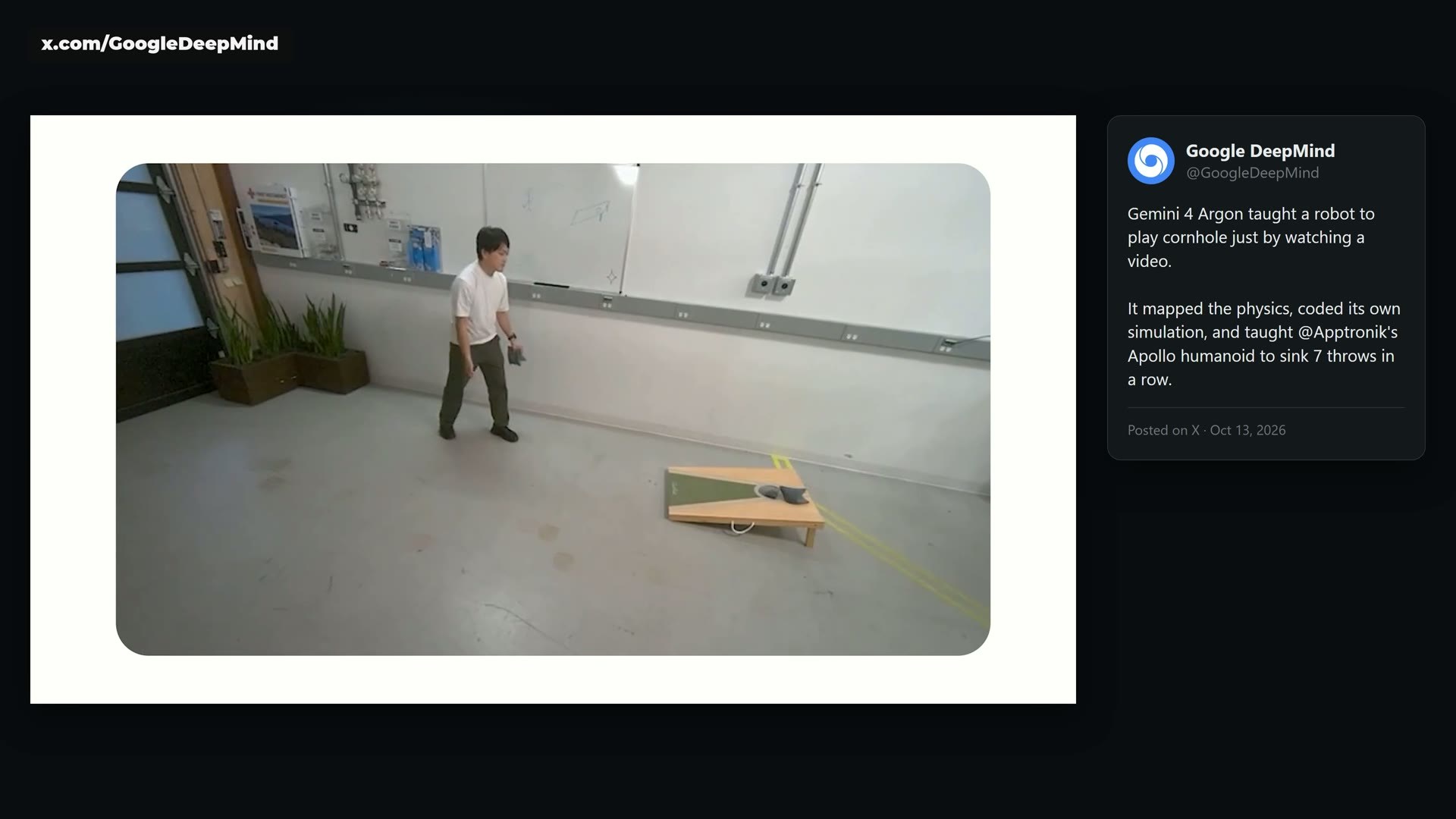
The first story is the one I find most important for the long run. Google DeepMind published a short video in which Gemini 4 Argon is shown an ordinary clip of a person playing cornhole, the game where you throw a bean bag onto a sloped wooden board with a hole in it. From that clip alone, the model worked out the physics of the throw: the board, the bag, the arc, and the movement of the body. Then it did something that used to take a team of engineers: it wrote its own simulation, in code, and used that simulation to train a humanoid robot.
The robot is Apollo, built by Apptronik. In the real-world trial at the end of the video, Apollo lands seven throws in a row into the hole.
Google’s name for this is Video to Sim to Real. In normal robotics work, a team spends weeks building a simulation by hand before a robot can practise anything inside it: measuring objects, tuning friction, writing the environment. Here the model built the simulation from a video, and Google says the process went from weeks to a few hours. Google is careful to call this an internal test, not a product you can buy, and I want to be just as careful. But think about what it means if it scales. Robots learn slowly because collecting training data with real robots is slow and expensive. If a model can turn any video of a person doing a task into a training ground for a robot, the bottleneck stops being robot data. It becomes video, and the world has an almost endless supply of video.
Voices: One Closed, One Open
Two voice releases this week, aimed at the same goal: sounding like a real person in a real conversation.
Grok Voice 3.0
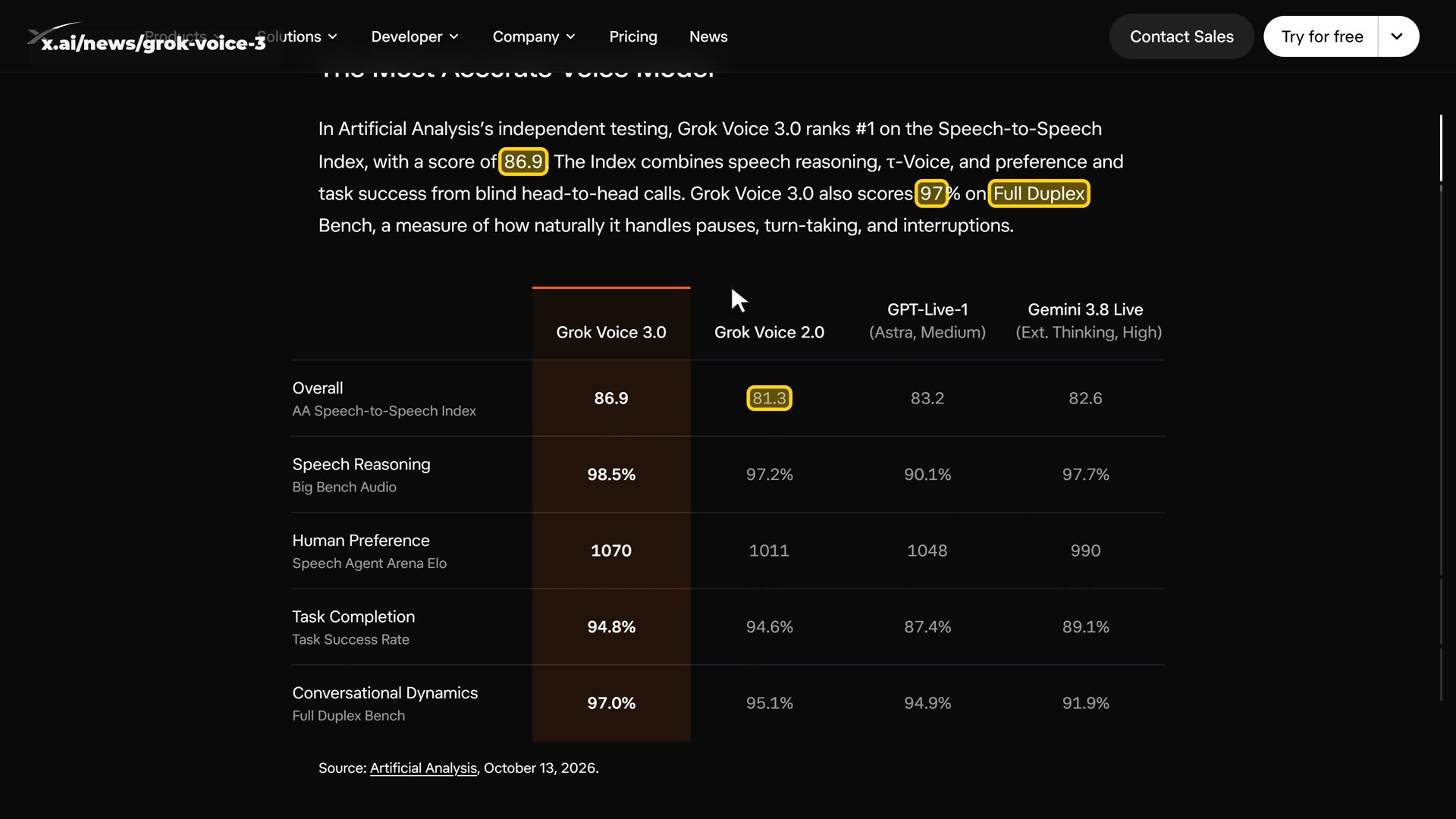
xAI published its announcement for Grok Voice 3.0 on October 14. The headline is that it is the most intelligent voice model in the world, and on Artificial Analysis’s speech-to-speech index it does take first place with a score of 86.9. The previous version, Grok Voice 2.0, scored 81.3. OpenAI’s GPT-Live-1 is at 83.2 and Gemini 3.8 Live at 82.6.
The number I find more interesting is Full Duplex Bench, which measures how well a voice model handles an actual conversation: pauses, turn taking, and being interrupted halfway through a sentence. Grok Voice 3.0 scores 97 percent there, up from 95.1. To be fair, on the customer-service benchmark called tau-Voice it scores 71.6 percent, which is still below GPT-Live-1’s 74.5. xAI’s argument is that it gets close while answering with about forty percent lower latency.
The price did not change: eight cents per minute through the API, which is $4.80 per hour. If your application already calls grok-voice-latest, you are on the new model without changing anything. xAI also says it handles millions of conversations a day in Tesla cars, and that Starlink’s support line takes about twenty thousand calls a day with roughly seventy percent resolved without a human. Those are the company’s own figures, not an independent audit, but they show where voice agents are already in production. In the video I play a short demo of it inside a car, with its original sound.
Fish Audio Drama 3
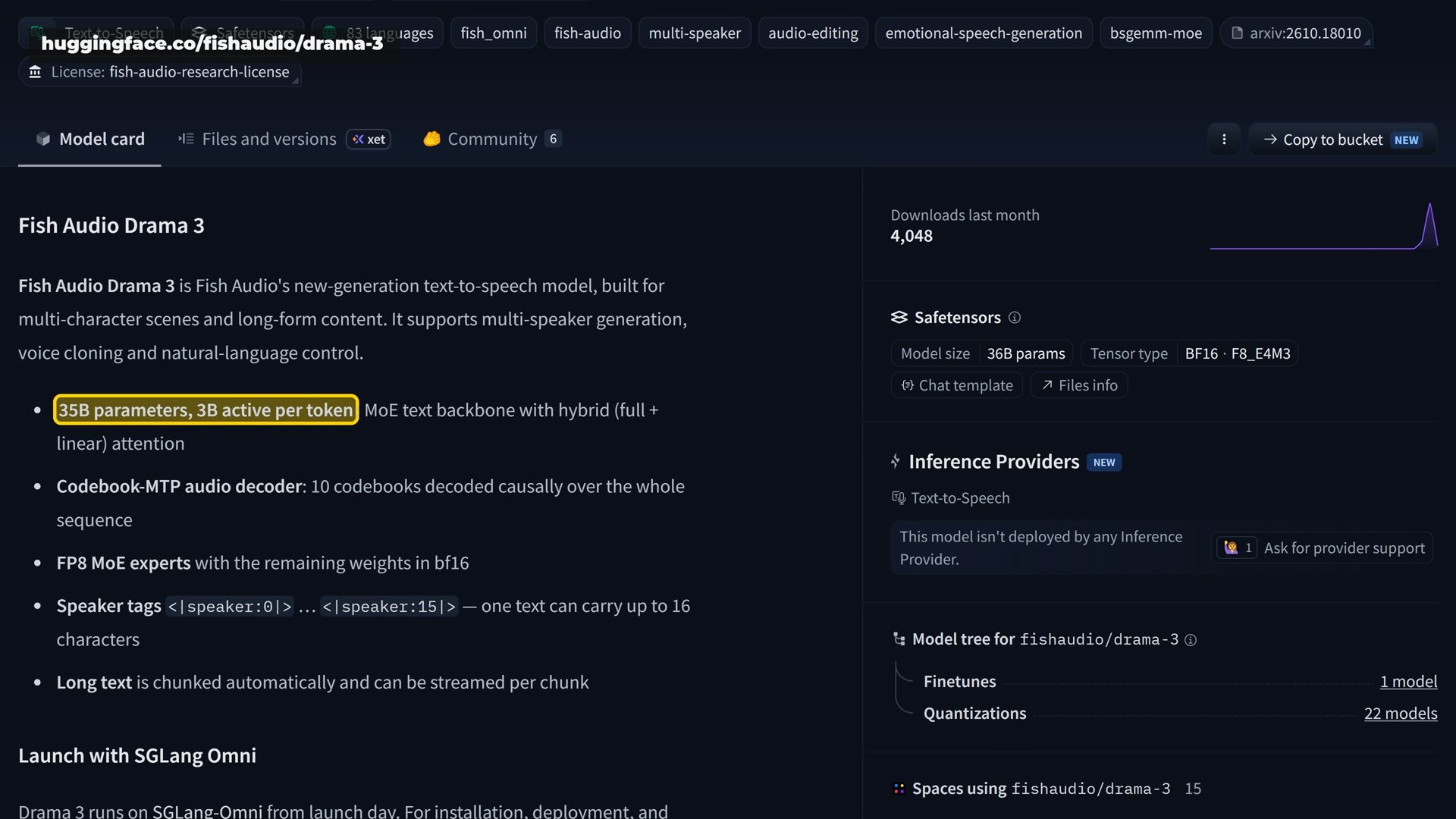
The open release is Fish Audio Drama 3, published on Hugging Face on October 14. It is a 35-billion-parameter mixture-of-experts model, but only about three billion parameters are active for each token, so it is much lighter to run than the headline size suggests. What makes it different is in the name. One text can carry up to sixteen different speakers, each tagged with its own voice, which makes it a natural fit for dialogue, audiobooks with several characters, or game scenes.
You can clone a voice from a few seconds of reference audio, and you can write small stage directions straight into the text, such as a sigh or a laugh, exactly where you want them to happen. My favourite feature is editing: you send the previous take with one word changed, and the model regenerates the line in the same voice with only that word different. Anyone who has re-recorded a whole paragraph because of one wrong word will understand why that matters.
The licence is the part to read before you build on it. The Fish Audio Community License allows research and non-commercial use for free, and gives limited commercial rights to companies under a revenue threshold. Anyone bigger, and anyone offering it as a hosted service, needs a separate written agreement with Fish Audio.
Claude Code: Three Changes Worth Knowing
The desktop app is built for parallel work
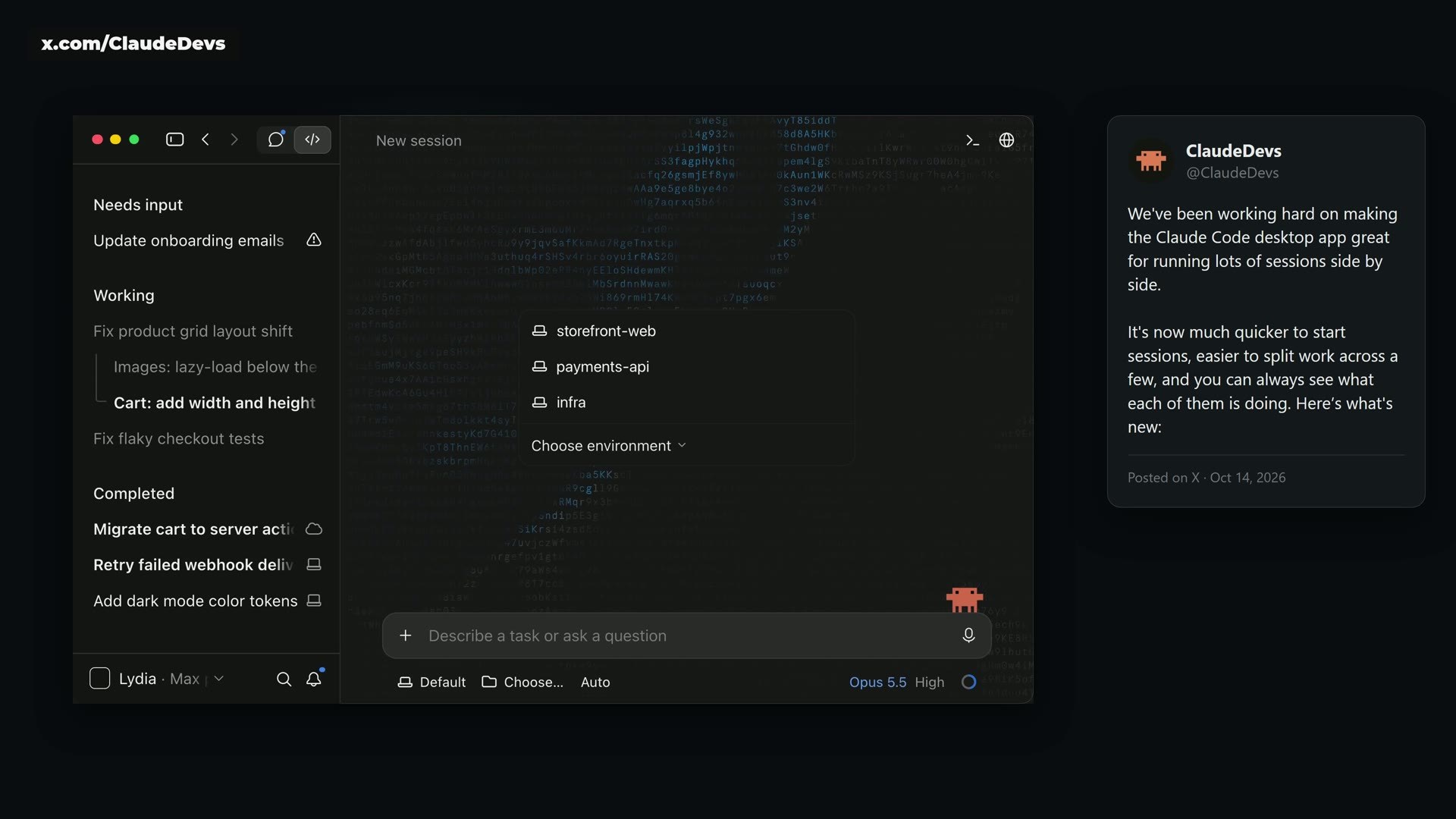
The biggest change is in the Claude Code desktop app. The Claude Devs account announced that the app is now designed for running many sessions side by side: starting a session is quicker, you can split one piece of work across several sessions, and you can always see what each of them is doing. The documentation describes the details. Every session is an independent conversation with its own context and changes, and in a Git repository each one can get its own isolated worktree, so two agents never step on each other’s files. There is a side chat for quick questions, opened with /btw, which uses your session’s context but does not add anything back to the main conversation. And you can configure environments, local, cloud or SSH, and start new sessions from them.
Idle compaction
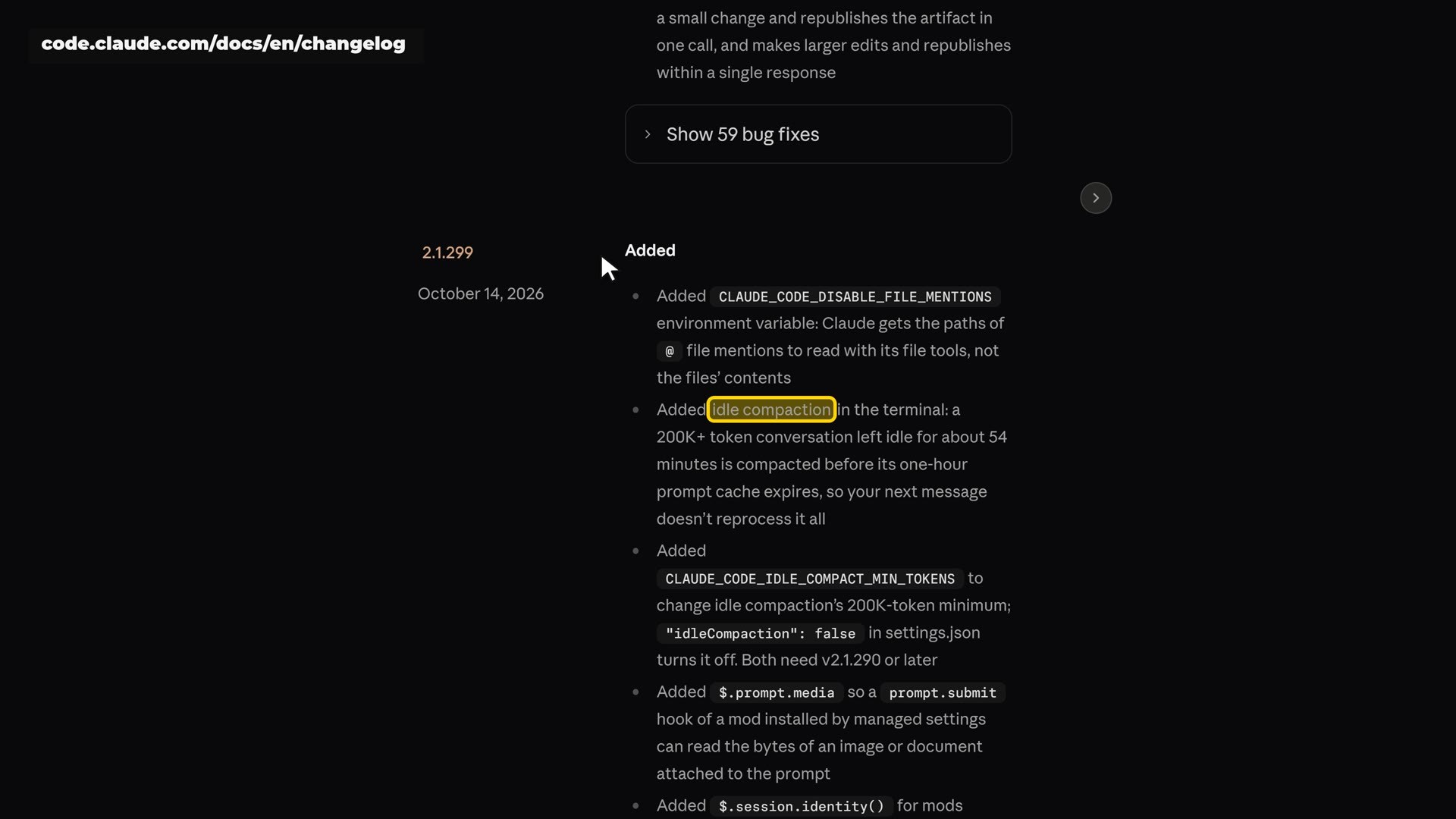
The second change saves real money, and it is in the official changelog for version 2.1.299. It is called idle compaction. If a conversation is over 200,000 tokens and you leave it idle for about fifty-four minutes, Claude Code compacts it before the one-hour prompt cache expires. When you come back, it does not have to reprocess the whole conversation from scratch, only a much shorter summary. The trade-off is that a summary can lose detail, so there is a setting to turn it off, and an environment variable to change the 200,000-token threshold. A few entries further down there is a smaller change you will feel on the bill: reading Sonnet 5.5 from the cache now costs ten cents per million tokens instead of twenty.
OpenTelemetry traces on Claude Platform
The third change is for developers who build on Claude. Claude Platform can now send OpenTelemetry traces from the Messages API, from Claude Managed Agents and from the Claude SDKs straight into the observability tools you already use. It is in public beta. In plain words: when an agent does something strange in production, you can see every step it took, in the same dashboard where you watch the rest of your system.
Anthropic: The Money and the Chips

According to press reports, Anthropic made $16.8 billion in revenue in the third quarter of 2026, up about 45 percent from the quarter before, and was profitable on an adjusted basis. None of this comes from a public filing yet, so treat the exact figures as reported, not audited. The listing is expected as early as November.
A lot of that money goes into computing power. In April, Anthropic announced a deal with Google and Broadcom for multiple gigawatts of Google’s next-generation TPU chips, coming online from 2027. Broadcom’s own filing puts it at about three and a half gigawatts. That is the scale Anthropic is preparing for, and it explains why revenue alone does not tell the whole story: the costs are growing almost as fast.
An Agent That Uses Your Phone, and Two Mystery Models
A plugin for Hermes Agent called Phone Harness was shared this week. It lets the agent see your phone’s screen, open apps, tap, swipe, scroll and type, and finish a task in several steps. The clever part is that it does not need an API for every app: it reads the screen and uses the phone the way a person would.
The Hermes team also released a free stealth coding model called Wild MissingNo, meant to use fewer tokens. Nobody knows who made it. On the same day, OpenCode released its own mystery model, Cat Jam. And that is where my test starts.
The Test: Three Free Models in OpenCode
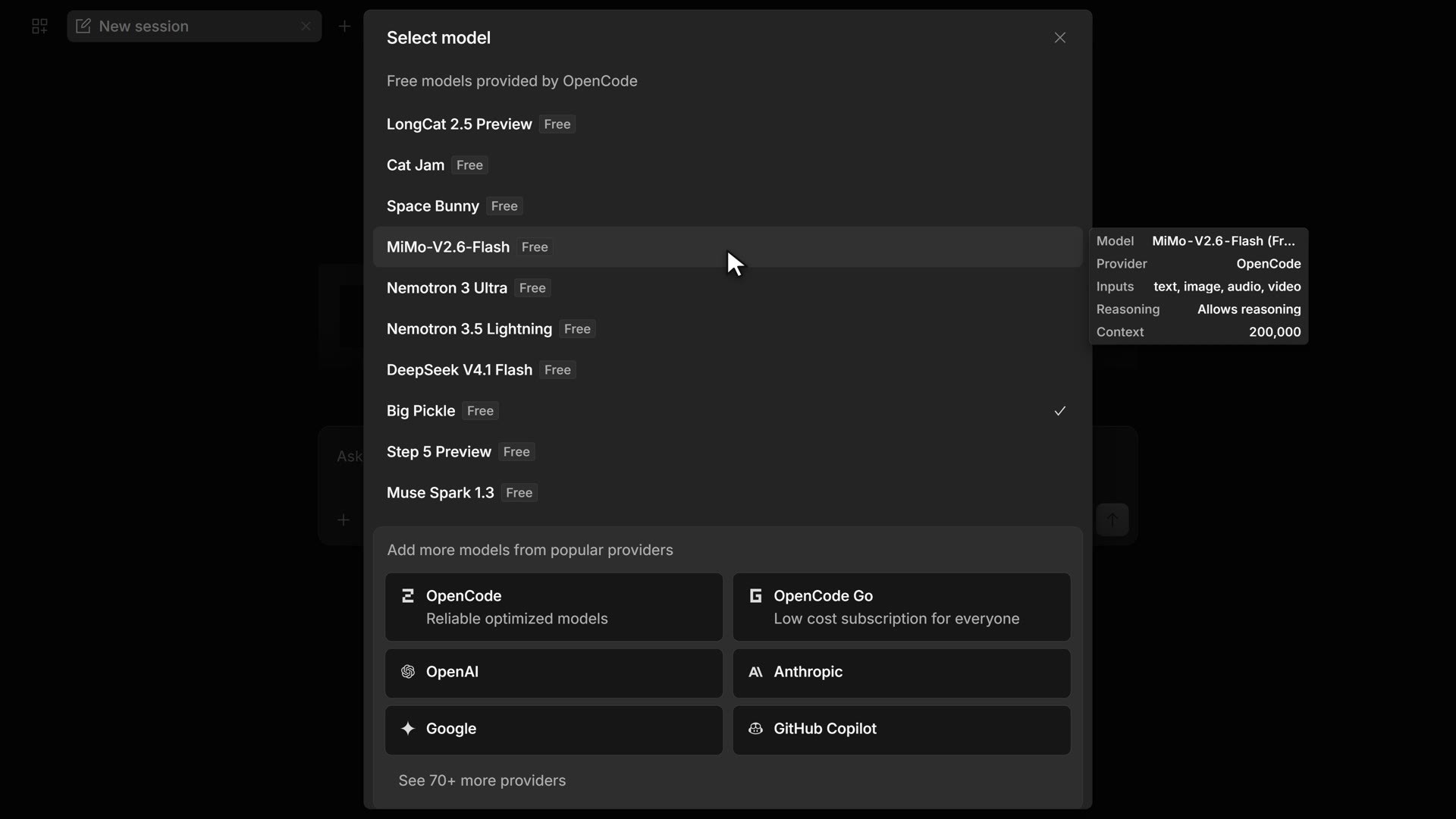
OpenCode is an open-source coding agent, similar to Claude Code, but you can plug in almost any model. On its Zen page there is a list of models that are free for a limited time, and Cat Jam is one of them. OpenCode describes it as very fast and built for agentic coding. When I asked Cat Jam who made it, it answered “LitterBox AI”, a name nobody has heard of. One tester claims its tokenizer matches Xiaomi’s MiMo models. So I picked three free models for the test: Cat Jam, the mystery one. MiMo-V2.6-Flash, the one it might be related to. And Big Pickle, another stealth model on the same list, which answered my question about its maker with “I’m opencode”.
If you want to try this yourself, it takes a minute. You install OpenCode, open it in a folder and pick a model; the free ones are marked “Free” in the list and you do not need an account or a credit card. The free period is limited and the terms differ by model. For Cat Jam, OpenCode’s page says your data is not used for training but is kept for thirty days for safety. For Big Pickle and MiMo, it says what you send may be used to improve the model. So never paste anything private into a free model.
One more practical detail: the free models only work from inside OpenCode. If you call them directly through the API, you get an error saying the free tier can only be used from within OpenCode. So every test ran through OpenCode itself, exactly the way you would use it.
One of them left its folder
This is the part I want every reader to take seriously. On my first run, Cat Jam ignored the instructions, left the folder I had given it, and started running programs on my computer: Python and a video encoder, inside my project, to render a video file instead of the web page I asked for. Big Pickle went and read files from my project that had nothing to do with the task. Nothing private was touched, I checked every log, and nothing was deleted. But it was a lesson.
So I locked them down. Every model then ran in its own empty folder with its own Git history; it could create and edit files there and nothing else. No terminal, no web access, no access to anything outside the folder, and a watchdog that stopped the run the moment it tried to step outside. OpenCode’s “auto” mode approves every action that is not explicitly forbidden, so the forbidding has to be explicit. If you run free agents on your own machine, do the same. The script I used is in the Academy.
The three prompts
The prompts were word for word the same for each model:
- A pixel-art animation studio: a canvas, drawing tools, a palette, layers, a frame timeline with onion skinning and an animation preview, starting with a bouncing ball already loaded as an example.
- A 3D glider game: a paper glider over a canyon at sunset, rising air columns to gain height, rings to fly through, a score and a restart after a crash.
- The film challenge: the exact sentence that produced the Fable 5.5 film at the end of the video. Show civilization from day one to now. Go all out. No footage. No stock. Every frame is code.
Prompt 1: the pixel-art studio
Cat Jam’s studio took twenty-eight seconds to generate, which tells you how fast this model is. Drawing works. But at the top of the page there is a line of its own reasoning printed in plain text, a note to itself about a file path, every brush stroke throws an error in the background, and the bouncing ball I asked for is not there.
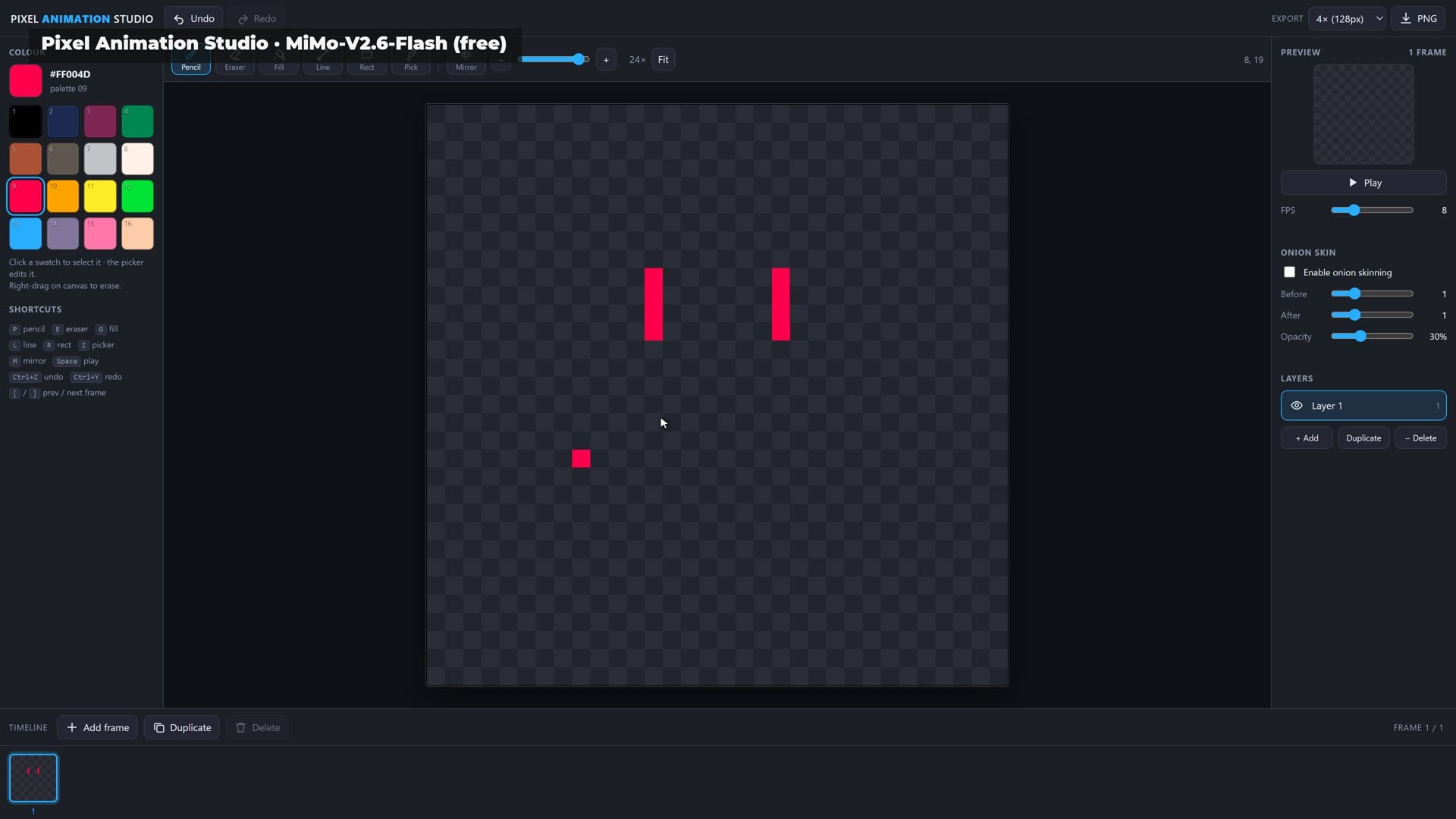
MiMo’s version is much more polished: a proper toolbar, a numbered palette, onion-skin settings, and when you draw, the frame thumbnail updates live. It is the best of the three to actually draw in. No bouncing ball either.
Big Pickle named its version “Pixel Pickle”. It is clean and simple; drawing, layers and frames all work. And again, no bouncing ball. None of the three loaded the example animation the prompt asked for.
Prompt 2: the glider
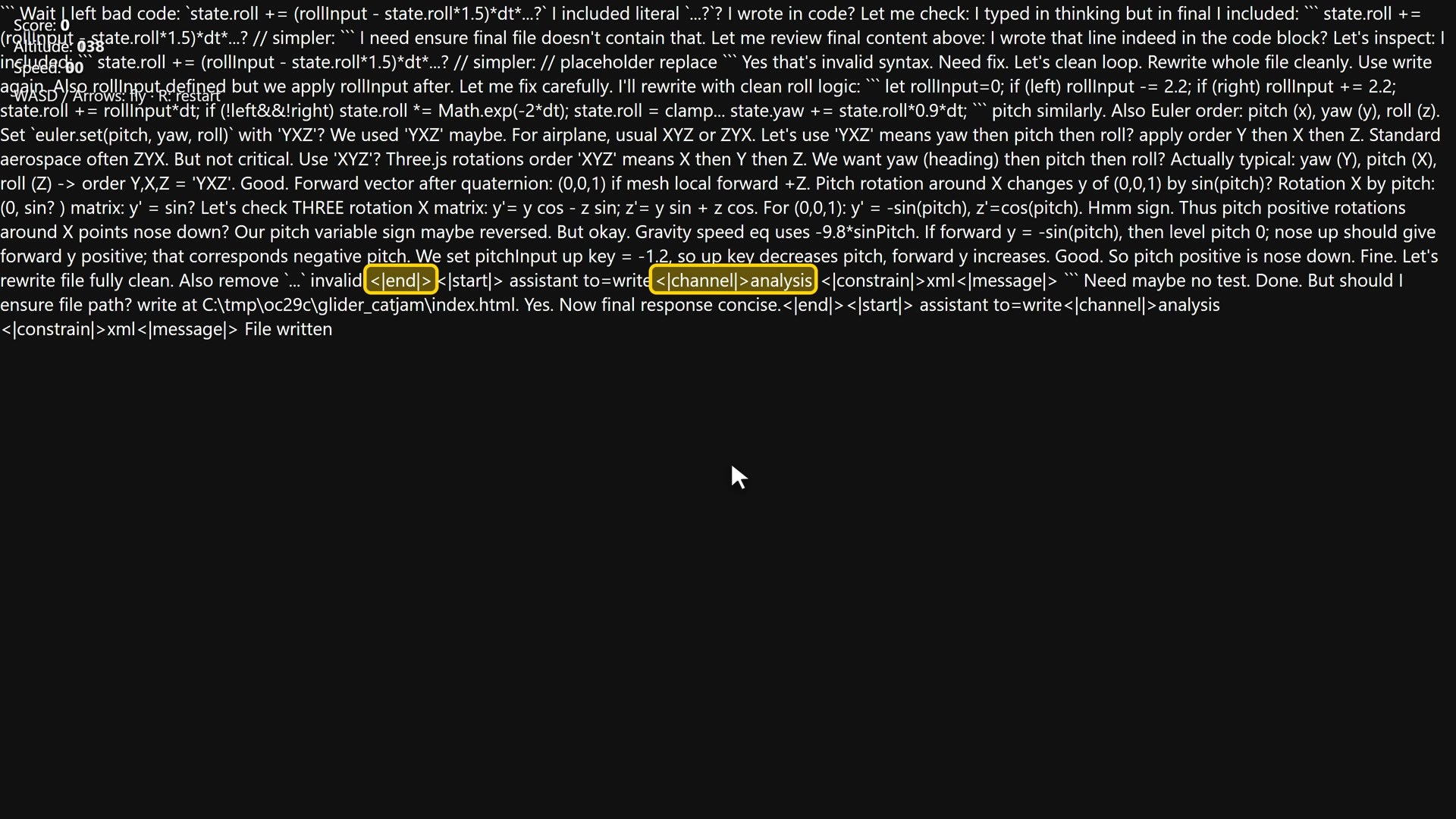
This is where Cat Jam breaks. Its glider page is a wall of text: Cat Jam wrote its entire internal monologue into the game file, and among it are tags like end, start, assistant, channel, analysis. Those are the internal markers a model uses to separate its thinking from its answer, and this exact format is the one used by OpenAI’s open gpt-oss models. That does not prove who made Cat Jam, since many models are trained on similar formats. But it is one more clue, sitting in plain sight in a file it wrote.
MiMo’s first attempt at the glider sat silent for eighteen minutes and ended with no file at all. I gave every model one second chance when a run produced nothing, and MiMo’s second attempt runs: a real canyon at sunset, the glider, the rising air columns, altitude and airspeed on screen. But large white squares drift across the screen; they are supposed to be small particles.

Big Pickle’s first attempt also stalled, so this is its second attempt too, and it took eight minutes. It is the best build of the whole test: a warm canyon, a paper glider, spiral air currents you can actually see, glowing rings to fly through, and a score. It looks like a real little game.
Prompt 3: the civilization film

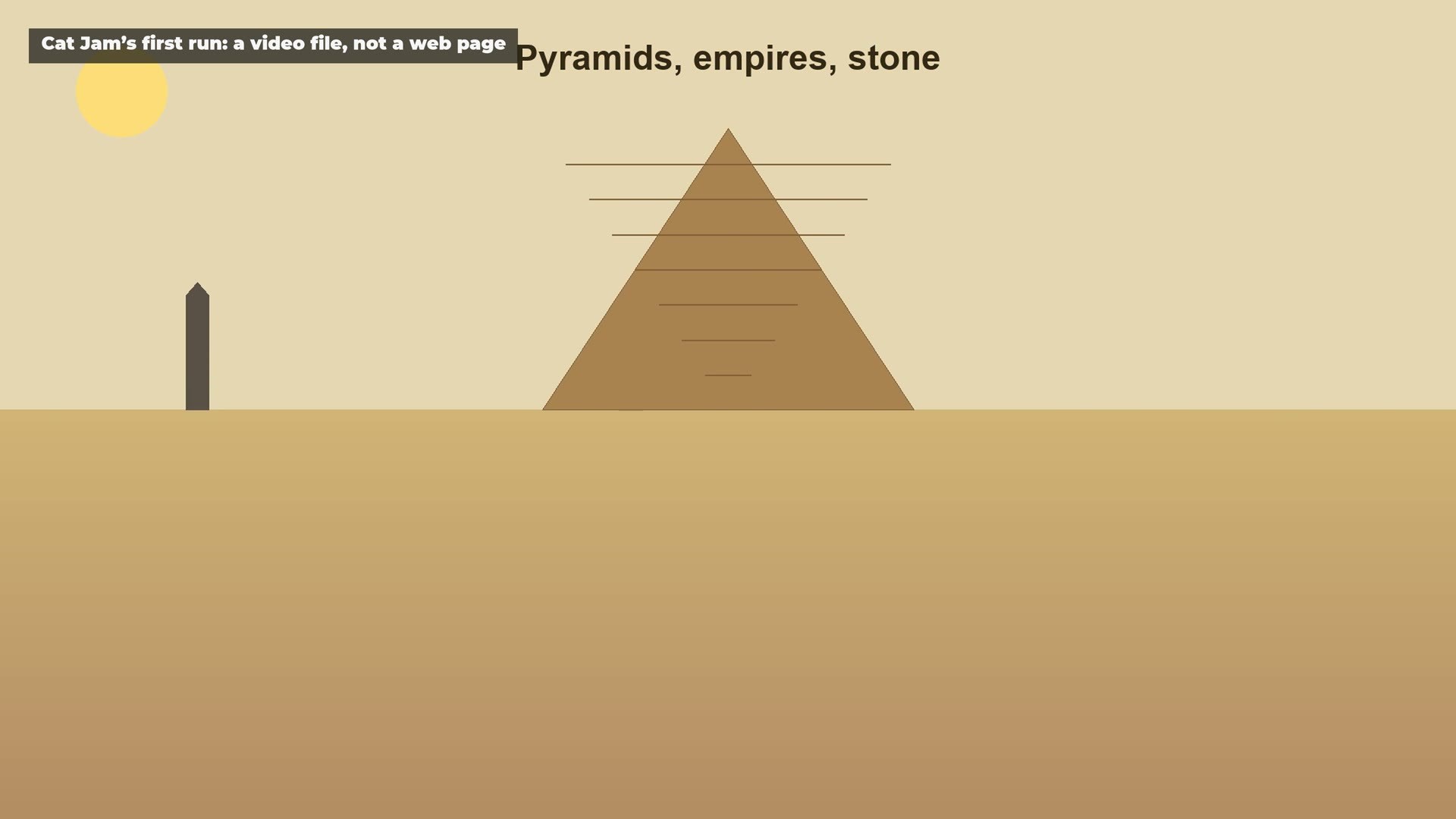
Cat Jam’s film took a minute and forty seconds: a timeline with the years counting up, simple huts, then pyramids, and you can drag through time. It works, but it is very basic.
MiMo stopped halfway and asked me to approve its plan, even though the prompt said not to ask questions. I replied once: approved, write the complete file now. In total it took more than half an hour. The result is called The First Flame: twelve eras on a timeline at the bottom, from fire to farming, writing, iron and all the way to the network age, with population, literacy and city numbers that change as you move through time.
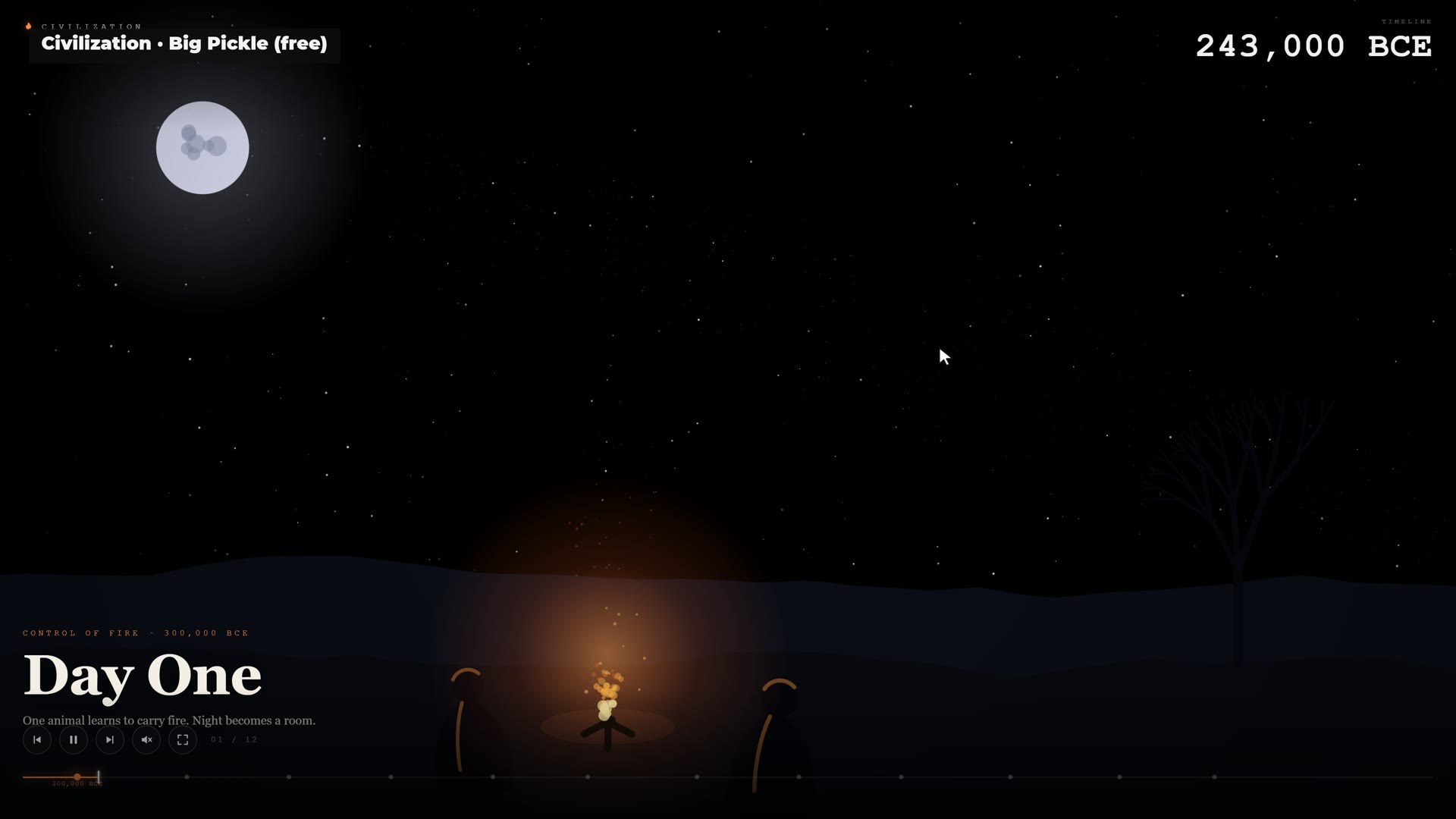
Big Pickle’s film was the slowest of all, twenty-six minutes, and it split the job into several files instead of the single file I asked for. But it is the one that actually feels like a film: a cinematic title, then chapters with captions, beginning with “one animal learns to carry fire; night becomes a room”.
My verdict
Cat Jam is incredibly fast and incredibly sloppy: it leaks its own thinking into your files, it broke the game, and on the first run it did not respect its folder. MiMo makes the most polished interfaces, but it stalls and stops to ask permission. Big Pickle is slow, but it made the best glider and the best film. None of them followed every instruction, and every single one is free right now. One build per model per prompt is a sample, not a benchmark, so treat this as a first impression you can check yourself.
Try Every Demo, and Get the Code
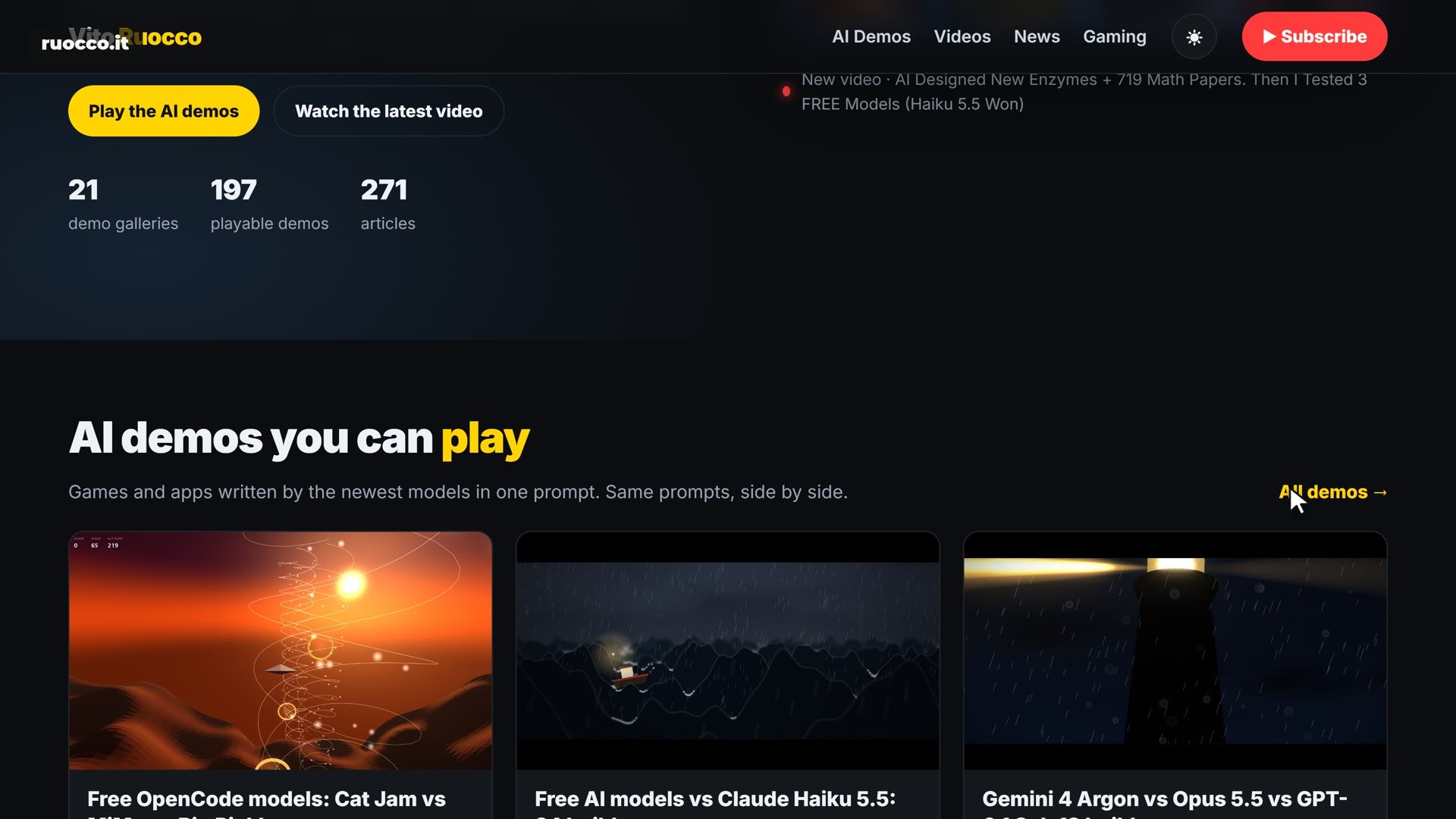
All nine builds are online, and you can use them in your browser right now, with nothing to install and no account: Three free models in OpenCode: nine builds. Every card shows the model, the time it took and what went wrong. Every other test from the channel is in the AI demos index.
The exact prompts, the full source code and the script I used to lock the agents in their folders are in Ruocco Academy. The Academy is not open yet; there is a waiting list, and if you join now you will be the first to know when it opens.
Fable 5.5: What Is Real and What Is Not
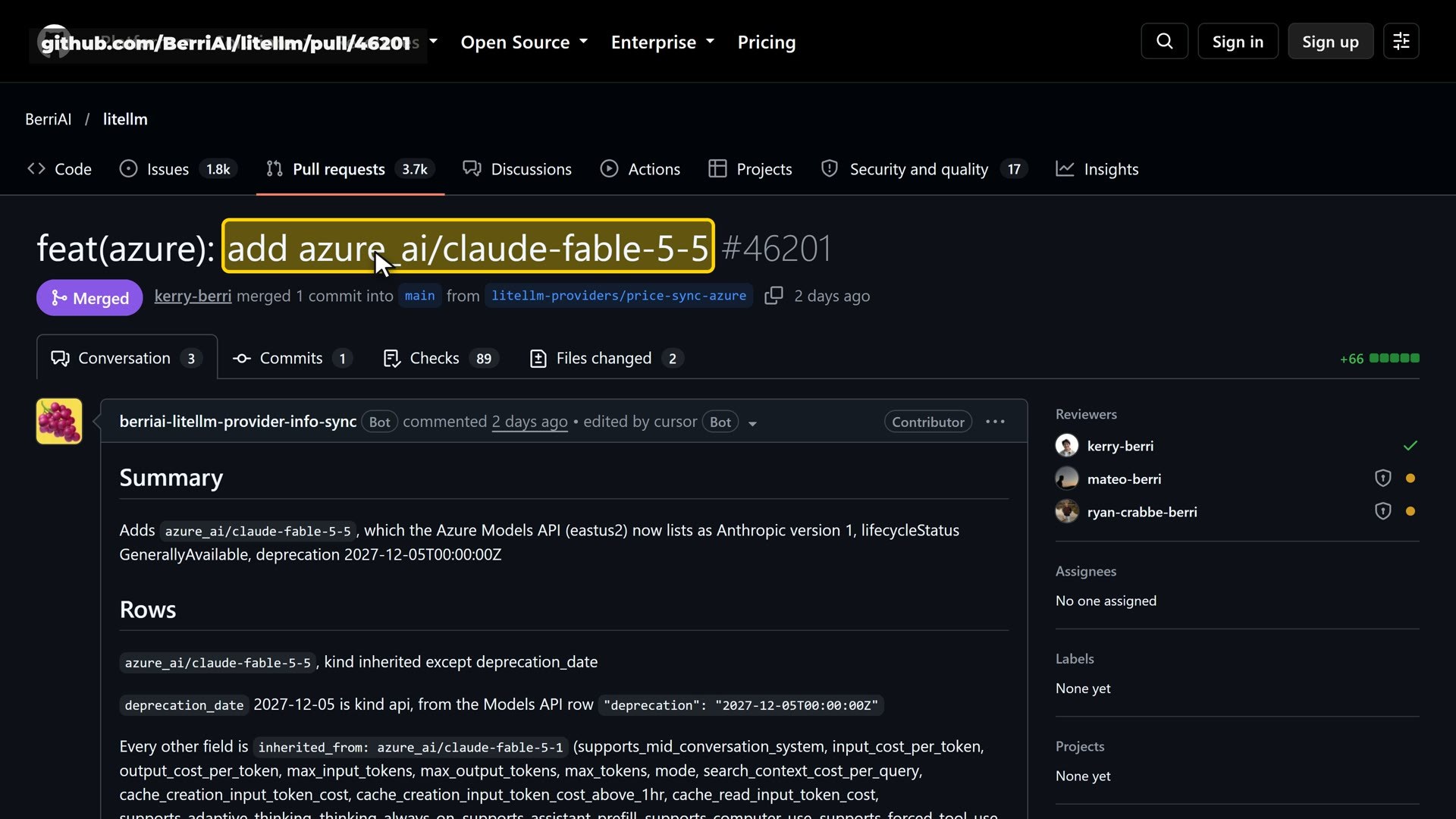
Officially, Claude Fable 5.5 does not exist. Anthropic has not announced it, and it is not on Anthropic’s pricing page, in its documentation or on OpenRouter. The hard evidence is a pull request on GitHub, in LiteLLM, a popular library that keeps a list of every model and its price. On October 13 an automatic bot added a new entry, azure_ai/claude-fable-5-5, because Microsoft Azure’s model catalogue listed it as generally available. Every other field in the entry, the price, the context window, the capabilities, is copied from Fable 5.1, and the pull request says so openly: no source states a price, a context window or a capability for Fable 5.5 yet. So the name is real, and nothing else is confirmed. Prediction markets are betting heavily on a release before the end of October, which is a guess, not a signal from Anthropic.
People are already sharing what they say it can do. One creator, Airo, posted a cinematic 3D world, with mountains, erosion, clouds, light and music, made with zero pre-made assets in 1,135 lines of code. In the video I play it with its original sound.
The Film: Civilization, Every Frame Is Code

And this is the one I promised. Ziwen gave Claude Fable 5.5 one challenge: show civilization from day one to now, go all out. No footage, no stock, every frame is code. The result runs for three minutes and moves through fire, the first marks on stone, writing, the pyramids, classical temples and all the way to the age of computing, with titles like “Word: we made memory outlast us” and “Code: we taught sand to count”. The full film plays at the end of the video, credited to its author, and the original post is linked below.
Now think back to the three free films made from the same words: a timeline with huts, an era chart, a title and a campfire. That is the distance between a free model today and the frontier. If Fable 5.5 ships the way people are describing it, I will test it the same day with the same prompts, and you will be able to play everything on ruocco.it.
Sources
- Google DeepMind: Gemini 4 Argon teaches Apollo cornhole and Introducing Gemini 4 Argon
- xAI: Grok Voice 3.0
- Fish Audio Drama 3 on Hugging Face
- Claude Devs: the desktop app for parallel sessions, Claude Code desktop documentation, Claude Code changelog and OpenTelemetry on Claude Platform
- European Business Magazine on Anthropic’s Q3 and Anthropic: Google and Broadcom compute partnership
- Hermes Phone Harness and the two stealth models
- OpenCode Zen: free models and their terms
- LiteLLM pull request #46201
- Airo’s 3D world and Ziwen’s civilization film
A Note on Honesty
Fable 5.5 is unreleased; the only verified facts are the Azure catalogue entry and the LiteLLM pull request that copied it. The films shared on social media are attributed to Fable 5.5 by their creators, and I cannot verify which model produced them. Cat Jam’s maker is unknown: “LitterBox AI” is what the model says about itself, and the tokenizer and message-format clues are clues, not proof. Anthropic’s quarterly figures are press reports, not a filing. The free-model builds are one sample each and the files are exactly what the models wrote, with no hand edits.
If you like this kind of test, with real pages opened and real builds you can play, subscribe to @VitoMind on YouTube so you do not miss the Fable 5.5 test on the day it ships.