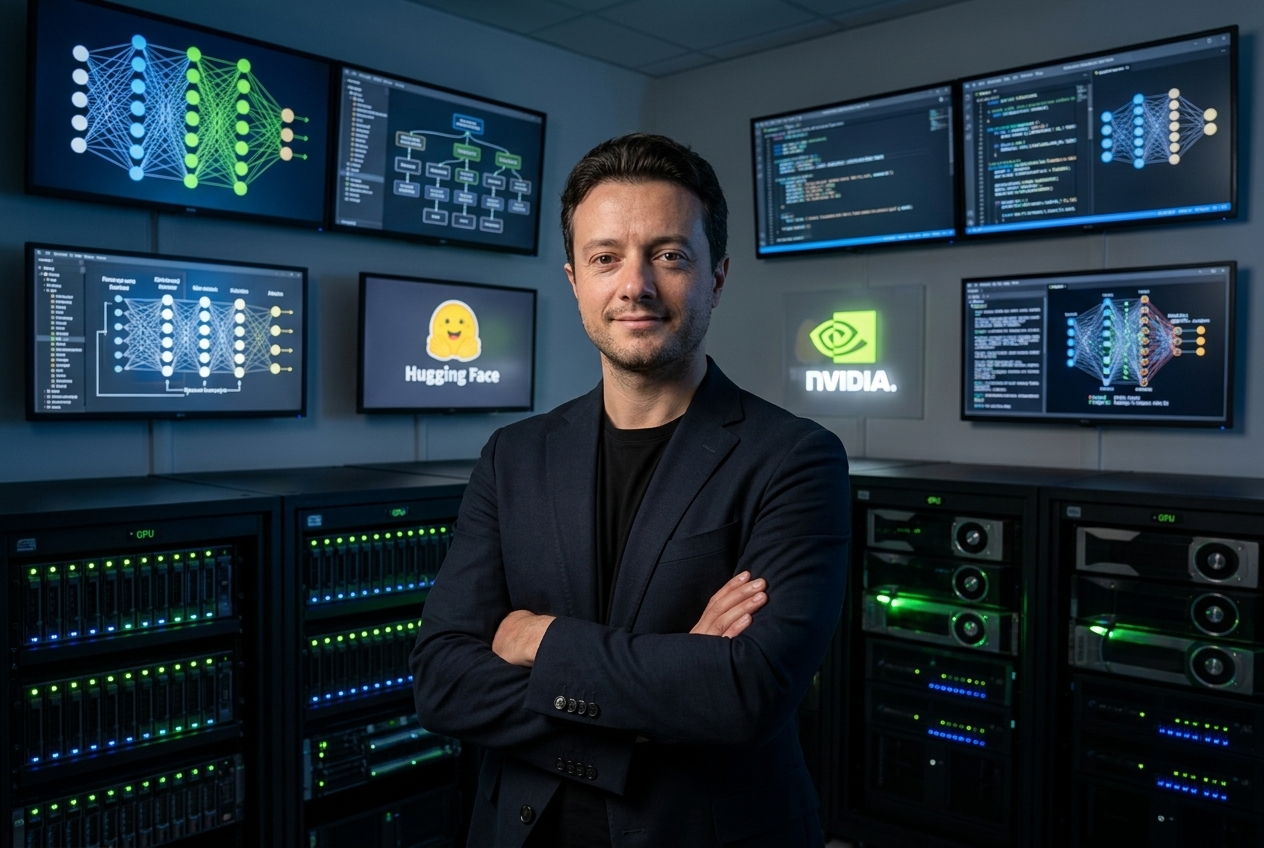
Nvidia’s $12.93 Billion Bet on the “GitHub of AI”: Inside the Hugging Face Megadeal — and the Week’s Biggest Tech Stories
October 29, 2026 — If there was any doubt that the artificial intelligence industry has entered a new era of consolidation, this week erased it. Nvidia — the world’s most valuable public company, now flirting with the trillion-dollar quarterly revenue mark — has agreed to acquire Hugging Face, the beloved open-source hub known as the “GitHub of AI,” for a staggering $12.93 billion. The deal, announced this week after months of speculation, is already drawing scrutiny from the US Department of Justice, and it signals a tectonic shift in how the AI ecosystem’s most powerful players plan to fight the next phase of the war for dominance. And that was just Monday.
Over the past 72 hours, the technology world has moved at a breakneck pace: Apple shipped its first-ever touchscreen MacBook Pro, ending a decade-and-a-half of stubborn resistance; Amazon quietly cut hundreds of jobs from its devices division under the growing pressure of AI coding tools; Google opened a new “Connected Apps” platform that lets developers build directly into Search and Gemini; and the company’s AI Mode found itself in hot water over cagey answers about the 2020 US presidential election. Below, we break down the biggest stories of October 28–29, 2026, what they mean, and where the industry is headed.
Nvidia to Acquire Hugging Face for $12.93 Billion
The headline deal of the week: Nvidia has agreed to buy Hugging Face, the online platform founded in 2016 that has become the de facto home for open-source AI models, datasets, and developer tools. Nvidia confirmed the acquisition this week after weeks of swirling speculation, bringing one of the most popular destinations in the AI world under the ownership of the company that makes most of the chips that run it.
Hugging Face is often described as the “GitHub for AI” — a browsable, community-driven library where developers share machine learning models, collaborate on training data, and publish tools used by millions of engineers worldwide. Its Transformers library, in particular, has become a foundational piece of infrastructure for open-source AI development, supporting everything from small startups to Fortune 500 research teams.
“Together, we will scale Hugging Face’s platform, strengthen its infrastructure, and expand access to AI for developers and institutions worldwide,” Nvidia CEO Jensen Huang said in the announcement. “Hugging Face will remain an open platform for the entire AI ecosystem. Developers will choose the models they want, the frameworks they want, the clouds and inference service providers they want and the computing platforms they want. Nvidia compute will not be required to build on or deploy through Hugging Face.”
The reassuring language matters: Hugging Face’s community is famously independent, and many developers fear that an acquisition by a hardware giant could tilt the platform toward Nvidia’s own ecosystem. Huang’s explicit promise — that Nvidia compute will not be required — is an attempt to keep the community calm and the platform’s neutrality intact.
For Hugging Face’s co-founder and CEO Clément Delangue, who built the company from a chatbot startup into the indispensable infrastructure of open AI, the deal also represents a validation of a decade of community building. Under the terms announced, Hugging Face’s leadership and Paris-based operations are expected to remain in place, with the platform’s libraries, Spaces, and model hub continuing to operate as before — at least publicly. The real changes will likely come in the form of Nvidia-funded infrastructure scaling: more compute for community projects, faster inference hosting, and deeper integration between Hugging Face’s tooling and Nvidia’s enterprise AI stack.
The developer community’s reaction, it must be said, has been mixed. On social media and developer forums, enthusiasm about a cash influx for open-source infrastructure sits uneasily alongside the familiar fear that “free” platforms eventually answer to their owners. Many open-source projects have learned that lesson the hard way over the past decade. Nvidia’s challenge is to prove that this time is different — or at least, that the openness is genuine enough to keep the community building on Hugging Face rather than forking away.
A Deal Months in the Making
Rumors of a Hugging Face sale first surfaced on August 23, when Business Insider reported that the startup was working with a bank to explore sale options at around $13 billion. Days later, on August 27, the outlet reported that Nvidia had been in acquisition conversations with the company — and The Information went further, reporting that a deal at roughly $12.9 billion had already been agreed in principle. This week, those reports became official.
The price tag represents a massive step up from Hugging Face’s last official valuation of $4.5 billion, set during its blockbuster 2023 funding round — a round in which Nvidia itself participated alongside Google and Amazon. According to The Financial Times, Hugging Face had actually rejected a $500 million investment offer from Nvidia last year that would have valued the company at around $7 billion, with the startup reportedly wary of handing a single dominant investor too much influence. Now, it seems, the price was simply too good to refuse.
Notably, Hugging Face is not a profit machine — at least not yet. The Information reports that the company generates roughly $150 million in annualized revenue, a fraction of the nearly $13 billion purchase price. But for Nvidia, which has an extraordinary amount of capital at its disposal — the company recently reported quarterly revenue in excess of $100 billion, has committed up to $10.5 billion to support an OpenAI data center project, and is backing a Goldman Sachs and BlackRock GPU compute fund — the strategic value of owning the open-source ecosystem’s front door dwarfs the financials on paper.
DOJ Scrutiny: Regulators Circle the Megadeal
No deal of this size goes unnoticed in Washington. Reuters reported this week that the US Department of Justice has “made inquiries” into the acquisition, including how it could affect competition in the AI industry. The probe adds to a growing pile of regulatory scrutiny surrounding Nvidia, which has reportedly faced a DOJ investigation since 2024 over its dominance of the AI chip market.
The antitrust concerns are easy to understand. Nvidia already controls the vast majority of the market for AI accelerators — the GPUs that virtually every major AI model is trained on. If it also controls the leading distribution platform for open-source models, regulators worry it could use that position to steer developers toward its own hardware, software stacks, and cloud partnerships, squeezing competitors like AMD, Intel, and the custom-chip efforts of hyperscalers.
“The question regulators are asking is simple,” one industry analyst noted in the days after the announcement. “Does owning the most important open-source model hub give Nvidia an unfair advantage in selling the hardware that runs those models? It’s a vertical integration play, and vertical integration always gets a second look.”
Nvidia’s public assurances that Hugging Face will remain neutral are likely to be central to its defense. Whether they will satisfy the DOJ — or whether the deal faces conditions, delays, or a challenge — will be one of the defining regulatory stories of 2026 and 2027.
Why Nvidia Needs the Open-Source Fortress
Beneath the surface, the acquisition is a defensive masterstroke. The AI landscape has shifted dramatically over the past two years: closed-source leaders like OpenAI, Anthropic, and Google are increasingly building their own custom AI chips, seeking to reduce their dependence on Nvidia hardware. If the biggest model makers stop buying Nvidia’s GPUs at scale, the company’s growth engine faces a genuine long-term threat.
Open-source developers, meanwhile, have been racing to catch up with the closed AI systems — and they are among Nvidia’s most loyal, volume-heavy customers. By owning Hugging Face, Nvidia gains a strategic foothold at the center of that open-source movement: a place where hundreds of thousands of developers browse, download, fine-tune, and deploy models every single day. Every one of those workflows touches compute — and Nvidia intends to be the compute they reach for.
- Distribution: Hugging Face is a direct channel to the open-source developer community that Nvidia’s enterprise strategy depends on.
- Ecosystem lock-in (soft): While Huang promises neutrality, deep integrations with Nvidia’s stack (NeMo, TensorRT, DGX Cloud) will inevitably be more seamless than with rivals.
- Data and signals: Hosting the world’s most-used open models gives Nvidia unmatched visibility into what developers actually run, on what hardware, and where the bottlenecks are.
- Defense against custom silicon: As OpenAI and Google build their own chips, Nvidia can anchor itself to the open-source community, which has little interest in proprietary silicon.
The strategic logic is sound. The execution, of course, is where things get interesting — and where the DOJ will have plenty to say.
It is also worth remembering that Nvidia’s appetite for strategic acquisitions has grown alongside its war chest. The company is reportedly providing up to $10.5 billion in funding to support an OpenAI data center build-out, has partnered with Goldman Sachs and BlackRock on a fund to acquire GPU compute assets and lease them to AI companies, and has now committed nearly $13 billion to buy Hugging Face outright. Add to that its existing investments across the AI stack — from chip design software to robotics firms — and a picture emerges of a company that is no longer content to simply sell shovels in the gold rush. Nvidia is buying the mine, the map, and the town that surrounds it.
Apple Finally Embraces the Touchscreen MacBook
In a move that would have seemed unthinkable just a few years ago, Apple this week unveiled its first-ever touchscreen laptop. Steve Jobs famously called touchscreen notebooks “ergonomically terrible,” and for over fifteen years, Apple refused to build one, even as rivals embraced the form factor. That resistance officially ended with the new MacBook Pro with PROLED XDR display.
Hands-on reports from The Verge describe a machine that is lighter, thinner, and brighter than its predecessors. The 14-inch touchscreen model weighs just three pounds — noticeably lighter than the 3.4-pound M6 models that launched alongside it — while the 16-inch version comes in at four pounds, down from 4.7 pounds for the M5 Pro generation. The displays themselves are stunning: punchy, saturated, and contrast-rich OLED panels that seem to confirm Apple’s decision to move away from Mini LED.
The software side has clearly received attention too. macOS now magnifies small controls when you poke at them, making the red, yellow, and green traffic-light buttons easier to hit with a finger. Drop-down menus magnify when tapped, and the Dynamic Island — borrowed from the iPhone — has replaced the notch, hosting everything from now-playing controls to volume and brightness sliders. Swiping to scroll, pinching to zoom, and double-tapping to maximize windows all work as you would expect in Apple’s first-party apps, and third-party apps receive a graceful fallback: macOS simply translates taps into clicks, so nothing becomes entirely unusable while developers catch up.
Of course, the ergonomics question that haunted Steve Jobs has not been fully solved. Reviewers note that the MacBook Pro’s hinge wobbles under firm taps near the top of the screen, and reaching up to poke a display remains a fundamentally different interaction than resting your hands on a trackpad. Apple’s answer — magnified touch targets and gesture-friendly system UI — is a pragmatic middle ground rather than a complete reinvention. The company is betting that for the millions of users who have grown up on iPhones and iPads, touch is simply expected, and that the Mac’s stubborn keyboard-and-trackpad purism was, in the end, a generational preference rather than a law of physics.
The return of the glowing Apple logo on the lid, matching the screen’s brightness and dimmable to off, has delighted longtime fans who remember the iconic illuminated logo of the MacBook era. But there are misses: notably, there’s no Apple Pencil support, which many reviewers called a “huge missed opportunity” for artists and note-takers. And the premium is real — the touchscreen PROLED XDR MacBook Pro starts at $2,899, $400 more than the otherwise similarly-specced M5 Pro model.
“On first impression, the touchscreen doesn’t seem likely to revolutionize the MacBook,” The Verge concluded. “It’s just a MacBook Pro variant and not an entirely new product line.” Whether the gamble pays off will depend on whether developers embrace touch-optimized Mac apps — a classic chicken-and-egg problem Apple has faced before.
Amazon Cuts ~250 Devices Jobs as AI Coding Tools Bite
Amazon has cut approximately 250 positions from its devices and services team, according to Reuters — a move that lands just weeks after the company launched a flurry of new hardware, including the Alexa Tablet 12 Pro, refreshed Kindle Paperwhite and Colorsoft models, a new digital picture frame, and multiple new Echo devices. The layoffs are reportedly focused primarily on software development roles.
Amazon did not confirm a reason for the cuts, but the timing and focus have drawn attention to a growing trend across the industry: increasingly advanced AI coding tools are changing the calculus of software hiring. “Developers are facing increased pressure from increasingly advanced AI coding tools,” The Verge noted — and Amazon is far from alone. Across the sector, engineering organizations are reassessing headcount as AI assistants handle an ever-larger share of routine development work.
The irony is hard to miss: a company that has invested billions in AI, and whose devices are powered by the Alexa assistant, is now trimming the very teams that build them, in part because AI itself has made those teams more productive. It’s a preview of the labor dynamics that will define the decade.
Google Opens the Gates: Agentic AI and “Connected Apps”
Google is pushing hard on its agentic AI ambitions. CEO Sundar Pichai has signaled that the company is working on a new agentic AI experience for consumers — an evolution of the Gemini Spark agent that launched earlier this year — and this week, Google took a major step toward making AI agents ubiquitous by launching its “Connected Apps” platform for developers.
Connected Apps, announced on the Google blog on October 28, lets developers build applications that plug directly into Gemini and Search — the same kind of integrations that OpenTable (restaurant reservations) and Instacart (grocery delivery) have already built into Google’s AI tools. Developers in the US can join the public beta waitlist starting today, with access to metrics like traffic and latency.
The implications are significant. Google’s Search and Gemini surfaces reach billions of users; opening them to third-party apps turns the company’s AI assistants into a genuine platform — a potential counterweight to the app ecosystems of OpenAI and Anthropic, which have been aggressively courting developers for their own agent frameworks. For Google, the goal is clear: make Gemini the place where users not only get answers, but take action.
Google’s AI Mode Gets Cagey About the 2020 Election
Not all of this week’s Google news was triumphant. The company found itself explaining why its AI Mode — the AI-powered search experience — refused to give direct answers about who won the 2020 US presidential election, instead telling users to “consult the official report compiled by the Federal Election Commission (FEC).”
Ars Technica’s testing found a pattern: AI Mode gave detailed, correct answers for presidential elections going back to 2000 — but for 2020 and 2024, it deflected to official sources. Asking about the party composition of the Senate after 2020 produced a similar dodge, while the same question about the 1992 election drew a direct answer (Democrats held a 57-43 majority). The evasiveness even appeared geographically inconsistent: spot checks via VPN from Taiwan, Russia, France, and Canada all returned straightforward answers, suggesting the behavior is tied to US-based safety configurations.
A Google spokesperson acknowledged the issue, saying: “The Gemini app answers this question more fully but this isn’t the most helpful response on Search. We’re looking into this and working to address it.” Later, the company said it was “fixing the issue with 2020 election queries in AI Mode,” attributing it to a “technical gap” in its verification systems, which use news articles or AP data for recent elections and historic records for older ones. The company also said the same issue affected 2022 Senate race queries.
The episode is a useful reminder of a deeper tension: AI companies are increasingly cautious about politically sensitive topics in election years, especially with US midterms looming — but over-correction produces the kind of weird, evasive behavior that erodes user trust in the other direction.
Quick Hits: Copilot, FTC, and a Massive DHS Breach
GitHub Copilot gets a major update. The GitHub Copilot app now supports “projects,” letting you assign Copilot a task spanning multiple repositories, pick up work where you left off across devices, and create reusable AI automations. For developers, it’s another step toward AI as a persistent engineering teammate rather than a chat-based helper.
FTC probes personalized pricing. The Federal Trade Commission has demanded information from Uber, Lyft, DoorDash, airlines, and retailers about how they use customer data to set individualized prices. The non-enforcement probe revives a theme from the Biden administration, though the current Republican-led FTC has criticized the prior approach as too focused on middlemen. Surveillance pricing — where your data influences what you pay — is squarely in regulators’ sights.
A massive DHS data breach. In a sobering security story, the names, job titles, phone numbers, and emails of thousands of ICE, CBP, and other Department of Homeland Security employees were compromised in a massive hack. The long-term risk for the affected federal workers — many of whom work in sensitive enforcement roles — is difficult to overstate.
Instagram on AI anxiety. In a lighter but telling moment, Instagram’s head said that worries about AI come down to “a fear of being left behind in some way” — a candid acknowledgment of the existential unease the current AI moment generates, even inside the companies building it.
The Big Picture: A Consolidating Industry
Take a step back, and this week’s news tells a coherent story. The AI industry is entering its consolidation phase: capital is concentrating in a handful of giants, regulators are waking up to the stakes, hardware and software are fusing into integrated stacks, and the labor market is beginning to feel the productivity shock of AI tools. Nvidia’s Hugging Face acquisition is the clearest symbol yet — the chipmaker at the center of the AI boom buying the community hub at its heart, promising openness while positioning for dominance.
Whether the DOJ lets it stand, whether Apple’s touchscreen bet pays off, and whether Google can navigate the political minefields of AI answers while opening its platforms to third-party agents — these are the threads to watch in the months ahead. One thing is certain: in 2026, the AI story is no longer just about models. It’s about power: who owns the chips, who owns the platforms, and who owns the communities that build on top of them.
— Vito Ruocco, Editor at Ruocco.it. Sources: The Verge, Ars Technica, Reuters, The Information, Financial Times, Business Insider, Google Blog, NVIDIA Blog.