October 29, 2026 — by Vito Ruocco
Every once in a while, a single day in the games industry feels like a year compressed into twenty-four hours. Today is one of those days. A Chinese action game nobody expected to move the needle has become one of the most-played games on Steam in its first hours on sale. Epic Games has officially admitted that its engineers are no longer writing the bulk of its code. Valve has spent the week insisting it will never become the gatekeeper of AI-made games, even as developers beg for help against a flood of clones. CD Projekt Red has quietly hinted that Cyberpunk 2 might finally do what the original never could: let you play with a friend. And Sony, Nintendo, and the rest of the industry have all thrown their own news into the pile.
If you blinked, you missed a lot. Here is the full picture of what happened — and why it matters for the next twelve months of gaming.
Phantom Blade Zero Shatters Expectations on Day One
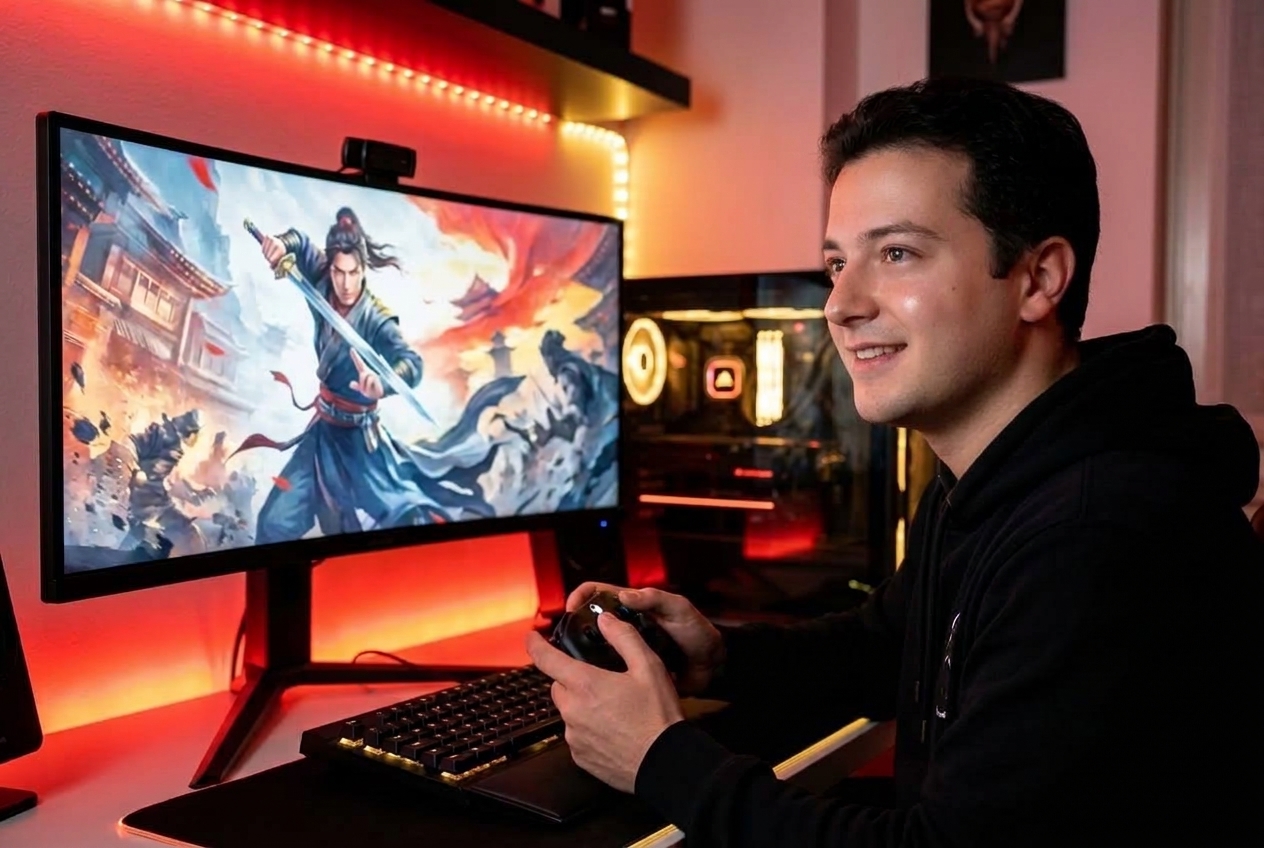
The headline of the week, without question, is the launch of Phantom Blade Zero, the wuxia action game from Beijing-based studio S-Game. The game officially released on October 28 across PC, PlayStation 5, and Xbox Series X|S — and within hours, it was sitting at an eye-watering 431,541 concurrent players on Steam, according to SteamDB. That peak placed it as Steam’s second most-played game at time of writing, trailing only Counter-Strike 2, and comfortably ahead of the usual roster of live-service juggernauts that dominate those charts on a typical Wednesday.
The commercial picture is even more striking. Phantom Blade Zero currently leads Steam’s global top sellers chart, having jumped an astonishing 16 places in a single week. S-Game hasn’t announced official sales figures yet, but the analysts are already doing the math for them. Rhys Elliott of Alinea Analytics estimates the game had sold roughly 850,000 copies across PC and PlayStation 5 by launch day — and that’s before accounting for its release on Tencent’s WeGame storefront in China, where Elliott believes additional sales push the grand total to well over one million copies in its first few days.
“Phantom Blade Zero has been officially released, and just as everyone expected, it’s popular.” — Sherif Saed, Eurogamer
To put that number in perspective: a few days before launch, Elliott estimated the game had sold around 500,000 copies on Steam alone, with roughly 80,000 of those coming after reviews went live just two days ahead of release. The pre-launch hype, driven by years of flashy trailers and a genuinely novel aesthetic, clearly converted into day-one purchases rather than wishlist inertia. And with word of mouth still building, Elliott predicts the game could clear 500,000 peak concurrent players by the weekend — a figure that would put it in rarefied air reserved for the biggest releases of any given year.
The Numbers: How Phantom Blade Zero Compares to Black Myth: Wukong
Any conversation about a breakout Chinese action game inevitably invites comparisons to Black Myth: Wukong, the 2024 phenomenon from Game Science that redefined what the world expected from Chinese AAA development. The numbers are instructive — and humbling, even for a game doing this well.
When Wukong launched in August 2024, it peaked at 2,415,714 concurrent players on Steam, a figure that ranks among the highest ever recorded on the platform. Game Science has since stated the game has sold over 30 million copies lifetime, making it one of the best-selling action RPGs of all time. Phantom Blade Zero, for all its early success, is operating on a different scale entirely — a fact Elliott acknowledges openly.
- Black Myth: Wukong (2024): 2.41M peak concurrents on Steam, 30M+ lifetime sales
- Phantom Blade Zero (2026): 431K peak concurrents on launch day, ~1M+ copies estimated across all platforms including WeGame
- Steam ranking at launch: #2 most-played (behind Counter-Strike 2), #1 on global top sellers
Does that gap mean Phantom Blade Zero is a disappointment? Far from it. Wukong was a once-in-a-generation event — a game that arrived with a decade of cultural weight and a near-perfect critical reception. Phantom Blade Zero is a different beast: a mid-sized studio’s ambitious swing at a global audience, launching simultaneously on three platforms with a distinctly martial-arts-flavored identity. Selling a million copies in its launch window is a triumph by any reasonable standard, and the trajectory suggests momentum that Wukong also enjoyed in its opening days — even if the absolute numbers will never match.
Critically, the reception has been solid if not rapturous. Early Steam user reviews put the game at a “Mostly Positive” rating. In Eurogamer’s review, Emma Kent praised the game’s swordplay and combat as genuinely excellent — the heart of any wuxia title worth its salt — while lamenting “a general lack of polish and pace-breaking boss fights” that dent an otherwise stylish package. That mixed-but-positive word of mouth is exactly the profile that tends to age well: players buy on hype, stay for the combat, and recommend it to friends who were on the fence.
Why This Matters: The Rise of China’s Action Renaissance
Phantom Blade Zero’s launch is more than one studio’s success story; it’s the latest data point in a trend that has reshaped the global market over the past two years. Chinese developers have moved from being perceived as mobile-and-live-service specialists to genuine contenders in premium, single-player, story-driven action games.
Consider the sequence: Black Myth: Wukong proved a Chinese studio could sell 30 million copies of a console-quality action RPG. Now S-Game has demonstrated that the formula can be repeated — not with the cultural gravity of the Monkey King behind it, but with an original IP built on wuxia tradition, a distinctly cinematic visual language, and combat that holds its own against the best action games Japan and the West have produced. The pipe dream of a “Chinese AAA wave” that analysts talked about for a decade is no longer a forecast; it’s a delivery schedule.
The business implications are significant. With Tencent backing distribution through WeGame and international publishing handled across PC and current-gen consoles, Phantom Blade Zero shows a repeatable playbook: partner with a domestic platform giant, launch globally on Steam, and let the aesthetics do the marketing. For Western studios, the competitive pressure is real — the bar for spectacle in action games has been permanently raised. For players, it’s pure upside: a genre that many feared was stagnating into remakes and sequels is suddenly full of new voices, new folklore, and new mechanical ideas.
Epic Games Goes All-In on Generative AI: “Our Engineers Are No Longer Writing the Bulk of the Code”
While S-Game celebrated its launch, Epic Games made its most explicit AI declaration yet — and it’s a doozy. In an interview with This Week In Video Games, Epic’s executive vice president of development, Marcus Wassmer, confirmed that generative AI is now baked into the company’s core tooling, from Fortnite to the upcoming Unreal Engine 6.
“We are definitely using AI to develop code and features for Unreal Engine,” Wassmer said, adding that “almost all development happening right now is being done in the dev streams attached to Fortnite, UEFN [Unreal Editor for Fortnite], and UE6.” When pressed on whether Epic was “vibe-coding” its engine — a term that has become a lightning rod in developer circles — Wassmer didn’t flinch.
“Yes, we are vibe-coding things. That means our engineers are no longer writing the bulk of the code, but they are still guiding the tools to get the architectural result we want. We’re not ‘one-shotting’ the engine; we’re iterating with AI to ship features developers want and keep the engine within the memory, performance, and scalability envelopes.” — Marcus Wassmer, Epic Games
The stakes here are enormous. Unreal Engine is the backbone of thousands of studios’ pipelines — from indies to AAA giants — and Epic has effectively stated that its future iterations will be built with AI as a first-class developer on the team. Wassmer claimed the approach lets Epic ship updates faster with fewer bugs, and framed any skepticism as a competitive risk rather than a legitimate concern.
“We are more concerned about the risks of moving too slowly than we are about AI skepticism,” he said. “We don’t think it’s viable to take a halfway approach to AI in development. We think it’s best to just be up front with what we’re doing, share best practices with other developers, and make the best UE6 we can with the best tools available at any given time.”
This isn’t Epic’s first AI flex of the month, either. Earlier in October, the company proudly admitted it had vibe-coded the latest iteration of the Epic Games Launcher in an attempt to run faster than Steam — a move accompanied by the delightfully honest statement that “programming is hard. So, instead of doing that, we vibe coded the new Epic Games Launcher.” Developers working on a troubled Disney-Marvel shooter were also reportedly instructed to let gen-AI handle code and art production. The pattern is unmistakable: Epic is not dipping its toes into AI-assisted development; it’s doing a cannonball.
Outside the company, the reaction ranges from unease to alarm. Epic’s own workers reportedly worry about job security. Developers point to plagiarized work and AI copycats — the Moonlighter studio recently had to overhaul a Steam playtest after AI clones flooded in. Even the UN has weighed in on the environmental cost of generative AI in a June 2026 report. None of that appears to be slowing Epic down.
Valve Fires Back: No AI Gatekeeping, But a Real Visibility Crisis
If Epic is the AI evangelist, Valve is playing the cautious referee — at least publicly. During a Steam Indie Connect event in South Korea this week, Steam Business Team members Tom Giardino and Marc Wilkinson fielded questions from Korean developers who are increasingly frustrated by a storefront that feels flooded with “AI slop” and clone games.
Valve’s answer was firm on principle, if soft on specifics. “We don’t want to be gatekeepers telling developers which tools they should or shouldn’t use,” Giardino said, confirming that Steam has no plans to filter or de-rank games based on their use of generative AI. He also addressed a chilling trend developers have reported: extortion emails from bad actors threatening to release AI-generated clones of their games unless they pay a ransom. Giardino said Valve would look into such cases when reported, but stressed that extortion is fundamentally a matter for law enforcement — a response that left some developers wanting more.
On the visibility crisis itself, Wilkinson offered a frank assessment. He explained that Steam Next Fest deliberately shows games in a random order for the first two days of the event before switching to personalized recommendations — a system designed to prevent early-registration abuse and give every developer a fair shot at exposure. The trade-off, he admitted, is that low-quality games get surface-time too.
“We recognize that the trade-off is some low-quality games get exposed. We are fully aware of the situation, and a significant number of people are thinking about how to solve this problem.” — Marc Wilkinson, Valve
That phrase — “a significant number of people are thinking about how to solve this problem” — is the most concrete acknowledgment yet that Valve considers discoverability a genuine engineering challenge rather than a community-relations talking point. Giardino drew historical parallels: when Steam Greenlight launched fourteen years ago, developers asked for filters to hide it; the same happened with Steam Direct. In each case, Valve’s philosophy held: don’t filter out bad games, elevate good ones.
“We don’t think we’re perfect and there’s plenty of room for improvement,” Giardino said. “Rather than limiting developer access, making Steam a smarter and more dynamic platform is the starting point of our philosophy.” He also offered practical advice to developers besieged by clones: “Rather than relying on a single mechanic that someone can easily copy, you need to keep growing your game by adding features, personality, and creativity that stem from your own perspective.”
Notably, the Valve-Epic tension now extends to policy as well as storefront competition. Epic CEO Tim Sweeney has publicly attacked Valve’s requirement that developers disclose gen-AI use on their store pages, calling it “forcing developers to write a political statement to be used against them by the hate mod they’re helping organize” — abhorrent, in his words. Expect this philosophical clash to intensify as UE6 approaches and more AI-made games hit Steam’s charts.
Cyberpunk 2 Might Finally Get Multiplayer — Or At Least Co-Op Quests
CD Projekt Red has spent years walking back its original promise that Cyberpunk 2077 would get an online mode. This week, it quietly opened the door again. A new job listing for a lead quest programmer on the upcoming Cyberpunk sequel — spotted by Cheap Happens — lists, under “Nice to Haves,” an “understanding of multiplayer network architecture and client-server synchronization for game state/quests.”
That’s not confirmation of multiplayer, but it’s a significant signal from a studio that has been burned by online ambitions before. The original game was supposed to receive a multiplayer component after launch, initially promised as its own standalone “triple-A release.” The disastrous 2020 launch shelved those plans indefinitely as CDPR scrambled to make the base game playable. But the studio never abandoned the idea internally: senior quest designer Philipp Weber told Eurogamer years ago that CDPR was “focusing on bringing online into all of our franchises one day” by “building an online technology that can be seamlessly integrated into development of our future games.” And in 2024, CEO Adam Badowski said the team was “considering” multiplayer elements for the sequel during its early concept phase.
Where would multiplayer fit in a Cyberpunk sequel? The listing’s mention of quest state synchronization suggests co-op questing rather than a full MMO — the ability to drop into Night City with a friend, share missions, and experience the story together. That would be a genuinely novel direction for a studio famous for dense, authored, single-player narrative. It also aligns with the industry’s growing appetite for co-op experiences in story-rich games, a trend that has only accelerated since Baldur’s Gate 3 proved how compelling shared narrative play can be.
Meanwhile, the original Cyberpunk 2077 continues to receive love. Earlier this week, the six-year-old game got a substantial update celebrating the debut of Cyberpunk Edgerunners Season 2 on Netflix, adding everything from dual-wielding to cross-platform mod support. CDPR has clearly mastered the art of keeping a live single-player game relevant — a skill that will serve it well as it builds toward whatever the sequel becomes.
PlayStation Plus November 2026: Dead Island 2, Tomb Raider Remastered, and Monster Train 2
Sony kicked off the week with the November 2026 lineup for PS Plus Essential, and it’s a genuinely strong month by historical standards. Subscribers will be able to claim:
- Dead Island 2 — the gory, sun-soaked zombie action RPG that finally arrived in 2023 after a decade in development hell, complete with its excellent LA setting and satisfying melee combat
- Tomb Raider IV-VI Remastered — the definitive collection of Lara Croft’s late-90s/early-2000s adventures, polished for modern platforms
- Monster Train 2 — the sequel to the beloved deck-building roguelike, which has quietly become one of the genre’s most-played titles
The inclusion of Dead Island 2 is particularly notable — it’s a major third-party release that has sold millions, and its arrival on the service suggests the game’s commercial run is winding down in favor of subscription reach. Tomb Raider IV-VI Remastered, meanwhile, is a gift to preservation-minded players who have been waiting for the classic Crystal Dynamics-free era of Lara to get the remaster treatment. And Monster Train 2 gives the month a dose of indie appeal that keeps the lineup balanced. For anyone holding an Essential subscription, November is shaping up as an easy month to justify the cost.
Hardware, Indies, and the Industry Pulse
Beyond the big stories, the week was rich with smaller-but-significant news across hardware, indie, and business fronts:
Sony’s Prism Collection. Sony announced a new line of transparent PS5 DualSense controllers and console covers in three striking finishes: Flare Orange, Emerald Green, and Graphite Gray. The see-through design nods to the beloved translucent consoles of the late 1990s, and the colors are aggressive enough to make any entertainment center feel like a showpiece. It’s a small announcement, but signal that Sony is still investing in PS5 hardware personality two years into the Pro generation — and a reminder that the console wars are increasingly fought on aesthetics.
Nintendo’s Indie World. Nintendo held its latest Indie World presentation this week, a 15-minute showcase featuring an impressive 23 games heading to Switch and Switch 2. The presentation leaned heavily on the Switch 2’s expanded library, with several titles using the new hardware’s capabilities for enhanced performance and Dual Screen-style features. The indie pipeline remains one of Nintendo’s sharpest competitive weapons, and this slate further cements that the Switch 2 won’t suffer the first-year software droughts that plagued some past launches.
Don’t Nod’s existential struggle. In a sobering counterpoint to Phantom Blade Zero’s success, French studio Don’t Nod — the creator of Life is Strange, Remember Me, Vampyr, Banishers: Ghosts of New Eden, and this year’s Aphelion — is facing deep unrest as it scrambles to restructure and guard against insolvency. Reports describe a company “driven into a wall for years,” with staff morale crumbling amid financial uncertainty. It’s a stark reminder that even studios with beloved IP and critical acclaim can find themselves on the edge, and that the industry’s current consolidation-and-casualty cycle shows no signs of slowing.
Alien: Isolation 2 goes physical. On a brighter note, Creative Assembly and Sega confirmed that the highly anticipated Alien: Isolation 2 will receive a full physical edition at release — a commitment that’s increasingly rare in the digital-first era. “Staying true to the analogue nature of Alien is one of our pillars,” the developers said, in a quote that neatly captures both the horror franchise’s retro-futurist aesthetic and the industry’s renewed appreciation for physical releases as collector culture thrives.
WWE 2K26’s final Ringside Pass. Wrestling fans got their last piece of WWE 2K26 DLC as the game’s final Ringside Pass launched, adding four more superstars including the legendary Earthquake and Typhoon. The season is joined by the previously announced Street Fighter crossover DLC — a pairing that has been one of the year’s most delightfully absurd crossovers.
Call of Duty controversy. Finally, Call of Duty: Modern Warfare 4 found itself in hot water after it emerged that the game uses real news footage from a South Korean tragedy in its campaign. Families of the victims have urged the developer to remove the footage, reigniting the perennial debate about how far games should go in using real-world tragedy as set dressing. It’s a sensitive situation that will likely force a patch and an apology in the coming days — and a reminder that authenticity in games cuts both ways.
The Week Ahead: What to Watch
With Phantom Blade Zero’s launch weekend approaching, the immediate story to track is whether its concurrent player count can push past the half-million mark — a milestone that would cement its place in Steam’s all-time top tier and give S-Game an enormous platform for its next project. The game’s Wukong-sized shadow will linger, but its own success story is already written: a mid-sized studio, an original IP, and a global audience hungry for something that doesn’t look like everything else.
On the AI front, the Epic-Valve philosophical split is the industry story of the season. Epic is betting its entire future — Fortnite, UEFN, Unreal Engine 6 — on generative AI being faster and better than traditional development. Valve is betting that the marketplace can self-correct with smarter algorithms rather than restrictions. Both approaches will be stress-tested by the same flood of AI-assisted games that has developers on edge, and the results will shape how every studio in the world builds games for the next decade.
And with Cyberpunk 2’s multiplayer hints, November’s PS Plus lineup, and the steady drumbeat of hardware and indie announcements, there’s no sign of the news cycle slowing down. In a week when a wuxia warrior conquered Steam, an engine developer admitted its coders were becoming editors, and a storefront fought a war against its own flood of content, one thing is certain: gaming has never been more dynamic — or more unpredictable.
This article was published on October 29, 2026. Sources: Eurogamer, VGC (Video Games Chronicle), SteamDB, Alinea Analytics, This Week In Video Games, Inven.