Google Is Sending AI Chips to Space Next Week – And Sonnet 5.5 Just Built 14 Wonders
September 25, 2026 — The AI world is moving at a breathtaking pace. In a single week, we’ve seen Anthropic quietly testing a model that builds explorable 3D worlds, OpenAI preparing a $500/month subscription tier while solving over 100 open math problems, and Google announcing it will literally launch AI chips into orbit aboard a SpaceX rocket. Here’s the full breakdown of what happened.
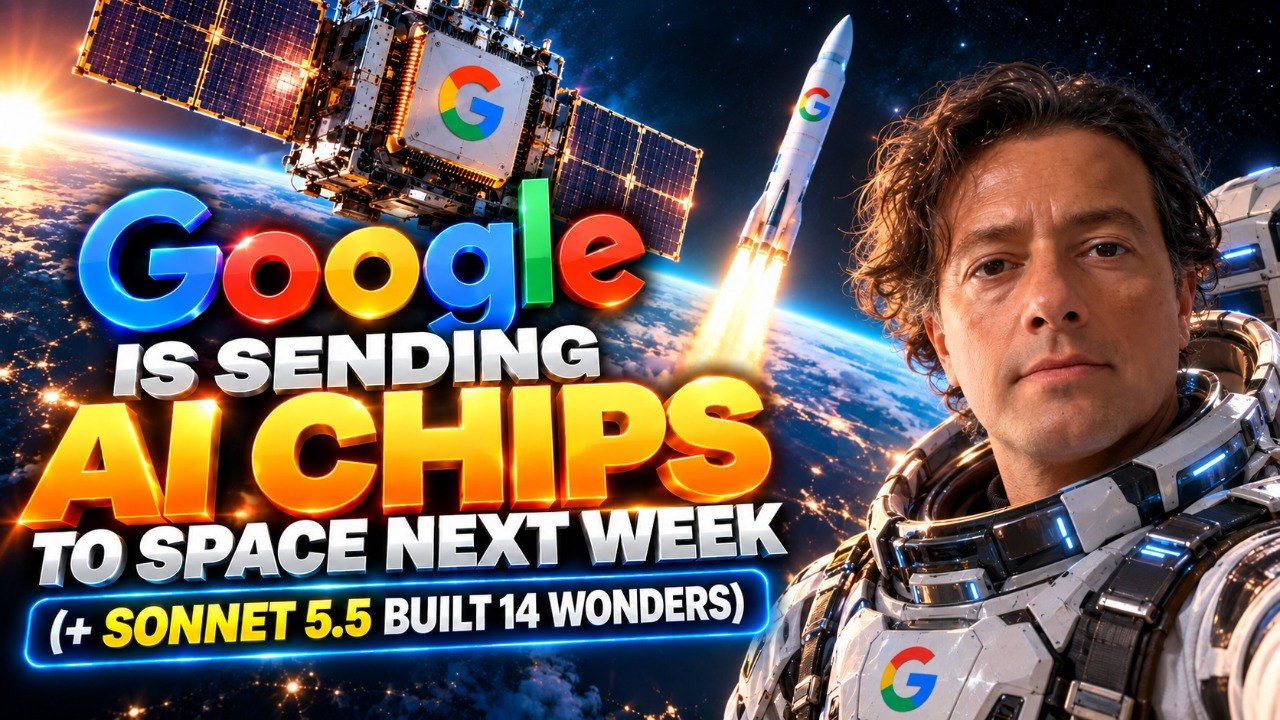
The Video Breakdown
Anthropic’s Sonnet 5.5: The Model That Builds Worlds
On September 23rd, a leaker known as Lyra spotted a new model being tested in stealth mode: Claude Sonnet 5.5. According to the leak, select partners received access for only 24 hours.
The rumored specs are impressive: a 1 million token context window with up to 128,000 tokens of output. The pricing — $2 per million input tokens and $10 per million output — is identical to the current Sonnet 5, so that part remains unconfirmed. But what matters is what this model can actually do.
The Seven Wonders Test
When prompted to build an explorable 3D world of the Seven Wonders, the results speak for themselves.
OpenAI’s GPT-6 Astra produced a clean, functional atlas: seven islands on a blue sea, each labeled, with a guided tour that flies the camera to each wonder. It’s well-made — but simple.
Sonnet 5.5, on the same prompt at high reasoning, produced something entirely different.
It started with the Ancient Wonders — the ones that no longer exist: the Great Pyramid, the Hanging Gardens, the Statue of Zeus, the Temple of Artemis, the Mausoleum, the Colossus of Rhodes, and the Lighthouse of Alexandria. Click on the Great Pyramid and the camera flies in, revealing real historical facts — originally 146 meters tall, built from approximately 2.3 million blocks, the only Ancient Wonder still standing. Click the Lighthouse of Alexandria and you see a three-tiered white tower, a harbor town around it with houses and palm trees.
Then there’s the time-of-day slider. Drag it toward evening, press night mode, and the sky goes dark, windows light up, and the fire atop the lighthouse begins to burn — a detail nobody asked for.
But Sonnet didn’t stop at seven. There’s a second tab: the New Seven Wonders. The Great Wall, Petra, Christ the Redeemer, Machu Picchu, Chichén Itzá, the Colosseum, and the Taj Mahal — all fully rendered and explorable. Open the Colosseum and you see three tiers of arches, the arena floor, dimensions of 189 by 156 meters, and the historical note that Emperor Titus opened it with 100 days of games.
The guided tour mode flies through every wonder at night with the lights on. For context: GPT-6 Astra took about 15 minutes to build its version. Sonnet 5.5 took about an hour. You can see exactly where that hour went.
Opus 5.5: A Complete Fighting Game in One HTML File
Sonnet wasn’t the only model flexing. Opus 5.5 was asked to create a stickman fighting game playable in a browser. The result is called “Strongest of Tomorrow: Black Flash Edition” — and at the bottom of the screen, a note reads: “Everything you see and hear is code.”
The game features:
- Full movement, jumping, and attack combos
- A charged heavy hit and dash mechanics
- Two specials, a skill, and an ultimate mechanic called Black Flash
- When a hit lands, a red ring closes on the enemy — strike again at the exact moment and deal 2.5x damage
- 10 playable characters, each with unique skills and passives
- Three fighting styles, suits, combo lists, and four art styles
It’s not a demo. It’s a real game menu. Play a wave and the combo counter climbs, the style rank rises, the score jumps. Piercing Blood fires a beam of blood across the screen; Blood Whip pulls enemies in. Every hit sprays ink on the ground and it stays there.
A full fighting game. Written by a model. Running smoothly in the browser.
OpenAI: $500/Month and Over 100 Math Problems Solved
OpenAI is preparing a new subscription tier discovered in the ChatGPT code: ChatGPT Pro Max. The price in the code is $500 per month before tax, $600 with tax in some regions. What do you get? The only description hints at “fastest work and codecs.” Some analysts speculate it could run on Cerebras hardware, but that remains unconfirmed. OpenAI Dev Day is next week, so we’ll know soon.
The bigger story is about mathematics. OpenAI announced an independent advisory group of mathematicians hosted at the Institute for Advanced Study in Princeton. The panel includes names like Timothy Gowers, Martin Hairer, and Edward Witten.
Why? Because after the Navier-Stokes solution OpenAI published earlier this month, the same internal model has resolved more than 100 additional open problems across most areas of mathematics. The advisory group’s job is to help OpenAI share these advances responsibly — verifying results, communicating findings, and maintaining academic standards. Notably, the group has no power to slow OpenAI down. It can only advise.
Google’s AI Chips Are Going to Space
And now, the story that sounds like science fiction.
Google published a page yesterday titled, simply: “We are sending TPUs to space.”
Project SunCatcher is launching a satellite to test if Google’s Tensor Processing Units can survive in orbit. The prototype was built in collaboration with Planet and carries four TPUs. It will launch aboard SpaceX’s Transporter 18 rideshare mission, scheduled for October 1st.
Why Space?
In low Earth orbit, a solar panel receives near-constant sunlight — up to 8 times more power than on Earth. The long-term vision is constellations of satellites packed with TPUs, working together as a single orbital data center.
The Engineering Challenges
1. Surviving the Launch
The ride to orbit lasts about 10 minutes, during which the chips experience forces of 50 to 100 . Google shook the satellite on all three axes to simulate a rocket launch. The hardware held up.
2. Radiation
The Trillium TPUs were placed in a proton beam at UC Davis while running AI workloads. The chips survived a radiation dose greater than they would receive during a 5-year space mission.
3. Cooling
In a vacuum, there’s no air — you can’t blow on the chips. Heat can only escape through radiators. Google is testing heat pipes and radiators in a thermal vacuum chamber.
The Science Fiction Part
Future satellites will carry dozens of TPUs each, flying in tight clusters and communicating with each other using lasers. Google says the precision required is like hitting a coin-sized target from miles away while both points are moving at orbital velocity. That laser link will be tested in 2027 with two satellites in orbit.
Next week, the first TPUs leave Earth.
What This All Means
This week captured something unique about where AI is headed. We saw models that don’t just generate text but build entire interactive worlds. We saw a model write a complete video game. We saw an AI solve mathematics that has stumped humans for decades.
And we saw Google decide that Earth isn’t big enough for its AI infrastructure.
The next 12 months are going to be extraordinary.
Watch the full video breakdown at the top of this article, and let us know in the comments — which story blew your mind the most?