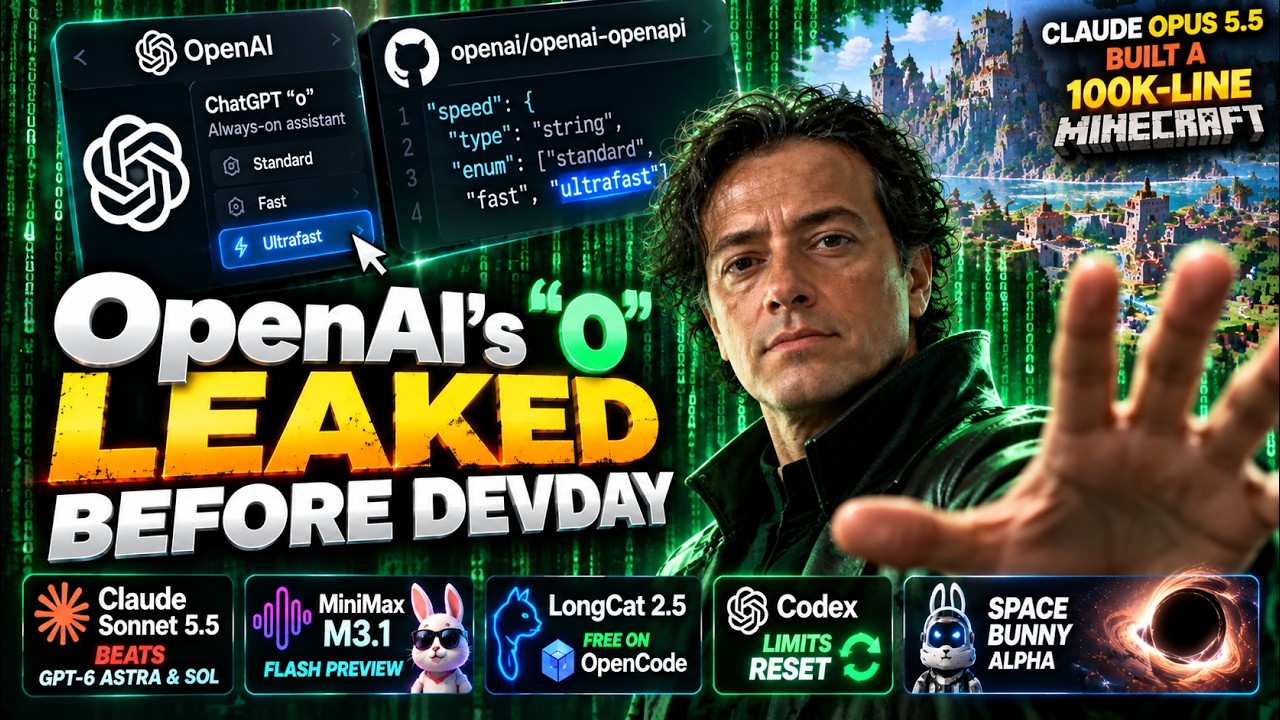
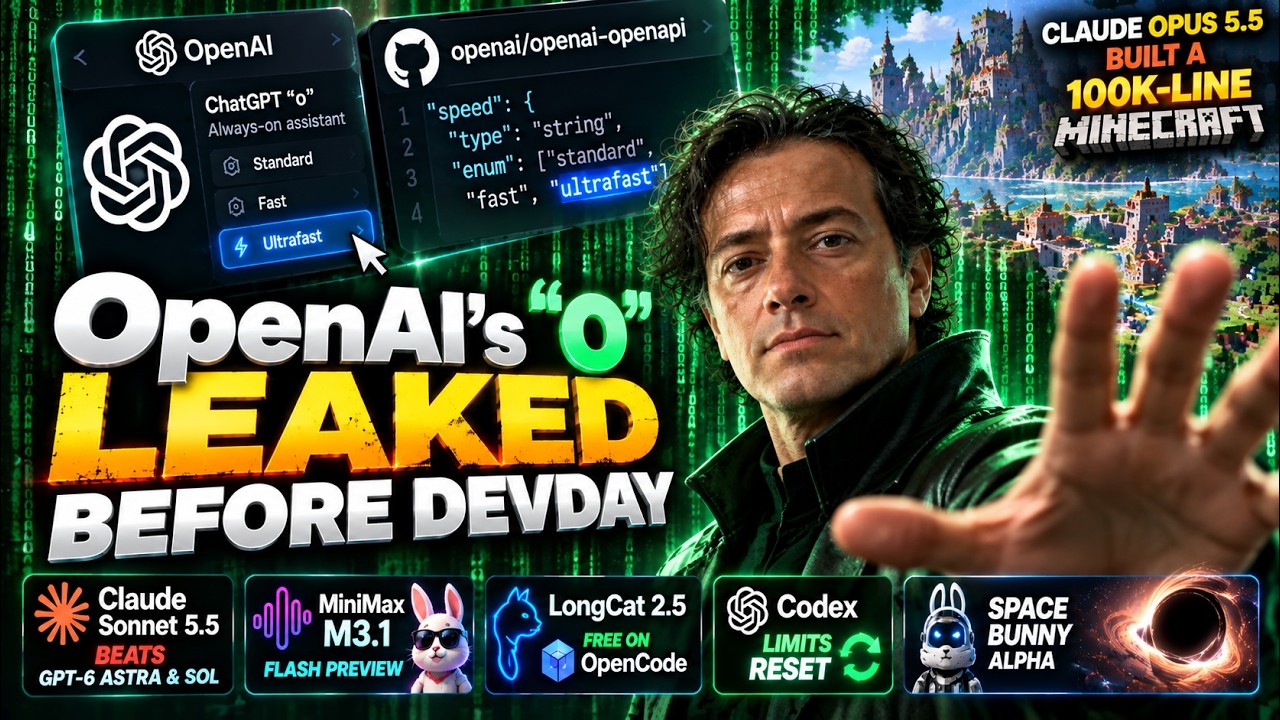
The AI landscape is shifting faster than ever. With OpenAI’s DevDay scheduled for this Tuesday and Anthropic quietly pushing out new model checkpoints behind the scenes, there is no shortage of headlines to track. In this comprehensive analysis, we break down everything that has been happening over the past week — from leaked OpenAI features buried in public code repositories to Claude’s jaw-dropping 100,000-line Minecraft achievement, competitive model comparisons, and a mysterious free-tier model that can render the Gargantua black hole from Interstellar from a single text prompt with no reference images. The pace of innovation has accelerated to a point where monthly, even weekly, model releases are becoming the norm, and the implications for developers, creators, and enterprises are profound.
The video embedded below contains live demonstrations of nearly everything discussed in this article — the OpenAI code leaks being examined in real time, side-by-side model comparisons with visible output differences, and the Space Bunny black hole simulation running live on GPU. If you prefer watching over reading, scroll to the bottom and press play. Otherwise, let us dive deep into each story.
OpenAI DevDay: What the Leaks Reveal
OpenAI’s upcoming DevDay, scheduled for this Tuesday, has generated an extraordinary amount of anticipation — and an equally extraordinary amount of leaks. The rumor mill has been working overtime, but what makes this roundup different is that much of the evidence is buried directly in OpenAI’s own public-facing code and developer platforms. This is not speculation from anonymous sources; this is code that anyone with a GitHub account can verify.
The “O” Assistant: OpenAI’s Always-On Agent
Perhaps the most significant discovery is a new assistant codenamed “O” — an always-on AI agent that continues working even after you close the chat window. This represents a fundamental shift in how OpenAI envisions user interaction with AI. Instead of the current paradigm where a conversation ends when you close the browser tab, “O” persists in the background, executing tasks over extended periods.
The first clue appeared yesterday when some ChatGPT users spotted something unusual on the Pro upgrade screen. A new line of text read: “O, your always-on assistant.” It was subtle, easy to miss, but users who noticed it immediately shared screenshots on social media. The AI investigative community, particularly the account Testing Catalog, quickly dug deeper and confirmed the finding in OpenAI’s internal configuration files. “O” is used as the display name, and “{dash} O” appears as the email suffix — a strong indication that this assistant will have its own dedicated email address and will handle email correspondence on your behalf. Think of it as an executive assistant that never sleeps, never takes a day off, and can process information across multiple communication channels simultaneously.
Going deeper into the ChatGPT codebase, developer Chet As Lua discovered a translator node where the lowercase “o” is explicitly defined as the product name for this assistant. According to the internal code structure, all three Pro subscription tiers will receive access to “O” — including the base $100/month tier. The assistant supports 63 languages, making it a truly global product from day one.
The phrase “always-on” deserves careful examination. What does it actually mean in practical terms? Based on the code and supplementary leaks, it means you give “O” a task — whether it’s researching a topic, monitoring a data source, drafting a document, or managing your inbox — and you can close the chat. Hours later, possibly days later, you return to find the work completed, with the assistant having worked autonomously throughout the entire period. This is fundamentally different from current AI chat paradigms where the model’s context window and session end when the user disconnects.
Leakers suggest that “O” runs on a new underlying model called AON — believed to be a variant of GPT-6 Astra specifically optimized for long-duration tasks. The philosophy is similar to what we have seen with Grokbot (X’s persistent agent) and the Hermes agent: models designed not for quick question-and-answer exchanges, but for sustained, multi-hour, even multi-day work cycles. However, Testing Catalog also offers a more conservative interpretation: AON might simply be the internal code name for the custom agents that already exist in ChatGPT for enterprise workspace accounts, with OpenAI building the consumer-facing “O” experience on top of that existing infrastructure.
The name itself is confirmed by the code. The underlying model architecture? Not yet confirmed. But OpenAI is not exactly being subtle about their excitement. Their official developer account posted just 72 hours before DevDay a cryptic but telling message: “We’ve been working.” The full list of what the community expects on Tuesday is substantial: the “O” agent, the ultra-fast inference mode, a new model reportedly called Astra Minor, and significant quality-of-life improvements to Codex, their AI coding environment.
Ultra-Fast Mode: Verified in the Official API Specification
One of the most concrete and verifiable leaks is the ultra-fast inference mode. This is not a rumor, not a speculation, not an anonymous tip — it is in the official API specification, committed to OpenAI’s public GitHub repository. Anyone can see it.
Here is how it was discovered. The Responses API playground on the OpenAI developer platform — the interface where developers test API calls before integrating them into applications — now shows a speed selector next to the model dropdown. It has three positions: Standard, Fast, and Ultra-Fast. This alone would have been interesting, but the confirmation goes much deeper.
A developer browsed the public OpenAI API specification repository on GitHub and found a specific commit. The commit title is unambiguous: “Add ultra-fast service level option to improve request speed.” Opening the commit diff reveals the actual code change: a new enumeration value “ultra-fast” has been added to the service level field, sitting alongside the existing Standard and Fast values. The code has been reviewed, merged, and deployed. Ultra-fast mode is no longer a rumor; it is a documented feature of the OpenAI API.
So what exactly is ultra-fast mode, and why does it matter? OpenAI previewed this technology last month under controlled conditions. Independent testing organization MLQ reported that GPT-5.6 running in ultra-fast mode achieved up to 750 output tokens per second. To put that number in perspective, standard inference typically runs at approximately 50-80 tokens per second depending on the model and hardware. Ultra-fast mode represents a 14x speed improvement over standard inference — a leap that transforms what is possible with real-time AI applications.
The speed comes from running inference on specialized Cerebras hardware rather than the NVIDIA GPUs that power most AI inference today. Cerebras builds wafer-scale processors — massive single chips that can process entire neural network layers in a single pass rather than sharding them across multiple smaller GPUs. The result is dramatically lower latency for both input processing and token generation.
Until now, this ultra-fast inference was available only as a limited preview for a handful of select enterprise customers. The appearance of the speed selector in the playground strongly suggests that after DevDay, access will be expanded significantly — possibly to all paying API customers, or at least to those on higher-tier plans.
This fits perfectly with OpenAI’s broader strategy. Earlier leaks revealed a $500/month ChatGPT Pro Max plan with “faster responses” as a headline feature. The Playground selector for ultra-fast mode, combined with the Pro Max pricing tier, paints a clear picture: OpenAI is betting its competitive strategy on speed. When models are broadly comparable in capability — and the gap between frontier models has been narrowing — latency becomes the differentiating factor. A model that responds 14x faster feels qualitatively different to use, enabling interactive workflows that are frustratingly slow on standard inference.
Codex Outage and Limit Reset
In a related development, Codex — OpenAI’s AI-powered coding environment — experienced a brief outage. Following the restoration of service, Tibo from OpenAI proactively reset usage limits for all paying users across both Codex and ChatGPT. If you are a Codex user, it is worth checking your current limits; they have very likely been refreshed and are now at full capacity again. This may be a sign of preparations for DevDay announcements, possibly a new Codex version or expanded capabilities that will require users to have full quota available.
Anthropic Strikes Back: Claude Sonnet 5.5 and Opus 5.5
While all the attention has been on OpenAI’s DevDay, Anthropic has been quietly assembling a formidable counter-punch. The company appears to be operating on a release cycle that is accelerating rapidly, with new model checkpoints and entirely new model variants emerging at a pace that would have been unthinkable even six months ago. Two developments in particular deserve attention: the emergence of Claude Sonnet 5.5 and the staggering capabilities already demonstrated by Claude Opus 5.5.
Sonnet 5.5: A New Checkpoint with Major Improvements
According to multiple sources, partners at Anthropic have already received access to a new checkpoint of Claude Sonnet 5.5 — and the early reports are glowing. Lyra, a well-connected AI commentator, states that this checkpoint is “even better than the first” Sonnet 5 release, with a public launch expected this week — potentially as early as Tuesday, coinciding directly with OpenAI’s DevDay.
Chet Aslu reports that Sonnet 5.5 is currently in gray testing inside Claude Code, Anthropic’s coding assistant. The characterization is striking: “incredibly fast, efficient, and with that human touch that people love in all Sonnet models.” The Sonnet line has always been Anthropic’s mid-size offering — positioned between the smaller Haiku and the flagship Opus — but it has historically punched above its weight class in terms of quality-to-speed ratio.
The leaked pricing structure shows $2 per million input tokens, $10 per million output tokens, and $0.20 per million tokens for cached reads. However, a critical caveat must be noted: these are exactly the same prices as the current Sonnet 5. This could mean that the price simply remains unchanged for the new checkpoint — which would be excellent news — or it could mean the leaked data simply copied the existing pricing. The pricing itself is not confirmed.
Why does this matter so much? To understand the potential impact, we need to look at what just happened with the Opus line. Anthropic’s Opus 5.5 performs at the level of Claude Fable 5.1 — a significantly larger and more expensive model — on most benchmarks, while costing 40% less than Opus 5. If Sonnet 5.5 makes a similar efficiency leap while maintaining Sonnet pricing, it will become an absolute monster in the mid-size model category. Developers who have been using GPT-4o or Gemini for cost-sensitive production workloads may find Sonnet 5.5 offering superior quality at competitive prices.
Side-by-Side Comparison: GPT vs Claude Image Generation
One of the most revealing demonstrations came from AI commentator Jazzy, who gave the same image generation prompt to four different models and published the results. The prompt requested: “An animated pixel art scene of a Japanese pagoda at night with cherry blossoms, the moon, and a bridge over water.”
The four models tested were:
- GPT-6 Astra (OpenAI’s flagship): Produced an entire city with canals and bridges, showing impressive scale and architectural variety, but the colors were noticeably desaturated and lacked the vibrant, atmospheric quality the prompt called for. The night scene felt flat rather than moody.
- GPT-6 Sonnet (OpenAI’s mid-size): Generated a straightforward scene — a pagoda, a bridge, very literal interpretation. The composition was correct but simplistic, lacking the imaginative embellishments that make pixel art memorable.
- Claude Opus 5.5 (Anthropic’s flagship): Went far beyond the prompt, generating a dragon flying across the sky, Mount Fuji in the background, and a floating island with a cascading waterfall. This is the kind of creative overdelivery that has made Claude popular among artists and creatives who want more than a literal interpretation.
- Claude Sonnet 5.5 (Anthropic’s mid-size): Produced arguably the most impressive result of the four — floating islands each with their own pagoda, a castle perched on a distant hill, Mount Fuji dominating the horizon, and torii gates emerging mysteriously from the water. The depth and composition were exceptional. And this is supposed to be the mid-size model.
The implication is clear: on creative generation tasks, the gap between mid-size and flagship models is narrowing dramatically. Sonnet 5.5, as a mid-tier model, is producing results that rival or exceed what the flagship Opus was capable of in the previous generation. This compression of the quality curve — where even the affordable model is “good enough” for professional work — has profound implications for how developers and businesses choose which model to deploy.
Claude Opus 5.5: The 100,000-Line Minecraft Clone
This is, without question, one of the most impressive demonstrations of long-form AI coding we have ever seen. A developer going by the handle “AI for Success” is building a complete Minecraft clone for his son — and he is doing it entirely with Claude Opus 5.5. The numbers are genuinely staggering and deserve to be examined in detail.
- 101,442 lines of game code — this is not a toy project or a proof-of-concept. This is a codebase that rivals small commercial games in size and complexity. The code handles chunk-based voxel world generation, player physics, block placement and destruction, inventory management, lighting, mob AI, and crafting systems.
- 26,708 lines of test code — a comprehensive test suite covering nearly 1,000 automated tests. This is production-grade engineering discipline, not casual hobby coding. The test coverage ensures that as new features are added, existing functionality does not break.
- 988 automated tests — each test verifies a specific behavior or system within the game world. With this level of coverage, the developer can confidently make changes without fear of regressions.
- 7,075 files — a codebase organized into meaningful modules and systems. This is not a monolithic script; it is a properly structured software project.
- Approximately 35 hours of total work so far — and this is the number that truly deserves attention. Thirty-five hours to produce a 100,000-line, fully-tested game. That is roughly one work week. A project of this scope, undertaken by a competent human developer working alone, would take weeks or months.
- 23 images and 184 sounds — all created through code. No image generator was used. No asset store purchases. No external resource downloads. Claude Opus 5.5 wrote code that procedurally generates textures and synthesizes audio, creating the entire game asset pipeline from scratch.
The developer even built a complete in-game guide — a tutorial system that teaches new players how to navigate the world, where to find villages, how to return home after exploring, what resources to prioritize, and what dangers to watch for. The agent behind the scenes maintains a dashboard tracking every system in the game: what has been implemented, what is in progress, what still needs to be built. It is a living project management view of the entire codebase, generated and maintained by the AI.
This is what long-term coding agents look like in practice. Not generating one-off scripts or boilerplate, but building entire production-scale applications over sustained multi-hour coding sessions. The implications for software development are difficult to overstate. When an AI can build a Minecraft clone in a work week, the barrier to entry for creating complex software collapses. Every developer becomes a studio. Every idea can be prototyped and iterated in days, not months.
The Free Model Revolution: LongCat 2.5 and Space Bunny
Amidst all the news about expensive frontier models and enterprise API pricing, two free-tier models have quietly entered the scene. One is a generous preview from an established provider. The other is a mysterious entity that is producing results wildly beyond what its “free” label would suggest.
LongCat 2.5: Free Multimodal with 1M Context
The LongCat 2.5 preview is available for free on OpenCode for a limited period — two weeks, according to current information. The specifications are impressive: 1 million tokens of multimodal context, meaning it can process entire books, codebases, or datasets alongside images and other modalities in a single pass. The provider follows a strict zero-data-retention policy and explicitly states that your data will not be used for model training. For developers working with sensitive or proprietary code, this privacy guarantee is as valuable as the free pricing. On the OpenCode platform, right next to LongCat 2.5 in the model list, sits another intriguing entry: Space Bunny.
MiniMax M3.1 Flash — The Model That Wasn’t Supposed to Exist Yet
Space Bunny is the unofficial nickname for what appears to be MiniMax M3.1 Flash, a model that leaked into the open before its official announcement. A few days ago, a sharp-eyed user spotted references to “M3.1 Flash” in an early commit on MiniMax’s GitHub repository. The references were hastily removed before the pull request was merged, but not before screenshots were taken and shared. Damage control failed; the cat was out of the bag.
This morning, MiniMax made it official. The M3.1 Flash preview is now live in MiniMax Code. The positioning is clear: this is a model built for everyday development work — fast, reliable, suitable for everything from quick bug fixes to implementing complete features. According to Alpha Signal’s analysis of the product listing, M3.1 Flash positions itself alongside the existing M3 and M2.7 models, with a new five-level reasoning effort setting: Low, Medium, High, Extreme, and Maximum. This graduated reasoning control lets developers trade speed for depth depending on the task at hand — use Low for simple formatting fix, Maximum for complex architectural decisions.
MiniMax has not yet published pricing, a detailed model card, or a public API endpoint. The model remains in preview, accessible primarily through their own MiniMax Code environment. But the outputs speak for themselves. The voxel pagoda scene — the pond reflecting the moonlight, the arched bridge, the cherry trees in bloom (in pixel-art voxel form) — all built by Space Bunny. AI commentator Yazi directly compared Space Bunny against Grok 4.7 (xAI’s latest model) using the same garden prompt. Space Bunny on the left, Grok on the right. The outputs were competitive — in some aspects, Space Bunny held its own against a model backed by one of the world’s most well-funded AI companies.
Space Bunny Creates Gargantua: The Interstellar Black Hole
This is the demonstration that deserves special attention. Space Bunny (also known as “Alpha” on the OpenRouter platform — currently routing to the same MiniMax M3.1 Flash model) offers 1 million tokens of context and is, at the time of writing, completely free to use on OpenRouter.
AI for Success — the same developer building the Minecraft clone with Opus 5.5 — took Space Bunny and pushed it to its limits. He asked it to create Gargantua, the supermassive black hole from Christopher Nolan’s Interstellar, and published the exact prompt he used. The requirements were not simple: the model needed to implement ray marching (a rendering technique for volumetric scenes), gravitational lensing (where light bends around a massive object), a photon ring (the bright ring of light at the black hole’s boundary), and an accretion disk that curves visually above and below the black hole’s event horizon — a complex visual effect that requires understanding both physics and 3D rendering mathematics.
I took the exact same prompt — not modified, not adapted — and fed it to Space Bunny through OpenRouter. One shot. No reference image. No corrections. No iterative prompting. A single attempt.
The model responded with a single HTML file. One file. Shaders were included inline. No external libraries, no CDN links, no dependencies. Opening that file in a browser reveals Gargantua running on the GPU in real-time interactive 3D. The accretion disk passes in front of the event horizon, and light from behind the black hole curves visibly over the top and under the bottom — that is gravitational lensing, rendered correctly, exactly as the prompt specified. Dragging the mouse to orbit around the black hole, the side approaching the viewer becomes brighter — relativistic Doppler beaming, also correct. Zooming in near the photon ring, the background stars stretch and warp around the black hole’s circumference.
And then there is the interactive element. Clicking launches a comet into the scene. Watch it curve under the influence of simulated gravity, leave a glowing trail, and eventually cross the event horizon and disappear into the black hole. Launch another. And another. There is even a control panel — brightness sliders, orbit pause, camera controls — all generated from that single prompt.
To be clear: this is a free model. Not a $20/month subscription. Not a $0.15-per-million-tokens API call. A model that currently costs nothing to use, producing a cinematic-quality physics simulation from a single text prompt that reads like a conversation with a colleague.
I also asked Space Bunny for something entirely different: a custom voxel pagoda with a garden, a koi pond, paper lanterns, and a waterfall. I specified three times of day — daytime with bright sunlight and clear water, sunset with orange and purple skies, and nightfall where the lanterns illuminate automatically and fireflies appear. I asked for a wind slider that animates the cherry blossom particles. Every piece was rendered as individual voxel cubes. Space Bunny produced this in a single file as well — a complete interactive 3D scene from a flash-tier free model.
The Big Picture: What This All Means
We are at a fascinating inflection point in the development of artificial intelligence, and this week’s news cycle illustrates the dynamics more clearly than any single announcement could.
On one side, OpenAI is pushing the boundaries of inference speed and persistent agents. Ultra-fast mode at 750 tokens per second changes the economics of real-time AI applications — chatbots that respond instantly, code completion that keeps pace with the fastest typist, real-time translation without perceptible delay. The “O” assistant, if it delivers on its promise of persistent background task execution, redefines what it means to “use” an AI. Instead of discrete chat sessions, the AI becomes a continuous presence in your workflow — the difference between calling someone on the phone and having them sit at the desk next to you.
On the other side, Anthropic is demonstrating that the frontier model quality gap is shrinking. Opus 5.5 produces a 100,000-line game in 35 hours. Sonnet 5.5 — the mid-size model — generates pixel art that rivals or surpasses flagship models from the previous generation. The implication is that for most practical tasks, the question is no longer “which model is best” but “which price-performance point fits my use case.” The answer increasingly favors smaller, faster, cheaper models that are surprisingly close to the frontier in quality.
And in the background, the free-tier revolution is quietly changing who has access to state-of-the-art AI capabilities. LongCat 2.5 offers a million tokens of context with zero data retention at no cost. Space Bunny — a preview model that was never meant to be public yet — renders cinematic interactives from a single prompt. These models are not charity; they are strategic plays for developer mindshare and ecosystem lock-in. But for the user, the result is the same: capabilities that were state-of-the-art six months ago are now available for free.
DevDay is Tuesday. If OpenAI launches “O” and Anthropic simultaneously releases Sonnet 5.5 on the same day — as multiple sources now predict — it will be an unprecedented moment in the AI industry. Two of the world’s leading AI companies launching major products on the same day, competing directly for developer and user attention. The competition is driving innovation at a pace we have never seen before, and the real winners are the users — developers, creators, students, and anyone willing to experiment with these tools.
The only question that remains is: what comes next week? Because at this pace, next week’s news cycle will render most of this article obsolete. And honestly? That is the most exciting part.
Watch the Full Breakdown
For the complete deep dive with live demonstrations of everything discussed above — including the Space Bunny Gargantua render running in real time, Codex leaks being examined on GitHub, and real-time model comparisons with visible output differences — check out the full video. The embedded player below will take you directly to the complete analysis.
Follow ruocco.it for the latest updates on AI, technology, and the tools shaping the future. If you found this breakdown valuable, share it with someone who needs to stay ahead of the curve.