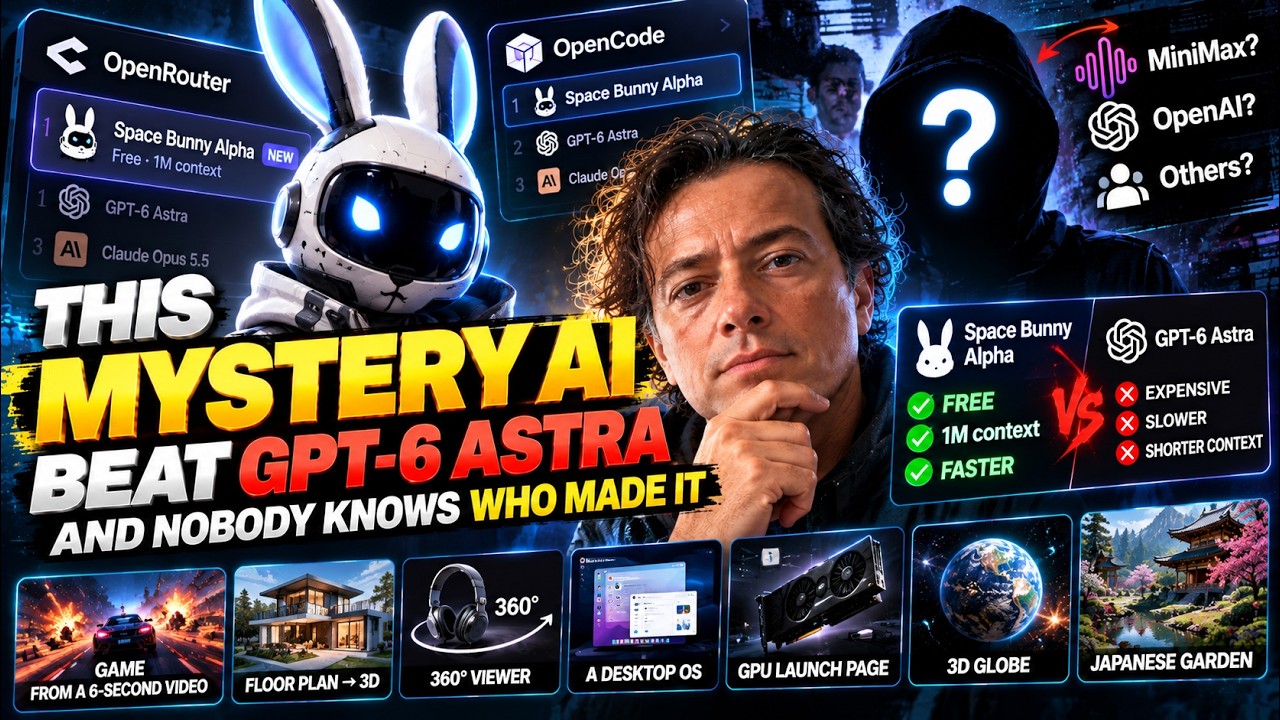
Space Bunny Alpha: The Anonymous AI That Is Taking Over OpenRouter for Free
Published on September 28, 2026
A mysterious new AI model has appeared on OpenRouter. It has no known creator, costs absolutely nothing to use, and is outperforming some of the most expensive models on the market. Its name is Space Bunny Alpha, and in the two weeks since its release on September 23, 2026, it has ignited one of the most fascinating debates in the AI community. Developers, researchers, and hobbyists alike are flocking to it in droves, not just because it is free, but because it genuinely delivers results that rival—and in some cases exceed—models that cost hundreds of dollars per run.
In this comprehensive article, we explore everything known about Space Bunny Alpha: its raw performance metrics, its real-world capabilities across multiple domains, the burning mystery surrounding its origins, how it compares head-to-head against industry giants like GPT-6 Astra, and what its emergence means for the broader AI ecosystem. We will also share interactive demos built entirely by Space Bunny Alpha that you can try for yourself.
Let us dive in.
What Is Space Bunny Alpha?
Space Bunny Alpha is listed on OpenRouter as a “stealth model.” According to the official page, a third-party provider built it and chose to remain anonymous during the public preview phase. OpenRouter itself simply forwards the requests to the underlying provider—they do not own, operate, or host the model themselves. This anonymity is at the heart of the mystery, and it is also why the AI community has become so obsessed with uncovering the model’s true identity.
The model was released on September 23, 2026, and it accepts text, images, and video inputs. That alone sets it apart from many open and closed models that only accept text and images. Being able to process raw video footage opens up use cases that most models simply cannot handle: watching gameplay and recreating it, analyzing real-world video feeds, understanding motion and time-based context, and generating code that reacts to visual temporal information.
Its context window is a staggering 1 million tokens. To put that into perspective, one million tokens is roughly equivalent to 750,000 words—or about three full-length novels. This rivals the largest context windows available in the industry today. But what makes Space Bunny Alpha truly remarkable is the price: zero dollars. No per-token fees, no tiered pricing plans, no hidden charges. It is, for all practical purposes, completely free. You can send a million tokens of context and receive tens of thousands of tokens of output, and your wallet will not feel a thing.
How Does the Anonymity Work?
OpenRouter serves as a marketplace for AI models. Providers—ranging from massive corporations like OpenAI and Google to smaller independent labs—register their models on the platform, and users pay per token. OpenRouter takes a small cut and forwards the rest to the provider. In Space Bunny’s case, the provider chose to keep their identity hidden. They are not listed anywhere on the platform. There is no company name, no contact email, no link to a website. Nothing.
This is highly unusual. Most providers want the visibility and branding that comes with listing on OpenRouter. An anonymous provider has no incentive to build reputation, no accountability for uptime, and no obligation to fix issues. The only logical explanation is that the provider has a different motive: testing, research, or perhaps a strategic soft-launch ahead of a public announcement. The privacy warning on the page reinforces this: “Your prompts may be kept by the provider—not for training, but do not send anything private.” This suggests data collection for evaluation purposes, which is consistent with a pre-release beta.
Raw Performance Numbers
Performance benchmarks are impressive across the board. Space Bunny Alpha delivers more than 50 tokens per second at the median, with latency under two seconds on standard queries. For comparison, GPT-6 Astra—one of the most capable commercial models available today—clocks in at around six seconds of latency on similar queries and writes at roughly half the speed. That means Space Bunny does not just win on price; it also wins on responsiveness.
The model can generate up to 5,400 tokens per response, which is more than enough for most practical applications. GPT-6 Astra supports up to 128,000 tokens in a single output, so for tasks requiring novel-length generation in one shot, Astra retains the advantage. However, for the vast majority of use cases—code generation, interactive demos, image description, architectural planning, data analysis—5,400 tokens is ample.
Another area where Space Bunny shines is reasoning depth. When not operating in maximum reasoning mode, the model responds in under two seconds. But when you need deep, thoughtful outputs, you can switch to max reasoning. In this mode, Space Bunny can think for extended periods—sometimes minutes—before generating a response. This trade-off between speed and depth is controlled by a simple setting on OpenRouter, giving users flexibility depending on their needs.
Real-World Capabilities: What Can It Actually Do?
The community wasted no time stress-testing Space Bunny Alpha across dozens of domains. The results have been nothing short of extraordinary. What follows is a detailed breakdown of the most impressive demonstrations, each one performed using a single prompt with no iteration or refinement.
1. Game Development from Raw Video Input
One of the most impressive demonstrations involved a user feeding Space Bunny a six-second clip of a game—no text description, no context, no explanation. Just raw video of someone playing a game. The model watched the footage frame by frame and then wrote a fully playable version of that game as a single, self-contained HTML file.
The game—dubbed Ballpoint Storm—included:
- Ballpoint-pen-style hand-drawn graphics rendered on virtual notebook paper, complete with the faint blue lines of classic school notebooks
- Auto-firing weapons so the player only needs to move with arrow keys
- Combo counters that climb incrementally during chains of kills, encouraging aggressive play
- Animated bomb effects that wipe enemy bullets off the screen in a satisfying radial burst
- A wind-screen effect that scrolls across the background during gameplay
- A boss fight against “The Black Biro” with its own health bar and three distinct attack phases
- Sound effects generated procedurally within the HTML rendering
- The boss’s name read directly off the source video footage
On the first token, Space Bunny reasoned for 7.8 seconds—a deep planning phase—and then generated nearly 50,000 tokens at approximately 120 tokens per second. The entire game was produced in under 7 minutes, start to finish, for zero cost. To put this in perspective: a human game developer with years of experience would need multiple days to build something equivalent from scratch. Space Bunny did it in minutes from a six-second video clip.
2. 3D Architectural Modeling from a Single Image
Another remarkable test involved a user who gave Space Bunny a single image: a hand-drawn floor plan of his apartment. He then connected the model to Blender, the open-source 3D creation suite. Space Bunny wrote the Python code to interface with Blender’s API, and then Blender built the entire apartment, room by room, based on the floor plan image.
The output included:
- Accurate wall placement matching every dimension from the floor plan
- Door and window openings in the correct positions
- Wood flooring in the living area
- Tiles in the kitchen and bathroom zones
- Fabric textures on furniture that Space Bunny inferred from room type
- Decorative plants placed in corners and near windows
- Color palettes consistent with a modern apartment
After approximately one hour of processing, every room matched the original floor plan with near-perfect fidelity. One image in, a fully textured, fully furnished 3D apartment out. This has massive implications for architects, interior designers, real estate agents, and game developers who routinely convert 2D plans into 3D environments.
3. Interactive 360° Product Viewer
Asked to build an interactive product viewer for a pair of premium headphones, Space Bunny delivered a fully functional 3D model built entirely in code—no external assets, no image textures, no 3D models imported from disk. The user can drag to rotate the headphones around any axis, revealing a real, subdivision-mapped 3D mesh. This is not a cube map or a rotating sprite; it is a genuine 3D object with geometric depth and surface polygons.
Interactive hotspots hover over key components. Click one, and the camera smoothly flies into that area, zooming in on the component while a tooltip explains its function. Four interchangeable color finishes can be selected: Midnight (deep blue-black), Sand (warm beige), Sage (muted green), and Coral (vibrant pink-orange). The exploded view mode disassembles the entire product into its constituent parts—ear cups, headband, driver units, cushions—allowing the user to see exactly how it is constructed.
This is the kind of interactive product visualization that typically requires a team of designers, 3D modelers, and frontend developers weeks to produce. Space Bunny did it in one prompt, in one shot, in under 6 minutes, for free.
4. A Complete Desktop Operating System in a Browser Tab
Perhaps the most audacious demo: Space Bunny built an entire desktop operating system—Nimbus OS—inside a single browser tab, from a single prompt. The output includes:
- A glass-style menu bar across the top with application menus
- A macOS-style dock at the bottom that magnifies icons on hover
- Every application icon drawn as an SVG graphic, not loaded from external files
- A working calculator with arithmetic operations, memory functions, and a clean UI
- A terminal application that supports commands like
neofetch,ls, andecho - A notes application with live text editing, cursor positioning, and scrollable content
- Spotlight-style search that opens any application by typing its name
- A notification center that slides in from the right edge of the screen
- Music player, file browser, and settings panels
- Keyboard shortcuts, window dragging, and multiple desktop workspaces
Every component is functional. The terminal runs real pseudo-commands. The calculator performs actual arithmetic. The notes app saves typed content. This is not a mockup or a wireframe—it is a genuine interactive environment. All generated from a single prompt. All free.
5. Product Launch Page with Real-Time 3D Rendering
Another single prompt produced a complete launch page for a fictional graphics card: The Helix Vortex RX 9090. The page features:
- A 3D model of the graphics card rendered in-browser with real-time WebGL
- Three fans on the card spinning continuously with animated blades
- Scroll-triggered animation: as the user scrolls down, the card rotates to reveal different angles
- Specifications that animate into view as the user scrolls: VRAM, clock speed, CUDA cores, bandwidth
- A performance chart that builds itself dynamically as it enters the viewport
- A ray-tracing toggle slider that switches the 3D render between ray-traced and rasterized modes in real time
- Color options, pricing tiers, and an order button
This is the kind of page that a marketing agency would charge tens of thousands of dollars to build. Space Bunny produced it in minutes, for zero cost, from a single descriptive paragraph.
6. 3D Earth with Live Flight Routes and Orbital Mechanics
Finally, the model generated a fully interactive 3D globe featuring glowing flight arcs between twelve major cities around the world. The cities are labeled, and curved arcs trace the great-circle flight paths between them. The Moon orbits the Earth at a realistic distance relative to the globe’s scale, with visible phases.
The interface includes:
- A control panel on the right side with toggle switches
- Cloud layer toggle: switch atmospheric clouds on and off
- Night shadow toggle: show the Earth’s dark side with city lights
- Time speed control: accelerate orbital motion for visual effect
- Drag to orbit the globe around any axis
- Scroll to zoom in and out
A community member ran a parallel test between GPT-6 Soul and Space Bunny for a similar globe. GPT-6 Soul took 5 minutes and consumed 520,000 tokens. Space Bunny took 43 minutes on max reasoning but consumed only 219,000 tokens. This shows Space Bunny’s reasoning mode trades time for token efficiency—a deliberate trade that reduces output cost even further.
Community Experiments: The Developer Playground
Beyond the headline demonstrations, developers across the AI community have been putting Space Bunny through its paces in dozens of creative experiments. Here are some of the most notable:
Karan’s Rocket Launch Simulation
Developer Karan built a full rocket launch simulation in approximately three minutes using a single one-shot prompt on Space Bunny running at maximum reasoning. He then ran the same prompt on Opus 5, GPT-6 Soul, and Gemini 3.8 Flash for comparison. The results were dramatic: Space Bunny produced a simulation with flame effects, stage separation physics, altitude and velocity telemetry displays, and a tracking camera that follows the rocket from ground to space. Karan’s verdict: “Space Bunny cooked the whole leaderboard. Watch the liftoff and judge for yourself.”
Victor’s Solar System Dashboard
Developer Victor built a 3D Earth with the entire solar system orbiting around it, combined with a shipping logistics dashboard. A route from Busan, South Korea, to Vancouver, Canada, was plotted directly on the globe surface using great-circle navigation. Victor’s main takeaways: Space Bunny is snappy at default settings, reads images and video embedded in a chat stream, handles up to 1 million input tokens, and generates code that runs without errors on the first try.
Pankage’s Equity Research Application
Developer Pankage gave Space Bunny a single prompt on Open Code to build an equity research application. The model went far beyond what was asked:
- It pulled live market data from public APIs
- Built interactive stock price charts with moving averages and volume bars
- Identified direct competitors and displayed their comparative metrics
- Summarized relevant SEC filings with key dates and filing types
- Researched recent news events affecting the selected company
- Generated bull case, base case, and bear case scenarios with supporting data
- Listed key risks with severity ratings
All of this appeared in a single, clean user interface with navigation tabs, data tables, and chart widgets. The breadth of autonomous research the model conducted was far beyond what the prompt explicitly requested.
Head-to-Head: Space Bunny vs. GPT-6 Astra
The comparison that everyone has been waiting for. A community member named Mark gave both Space Bunny Alpha and GPT-6 Astra the exact same one-shot prompt, word for word, with no additional context or guidance:
“Build a detailed voxel-style Japanese garden in Three.js with a pagoda, tiny villagers, a flying dragon, and interactive details.”
The Results
GPT-6 Astra took approximately 15 minutes to generate its version. The total cost was $424 in compute tokens. The garden was technically sound: a pagoda with proper proportions, a pond with reflective water, trees arranged in a convincing layout, and basic interactivity for camera control.
Space Bunny Alpha took approximately 45 minutes on its max reasoning setting and cost exactly $0. The garden it produced was noticeably more detailed:
- Lanterns around the pagoda cast dynamic light in the night view
- Tiny villagers walked along paths with idle animation cycles
- The dragon had visible wing articulation and flew in a circuit around the garden
- A bridge arched over a koi pond with fish swimming beneath the surface
- A torii gate stood at the garden entrance with proper perspective
- Dawn, rain, and festival modes could be toggled, each changing the lighting, weather effects, and ambient activity
Mark expected Astra to win given its proven track record and massive budget. Instead, he concluded that Space Bunny “paid way more attention to the details.” The model had not just followed instructions—it had made creative decisions about what would make the garden feel alive and immersive.
When the same prompt was independently run by another user, Space Bunny answered in under 3 minutes on default settings—again for zero cost—producing an equally detailed garden with the same interactive features. The garden named Tsukimi Garden became one of the most shared demos in the community.
The Great Mystery: Who Built Space Bunny?
Naturally, the biggest question on everyone’s mind is: who is behind this model? How can a free model compete with multi-hundred-dollar competitors? Why would anyone build something this capable and give it away for nothing?
An independent website was set up by curious community members—not the creators themselves—to investigate. The evidence trail is as fascinating as the model itself.
Clue #1: The Tokenizer Fingerprint
Every AI model uses a tokenizer—a system that breaks text into smaller units (tokens) for processing. Different model families use different tokenization strategies, and these leave a fingerprint that can be detected by analysis. Space Bunny counts tokens in a way that closely matches the Minitron and Miniax model families.
When Miniax released the M3.1 Flash preview around the same time, one community researcher wrote: “Looks like I called it—Space Bunny is Miniax.” The timing and the tokenizer match seemed to confirm this theory.
However, there is a problem. When researchers asked both Space Bunny and Miniax M3.1 Flash to produce the same drawings—characters, faces, poses, objects—Space Bunny’s results were clearly superior. The faces had better proportions, the poses were more anatomically correct, and the details were richer. If they were the same underlying model, the outputs should have been equivalent. This discrepancy suggests either a different architecture entirely or a significantly upgraded and fine-tuned version of the Miniax base.
Clue #2: The System Prompt Format
The reconstructed system prompt—which researchers extracted by analyzing the model’s behavior—bears a striking resemblance to OpenAI’s Harmony format. Harmony is the system prompt schema used by GPT-o3 and later OpenAI models. It has a distinctive structure and syntactic signature that is hard to forge.
This clue is significant because OpenAI has been known to release preview models anonymously. They did something similar with GPT-2’s staged rollout and have experimented with anonymous beta releases in the past. OpenAI’s Dev Day is scheduled for September 29, 2026—just days after Space Bunny’s release. The timing would be perfect for a pre-Dev Day soft launch.
Could Space Bunny Alpha be a preview of a new OpenAI model? A version of GPT-o3 or a new open-weights model designed to gather real-world usage data and feedback before a public announcement?
Clue #3: The Multimodal Capabilities
Space Bunny’s ability to accept video input is rare. Very few models support raw video ingestion. OpenAI’s GPT-4o and GPT-6 series do. Google’s Gemini family does. Most open-source models and smaller providers do not. If Space Bunny truly is an anonymous release, the provider must have invested significant resources in multimodal training—which points to a well-funded organization rather than an independent group.
Who Stands to Benefit?
Consider the strategic value of an anonymous free release:
- For a major company: gather real-world usage data, identify edge cases, benchmark against competitors without reputational risk if the model underperforms, and build community goodwill before an official launch
- For an open-source lab: demonstrate capabilities, attract developer attention, build an ecosystem of users and contributors, and prove the model’s worth before seeking funding or commercial adoption
- For a research project: collect diverse prompts and interactions for training data, study how users interact with the model under real conditions, and evaluate safety and alignment in an uncontrolled environment
As of this writing, nobody has confirmed anything. The helmet stays on. The identity remains unconfirmed. The community continues to speculate, and the debate shows no signs of settling.
Limitations, Caveats, and Warnings
Before you rush to use Space Bunny for everything, there are important caveats to keep in mind. Every powerful tool has its limitations, and Space Bunny is no exception.
Privacy Warning
OpenRouter’s page explicitly states that prompts may be kept by the anonymous provider. They are not used for training, but the statement is intentionally vague. You should never send anything private, confidential, or personally identifiable through this model. Treat every interaction as potentially recorded and stored by an unknown third party.
Maximum Output Length
Space Bunny supports up to 5,400 tokens per response. While this is generous and sufficient for most practical tasks, it is a fraction of GPT-6 Astra’s 128,000-token maximum. For tasks requiring book-length outputs, detailed long-form analysis, or processing of extremely large documents in a single response, commercial models remain the better choice.
Reasoning Speed Trade-Off
On maximum reasoning mode, Space Bunny can think for extended periods. In one globe test comparison, GPT-6 Soul completed the task in 5 minutes using 520,000 tokens, while Space Bunny took 43 minutes but used only 219,000 tokens. The model trades time for token efficiency at high reasoning levels. For time-sensitive applications, keep the model on its default settings. For deeply analytical tasks, the max reasoning mode is worth the wait.
No Service Guarantees
Since the provider is anonymous, there are no service-level agreements. No guarantees about uptime. No support channels. The model could disappear as suddenly as it appeared. Do not build production systems that depend on its availability without a fallback strategy. Use it for exploration, prototyping, and experimentation—not for mission-critical workflows.
Potential Rate Limiting
Free models on OpenRouter often face rate limiting as usage grows. With over 170,000 users and 10 million sessions already recorded, Space Bunny may experience slowdowns during peak usage periods. If you encounter delays, consider switching to a lower reasoning setting or trying again during off-peak hours.
Usage Statistics: The Numbers Behind the Hype
Open Code’s analytics page shows Space Bunny Alpha ranking number one across the previous week’s usage. The numbers are staggering for a model that has only been available for a few days:
- More than 40 trillion tokens processed in the first week of public availability
- Over 170,000 unique users across the OpenRouter and Open Code ecosystems
- More than 10 million sessions initiated by users worldwide
- Total spend: $0 across all users, all sessions, all tokens
To give this context: processing 40 trillion tokens on GPT-6 Astra would cost approximately $400,000 at its input rate alone, not counting output tokens. Space Bunny processed the same volume for nothing. The economic efficiency is unprecedented in the industry.
Try It Yourself: Space Bunny Interactive Demos
Space Bunny Alpha is available right now on OpenRouter. No sign-up fees, no credit card required, no API key needed for basic access. Just navigate to the Space Bunny page, type your prompt, and watch it work. If you want access through a programming interface, OpenRouter provides standard API endpoints with compatibility for OpenAI’s SDK format.
We have prepared a dedicated collection of interactive demos built entirely with Space Bunny Alpha during the tests described in this article. You can try them directly in your browser without any setup or configuration:
- Tsukimi Garden — The voxel-style Japanese garden with dawn, rain, and festival modes. Drag to orbit, scroll to zoom, and watch the dragon fly.
- Ballpoint Storm — The side-scrolling shoot-em-up drawn in ballpoint pen style. Play against The Black Biro boss.
- Aria One — The 360° product viewer for premium headphones with hotspots, four finishes, and exploded view.
- Nimbus OS — The full desktop operating system in a browser tab with calculator, terminal, notes, and more.
- Vortex RX 9090 — The 3D graphics card launch page with spinning fans, ray-tracing slider, and scroll animations.
- Global Routes — The interactive 3D Earth with flight arcs, cloud controls, night shadow, and time speed.
👉 Explore the Space Bunny Alpha Interactive Demos on Ruocco.it
Each demo was generated in a single one-shot prompt with zero manual editing. They are a testament to what this model can achieve when given clear instructions and creative freedom.
What This Means for the AI Industry
Space Bunny Alpha’s emergence has implications that extend far beyond a single model release. Here is what we believe its impact will be:
Commoditization of High-Quality AI
The traditional model of charging per token is facing its first serious challenge. If a free model can match or exceed paid competitors in common use cases, then the entire pricing structure of the industry becomes questionable. Providers will need to justify their costs through specialized capabilities, guaranteed uptime, data privacy assurances, or ecosystem integrations that free models cannot match.
Democratization of AI Development
Developers in developing countries, students, hobbyists, and independent researchers now have access to frontier-level AI capabilities without financial barriers. This could accelerate innovation in regions that were previously priced out of the AI ecosystem. The next breakthrough application might come from someone who could never afford GPT-6 Astra credits but can iterate freely on Space Bunny.
Erosion of the “Safety First” Model
Major AI companies invest heavily in safety testing, alignment research, and content filtering. An anonymous model with minimal guardrails represents both an opportunity and a risk. On one hand, users have more freedom to explore the model’s capabilities without artificial restrictions. On the other hand, the lack of oversight means the same model could be used for harmful applications that a commercial provider would block. The debate between openness and safety is about to intensify.
The Anonymous Release as Strategy
If Space Bunny does turn out to be a preview from a major company, it will establish a new playbook for market testing. Anonymous releases allow companies to gather real-world data, identify weaknesses, and benchmark against competitors without the brand risk of a failed launch. If successful, they take credit. If underwhelming, they deny involvement and try again. This asymmetric strategy could become common practice in the industry.
Final Thoughts
Space Bunny Alpha represents something genuinely exciting in the AI landscape: a capable, free model that can compete with multi-hundred-dollar competitors across a wide range of tasks. Whether it is an open beta of a major company’s upcoming release, an independent project from a team that prefers to stay in the shadows, or something else entirely, one thing is certain: the AI community has not had this much fun with a new model in a very long time.
If we had to make an educated guess: the combination of the Miniax-compatible tokenizer fingerprint and the OpenAI-format system prompt strongly suggests this could be a hybrid or collaborative project. A Miniax-style base architecture wrapped in an OpenAI-compatible serving stack and prompted with a format that only a handful of organizations use. But that is speculation, not confirmed fact. The evidence is suggestive, not conclusive.
What is confirmed is that Space Bunny Alpha can read images and video, write working code from raw visual input, generate complex interactive 3D scenes from a single prompt, build fully functional applications in a browser tab, perform autonomous research across multiple data sources, and do all of this without charging a single cent.
That alone is worth paying attention to. That alone makes Space Bunny Alpha one of the most significant AI developments of 2026—regardless of who built it.
Try the interactive demos and see for yourself: https://ruocco.it/ai-demos/space-bunny/
Subscribe to the YouTube channel for more deep dives into emerging AI models, tools, and technologies: Watch the original video review of Space Bunny Alpha.