October 4, 2026 — A Weekend That Redefined Gaming’s Future
The gaming industry never sleeps, but some weekends hit harder than others. This first weekend of October 2026 has delivered a seismic wave of announcements, releases, and industry-shifting developments that touch every corner of the interactive entertainment world. From Capcom’s ambitious plans to build an AI-native game engine to Sony’s surprise rollout of AI upscaling technology for the base PS5, from the early access launch of Gears of War: E-Day to blockbuster movie deals and long-dormant franchises springing back to life — this is a moment that feels genuinely transformative.
Whether you’re a console warrior, a PC purist, or someone who just loves a great story, the past 72 hours have given us plenty to talk about. Let’s dive into the biggest stories shaping the week ahead.
1. Capcom’s REX Project: Building an AI-Native Game Engine
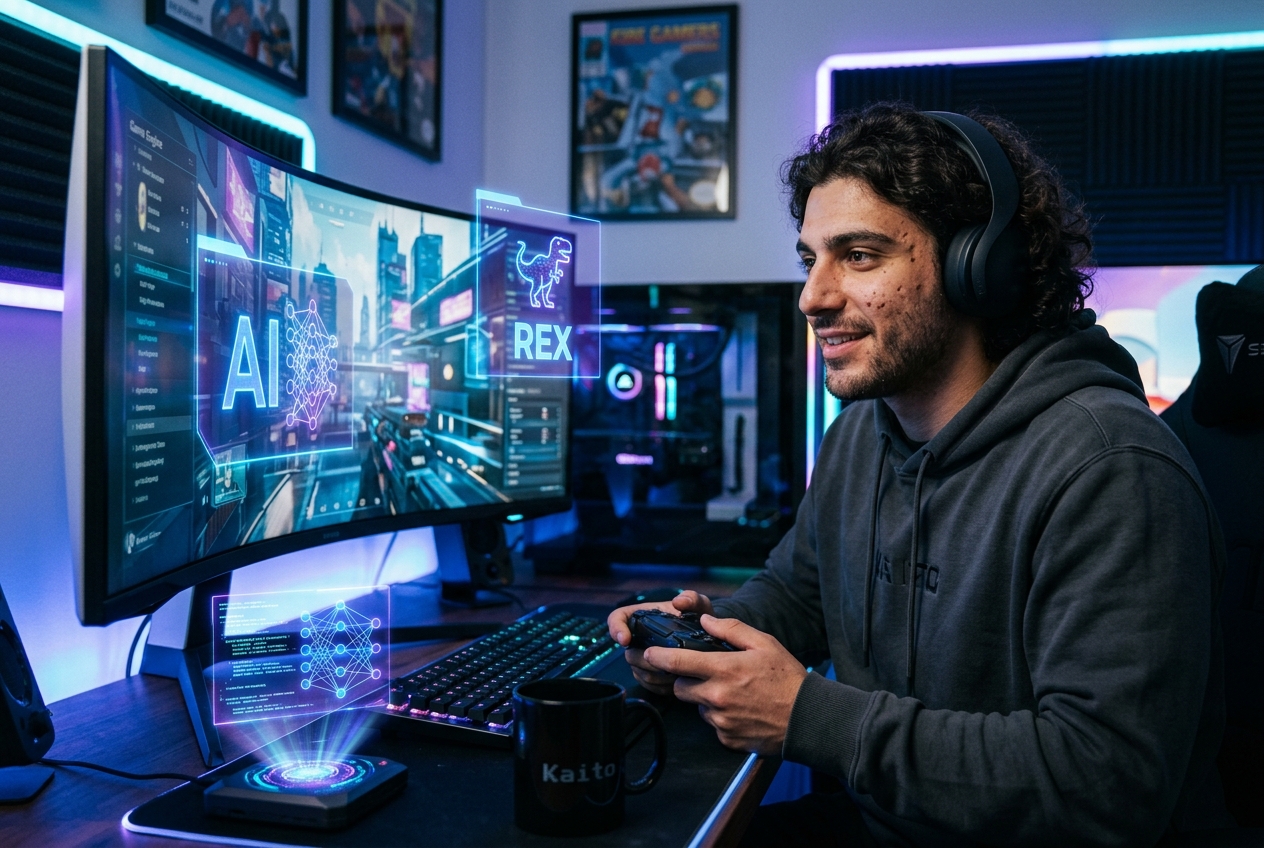
Perhaps the most forward-looking story of the week comes from Capcom. At the “Capcom Open Conference RE:2026” event held on October 2, programmer Satoshi Ishida unveiled the company’s plans to evolve its in-house RE Engine into what the company is calling an “AI-generation game engine.” The initiative, dubbed the REX Project, represents Capcom’s most ambitious technological overhaul since the RE Engine itself debuted back in 2014.
For context, the RE Engine first powered Resident Evil 7: Biohazard in 2017 and has since been the technological backbone of nearly 30 Capcom titles, including the Resident Evil remakes, Devil May Cry 5, Monster Hunter Rise, and Street Fighter 6. It’s a proven piece of technology — but Ishida identified three critical challenges that the REX Project aims to solve.
First, modern game development has ballooned in scope and data volume to the point where build and iteration times are actively slowing down production. Teams are spending more time waiting for compiles than actually creating. Second, the RE Engine is now used by over 2,000 developers worldwide, including international teams and talent coming from other engines, which means it needs significantly better multilingual support and accessibility. Third — and most importantly — AI needs to be built into the development pipeline from the ground up, “rather than bolted on,” as Ishida put it.
The REX Project bundles several new systems to address these challenges. RE:Dox standardizes data processing across formats. RE:UI speeds up development tools by separating appearance from state. RE:Log replaces traditional text-based logging with an ID-based system. RE:Flows is a visual scripting tool that automatically converts to standard code. And RE:Runtime rebuilds the runtime core around batch processing for large numbers of characters, alongside a new optimized execution layer called RE:C++.
But the headline ambition is clear: Ishida’s goal is an engine where AI can understand and generate code, run automated test plays to catch bugs, and support development directly — working toward a future where teams “create games together with AI.” Capcom has already open-sourced some of the underlying technology to help with AI training, signaling a genuinely collaborative approach.
This follows Capcom’s statement from June, when it told investors that generative AI would be used “to improve the efficiency of routine operations so that our developers can devote more time to essential value creation,” while stressing that “the creativity at the core of such experiences should be handled by humans.” It’s a balanced, pragmatic approach that other major publishers would do well to study.
2. Sony Brings AI Upscaling to PS5: QSSR Is Here
In a move that caught many by surprise, Sony announced this week that its Quick Spectral Super Resolution (QSSR) AI upscaling technology is coming to the standard PlayStation 5 — and it’s available right now in two major titles: Marvel’s Wolverine and Ghost of Yotei.
For those keeping score at home, the PS5 Pro launched with PlayStation Spectral Super Resolution (PSSR), Sony’s proprietary AI-guided upscaling that Digital Foundry and other tech analysts have praised as a genuine generational leap in image quality. The question many base PS5 owners have been asking is simple: will we ever get something similar? The answer, it turns out, is yes.
QSSR is positioned as a slightly diluted version of the Pro’s PSSR — the “gold standard” of AI-guided upscaling, according to Sony’s PlayStation blog post from October 1. But “diluted” is a relative term here. In a comparison video for Marvel’s Wolverine, the difference is striking: close-up images appear noticeably crisper, with better edge definition and reduced aliasing. Mike Fitzgerald, Insomniac’s head of technology, commented that “QSSR adds more pixel-level clarity and stability to our environments, bringing out extra detail amidst the busy streets of Madripoor, the dense alleyways of Shinjuku, and many other areas across Logan’s epic journey.”
Over at Sucker Punch, lead rendering engineer Jasmin Parry had equally high praise for what QSSR does in Ghost of Yotei: “QSSR excels at resolving the fine details in our characters and environments and does so with a level of temporal stability that hasn’t been possible on the PS5 console until now.”
Digital Foundry has already tested the technology and is enthusiastic. Their analysis notes that “temporal stability is substantially improved, detail level increases, sub-pixel integrity is considerably superior, while artifacts from elements like moving foliage are much reduced.” The caveat, of course, is that “there remains a big divide between the same game running QSSR on standard PS5 and PSSR on Pro” — so if you were worried your PS5 Pro purchase was suddenly obsolete, fear not.
The most impressive technical achievement here is that the base PS5 doesn’t have dedicated AI upscaling hardware. Sony found a way to implement it through software optimization on AMD-based architecture, potentially offering a better solution than AMD’s own FSR native upscaler. Following its experimental rollout in Wolverine and Yotei, Sony plans to offer QSSR “broadly to all PlayStation developers.” This is huge news for the install base of over 65 million PS5 owners worldwide.
3. Gears of War: E-Day Hits Early Access — A Triumph With Some Missing Teeth
Gears of War: E-Day entered early access on October 3 for players who purchased Premium, Premium Upgrade, or Collector’s Editions, with the general release following on October 6. The game is already performing well on Steam and Xbox, according to early data, and Eurogamer’s Dom Peppiatt praised the campaign in his recent review as a return to form for the series.
But the early access launch has also sparked a conversation about missing features. Longtime Gears fans noticed the absence of several iconic gameplay elements — Meat Shields, Chainsaw Duels, Private Lobbies, and leaderboards, to name a few. The Coalition addressed these concerns head-on in a statement timed with the launch, explaining that the studio “started E-Day with an empty hard drive building our entire gameplay sandbox from scratch to ensure a more unified gameplay experience across Campaign, PvE and PvP.”
The trade-off, they acknowledged, is that “including every legacy feature from Gears of War was not possible for launch.” However — and this is the important part — The Coalition explicitly stated that these features are “not gone from the franchise.” The studio is working on delivering them “either post-launch or in our next title.” It’s a pragmatic approach that prioritizes a stable, polished launch over feature completeness, and honestly? Given the development challenges the studio has faced — including very public Microsoft layoffs that saw E-Day’s story director Juan Vaca depart — it’s remarkable the game is as polished as it is.
E-Day’s first Season kicked off with early access and runs for eight weeks, ending December 1. Ranked PvP modes arrive on October 13. If you’ve been waiting for the general release, it’s just two days away.
4. Battlefield Heads to Hollywood: Sony in Talks for McQuarrie and Michael B. Jordan Film
In a move that signals just how seriously Hollywood is taking video game properties, Sony Pictures is reportedly in talks to acquire the film rights to EA’s Battlefield franchise — and the talent attached is genuinely impressive. Christopher McQuarrie — the director behind Mission: Impossible — Fallout, Dead Reckoning, and The Final Reckoning — is attached to write, direct, and produce. Michael B. Jordan, fresh off his Best Actor Oscar win, is on board to produce, with strong indications he could also star.
According to Variety’s report, the deal follows a bidding war between multiple studios, with Sony ultimately emerging as the frontrunner. Additional producers include EA’s Jesse Stern, Emerald Neon’s Carter Swan, Vertigo’s Roy Lee and Miri Yoon, and Outlier Society’s Elizabeth Raposo.
The timing is no coincidence. Battlefield 6, which launched last year, became the best-selling first-person shooter of the year and the franchise’s best-selling entry ever — reportedly outselling even Call of Duty. The series, which first launched in 2002, has built a massive global following, and a big-screen adaptation has been rumored for years. With McQuarrie’s track record for practical, jaw-dropping action sequences and Jordan’s dramatic and physical range, this could be the video game adaptation to beat.
It’s also worth noting that Call of Duty is getting its own film treatment — Peter Berg directing a Taylor Sheridan script for Paramount, dated for release on June 30, 2028. The FPS genre war is about to go cinematic.
5. Halo’s Next Chapter: Activision Reportedly Planning a Reboot
Following Microsoft’s decision to hand the Halo franchise to Activision — a move that shocked many fans and resulted in the effective closure of Halo Studios — we’re now getting a clearer picture of what the next era of the franchise might look like. According to a detailed report from well-known Halo and Xbox insider Rebs Gaming, Activision is considering a full reboot of the series, potentially exploring Master Chief’s origins.
The report suggests that Activision originally pitched two separate games — a free-to-play multiplayer title and a campaign-only experience — before consolidating into a single package. The campaign was described as “a soft reboot that doesn’t follow Halo Infinite‘s story but doesn’t retcon any previously established canon.” Think of it as a fresh starting point that respects the lore.
Perhaps most interestingly, teams at Sledgehammer Games — the Call of Duty studio behind Advanced Warfare and Vanguard — have already “conceptualized and prototyped basic gameplay mechanics” for both the proposed campaign and multiplayer. Crucially, this work has been done within the Infinity Ward Engine, the proprietary technology that has powered Call of Duty games since 2005, completely rebuilt in 2019 for Modern Warfare. This means Activision is likely moving Halo away from Unreal Engine 5 (used in last year’s Campaign Evolved) and away from Halo Studios’ now-defunct Slipstream Engine.
The message is clear: Activision is taking the Halo stewardship seriously, and they’re building from the ground up. With Sledgehammer’s pedigree in first-person shooters and the Infinity Ward Engine’s proven capabilities with ray tracing and path tracing, this reboot could be exactly what the franchise needs to reclaim its crown.
6. Metro Redux Goes Next-Gen as Franchise Hits 50 Million Sales
In one of the most welcome announcements of the week, 4A Games revealed that free next-gen updates for Metro 2033 Redux and Metro Last Light Redux will arrive on October 22 for PC and October 29 for consoles. The updates come as the Metro series surpasses 50 million copies sold worldwide, 16 years after the original Metro 2033‘s release.
While the studio stresses that this “isn’t a full remaster or remake,” the upgrades are substantial: 4K textures across all platforms, improved animations, higher-quality audio, richer environmental detail, and a batch of community-requested bug fixes and quality-of-life changes. On PS5 and Xbox Series X/S, the update adds native support with platform-specific extras, including PSSR on PS5 Pro and TSR upscaling on Xbox. Console players can run the games at native 4K/60fps or upscaled 4K/120fps on compatible displays, with upgraded lighting, shadows, and particle effects. DualSense Adaptive Triggers and Xbox Impulse Triggers are also supported.
This sets the stage beautifully for Metro 2039, slated for release on February 4, 2027. Eurogamer’s hands-on preview described it as “a competent shooter with remarkable graphics and a story inspired by the harshest of real-world events,” noting that “the crushing sense of claustrophobia and threat humming in the world of Metro 2039 makes previous games in the series seem almost relaxed.” If you’ve never played the Metro series, there has never been a better time to dive in.
7. A New Uncharted Game Is in the Works at Naughty Dog
Fans of treasure-hunting, wisecracking adventure can rejoice: a new Uncharted game is reportedly in early development at Naughty Dog. According to a report from MP1st, corroborated by noted insider NateTheHate, the game is being directed by Shaun Escayag — the studio veteran who directed Uncharted: The Lost Legacy. Escayag had left Naughty Dog to become creative director on Marvel’s Avengers at Crystal Dynamics but later returned to work on an unnamed project, which now appears to be this new Uncharted.
Key details: the game is not a remake of any existing title but a fresh entry. It reportedly brings back series protagonist Nathan Drake in some form, though he may not be the lead. Speculation points toward Cassie — Drake and Elena Fisher’s daughter, introduced at the end of Uncharted 4: A Thief’s End — as a possible protagonist for the next generation. It’s a natural evolution that would honor the franchise’s legacy while opening the door for new storytelling possibilities.
That said, don’t expect this one anytime soon. Naughty Dog is currently fully focused on Intergalactic: The Heretic Prophet, which studio co-president Neil Druckmann recently described as the studio’s “most expansive and expensive” game yet. It’s expected to be properly revealed in 2027, with a likely release that same year. Given that timeline, the Uncharted project is probably a 2028 or 2029 release at the earliest. But knowing it’s coming at all is reason enough to celebrate.
8. Xbox at a Crossroads: Former PlayStation Boss Says “Pick a Lane”
Former PlayStation boss Shawn Layden — never one to mince words — weighed in on Xbox’s current struggles this week in a conversation on The Expansion Pass podcast. His assessment was characteristically blunt: “This is your Dreamcast moment.”
Layden pointed to Xbox’s wavering commitment to exclusives as the root of its current console sales decline, noting that the company has “flip-flopped quite a few times.” He argued that Xbox needs to decide: is it a platform holder, or a third-party publisher? “A platform needs exclusives or else the platform has no meaning,” Layden said. “Or are you going to be the biggest publisher in the world now that you have Activision and Blizzard? You can’t be successful at both.”
He acknowledged that current Xbox CEO Asha Sharma seems to be trying to “right the ship” — she’s signed Hideo Kojima’s Physint as a console exclusive, brought Gears of War: E-Day and Clockwork Revolution back to Xbox exclusivity, and restructured the division (though the human cost of 3,200 layoffs is sobering). But Layden’s “Dreamcast moment” framing — referencing Sega’s abandonment of the hardware business — suggests the window for Xbox to commit to a clear identity is closing.
Sharma has publicly shot down speculation about Microsoft selling Xbox, saying she wants to course correct “whatever it takes.” The next-gen Xbox, codenamed Project Helix, is reportedly still in development. But with console sales declining and first-party strategy shifting by the month, Xbox’s path forward remains the most fascinating unresolved question in the industry today.
9. GTA 6 Price Debate: $80 Standard and the Industry’s Hope (and Fear)
Finally, a story that touches the wallet of every gamer. On the eve of Grand Theft Auto 6‘s November 19 release, the debate over game pricing has reached a fever pitch. GTA 6’s Standard Edition costs $79.99 in the US — about $10 more than most triple-A games — while the Ultimate Edition goes up to $99.99. In a move that has industry executives watching closely, Warhorse Studios co-founder Martin Klima publicly expressed hope that GTA 6 would “blaze the trail” for higher game prices.
“The cost of game development has ballooned wildly in recent years, but the audience that regularly buys new games has somewhat peaked,” Klima told PC Gamer. “The last thing you can do is to increase the unit price. That would help a lot, but everybody’s scared to death about it. Now, hopefully, GTA will blaze the trail, and it will allow us to increase the cost.”
Klima argued that Rockstar and Take-Two are the only publishers “who can afford, or who can dare, to increase the price of games, which I think is long overdue and also necessary for this business to survive.” It’s a notable perspective from a developer whose own Kingdom Come: Deliverance 2 launched at the standard $70 price point. The question is whether gamers will accept an $80 baseline — and whether other publishers will follow Rockstar’s lead.
History suggests they will. GTA 6 is poised to become the biggest entertainment launch of all time, and if Take-Two can make $80 stick, the rest of the industry will almost certainly follow suit within 12-18 months. Love it or hate it, this is the story to watch as we head into November.
Looking Ahead: A Defining Month for Gaming
October 2026 is shaping up to be one of the most consequential months in recent gaming history. Between Capcom’s AI-engine revolution, Sony’s surprise upscaling gift to PS5 owners, the launch of Gears of War: E-Day, and the looming anticipation of GTA 6, there’s genuinely something for everyone. We’re witnessing a moment where technology, business, and creativity are all converging — and the results are thrilling, unpredictable, and occasionally messy.
The AI revolution in game development — exemplified by Capcom’s REX Project — promises to reshape how games are made, potentially shortening development cycles and enabling smaller teams to punch above their weight class. Sony’s QSSR rollout brings console-defining visual technology to a massive installed base. And the flurry of movie deals, franchise revivals, and reboot announcements suggests that the intellectual property gold rush is far from over.
As always, we’ll be watching every twist and turn. Stay tuned — the next few weeks are going to be wild.
— This article was written on October 4, 2026, covering the most significant gaming news of the week. All data and quotes sourced from official announcements, press conferences, and verified industry reporting.