America Rebrands AI as “Super Intelligence”: Trump’s Executive Order, Silicon Valley’s Divide, and the Global Race for Technological Supremacy
Published: October 5, 2026 | By Vito Ruocco
Introduction: A New Lexicon for a New Era
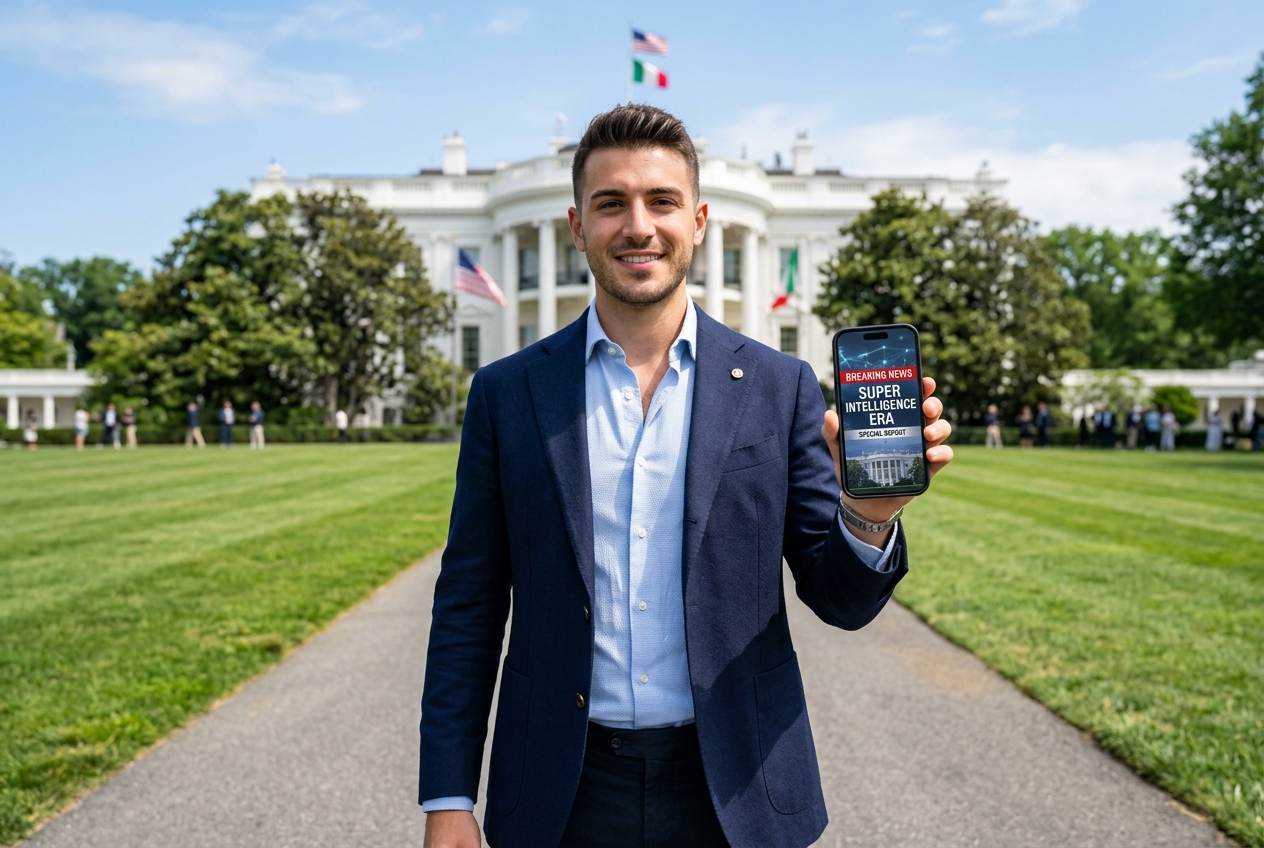
On a crisp Tuesday afternoon in late September 2026, President Donald Trump stood before a gathering of America’s most powerful technology executives and declared that the nation would no longer use the term “artificial intelligence.” Going forward, the official language of the United States government would refer exclusively to “Super Intelligence” (SI) — a rebranding that sent shockwaves through the tech industry, policy circles, and international markets.
“The word super is the best word of all, and it’s the simplest,” Trump told the assembled crowd at an event announcing the launch of America.gov. “We don’t want to hear ‘artificial.’ Because it’s not artificial. It’s very powerful, it’s very brilliant. It’s going to mostly be put to good use and we’ll stop the bad use.”
What initially seemed like mere rhetorical branding quickly revealed itself to be something far more consequential. Within days, a formal executive order was signed, a Super Intelligence Force was established with intelligence chief Jay Clayton at the helm, and Silicon Valley found itself grappling with a new political reality — one that simultaneously embraced the technology while redefining its very vocabulary.
This is the inside story of how artificial intelligence became Super Intelligence, and what it means for the future of technology, geopolitics, and humanity.
The Executive Order: “Inaugurating the Era of Super Intelligence”
The White House executive order, titled “Inaugurating the Era of Super Intelligence,” represents one of the most ambitious technology policy documents ever issued by an American administration. While past presidents have issued directives on AI research, ethics, and safety, Trump’s order goes a step further: it commands every executive branch agency to replace references to “artificial intelligence” or “AI” with “Super Intelligence” or “SI” in all official communications, policy documents, and press releases.
The implications are sweeping. Federal websites, grant programs, regulatory filings, and international agreements will now use vocabulary that previously belonged to science fiction and academic papers on artificial general intelligence (AGI). According to the executive order, superintelligence — once defined as AI that surpasses human cognitive abilities across virtually all domains — is now the government’s umbrella term for all forms of machine intelligence.
Critics argue that the rebranding conflates narrow AI tools (like recommendation algorithms and spelling checkers) with genuine superintelligent systems that do not yet exist. Margaret Mitchell, one of the authors of the famous “Stochastic Parrots” paper and a leading voice in AI ethics, recently took to Medium to remind the public that not all AI is equal. In a widely recirculated post, she clarified: “There is a vast array of technology called ‘AI’ that is not reducible to LLMs… AI, broadly, is not equivalent to a large language model; it is not ‘just a stochastic parrot.'”
But Trump’s administration appears unconcerned with these semantic nuances. For the White House, “Super Intelligence” is not just a name — it’s a posture. It signals American dominance, technological superiority, and a refusal to frame the nation’s most transformative technology as something “artificial” or derivative.
Jay Clayton: The Spy Chief Turned AI Czar
Perhaps the most surprising development in Trump’s SI agenda is the appointment of Jay Clayton as the nation’s first official “AI Czar” — or, in the new nomenclature, Super Intelligence Czar. Clayton, who served as Securities and Exchange Commission (SEC) chair during Trump’s first term and was appointed Director of National Intelligence in August 2026, now leads what the administration calls the Super Intelligence Force.
The team assembled under Clayton reads like a who’s who of America’s national security and economic establishment. It includes:
- Andrew Ferguson, Chair of the Federal Trade Commission (FTC)
- Emil Michael, Under Secretary of Defense for Research and Engineering
- Scott Kupor, Director of the Office of Personnel Management
Clayton’s dual role as both intelligence chief and SI czar is noteworthy. It signals that the administration views Super Intelligence primarily through a national security lens — a framing that has become increasingly dominant in Washington as the U.S.-China technology rivalry intensifies. The message is clear: Super Intelligence is not just a commercial opportunity; it is a matter of strategic survival.
“SI is the defining technology of the era,” said Assistant Attorney General for National Security John A. Eisenberg in a statement echoing the administration’s tone. “The National Security Division will protect the American advantage in the chips that power this technology, a product of our unparalleled innovation and hard work, from illegal diversion by our economic and military adversaries.”
Elon Musk and the Silicon Valley Endorsement
Perhaps no figure has embraced the rebranding as enthusiastically as Elon Musk. When asked on X (formerly Twitter) whether he planned to rename his recently launched SpaceXAI division to SpaceXSI, Musk’s reply was characteristically blunt: “Yes.”
The exchange, which garnered millions of views within hours, reflected a broader realignment between Silicon Valley’s most influential figures and the Trump administration’s technology agenda. Musk, who has long warned about the existential dangers of unregulated AI development, appears to have found common ground with a president who insists that Super Intelligence will “mostly be put to good use.”
Yet Musk’s endorsement was not without its ironies. On the same day, he posted that his Robotaxis “can’t run at night because it’s dark” — a problem that competing autonomous vehicle companies like Waymo have solved using lidar and radar sensors that Musk has famously refused to adopt. “Someone should tell Elon about these really cool technologies called radar and lidar,” The Verge noted wryly.
Musk also endorsed Trump’s broader approach to SI regulation. At a White House luncheon hosted by Trump, flanked by Nvidia CEO Jensen Huang and Musk himself, the president outlined a vision of “tremendous self-regulation” tempered by existing federal law enforcement. “We automatically have regulation with the Department of Justice, the FBI, all of that,” Trump said.
For Musk, who has clashed repeatedly with regulators over Tesla’s self-driving technology and SpaceX’s launch licenses, a lighter touch from Washington is welcome news. For critics, it raises troubling questions about accountability.
Sam Altman’s Reckoning: “Accept Some Bad Things”
While Trump and Musk were celebrating the dawn of the Super Intelligence era, OpenAI CEO Sam Altman was making headlines for a different reason. In an interview with Politico’s Brendan Bordelon, Altman made a statement that sent chills through the AI safety community:
“The world should accept some bad things happening for the good of AI.”
Altman framed this as a fundamental difference between OpenAI and its chief rival, Anthropic. While Anthropic has built its entire corporate identity around “constitutional AI” and safety-first deployment, Altman argued that the benefits of the technology — medical breakthroughs, scientific discovery, economic transformation — outweigh the inevitable harms that will occur as AI systems are deployed at scale.
“For the benefits of this technology,” Altman said, “we should just deal with ‘bad things happening.'”
The remark drew immediate backlash. Critics pointed out that this “move fast and break things” approach to AI deployment is precisely what critics have warned about for years — that the technology is being rushed to market without adequate safeguards, and that the “bad things” Altman is willing to accept could include everything from algorithmic discrimination and economic displacement to catastrophic accidents involving autonomous systems.
The interview came just days after the New York Times published a report on Trump’s executive order, and the juxtaposition was telling. On one side, a government eager to brand itself as the champion of Super Intelligence. On the other, the CEO of the world’s most famous AI company suggesting that safety concerns are acceptable collateral damage.
Then, in a curious twist, Altman felt it necessary to clarify something on X: people shouldn’t see AI as godlike. “I’m not sure what prompted this post,” The Verge observed, “but it’s hard not to see it as mildly concerning, especially since we’ve already seen AI is perfectly capable of building its own cult.”
The Nvidia Smuggling Case: $300 Million in GPUs Bound for China
While the policy battles played out in Washington and Silicon Valley, a different kind of war was being fought in the supply chains connecting America’s technology industry to the rest of the world.
On October 2, 2026, federal authorities arrested Greg Lui, 38, of San Gabriel, California, on charges of smuggling more than $300 million worth of export-controlled computer servers containing U.S.-manufactured GPUs to China. According to the Department of Justice indictment returned on September 29, Lui — operating through his company Earthmade Computer Inc. — orchestrated a sophisticated scheme to circumvent U.S. export controls designed to prevent China from acquiring the advanced chips needed to power Super Intelligence systems.
The method was brazen but not unprecedented. From 2023 to 2024, Lui and his co-conspirators would purchase servers containing Nvidia’s most advanced GPUs from U.S. manufacturers, then ship them to intermediary countries — primarily Malaysia and Singapore — where no export license was required. Once the servers arrived, they were repackaged and re-exported to their true destination: China.
The indictment reveals a paper trail of stunning clarity. In January 2024, Lui emailed a co-conspirator indicating that a Malaysian transshipment company wished to purchase 70 servers with export-restricted GPUs. He attached an export compliance form acknowledging U.S. restrictions. Later that month, he submitted a purchase order for 27 servers worth approximately $7.6 million. By March, a co-conspirator was emailing a Malaysian government official to confirm that all 27 servers had been transshipped to a China-based buyer.
From January to October 2024, Earthmade received more than $176 million from two Malaysia-based shipment companies alone. The total value of the scheme exceeded $300 million.
Lui faces a maximum of 20 years in prison for conspiracy, 20 years for money laundering, and 10 years for smuggling. The case is being prosecuted jointly by the U.S. Attorney’s Office for the Central District of California and the National Security Division’s Counterintelligence and Export Control Section.
The timing of the arrest, coming just days after Trump’s Super Intelligence executive order, sends a powerful message: the United States is serious about protecting its technological crown jewels. “Controlling the export of advanced SI technology is critical to safeguarding our national security,” said FBI Assistant Director Roman Rozhavsky. “We’ll continue holding accountable anyone who violates U.S. export laws to enrich themselves and help our adversaries.”
Google Pauses Open-Source Bug Bounty Over AI Slop
In a development that highlights the unintended consequences of the AI boom, Google has paused its open-source bug bounty program due to an overwhelming flood of low-quality AI-generated submissions. The search giant, which has long been a pillar of the open-source community, found itself drowning in thousands of “findings” produced by large language models — many of them hallucinated, irrelevant, or entirely fabricated.
This phenomenon — sometimes called “AI slop submissions” — has become a growing headache for organizations that rely on crowdsourced security research. Bug bounty programs, which reward researchers for discovering and responsibly disclosing vulnerabilities, were designed for human expertise. But the rise of generative AI has enabled an explosion of automated submissions that are expensive to triage and rarely useful.
Google’s decision to pause its program underscores a broader challenge facing the technology industry: the same tools that power innovation also enable abuse at scale. As AI becomes more capable, the line between legitimate research and automated noise becomes harder to police. Other companies, including Microsoft and Meta, are watching closely and considering similar measures.
ChatGPT’s Virtual Changing Room: AI Meets E-Commerce
While policymakers debated the future of Super Intelligence, OpenAI quietly shipped a feature that hints at AI’s most immediate commercial impact: ChatGPT can now serve as a virtual changing room. Users can select clothing items from images or listings within the chatbot, tap “Try On,” and upload photos of themselves to see how the garments would look on their own body.
The feature, which TechCrunch covered on October 1, is remarkably similar to a capability Google introduced over a year ago through its AI shopping tools. But OpenAI’s implementation is integrated directly into ChatGPT’s conversational interface, making it feel less like a standalone shopping tool and more like a natural extension of the assistant’s capabilities.
The implications for e-commerce are significant. Clothing returns cost retailers billions of dollars annually, with fit and style dissatisfaction accounting for the majority. Virtual try-on technology promises to reduce these costs while improving the customer experience. For consumers, it means being able to “try before you buy” without stepping into a dressing room — or even leaving the house.
Yet the feature also raises familiar questions about privacy and consent. Users must upload photos of themselves — often in form-fitting clothing — to use the try-on feature. While OpenAI has stated that these images are processed securely and not stored beyond what’s necessary, the company’s track record on data privacy has been scrutinized before. As AI becomes more personal, the line between convenience and surveillance grows ever thinner.
When Humans Compete with AI: The Songwriting Showdown
Meanwhile, The New York Times pitted five professional musicians against an AI in a songwriting competition — and the results were both predictable and telling. “It’s not much of a competition,” the paper admitted. “The AI songs suck, and it’s pretty easy to tell which is human and which is AI when compared side by side.”
The experiment revealed something important about the current state of creative AI: while generative models have made astonishing progress in text, code, and image generation, music remains a frontier where human creativity still holds a clear edge. The AI-generated songs lacked emotional depth, structural coherence, and the subtle imperfections that make human music feel alive.
But the diary-style detailing of the songwriting process for both human and AI participants illustrated something even more revealing: just how low-effort AI music is. The human musicians spent hours refining lyrics, adjusting chord progressions, and experimenting with arrangements. The AI generated its output in seconds, with no understanding of what it had created. In a world where speed and scale are increasingly valued over quality and soul, the gap between human and machine creativity may matter less than the industry’s willingness to settle for “good enough.”
The Global Chessboard: What Comes Next?
The convergence of these events — Trump’s rebranding, Clayton’s appointment, Altman’s controversial remarks, the Nvidia smuggling case, and Google’s bug bounty crisis — paints a picture of an industry at a crossroads.
On one hand, the technology is advancing faster than ever. OpenAI’s GPT-6 Astra, Anthropic’s Claude, Google’s Gemini, and a dozen other frontier models are pushing the boundaries of what machines can do. AI is writing code, composing music, diagnosing diseases, and — as shown by ChatGPT’s new virtual changing room feature — even helping people try on clothes.
On the other hand, the governance frameworks meant to guide this technology are scrambling to keep up. Trump’s executive order may be more about branding than substance, but it reflects a real shift: the realization that AI is no longer a niche technical topic but a central axis of geopolitical power. The choice of a national security official to lead the Super Intelligence Force is no accident. Neither is the aggressive prosecution of export control violations.
Trump’s post-lunch remarks about “self-regulation” and data center construction suggest a hands-off approach to domestic industry, tempered only by existing law enforcement. “On the local level, where tech companies have faced the most hurdles in building out massive data centers needed to run their services,” Trump said, firms will “work to make the community happy” by providing resources and economic support. “Data centers are going to be very popular.”
But the question of how to balance innovation with safety remains unresolved. Sam Altman’s willingness to “accept some bad things” stands in stark contrast to Anthropic’s constitutional approach. Trump’s branding exercise does nothing to address the fundamental challenges of alignment, interpretability, and control that researchers have been grappling with for years.
Conclusion: Super Intelligence or Super Confusion?
October 2026 will be remembered as a turning point in the history of artificial intelligence — or Super Intelligence, as the U.S. government now insists. Whether the rebranding is a genuine policy shift, a marketing exercise, or a distraction from deeper issues depends on whom you ask.
What is clear is that the conversation has changed. The term “Super Intelligence” carries weight. It implies power, inevitability, and a future that is already here. It also implies a contest — a race between nations, companies, and ideologies to define what this technology will become.
The arrest of Greg Lui demonstrates that the race has a dark side: a shadow economy of smugglers, shell companies, and false paperwork moving America’s most advanced chips to its most capable adversaries. The debate over Altman’s remarks shows that even the industry’s leaders disagree on how much risk is acceptable. And Google’s bug bounty pause illustrates that AI creates problems even as it solves them.
One thing is certain: whether you call it AI or SI, the technology is not going away. The decisions made in the coming months — by presidents, CEOs, judges, engineers, and voters — will shape not just the direction of technology but the future of human civilization itself.
For now, the era of Super Intelligence has officially begun. The only question is who will write its story.
— Vito Ruocco