Google Just Launched an AI Data Center Into Space: Inside Project Suncatcher’s First Orbital Test
Published: October 3, 2026 | By Vito Ruocco
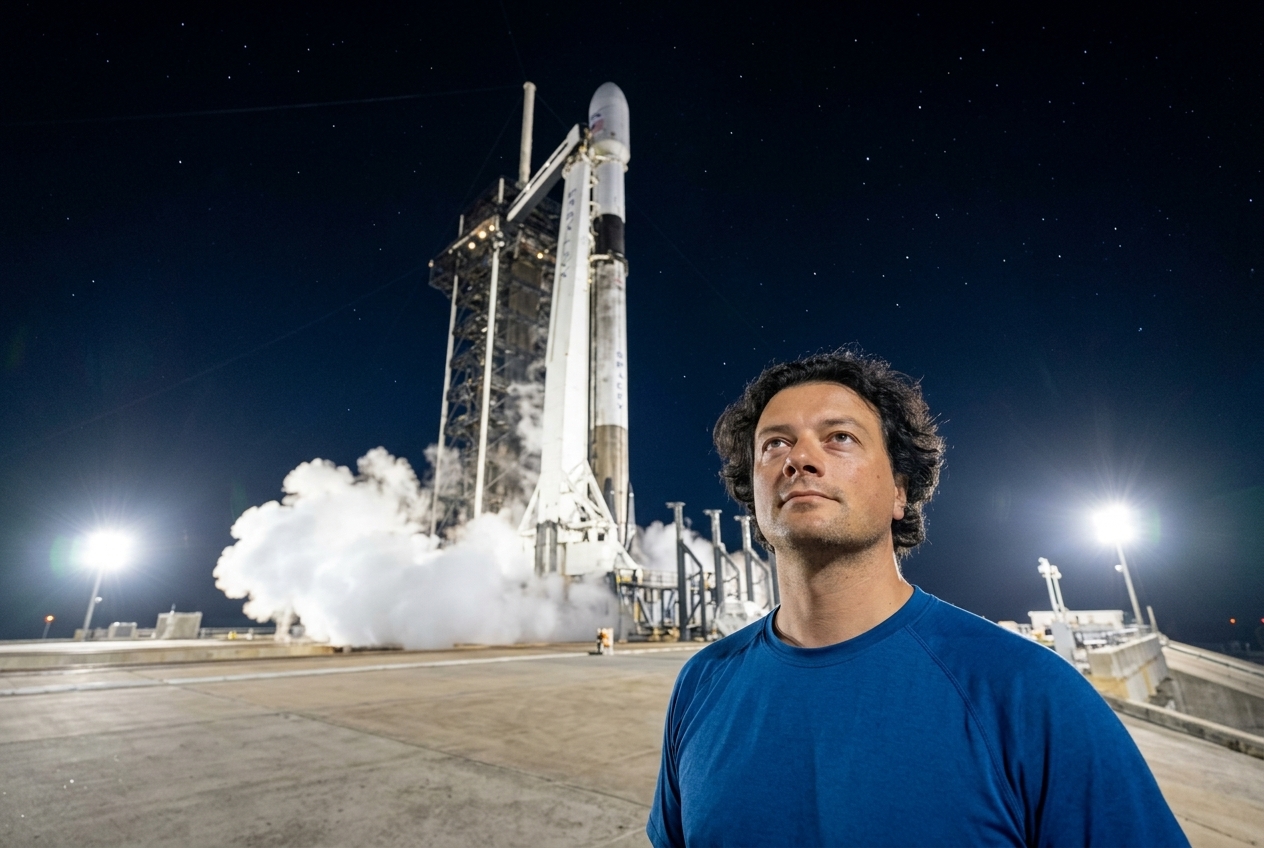
On October 1st, 2026, a SpaceX Falcon 9 rocket lifted off from Cape Canaveral carrying something the launch industry has never seen before: Google’s Tensor Processing Units — the same chips that power its massive AI infrastructure on Earth — strapped into a satellite destined for low Earth orbit. It marks the beginning of Project Suncatcher, Google’s audacious “moonshot” to one day put entire AI data centers in space.
This isn’t science fiction. The satellite, built in partnership with Planet Labs, is already in orbit, beaming back telemetry data on how AI hardware handles the brutal realities of spaceflight. And the implications for the future of artificial intelligence — and for the planet — are staggering.
The Launch: A New Kind of Payload
The satellite launched as part of SpaceX’s Transporter-18 rideshare mission, a regular multi-payload deployer that typically carries Earth observation CubeSats and small communications satellites. But this particular payload was different. Tucked inside a custom-built chassis from Planet Labs was a set of Google’s Trillium-generation TPUs — specialized AI accelerator chips designed for training and running machine learning models.
“After years of research, Project Suncatcher is scheduled to embark on its first test in orbit,” wrote Travis Beals, Google’s Senior Director of Paradigms of Intelligence, in the company’s announcement blog post. “This initial mission is designed to gather in-orbit data on how our TPUs handle the physical stress of spaceflight and the radiation and thermal extremes of space.”
The launch had been anticipated since Google first unveiled Project Suncatcher in 2025, but the timeline moved faster than most expected. What was initially presented as a long-term research concept became a real, orbiting test platform in less than 18 months.
Why Space? The Energy Argument
The core motivation behind Project Suncatcher is startling in its simplicity: energy. AI data centers on Earth consume staggering amounts of electricity. A single large-scale AI training run can use as much power as a small town. Google’s own carbon emissions have risen nearly 50% since 2019, driven almost entirely by the energy demands of its AI infrastructure.
In space, the calculus changes dramatically. Satellites in low Earth orbit can access near-constant sunlight — up to eight times more solar power per square meter than the best locations on Earth. There are no clouds, no night cycles, and no atmospheric interference. A space-based data center could theoretically operate on clean solar power 24/7, with no carbon footprint and no strain on terrestrial power grids.
“In the future, space may be the best place to scale AI compute,” Beals wrote in the original Project Suncatcher announcement. That statement, which seemed almost absurdly ambitious when first published, now has a working prototype in orbit to back it up.
Engineering at the Edge: Can TPUs Survive Space?
Getting a delicate AI accelerator chip to survive a rocket launch and then operate in the vacuum of space is no small feat. The engineering team at Google has spent years preparing for this moment.
Vibration and G-Force Testing
A rocket ride to low Earth orbit lasts about 10 minutes, during which the spacecraft experiences intense vibration and sustained acceleration loads up to 10 times the force of gravity. Individual components, including the TPU chips themselves, can experience forces up to 50 to 100 G. Google’s team conducted exhaustive vibration testing by shaking the satellite violently on all three axes to simulate the punishing frequencies of a Falcon 9 launch.
“Tests like this rarely go as planned, so we were pleasantly surprised that the hardware held up to the force,” Beals noted in a behind-the-scenes video series the team released.
Radiation: The Silent Killer
Once in orbit, the radiation environment presents an even greater challenge. Without Earth’s thick atmosphere as a shield, solar events and cosmic rays constantly bombard electronics. Google’s team took their Trillium TPUs to the Crocker Nuclear Laboratory at UC Davis, where they fired proton beams at the chips while running live AI workloads to measure how errors — like a bit flip caused by a high-energy particle — would affect computations.
The results were surprisingly positive. Google reports that the TPUs “survive a total ionizing dose equivalent to a 5 year mission life without permanent failures.” This is a critical finding: if the chips can handle five years of radiation exposure in ground testing, they have a real shot at surviving a full orbital mission.
Cooling in a Vacuum
Perhaps the trickiest engineering challenge is keeping the chips cool. On Earth, data centers use powerful fans and air conditioning systems to vent heat. In space, there is no air. Heat can only be dissipated through radiators — a fundamentally different approach to thermal management.
The Project Suncatcher team has developed a cooling system using heat pipes and radiators. They tested the technology in a thermal vacuum chamber that simultaneously simulates both the extreme cold and vacuum of space. The satellite currently in orbit carries this cooling system, and Google will be gathering data on how well it performs in the real space environment.
There is, however, a significant current limitation: the chips can only run for about 15 minutes before they need to be powered down to cool off, according to Travis Beals in an interview with The New York Times. This is a far cry from the continuous operation needed for a production data center, but it’s exactly the kind of data point the team needs to iterate on.
The Technical Details: Trillium TPU Specs
The chips aboard the Suncatcher satellite are Google’s sixth-generation Trillium TPUs, announced in 2025. While Google has not disclosed the precise configuration of the orbital test unit, the Trillium architecture offers some context for what’s being tested:
- Peak compute: Trillium TPUs deliver up to 4x the training performance of the previous-generation TPU v5, with significant improvements in both training and inference efficiency.
- Energy efficiency: The architecture was designed with power efficiency as a first-order constraint, making it a natural fit for the power-limited environment of a satellite.
- Error resilience: Trillium includes hardware-level error correction that can detect and mitigate bit flips — a feature that turns out to be critical in the radiation-heavy space environment.
- Interconnect: The chips support Google’s proprietary intra-node interconnect, which is necessary for the distributed computing that multi-satellite constellations would require.
It’s worth noting that the Trillium chips in orbit are likely running at reduced capacity compared to their terrestrial counterparts, given the thermal constraints. But even limited operation at 15-minute intervals provides invaluable data.
Beyond This Launch: The 2027 Constellation Plan
This first satellite is just the beginning. Google has already announced plans to launch two satellites in 2027 — a significant step up from the single test unit currently in orbit.
The 2027 mission will test something even more ambitious: satellite-to-satellite laser communication. For a space-based data center to be viable, individual satellites need to work together as a cluster, routing data and sharing computational loads at extremely high bandwidth. Google envisions formations of satellites flying within “kilometers or less” of each other — much closer than most satellite constellations operate today.
“To maintain the bandwidth necessary to process AI, every satellite has to know both its own position and where it sits relative to its neighbors,” the Project Suncatcher team explains. “The satellites will communicate via lasers.”
The challenge is maintaining a laser link between two small satellites traveling at orbital velocity. Google compares it to “hitting a coin-size target from miles away while both points are in motion.” The 2027 dual-satellite mission will be the first real-world test of this extraordinary engineering problem.
The Competitive Landscape: Everyone Wants Space Data Centers
Google is not alone in eyeing space for AI compute. The idea of orbital data centers has been floated by some of the biggest names in technology:
- Elon Musk has discussed using SpaceX Starship to deploy data center modules in orbit and has explored connecting Starlink’s laser mesh network to support orbital computing.
- Jeff Bezos has proposed using Amazon’s Project Kuiper satellite network as a backbone for space-based computing infrastructure.
- Eric Schmidt, former Google CEO, has apparently acquired Relativity Space with the explicit goal of developing orbital data center technology.
But Google is the first to actually put AI hardware into orbit and test it. That first-mover advantage, combined with the company’s vertically integrated approach — designing its own chips, launching on its own customer rockets, and building its own software stack — gives Project Suncatcher a significant lead.
The economics are also trending in Google’s favor. A cost analysis performed by the company suggests that launching and operating a data center in space could become “roughly comparable” to the energy costs of an equivalent terrestrial data center on a per-kilowatt/year basis by the mid-2030s. When you factor in the carbon-free energy advantage and the elimination of land-use conflicts — space data centers don’t consume farmland, strain municipal water supplies, or anger local residents — the equation becomes increasingly attractive.
The Bigger Picture: Why This Matters for AI
The race to build bigger and more capable AI models is fundamentally an energy competition. Every generation of models — from GPT-3 to GPT-4 to the latest Gemini models — requires exponentially more compute than the last. The Goldman Sachs estimate that AI data center power demand would grow 160% by 2030 now looks conservative. Some projections suggest that without a fundamental shift in how we power AI, the industry could consume as much electricity as entire countries within a decade.
Space-based AI compute offers an escape from this trajectory. It doesn’t solve the compute problem — chips in space still have thermal and power limits — but it decouples AI growth from terrestrial energy constraints. A constellation of solar-powered orbital data centers could theoretically scale AI compute without adding a single watt of demand to terrestrial power grids.
There are also latency and privacy considerations. Low Earth orbit data centers would have signal round-trip times of only a few milliseconds — comparable to cross-country terrestrial fiber, and in some cases faster. For applications where data sovereignty is a concern, orbital data centers could process information without it ever touching ground-based infrastructure in certain jurisdictions.
Challenges Ahead: Reality Check
For all its promise, Project Suncatcher faces formidable obstacles. The 15-minute thermal limit on the current chips is a reminder of how far we are from a real orbital data center. Scaling from a single test satellite running brief AI workloads to a constellation of hundreds interconnected at terabit speeds is a generational engineering challenge.
Space debris is another major concern. Google envisions dense formations of satellites, but low Earth orbit is already crowded with active satellites and debris. A collision could destroy the constellation and add to the growing space junk problem. The company’s laser link technology requires satellites to fly in tight formation — precisely the kind of configuration that increases collision risk.
Launch costs, while declining thanks to SpaceX’s reusable rockets, remain significant. Google’s own analysis pegs the crossover point at the mid-2030s, meaning terrestrial data centers will remain cheaper for at least another decade.
And then there’s the regulatory question. Who governs orbital data centers? Which countries’ laws apply to AI computations performed in space? The Outer Space Treaty of 1967 — the foundation of international space law — was written long before anyone contemplated AI chips in orbit. The legal framework for space-based computing is essentially nonexistent.
What This Means for the Rest of Us
For the average person, Project Suncatcher may feel like a distant, abstract pursuit. But the trajectory is clear: within a decade, the AI services we use every day — from Google Search to Gemini to whatever comes next — could be powered by chips orbiting hundreds of kilometers above our heads.
The environmental implications are significant. Every AI query answered by a solar-powered satellite is one less query drawing power from a coal or natural gas plant on Earth. If Google can scale orbital compute to handle a meaningful fraction of its AI inference load, it could fundamentally change the carbon footprint of the AI industry.
The geopolitical implications are equally profound. AI compute is rapidly becoming the most strategically important resource in the world, and the nation or company that controls orbital compute infrastructure will hold a significant advantage. The recent arrest of a California man for smuggling $300 million worth of Nvidia AI chips to China underscores how fiercely the global competition for AI hardware has become. Space-based compute adds a new dimension to this rivalry.
Conclusion: A Small Step, But in a Bold Direction
Google’s Project Suncatcher is, by the company’s own admission, a “moonshot” — a long-term research project with no guarantee of commercial success. The satellite that launched on October 1st may prove nothing more than that Google’s TPUs can survive a rocket launch and a few minutes of operation in orbit. That alone would be a useful data point, but hardly a revolution.
But it’s impossible to ignore the direction of travel. The idea of putting AI data centers in space has moved from a thought experiment to a funded engineering program with hardware in orbit in less than two years. The 2027 dual-satellite test will be a critical milestone. If the laser interconnect works, if the cooling system proves viable, if the chips survive prolonged exposure to space radiation, the path toward operational orbital data centers becomes real.
“Exploring space as a viable location for scalable AI compute won’t happen all at once,” Beals wrote. “It takes methodical engineering, starting with proving our hardware can handle the physical and unpredictable realities of operating in orbit. This first launch is about seeing what works, identifying points of failure, and applying those findings to future missions.”
As of this weekend, that first round of data is already flowing back to Earth. And for anyone who cares about the future of artificial intelligence — or the future of the planet — it’s worth paying very close attention to what Google’s orbiting TPUs have to say.
Sources: Google Blog (Project Suncatcher official announcement), The Verge, CNBC, The New York Times, SpaceX press materials.