MiniMax just dropped M3.1 Flash — a coding model that builds entire 3D worlds inside a browser in under an hour. And for one week, it’s free to use as much as you want. But there’s a twist: a mysterious model called Space Bunny Alpha appeared on OpenRouter days before the launch, and nobody knew who made it. Until now.
In this article, we break down everything you need to know about MiniMax M3.1 Flash: the speed, the pricing, the community builds, the H3 video model, and the compelling evidence that Space Bunny Alpha and M3.1 Flash might be the same brain running under different names.
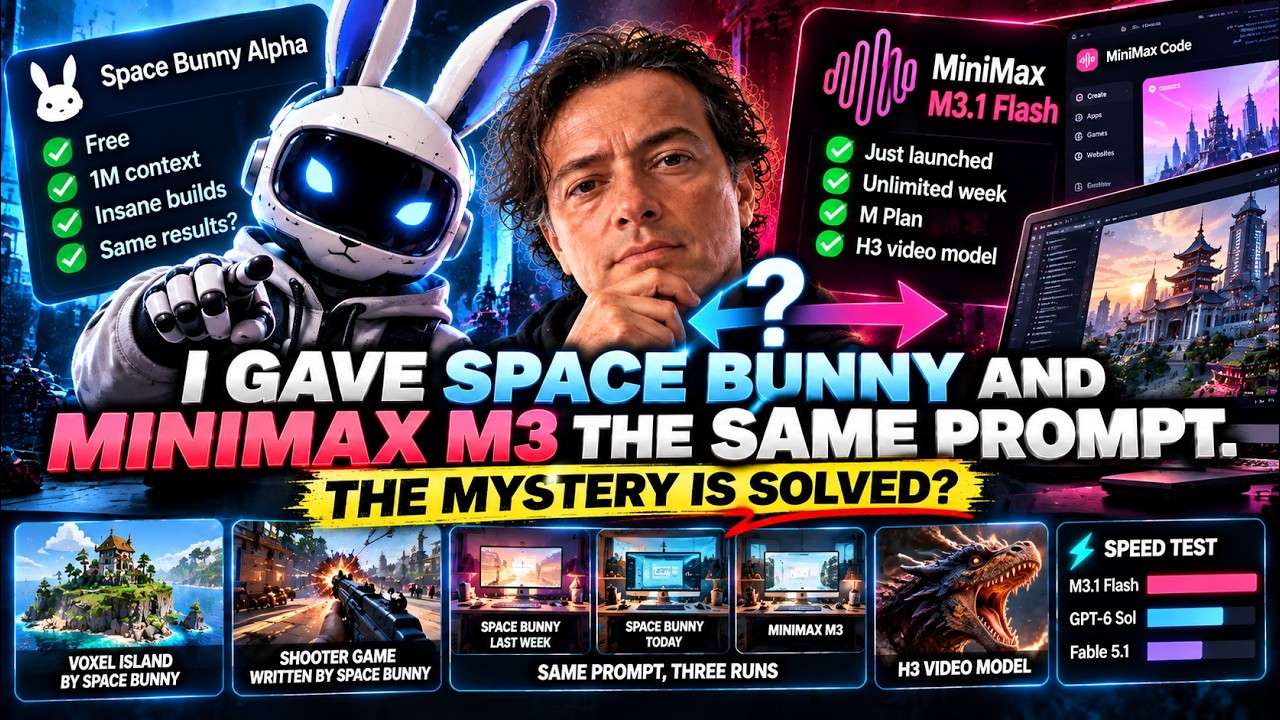
The Speed Revolution: M3.1 Flash vs. The Giants
The whole point of a “Flash” model is speed, and MiniMax delivers. In side-by-side tests against GPT-6 Sol and Fable 5.1 running the same night scene prompt at max reasoning, M3.1 Flash kept up impressively. Where Fable 5.1 needed close to two hours for a comparable output, MiniMax finished in about an hour at over 150 tokens per second.
As one independent tester noted, Fable’s result was more polished — but the real rival for M3.1 Flash isn’t Fable. It’s something like GPT-6 Luna Max. MiniMax isn’t competing with the slow, deliberative models. It’s going after the speed tier, and it’s winning on token generation rate right out of the gate.
Inside MiniMax Code: The Unlimited Week
From October 1 to October 7, every subscriber gets unlimited use of M3.1 Flash inside MiniMax Code. New subscribers also get 50% off their first month until October 14. When you open the MiniMax Code app, the default model in the prompt box is already M3.1 Flash Preview.
The official changelog tells the full story:
- Version 3.0.74 (September 28): M3.1 Flash Preview debuts — built for everyday development, from bug fixes to complete features. Daily check-in gives double free points. Every token plan quota was reset at launch.
- Version 3.1.0 (September 30): Redesigned app, new plan, unlimited week activated.
Pricing: The M Plan and What You Get
MiniMax introduced the M Plan, its new subscription tier. At $220 per year, it’s the cheapest paid tier and already includes M3.1 Flash Preview. Here’s how the tiers break down:
- Free tier: M3.1 Flash is available but limited.
- M Plan ($220/year): Full M3.1 Flash access + API key for use inside your own code, Cursor, Claude Code, or OpenCode.
- Higher tiers: Add video models like H3.
What MiniMax hasn’t published yet: a model card, benchmark scores, open weights, or a pay-as-you-go API. For now, M3.1 Flash lives entirely inside MiniMax Code. But the specifications we do know are impressive: 1 million token context, image and video input support, and five effort levels from Low to Max.
MiniMax H3: The Open Video Model
MiniMax also highlighted H3, its own open video model — and it’s worth a minute of your attention. H3 reads text, images, video, and audio together natively. It generates video with native stereo sound at up to 2K resolution. According to MiniMax, at 2K, H3 costs less than a third of mainstream models per second of generated video.
The key insight: one plan now gives you both the fast coder (M3.1 Flash) and the video model (H3) together. For creators and developers, that’s a potent combination.
What the Community Built With M3.1 Flash
The community results speak for themselves. Here’s what people built during the first days of the unlimited week:
- Voxel Island: AJ prompted a tropical island with palm trees, chickens, huts, and a shoreline — no external assets. It took a few rounds and M3.1 added extra details on its own.
- Village Terrain: Alan built an entire 3D village from a single prompt. 40 minutes, $0.
- Cinematic Earth: Sakata generated a stunning rotating Earth in 45 minutes, noting it “looks better and comes faster than earlier models.”
- 3D Landing Page: ExploraX gave it one prompt for a 3D landing page and got a complete interactive page in under an hour.
- Mechanical Sandworm: A mechanical sandworm over 1:300 scale with X-ray mode, six camera angles, and four movement beats — all in a single HTML file. It took seven rounds and over 4 hours, but one round ran autonomously for 55 minutes, then checked the page in a real browser.
All of these demos are playable live at ruocco.it/ai-demos/minimax-m3-1-flash.
The Mystery: Space Bunny Alpha
On September 23 — four days before MiniMax launched M3.1 Flash — a free model called Space Bunny Alpha appeared on OpenRouter with nobody’s name on it. No model card, no organization, no explanation. Just a free model with 1 million tokens of context and a red tag: “Going away on October 4.”
The AI community went into detective mode almost immediately:
- Tokenizer analysis: @cheatyyyy noticed that Space Bunny’s text tokenizer matched MiniMax M3’s tokenizer perfectly.
- 36/36 matches: @MarMarLabs ran 36 token comparisons — every single one matched MiniMax’s tokenizer exactly.
- Code references: MarMar found MiniMax’s own public code mentioning M3.1 in tests from September 18 with the same five effort levels (Low, Medium, High, Max, and one more).
- Benchmark runs: @vikktorrrre spotted MiniMax’s own M3 deployment answering as Space Bunny in benchmark leaderboards.
As one prominent tester put it: “Everyone thought it was MiniMax, and the team still hasn’t said a word.”
The Definitive Test: Same Prompt, Three Models
To settle the question, a controlled experiment was run: the exact same prompt — “Build a desktop operating system in the browser” — was given to three versions:
- Space Bunny Alpha (September 28): Took 7 minutes and 30 seconds. The calculator, music player, and settings all worked on first try.
- Space Bunny Alpha (October 2): Took 4 minutes and 30 seconds — almost twice as fast on the exact same prompt. Clearly a new checkpoint. New layout, new dock, terminal running Neofetch. But the finder crashed on open — one character was wrong in the code.
- MiniMax M3 (official): Took 21 minutes, spent 32,000 tokens thinking before writing a line, cost 6 cents. Worked perfectly on first try. Finder, notes, music player — all functional.
The evidence is compelling. Space Bunny matches MiniMax’s tokenizer. It gets faster week after week. It writes like a speed-first model — much faster than official M3 — but checks its own work less. That’s exactly what MiniMax promises with “M3.1 Flash.”
Has MiniMax confirmed it? No. But everything points in the same direction.
Zombie Shooter: Stress Testing Space Bunny
Beyond the desktop prompt, Space Bunny was pushed further. A custom prompt asked it to build a zombie wave shooter — an abandoned outpost at night, boarded windows, weapons on the walls, an upgrade machine. The results were impressive but inconsistent: out of 10 tries, only 2 versions started without an error.
The best version that did work featured climbing enemies, a shotgun upgrade system (200 points to buy, 1,000 to overcharge), window barricades with an “F” key rebuild mechanic, and a live score counter at 5,000 practice mode points. The only bug was mirrored walking directions, fixed by flipping two signs in the code.
This tells us something important about the model’s personality: it’s fast and creative, but you need to test and iterate. It won’t get everything right on the first shot — but when it works, the results are genuinely impressive for a single-prompt 3D game.
Verdict: Who Should Use M3.1 Flash?
M3.1 Flash isn’t trying to replace your deep-thinking reasoning model. It’s filling a different niche: speed-first everyday coding. For bug fixes, feature prototyping, and 3D world generation, it’s a revelation. For complex architectural decisions and multi-step reasoning, you’ll still want a heavier model.
The practical advice: Both Space Bunny Alpha (free on OpenRouter until October 4) and MiniMax Code (unlimited for subscribers until October 7) give you a chance to test-drive this model at zero cost. Use it for speed. Test what it gives you. Iterate on the results.
If the evidence holds — and MiniMax eventually confirms what the community has already figured out — then M3.1 Flash represents a fascinating new chapter in AI coding models: fast, cheap, and good enough that the question “is it the same model?” becomes almost irrelevant. What matters is what you can build with it.
Video by VitoMind: “I Gave Space Bunny and MiniMax M3 the Same Prompt. The Mystery Is Solved.” Watch the full test, live demos, and the zombie shooter in action.
▶️ Links & Resources:
- Play all demos live — Voxel island, village terrain, cinematic earth, 3D landing page, and the mechanical sandworm.
- MiniMax Code — Try M3.1 Flash directly (free unlimited until October 7).
- Space Bunny Alpha on OpenRouter — Free model, going away October 4.
- MiniMax M Plan — $220/year subscription details.
- MiniMax H3 Video Model — Open video generation with stereo sound.
MiniMax has not officially confirmed that Space Bunny Alpha is one of its models. The analysis and testing in this article are based on publicly available evidence from the AI community. The video uses an AI avatar with a cloned voice for intro and outro.