Gears of War: E-Day Launches to Critical Acclaim — Plus: Steam’s £11bn Year, GTA 6 Weather Reveal & PlayStation’s Digital-Only Future
Published: October 2, 2026 | By Vito Ruocco
Introduction: A Massive Week for Gaming
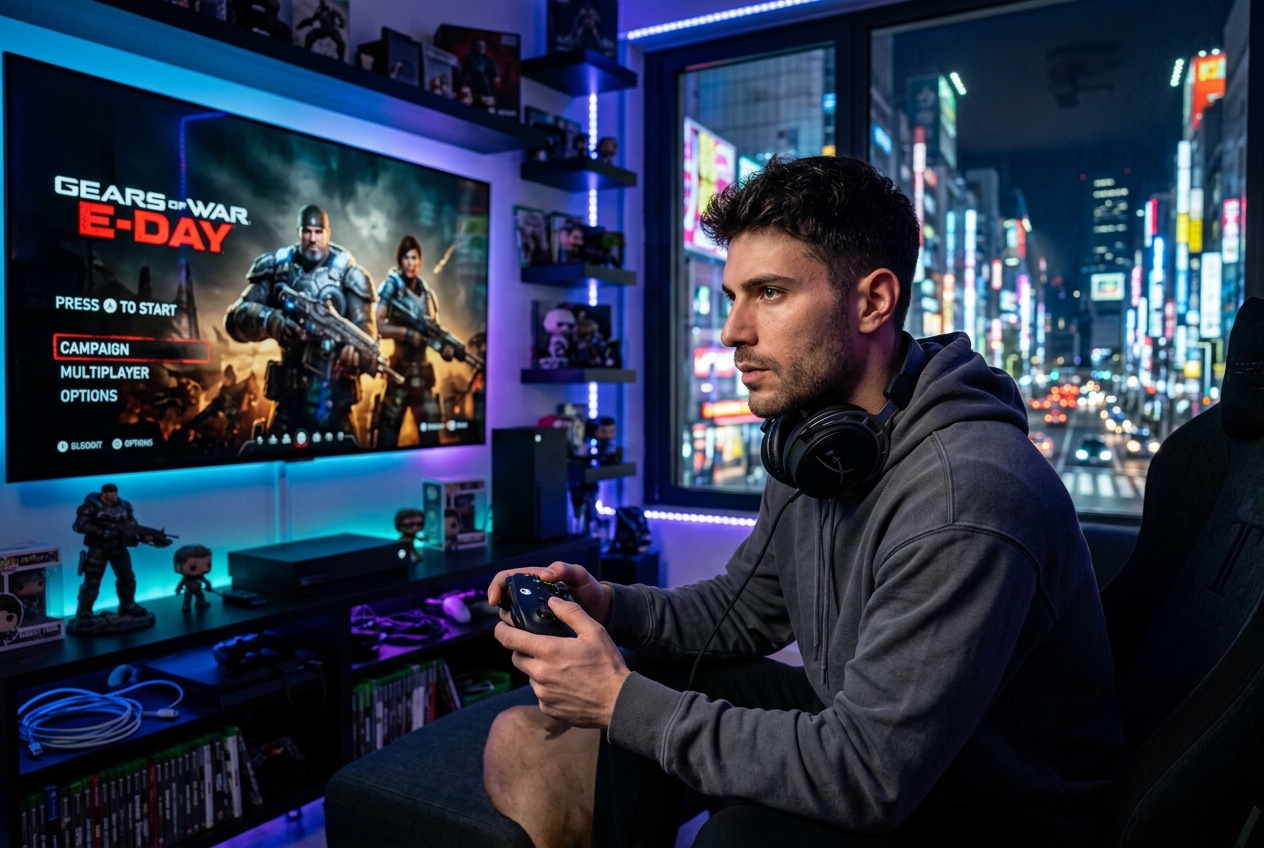
October 2026 is shaping up to be one of the most explosive months in recent gaming memory. Just 24 hours ago, Gears of War: E-Day stormed onto store shelves (and digital storefronts) worldwide, delivering the first major triple-A blockbuster of the autumn season. Early reviews are pouring in, and the consensus is clear: The Coalition has delivered a roaring comeback that honors the franchise’s gory, bombastic roots while modernizing its combat in meaningful ways.
But E-Day is far from the only story dominating headlines this week. Rockstar Games has pulled back the curtain on Grand Theft Auto VI’s jaw-dropping weather systems, Steam has reportedly generated a staggering £11 billion in revenue for Valve this year alone, Sony has confirmed its slow farewell to physical discs, and a new exposé has revealed how Amazon pressured one of its teams to build an AI-powered game — only to lay them off anyway. This is the week that had everything: new releases, industry drama, financial milestones, and a glimpse at gaming’s very uncertain future.
Let’s dive into the stories that matter most.
1. Gears of War: E-Day — The Return of the COG
After years of speculation and anticipation, Gears of War: E-Day launched on October 1, 2026 for Xbox Series X|S and PC. The game serves as a prequel set during the harrowing first day of the Locust invasion — the event that changed Sera forever — and follows a younger, more vulnerable Marcus Fenix alongside his long-time comrade Dom Santiago.
Eurogamer’s review calls it “less a complete reset for the series, and more of an ‘active reload,'” praising the campaign’s ability to channel the original trilogy’s intensity while layering on more sophisticated combat mechanics. The review clocks the campaign at a meaty 20 to 25 hours on Hardcore difficulty — the game’s so-called “intended” experience — and describes it as “incredible” at setpieces, with a “tidal push and pull” that keeps players perpetually on edge.
One of the standout innovations is the enhanced weapon upgrade system. Each of the game’s iconic firearms — the Gnasher shotgun, the Longshot sniper, the Boomshot heavy weapon, and the chainsaw-equipped Lancer — now features four upgrade slots. Players hunt for lockboxes and complete side missions to unlock augmentations that improve range, focus fire, enhance lethality, or modify perfect reload behavior. The Torque Bow, arguably the best weapon in series history, makes a triumphant return in the latter half of the campaign, and its explosive bolt remains one of gaming’s most satisfying tools of destruction.
The review does note some pacing issues, with open-ended sections that “completely hobble the momentum” the rest of the game builds so effectively. These wide-linear segments, reminiscent of some weaker moments in Gears 4 and 5, see players exploring the same city districts in varying states of disrepair. But the reviewer is quick to forgive, noting that “it’s hard to stay mad when there are such incredible, fun gauntlets of misery waiting for you around every bend.”
Online co-op, PvP, and Horde mode will be evaluated in a separate scored review as the full multiplayer suite becomes available for testing. Given Gears’ long history as a competitive and cooperative juggernaut, early signs suggest E-Day will satisfy both campaign purists and multiplayer grinders alike.
2. Steam’s £11 Billion Year — Forza Horizon 6 Leads the Pack
In a year that has seen endless layoffs and studio closures across the industry, Valve’s Steam platform continues to print money. According to fresh analysis from Alinea Analytics, Valve has generated an estimated $15 billion (~£11.1 billion) in revenue from Steam in 2026 alone — representing the company’s cut from game sales, DLC, and software.
The biggest-earning new release on the platform? Forza Horizon 6, Playground Games’ open-world racing behemoth, which has generated an estimated $210.5 million (~£155.7 million) in revenue for Valve. It’s followed closely by Crimson Desert at $203.3 million and Resident Evil Requiem at $200.9 million — creating a top three that demonstrates the incredible diversity of PC gaming’s audience in 2026.
Alinea analyst Rhys Elliott notes that the top six highest-grossing new releases on Steam account for just $1 billion (~£735.8 million) of that $15 billion total — a mere 6.6 percent. That statistic underscores just how massively long-tail the PC market has become: Steam’s revenue isn’t driven by a handful of mega-hits but by thousands of titles, from indie darlings to AAA staples, each contributing to an ecosystem that shows no signs of slowing down.
Encouragingly, two games in the top six — Crimson Desert and Meccha Chameleon — come from brand-new intellectual properties, suggesting that players are hungry for fresh ideas, not just established franchises. Expanding the scope to the top 100 highest-grossing new releases brings the total value to $2.4 billion (~£1.78 billion), or 15.9 percent of Steam’s overall revenue. With heavy hitters like Call of Duty: Modern Warfare 4, Phantom Blade Zero, and Gears of War: E-Day still to come in the year’s final quarter, 2026 is on track to be Steam’s biggest year ever.
3. Grand Theft Auto VI — Hurricanes, Rainbows, and a Tightened Leash
With just 48 days to go until its November 19 launch on PS5 and Xbox Series X|S, Rockstar Games has begun unveiling technical details about Grand Theft Auto VI in earnest — and the picture it paints is staggering.
Speaking to Game Informer, Rockstar’s vice president of art for lighting and rendering, Owen Shepherd, revealed that the studio has “re-engineered our weather system” from the ground up. The result is a dynamic, localized climate model where players in Leonida (the game’s fictional Floridian setting) can witness a rain shower pouring over a distant neighborhood while staying perfectly dry themselves. The after-effects of those storms — glistening wet pavements, reflective puddles, and the occasional rainbow — persist long after the clouds have cleared.
“The world features new fully dynamic cloudscapes that roll across the map,” Shepherd explained. “These give us a broad spectrum of weather, from the clear blue skies of a Miami winter to the vertiginous cumulonimbus clouds with sporadic lightning that you see most afternoons in the Floridian summer and autumn.” Hurricanes, heavy rain, and “dense atmospherics” are all part of the package, with water “gushing off roof edges and lampposts” during the most intense storms.
Beyond the weather, Rockstar confirmed that over 170 animal species inhabit Leonida’s world, including 60 different birds and more than 30 land mammals. Underwater scuba-diving returns as an activity, giving players the chance to discover manatees, jellyfish, and even whales. The game borrows Red Dead Redemption 2’s system of discoverable and studyable wildlife, alongside a new tier of “Legendary” animals that Rockstar is keeping tightly under wraps.
But it’s not all good news for the modding community. Rockstar recently updated its mod guidelines with strict new restrictions, banning mods that “expand or modify Rockstar Games’ official storylines, plots, missions, characters, or other elements of our established continuity.” The new rules also prohibit combining maps or assets from different Rockstar games — sorry, no Arthur Morgan in Vice City — and block third-party IP from appearing in mods. The era of modded Shrek rampaging through Los Santos may well be over before GTA 6 even ships.
4. Resident Evil Requiem Crosses $500 Million
Capcom’s horror juggernaut continues its generational victory lap. Resident Evil Requiem, the ninth mainline entry in the legendary survival horror series, has now generated over $500 million (~£377 million) in revenue, according to Alinea Analytics estimates. That makes it the fastest-selling Resident Evil game in history and puts it within striking distance of the Resident Evil 4 remake, which has surpassed $600 million over three years.
The game’s most popular platform is PS5, accounting for 4 million copies sold — 30 percent of which were physical, a notable figure given Sony’s recent announcement that it will phase out disc production by 2028. Interestingly, the new Resident Evil film reboot directed by Zach Cregger — which set a series-best opening weekend with $108 million worldwide — didn’t move the needle on game sales as much as expected. Capcom’s aggressive discounting strategy, which kicked off eight days before the film’s release, actually saw the game making slightly less per day during opening weekend ($271,000 vs. $284,000 pre-discount).
What the film did do was boost player counts across the entire series. Resident Evil 2 Remake saw the biggest bump, enjoying a 48 percent increase in daily players across all platforms during the film’s opening week — a testament to the enduring power of Raccoon City’s zombie apocalypse.
5. PlayStation’s Digital-Only Future — “A Hammer Blow for Games Retail”
Last week’s bombshell from Sony — announcing that large-scale production of physical discs for new games would cease in January 2028 — continues to send shockwaves through the industry. Eurogamer spoke to multiple industry experts to gauge the potential fallout, and the picture is bleak for brick-and-mortar retailers.
Chris Dring of The Game Business notes that while physical PlayStation sales represent “a smaller part of the business than digital,” we’re still talking millions of copies worldwide. “From a retail perspective, it’s clearly a blow.” He suggests that Sony’s likely transition to a “code-in-a-box” model — already adopted by Rockstar for GTA 6 — could become the new normal, with stores essentially selling digital codes rather than discs.
Rhys Elliott of Alinea Analytics is more blunt, calling the news a “hammer blow for games retail.” “The margins on new physical games are so thin for retailers, but used games are where the real money was,” he explains. “A code-in-box has none of the things that made physical worth choosing: no resale value, no lending, less collectability. The physical channel has no reason to exist.”
To make matters worse for traditional game stores, physical trade-ins and pre-owned sales — long the lifeblood of chains like GAME in the UK and GameStop in the US — have been sputtering for years. GAME has already stopped accepting trade-ins, and secondhand specialist CEX is “basically gone.” The transition to all-digital appears inevitable, but as Piers Harding-Rolls of Ampere Analytics points out, it may force retailers to innovate around digital sales in-store, potentially keeping physical retail alive in a new form.
6. Amazon’s Project Trident — The AI Game That Wasn’t Enough to Save Its Team
In one of the most damning industry exposés of the year, Eurogamer has revealed the full story of Project Trident, a third-person action game set in a comedic Nordic world that was being developed inside Amazon Game Studios — until the entire team was laid off.
The game’s central gimmick was its use of generative AI to power player-to-NPC communication. In combat, players could command companion characters (like Thor, the thunder god) by either saying their name aloud or typing commands into a text box. Environmental puzzles required convincing NPCs to cooperate through custom dialogue, with the LLM-powered characters reacting dynamically to whatever the player said or wrote. One standout example: capturing an enemy and then trying to recruit them to a fictional company called Valhalla Ventures by stroking their ego or finding the right argument.
Project Trident wasn’t always an AI game. Before 2024, it was a cooperative four-player action game — still set in the same Nordic-inspired world, but with a more serious tone where players fought giant, looming monsters in the vein of Shadow of the Colossus. The pivot to AI was driven by a company-wide mandate from Amazon leadership to incorporate generative AI into products across the board.
The tragedy, as reported by Eurogamer’s sources, is that the team actually made it work. “We were playing outside of the play tests because it was really fun,” one developer recalled. “We knew what we wanted to make and how to do it, we just needed time to make it.” The game’s art, music, story, and core gameplay remained hand-crafted by developers — AI was only used for NPC interaction and for dynamically generated lip-syncing animations.
It wasn’t enough. In October 2025, the Project Trident team — along with hundreds of other Amazon Game Studios employees — was called into meetings and locked out of company accounts. The Lord of the Rings MMO that Amazon had been working on was also confirmed as cancelled. The message to developers was clear: even when you do exactly what corporate leadership asks, it doesn’t guarantee your job is safe.
7. Why Japanese Studios Don’t Lay Off — Lessons for the West
With over 57,000 jobs lost across the global games industry between 2022 and 2026, and 96 percent of all layoffs this year concentrated in North America and Europe, one question keeps coming up: why are Japanese studios seemingly immune?
According to Amir Satvat, who has run the ASGC Games Industry Layoffs Tracker since 2022, the answer lies in fundamental structural differences. “Japanese teams tend to be much smaller and leaner,” he explained in an interview with Edge magazine. “They didn’t get swept up in the live-service trend, or into these mega-blockbusters with 500-person teams.”
But the most striking difference is executive compensation. While EA’s Andrew Wilson earned $38.6 million last year and Take-Two’s Strauss Zelnick made $42.1 million in 2022 — both companies that laid off staff — Satvat notes that Japanese game executives “still make great money, but it’s two or three million dollars, not 30 million.” When executives aren’t extracting hundreds of times the salary of their developers, there’s less pressure to engage in boom-and-burst hiring cycles.
The results speak for themselves. Nintendo, Konami, and Capcom all maintain staff retention rates above 97 percent. Capcom is currently enjoying a generational winning streak with Resident Evil Requiem, Onimusha: Way of the Sword, and Pragmata. Nintendo just surpassed the Nintendo DS to become the company’s best-selling console ever with the Switch family. Koei Tecmo has explicitly stated it believes in smaller, more focused titles rather than chasing blockbuster trends.
Satvat doesn’t mince words about the severity of the situation in the West: “I think this is as bad as the ’83 crash if you’re a game developer based in North America or western Europe, in a traditional triple-A studio. That is ground zero for the destruction.” As Epic’s Tim Sweeney put it, “this is the worst videogame crash, or disruption, that we’ve seen since the 1980s.”
The lesson for Western publishers is clear: smaller teams, proportionate executive pay, and a focus on craft over trend-chasing may be the only sustainable path forward.
8. Quick Hits — More News Shaping October 2026
A few more stories worth your attention this week:
- Crimson Desert: Charting the Unknown — Pearl Abyss’ first major DLC for its breakout open-world action RPG has been delayed by two weeks, with the studio citing a desire to “deliver a more polished and stable gameplay experience.” The delay pushes the expansion to mid-October.
- Twitch CEO’s GTA 6 Online Slip — In a recent interview, Twitch’s CEO inadvertently revealed that GTA 6 Online might launch separately in 2027, rather than alongside the single-player campaign in November. Rockstar has yet to comment officially.
- Onimusha: Way of the Sword Crosses 1 Million — Capcom’s surprise revival of the classic samurai action series has already sold over 1 million copies in its first week, proving that nostalgia — when done with quality — still sells.
- Ace Combat 8: Wings of the Revolution — Bandai Namco’s aerial combat franchise returned on September 29 to strong reviews, with critics praising its refined flight physics and cinematic storytelling.
Conclusion: An Industry at a Crossroads
If the first week of October 2026 is any indication, the video game industry is in the midst of a transformation as profound as any we’ve seen. On one hand, we have genuine creative triumphs — Gears of War: E-Day proving that a 20-year-old franchise can still feel fresh, GTA 6 promising technical wizardry that redefines open-world possibilities, and Japanese studios showing that disciplined, sustainable development is not only possible but profitable.
On the other hand, the industry’s structural problems feel more acute than ever. Amazon’s Project Trident story is a cautionary tale about corporate mandates overriding creative vision — and laying off the people who made it work anyway. Sony’s disc-less pivot, however inevitable, will reshape the relationship between publishers, retailers, and players. And the continued hemorrhaging of talent in North America and Europe, contrasted with Japan’s relative stability, raises uncomfortable questions about whether the Western triple-A model is fundamentally broken.
For players, though, this much is clear: the games themselves have never been better. Whether you’re chainsawing Locusts in E-Day, racing across Mexico in Forza Horizon 6, planning your heist strategy for GTA 6, or diving back into Raccoon City after the new Resident Evil film, there’s no shortage of incredible experiences to lose yourself in. The industry may be fractured, but the art form is thriving.
This is Vito Ruocco, signing off. Stay tuned for more coverage throughout October.