Published September 22, 2026 — by Vito Ruocco
Introduction: Who You Gonna Call? — Again
For gamers of a certain age, few things trigger a rush of pure nostalgia quite like the opening bars of the classic Ghostbusters theme song. Released during the golden era of 8-bit computing — across legendary machines like the Amstrad CPC, the ZX Spectrum, and above all, the Commodore 64 — the original 1984 movie tie-in game remains an absolute touchstone of retro gaming history. It was quirky, ambitious, and imperfect, yet it captured the spirit of the film in a way that few licensed games of the era managed.
Now, nearly four decades later, one passionate homebrew developer is preparing to grab the retro gaming community’s attention once again. The game is called ‘Ghostbusters Revisited’, and it is shaping up to be one of the most intriguing Commodore 64 homebrew projects of 2026.
Developed by Dave Izon, this first-person reimagining takes the ghost-catching formula of the original and flips it on its head. Instead of the top-down, menu-driven gameplay that defined the 1984 classic, Ghostbusters Revisited plunges players into a first-person perspective, tasking them with navigating hotel rooms, tracking down spectral entities, and wrangling them into traps using a proton stream — all rendered through the pixel-powered charm of the Commodore 64.
The Story Behind Ghostbusters Revisited
Every great homebrew project has an origin story, and Ghostbusters Revisited is no exception. Dave Izon first began experimenting with a Ghostbusters-themed demo for the Commodore 64 back in 2021. That early prototype was rough — a proof of concept more than a game — and it was eventually shelved as life and other projects took priority.
But the idea never quite left him. In 2026, Izon decided to dust off the old code and pick the project back up. What emerged was a dramatically more polished and ambitious take on the concept. The new version, now officially named Ghostbusters Revisited, represents years of accumulated skill, a deeper understanding of the C64 hardware, and a clear vision of what a first-person Ghostbusters game could look like on the beloved 8-bit machine.
“Thank you so much for following along, and I hope you enjoy seeing how much this passion project has grown over the years!” Izon wrote in a statement accompanying the latest gameplay video, underscoring the deeply personal nature of the project.
The developer has been sharing progress openly, releasing gameplay footage that demonstrates the game’s evolution from those early, unfinished demo days to the current build, which — while still a work in progress — is already playable and genuinely impressive.
Gameplay: First-Person Proton Pack Action on the C64
The most striking aspect of Ghostbusters Revisited is its perspective. While the original 1984 game presented a top-down, bird’s-eye view of the city, interspersed with a driving section and a side-on ghost-catching mini-game, Izon’s take is fundamentally different. Ghostbusters Revisited adopts a first-person viewpoint, a brave and technically challenging choice for a C64 title.
Players explore a series of hotel rooms — presented through a first-person window — scanning the environment for ghostly presences. When a ghost is spotted, the player must aim their proton stream carefully and fire to weaken the apparition. The real trick, however, lies in the capture mechanic: once the ghost is sufficiently weakened, the player must maneuver it into a trap, mirroring the iconic scene from the film where the team corners Slimer in the Sedgewick Hotel.
This room-by-room exploration, combined with item searching and ghost wrangling, gives the game a feel that’s part dungeon crawler, part action title. Early gameplay footage shows a system where ghosts move unpredictably through the rooms, forcing the player to track their movement while managing the proton stream’s energy. The game uses the C64’s character set for much of its graphical presentation, which gives it a distinctive, blocky aesthetic that purists will appreciate.
Key Gameplay Features (From Current Build)
- First-person exploration: Navigate hotel rooms from a first-person perspective, searching for ghosts and clues.
- Proton stream combat: Aim and fire your proton pack to weaken ghosts before capturing them.
- Trap-based capture system: Wrangle ghosts into traps — a faithful nod to the film’s iconic containment strategy.
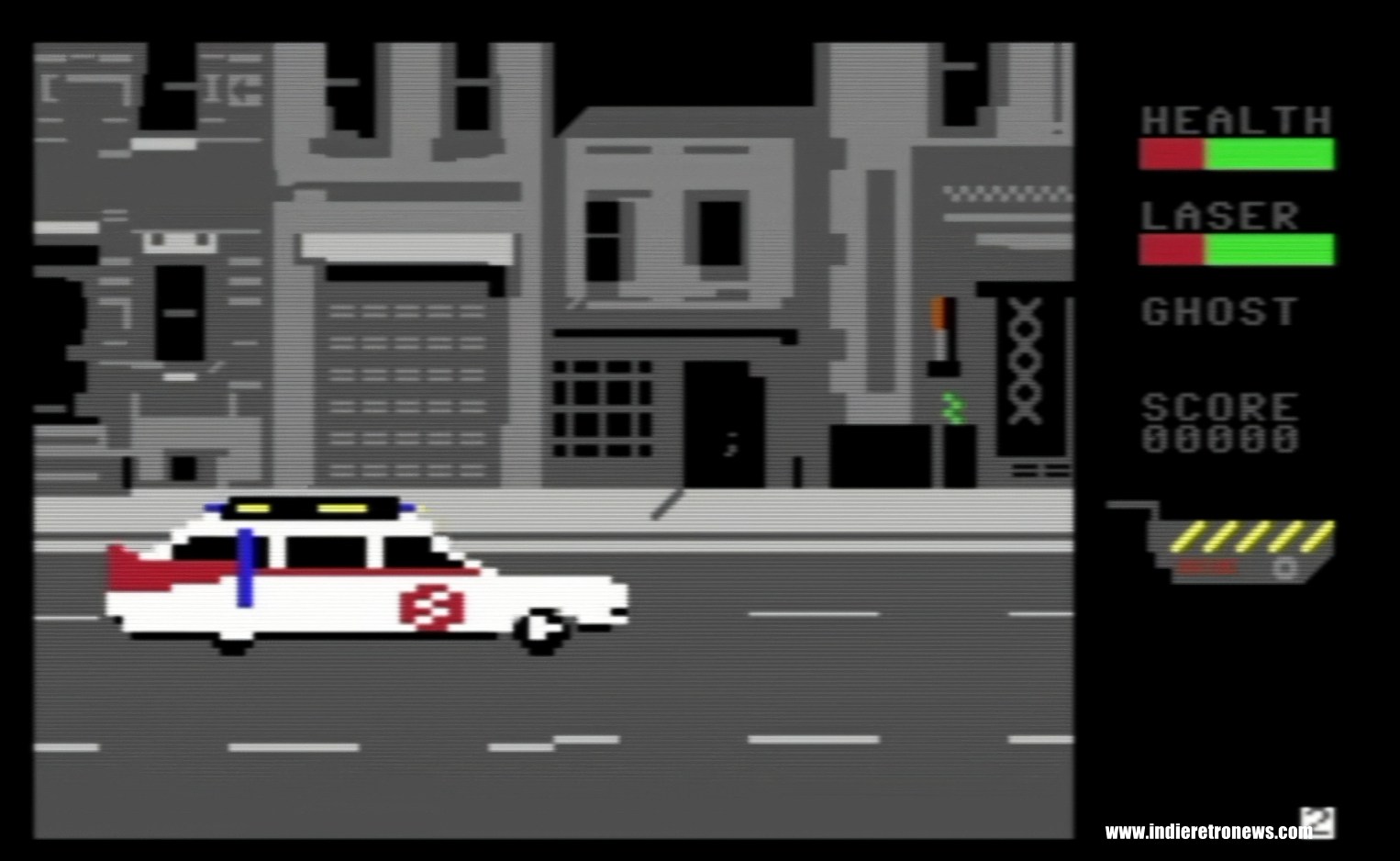
- Driving sequences: The Ecto-1 driving sections return, letting players cruise the city streets between ghost callouts.
- Item interaction: Search furniture and room objects to find useful items and progress through the hotel.
- Multiple room types: The hotel features several distinct rooms, each with its own layout, ghost types, and challenges.
A Separate Path: Ghostbusters Revisited vs. Ghostbusters Remastered
It is important to note that Ghostbusters Revisited is completely separate from another high-profile C64 Ghostbusters project that has caught the community’s attention: Ghostbusters Remastered (also referred to by some as “He Slimed Me” based on a popular YouTube preview).
While Ghostbusters Revisited adopts a first-person perspective and a room-exploration structure, Ghostbusters Remastered takes a more traditional approach with sprite-based gameplay and a sleeker, more polished presentation. The Remastered project uses more conventional run-and-gun mechanics, with ghosts appearing as sprites on a scrolling playfield rather than the first-person view that defines Izon’s project.
Both projects are being developed independently, by different developers, and both cater to distinctly different tastes in retro gaming. Ghostbusters Revisited is the more experimental of the two, pushing the C64 into first-person territory that was rarely explored during the platform’s commercial heyday. Ghostbusters Remastered, by contrast, aims for a more immediately accessible arcade-style experience.
The retro community has embraced both projects enthusiastically, with discussions on forums and social media weighing the merits of each approach. For many, having two ambitious takes on the same franchise, running on the same aging hardware, is a sign of the vibrant creativity that continues to define the C64 homebrew scene.
Community Reaction: What Retro Gamers Are Saying
Since the Indie Retro News feature broke the story in August 2026, the retro gaming community has been buzzing with reactions. The comments section of the original article paints a vivid picture of a community that is both excited and constructively critical:
“Definitely looks interesting although not too sure about the ‘Infiltrator’ style of walking around the hotel and searching items in rooms etc. Hopefully as well the car sequence lets you hoover up the ghosts as you drive to a location and the screen can be increased in size as it doesn’t give much reaction time if there’s going to be oncoming vehicles. Would also like more defined ghosts, the green ones seem a bit hard to see against the backgrounds. Otherwise a successor to the original C64 game is a welcome sight to behold and I definitely look forward to trying it when it’s released, keep up the good work!”
— Bazzietuk on Indie Retro News
“This could be a more interesting game than the original, but it was also technically better, with a smooth scrolling road, and good graphics + music. This game looks like it has poor scrolling, and gfx made of usual character set.”
— plööh on Indie Retro News
The feedback reflects a community that holds the original 1984 game in high regard but is hungry for fresh takes. The constructive criticism around ghost visibility, scrolling smoothness, and UI size is exactly the kind of detailed, experienced feedback that makes the C64 homebrew scene so valuable — players who grew up with the hardware know what it’s capable of, and they’re not afraid to point out where a project can improve.
Other commenters were simply enthusiastic about the project’s existence: “It looks great!” wrote one commenter, capturing the general sentiment of excitement around seeing the franchise revisited on the platform that first brought it to so many living rooms.
The Technical Challenge: First-Person Gaming on the Commodore 64
Developing a first-person game on the Commodore 64 is no small feat. The C64’s MOS Technology 6510 processor runs at approximately 1 MHz, and the machine is equipped with just 64 KB of RAM. For context, that is less memory than a single high-resolution smartphone photograph requires today. The VIC-II graphics chip, while legendary for its era, is severely limited by modern standards: it supports 16 colors, with a maximum of 11 per text-mode character cell, and its sprite system — while ahead of its time — is constrained by hardware limitations that demand careful programming to overcome.
First-person games on the C64 were rare during its commercial lifespan. The most famous example is arguably Maze (also known as Wizard of Wor‘s maze sections), but true first-person perspective titles like Phantoms of the Astral or Druid II: Enlightenment pushed the hardware to its limits with raycasting techniques. More recently, homebrew developers have achieved impressive results with games like Alice’s Mom’s Rescue and Maze Sum, which pull off smooth first-person rendering on the C64.
Ghostbusters Revisited joins this lineage of technical ambition. The game’s first-person rooms require the C64 to render walls, floors, furniture, and ghost sprites from a first-person viewpoint while maintaining acceptable frame rates. The character-set-based graphics approach that some commenters noted is a pragmatic choice — using the C64’s built-in character map mode allows for faster rendering than full bitmap mode, freeing up precious CPU cycles for gameplay logic and ghost AI.
The Legacy of the 1984 Ghostbusters Game
To understand why Ghostbusters Revisited matters, it helps to appreciate what the original game meant. The 1984 Ghostbusters game was developed by Activision and designed by David Crane (the legendary programmer behind Pitfall!). It was a complex, multi-faceted title that mixed driving on the C64’s famous scrolling road, a top-down city view for navigating between locations, and a ghost-catching sequence that required players to cross the proton streams (which the movie explicitly warned against, adding a layer of ironic humor).
The game was notable for its use of the iconic theme song — a technological achievement in itself, squeezing recognizable audio into the C64’s SID chip. It sold well and was ported to virtually every major home computer of the era. But it also had its quirks: the ghost-catching sequence was notoriously finicky, the city navigation could be confusing, and the overall experience was more about atmosphere than tight gameplay.
Despite (or perhaps because of) these quirks, the 1984 Ghostbusters game holds a special place in retro gaming hearts. It was an early example of a licensed game that tried to do something different — not just a simple platformer or shoot-em-up, but a simulation of the Ghostbusters’ daily operations, complete with a cash management system, equipment purchases, and a surprisingly tense final confrontation with Gozer.
Ghostbusters Revisited honors that spirit of ambition while updating the formula for modern sensibilities. It retains the multi-faceted structure — exploration, combat, driving — but streamlines the execution into a more coherent first-person experience.
The C64 Homebrew Scene in 2026
Ghostbusters Revisited arrives at a time when the Commodore 64 homebrew scene is enjoying a remarkable renaissance. In 2026, new C64 games are being released at a pace that rivals the platform’s commercial heyday. Developers are pushing the hardware to previously unimagined limits, with titles that boast smooth scrolling, sampled audio, multi-load adventures, and graphical effects that would have seemed impossible in 1984.
Recent notable C64 homebrew releases include:
- Sam’s Journey 2 — A platformer that uses advanced raster techniques for parallax scrolling
- Deus Ex Machina 2 — A C64 demake of the surreal PC classic
- Planet X3 — A horizontally scrolling shooter with effects that push the VIC-II chip
- Steel Ranger — A Contra-inspired run-and-gun with impressive sprite multiplexing
This thriving ecosystem is supported by a robust community of developers, artists, musicians, and testers who share resources, tools, and expertise. Modern development tools like C64 Studio, Kick Assembler, and cross-platform C compilers have made C64 development more accessible than ever, while digital distribution platforms like Itch.io and physical releases through boutique publishers like Psytronik Software and RGCD ensure that new games can find an audience.
Ghostbusters Revisited is very much a product of this ecosystem — a labor of love by a developer who, like many in the scene, grew up with the C64 and wants to give something back to the platform that shaped their childhood.
Where to Follow Ghostbusters Revisited
As of September 2026, Ghostbusters Revisited is still in active development. Dave Izon continues to refine the game, adding new rooms, ghost types, and general polish. A release date has not yet been announced, but the developer has been transparent about progress, sharing gameplay footage and updates via YouTube.
The best ways to follow the project’s development:
- YouTube: Watch the latest gameplay footage at Ghostbusters Revisited – Commodore 64
- Indie Retro News: The original coverage at Indie Retro News includes the developer’s comments and community discussion
- Ghostbusters Remastered (the alternative project): Check out “He Slimed Me” on YouTube for a different take on the franchise
Stay tuned to ruocco.it for further updates on this and other C64 homebrew projects as they develop. The Commodore 64 may be forty years old, but thanks to passionate developers like Dave Izon, its story is far from over.
The Verdict: Why Ghostbusters Revisited Matters
Ghostbusters Revisited is more than just a nostalgia trip. It represents something genuinely meaningful in the retro gaming landscape: the ability of passionate individuals to take beloved concepts and reimagine them through the constraints of vintage hardware. It is not a remaster, not a port, and not a simple clone. It is a revisiting — a chance for a developer to ask “what if?” and answer with code, pixels, and chip-tune sound.
In an era where the games industry is dominated by billion-dollar sequels, photorealistic graphics, and live-service monetization, projects like Ghostbusters Revisited remind us why we fell in love with games in the first place. They are made by one person, for the love of the craft, running on hardware that most people threw away decades ago. And yet — or perhaps because of that — they feel more alive, more personal, and more meaningful than many modern blockbusters.
Whether you’re a C64 veteran who remembers booting up the original Ghostbusters game from a floppy disk, or a younger gamer curious about what 8-bit computing can achieve, Ghostbusters Revisited is a project worth watching. Who you gonna call? In 2026, the answer might just be Dave Izon.
Article by Vito Ruocco. Cover image: Ghostbusters Revisited gameplay screenshot courtesy of Dave Izon / Indie Retro News.